

Homework Answers
Add Answer to:
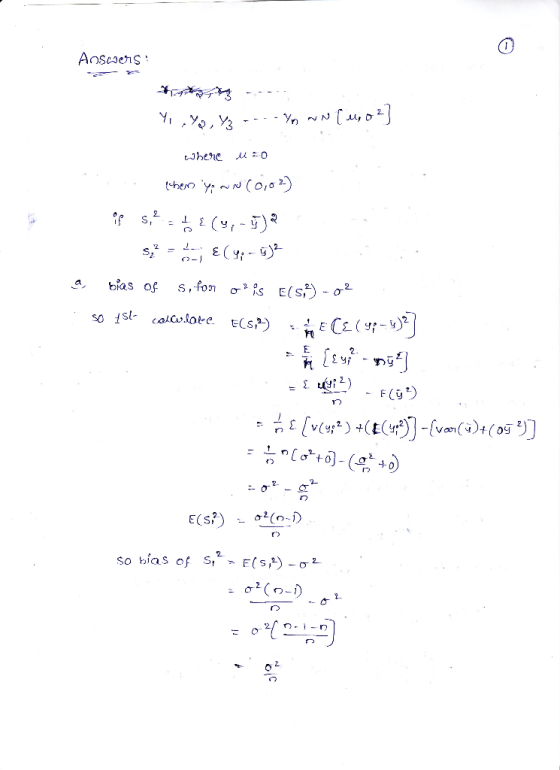
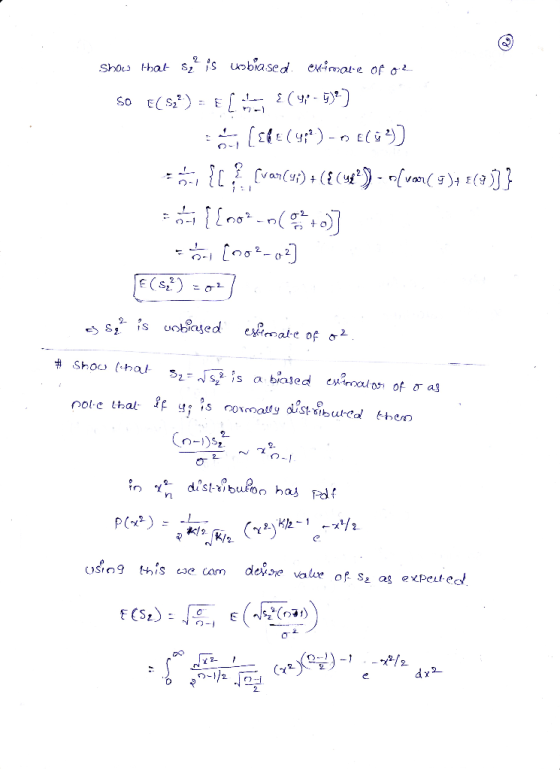
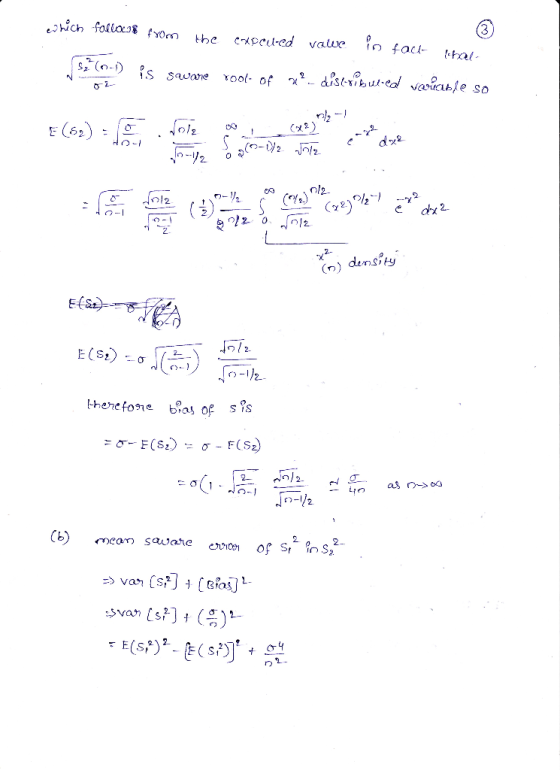
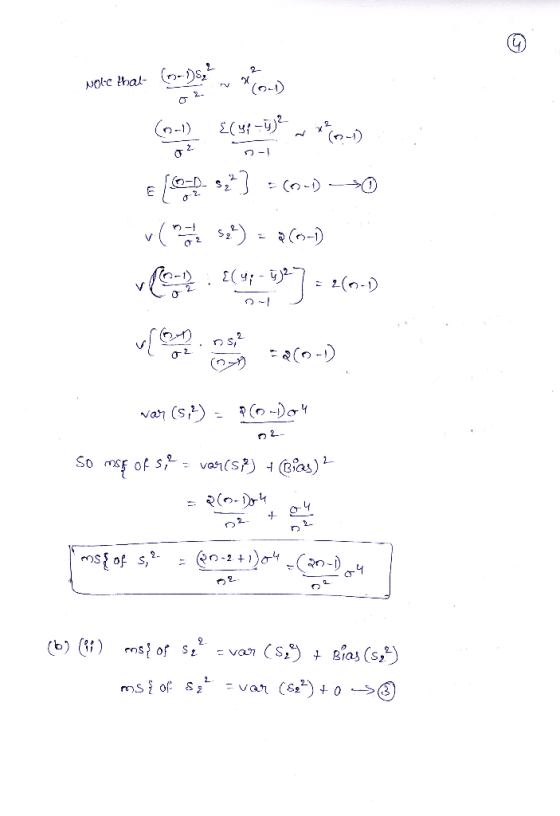
Problem 1. (5 marks; 3, 2) Assut Y Y2, YY are a random sample of normally...
3. You have two independent random samples: XiXX from a population with mean In and variance σ2 a...
 3. You have two independent random samples: XiXX from a population with mean In and variance σ2 and Y, Y2, , , , , Y,n from a population with mean μ2 and variance σ2. Note that the two populations share a common variance. The two sample variances are Si for the first sample and Si for the second. We know that each of these is an unbiased estimator of the common population variance σ2, we also know that both of...
QUESTION 2 Let Xi.. Xn be a random sample from a N (μ, σ 2) distribution,...
 QUESTION 2 Let Xi.. Xn be a random sample from a N (μ, σ 2) distribution, and let S2 and Š-n--S2 be two estimators of σ2. Given: E (S2) σ 2 and V (S2) - ya-X)2 n-l -σ (a) Determine: E S2): (l) V (S2); and (il) MSE (S) (b) Which of s2 and S2 has a larger mean square error? (c) Suppose thatnis an estimator of e based on a random sample of size n. Another equivalent definition of...
Y2 Let Yİ'ý, variance σ. We showed in class that minimally sufficient estimators. Does this imply...
 Y2 Let Yİ'ý, variance σ. We showed in class that minimally sufficient estimators. Does this imply that y and S2 are MVUE estimators of μ and X, be independent and identically distributed random variables with mean μ and (Ση! YǐΣι Y?) is sufficient for (μ, σ2). These are also σ2 respectively? Explain why or why not.
Let Y, Y2, ..., Yn be n i.i.d random variables drawn from the population distribution of...
 Let Y, Y2, ..., Yn be n i.i.d random variables drawn from the population distribution of Y-(My, oy). Suppose we want to estimate My and we are asked to choose between two possible estimators of Wy: (1)Y, and (2) Y = (x + 3) (a) Show both estimators are unbiased (2 points) (b) Derive the variance of both estimators and discuss which estimator is more efficient (3 points)
Problem 5 of 5Sum of random variables Let Mr(μ, σ2) denote the Gaussian (or normal) pdf with Inea...
 Problem 5 of 5Sum of random variables Let Mr(μ, σ2) denote the Gaussian (or normal) pdf with Inean ,, and variance σ2, namely, fx (x) = exp ( 2-2 . Let X and Y be two i.i.d. random variables distributed as Gaussian with mean 0 and variance 1. Show that Z-XY is again a Gaussian random variable but with mean 0 and variance 2. Show your full proof with integrals. 2. From above, can you derive what will be the...
1. A researcher has just finished a statistical analysis and claims that he found evidence that...
1. A researcher has just finished a statistical analysis and claims that he found evidence that x affects y positively. Using a 1-tailed test, he found that the estimated coefficient for x is significantly positive at the 5% level, but is not significant at the 4% level. Assume that the classical linear regression assumptions hold. If the researcher used a 2-tailed test instead, what would he have found? a. The estimated coefficient for x is significantly positive at the 2.5%...
. Suppose the Y1, Y2, · · · , Yn denote a random sample from a...
 . Suppose the Y1, Y2, · · · , Yn denote a random sample from a
population with Rayleigh distribution (Weibull distribution with
parameters 2, θ) with density function f(y|θ) = 2y θ e −y 2/θ, θ
> 0, y > 0
Consider the estimators ˆθ1 = Y(1) = min{Y1, Y2, · · · , Yn},
and ˆθ2 = 1 n Xn i=1 Y 2 i .
ii) (10 points) Determine if ˆθ1 and ˆθ2 are unbiased
estimators, and in...
. Suppose the Y1, Y2, · · · , Yn denote a random sample from a
population with Rayleigh distribution (Weibull distribution with
parameters 2, θ) with density function f(y|θ) = 2y θ e −y 2/θ, θ
> 0, y > 0
Consider the estimators ˆθ1 = Y(1) = min{Y1, Y2, · · · , Yn},
and ˆθ2 = 1 n Xn i=1 Y 2 i .
ii) (10 points) Determine if ˆθ1 and ˆθ2 are unbiased
estimators, and in...
Suppose that Y1 , Y2 ,..., Yn denote a random sample of size n from a...
 Suppose
that Y1 , Y2 ,..., Yn denote a random sample of size n from a
normal population with mean μ and variance 2 .
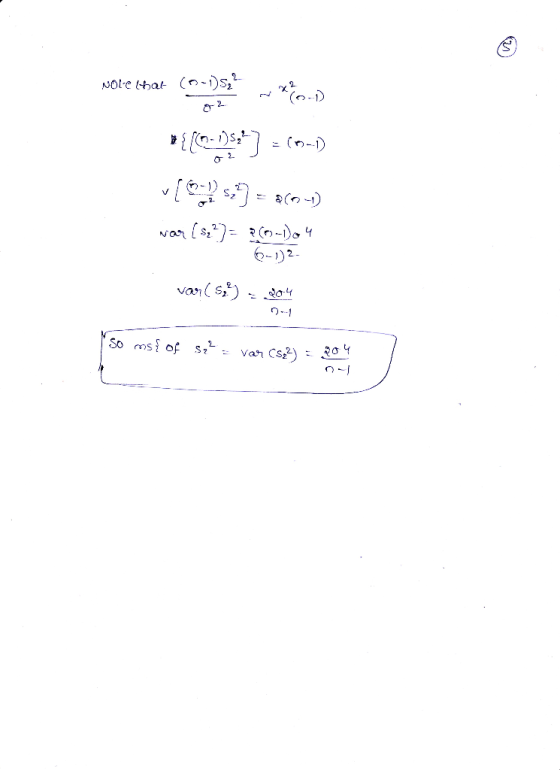
Problem # 2: Suppose that Y , Y,,...,Y, denote a random sample of size n from a normal population with mean u and variance o . Then it can be shown that (n-1)S2 p_has a chi-square distribution with (n-1) degrees of freedom. o2 a. Show that S2 is an unbiased estimator of o. b....
Suppose
that Y1 , Y2 ,..., Yn denote a random sample of size n from a
normal population with mean μ and variance 2 .
Problem # 2: Suppose that Y , Y,,...,Y, denote a random sample of size n from a normal population with mean u and variance o . Then it can be shown that (n-1)S2 p_has a chi-square distribution with (n-1) degrees of freedom. o2 a. Show that S2 is an unbiased estimator of o. b....
4. , XnER, let Eo,E1,..,Enbe independent normally distributed random Let Xo, X1, variables with common mean...
 4. , XnER, let Eo,E1,..,Enbe independent normally distributed random Let Xo, X1, variables with common mean 0 and common variance σ2, and suppose Let a, b and σ2 be the maximum likelihood estimators of b,a and σ2 Note that these expressions involve only the training data(X1, Y the test data(xo. Yo) ,(xn%,). They omit The training error of our regression model is While its teat prediction) error is We know that In this exercise, we prove MSE (1+1+grt*)e* Note that...
Consider two random variables with joint density fY1,Y2(y1,y2) =(2(1−y2) 0 ≤ y1 ≤ c,0 ≤ y2...
 Consider two random variables with joint density fY1,Y2(y1,y2)
=(2(1−y2) 0 ≤ y1 ≤ c,0 ≤ y2 ≤ c 0 otherwise
(a) Find a value for c. (4 marks) (b) Derive the density function
of Z = Y1Y2. (10 marks)
. Consider two random variables with joint density fyiy(91, y2) = 2(1 - y2) 0<n<C,0<42 <c o otherwise (a) Find a value for c. (4 marks) (b) Derive the density function of Z=Y Y. (10 marks)
Consider two random variables with joint density fY1,Y2(y1,y2)
=(2(1−y2) 0 ≤ y1 ≤ c,0 ≤ y2 ≤ c 0 otherwise
(a) Find a value for c. (4 marks) (b) Derive the density function
of Z = Y1Y2. (10 marks)
. Consider two random variables with joint density fyiy(91, y2) = 2(1 - y2) 0<n<C,0<42 <c o otherwise (a) Find a value for c. (4 marks) (b) Derive the density function of Z=Y Y. (10 marks)
 3. You have two independent random samples: XiXX from a population with mean In and variance σ2 and Y, Y2, , , , , Y,n from a population with mean μ2 and variance σ2. Note that the two populations share a common variance. The two sample variances are Si for the first sample and Si for the second. We know that each of these is an unbiased estimator of the common population variance σ2, we also know that both of...
 QUESTION 2 Let Xi.. Xn be a random sample from a N (μ, σ 2) distribution, and let S2 and Š-n--S2 be two estimators of σ2. Given: E (S2) σ 2 and V (S2) - ya-X)2 n-l -σ (a) Determine: E S2): (l) V (S2); and (il) MSE (S) (b) Which of s2 and S2 has a larger mean square error? (c) Suppose thatnis an estimator of e based on a random sample of size n. Another equivalent definition of...
 Y2 Let Yİ'ý, variance σ. We showed in class that minimally sufficient estimators. Does this imply that y and S2 are MVUE estimators of μ and X, be independent and identically distributed random variables with mean μ and (Ση! YǐΣι Y?) is sufficient for (μ, σ2). These are also σ2 respectively? Explain why or why not.
 Let Y, Y2, ..., Yn be n i.i.d random variables drawn from the population distribution of Y-(My, oy). Suppose we want to estimate My and we are asked to choose between two possible estimators of Wy: (1)Y, and (2) Y = (x + 3) (a) Show both estimators are unbiased (2 points) (b) Derive the variance of both estimators and discuss which estimator is more efficient (3 points)
 Problem 5 of 5Sum of random variables Let Mr(μ, σ2) denote the Gaussian (or normal) pdf with Inean ,, and variance σ2, namely, fx (x) = exp ( 2-2 . Let X and Y be two i.i.d. random variables distributed as Gaussian with mean 0 and variance 1. Show that Z-XY is again a Gaussian random variable but with mean 0 and variance 2. Show your full proof with integrals. 2. From above, can you derive what will be the...
 . Suppose the Y1, Y2, · · · , Yn denote a random sample from a
population with Rayleigh distribution (Weibull distribution with
parameters 2, θ) with density function f(y|θ) = 2y θ e −y 2/θ, θ
> 0, y > 0
Consider the estimators ˆθ1 = Y(1) = min{Y1, Y2, · · · , Yn},
and ˆθ2 = 1 n Xn i=1 Y 2 i .
ii) (10 points) Determine if ˆθ1 and ˆθ2 are unbiased
estimators, and in...
. Suppose the Y1, Y2, · · · , Yn denote a random sample from a
population with Rayleigh distribution (Weibull distribution with
parameters 2, θ) with density function f(y|θ) = 2y θ e −y 2/θ, θ
> 0, y > 0
Consider the estimators ˆθ1 = Y(1) = min{Y1, Y2, · · · , Yn},
and ˆθ2 = 1 n Xn i=1 Y 2 i .
ii) (10 points) Determine if ˆθ1 and ˆθ2 are unbiased
estimators, and in...
 Suppose
that Y1 , Y2 ,..., Yn denote a random sample of size n from a
normal population with mean μ and variance 2 .
Problem # 2: Suppose that Y , Y,,...,Y, denote a random sample of size n from a normal population with mean u and variance o . Then it can be shown that (n-1)S2 p_has a chi-square distribution with (n-1) degrees of freedom. o2 a. Show that S2 is an unbiased estimator of o. b....
Suppose
that Y1 , Y2 ,..., Yn denote a random sample of size n from a
normal population with mean μ and variance 2 .
Problem # 2: Suppose that Y , Y,,...,Y, denote a random sample of size n from a normal population with mean u and variance o . Then it can be shown that (n-1)S2 p_has a chi-square distribution with (n-1) degrees of freedom. o2 a. Show that S2 is an unbiased estimator of o. b....
 4. , XnER, let Eo,E1,..,Enbe independent normally distributed random Let Xo, X1, variables with common mean 0 and common variance σ2, and suppose Let a, b and σ2 be the maximum likelihood estimators of b,a and σ2 Note that these expressions involve only the training data(X1, Y the test data(xo. Yo) ,(xn%,). They omit The training error of our regression model is While its teat prediction) error is We know that In this exercise, we prove MSE (1+1+grt*)e* Note that...
 Consider two random variables with joint density fY1,Y2(y1,y2)
=(2(1−y2) 0 ≤ y1 ≤ c,0 ≤ y2 ≤ c 0 otherwise
(a) Find a value for c. (4 marks) (b) Derive the density function
of Z = Y1Y2. (10 marks)
. Consider two random variables with joint density fyiy(91, y2) = 2(1 - y2) 0<n<C,0<42 <c o otherwise (a) Find a value for c. (4 marks) (b) Derive the density function of Z=Y Y. (10 marks)
Consider two random variables with joint density fY1,Y2(y1,y2)
=(2(1−y2) 0 ≤ y1 ≤ c,0 ≤ y2 ≤ c 0 otherwise
(a) Find a value for c. (4 marks) (b) Derive the density function
of Z = Y1Y2. (10 marks)
. Consider two random variables with joint density fyiy(91, y2) = 2(1 - y2) 0<n<C,0<42 <c o otherwise (a) Find a value for c. (4 marks) (b) Derive the density function of Z=Y Y. (10 marks)
Most questions answered within 3 hours.
-
Where is the error in this code sequence?
String s1 = "Hello";
String s2 = "ello";...
asked 10 months ago -
Financial data for Joel de Paris, Inc., for last year
follow:
Joel de Paris, Inc.
Balance...
asked 10 months ago -
Consider this reaction:
Al2(SO4)3 (aq)+ BaCl3
(aq) Al2Cl6 (aq)- +
3BaSO4(s) . What is the...
asked 10 months ago -
Suppose that Savneet is considering increasing her
recent random sample from 20 car rentals to 40...
asked 10 months ago -
Trucks arrive at an unloading terminal at an average rate of 120
per hour.
Trucks arrive...
asked 10 months ago -
Why are methanol and ethanol completely soluble in water while
octanol is not very little soluble....
asked 10 months ago -
A facilities manager at a university reads in a research report
that the mean amount of...
asked 10 months ago -
When the CuSO4 is rehydrated by adding water to the anhydrous
compound, is this an endothermic...
asked 10 months ago -
A ray of sunlight is passing from diamond into crown glass; the
angle of incidence is...
asked 10 months ago -
A block of mass 0.249 kg is placed on top of a light, vertical
spring of...
asked 10 months ago -
how do the kidneys compensate in the presences of acidosis
a) trigger hyperventilate
b) reserve acid...
asked 10 months ago -
Question 501 pts
The rental rate of capital to the firm increases. Which of the
following...
asked 10 months ago