
Homework Answers
Add Answer to:
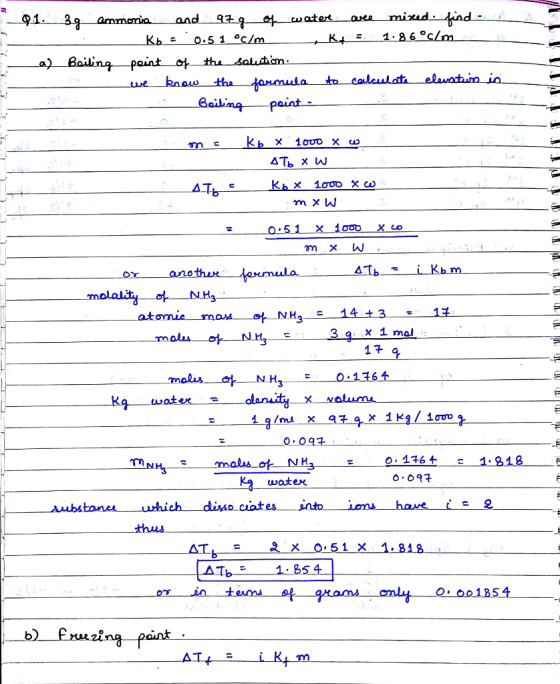
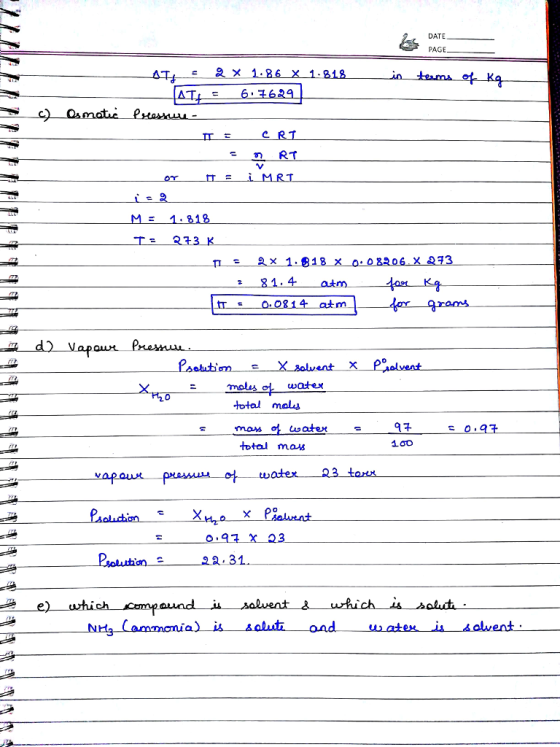
1. 3.0g ammonia and 97.0g of water are mixed. Find (assume density of the solution is...
1. Ethylene glycol, formula C2H602, is used as antifreeze for automobiles and is sometimes mixed with...
 1. Ethylene glycol, formula C2H602, is used as antifreeze for automobiles and is sometimes mixed with water at a 1:1 ratio by volume and produces a solution with a density of 1.07 g/mbu Assume that the solution behaves ideally. Notes: at 25 °C the densities of water and ethylene glycol are 1.00 g/mL and 1.11 g/mL, respectively, the vapor pressures of water and ethylene glycol at 20 Care 17.54 torr and 0.06 torr, respectively, and Ky and K of water...
14. What is the vapor pressure in mmHg of a solution of a solution that contains...
 14. What is the vapor pressure in mmHg of a solution of a solution that contains 10.0 g of urea, CHAN20, in 150.0 g of water at 45.0 "C. The vapor pressure of water at 45.0°C is 71.93 mmHg and urea is a nonvolatile solute. 15. What is the freezing point in °C for the above problem? For water, Kr-1.86 °C/m. 16. The van't Hoff factor for KClisi = 1.85. What is the boiling point of a 0.75 m solution...
5. If you had 0.10 m solutions of each of the solutions in question #4, which would have: (hint, more ions cause bigger colligative properties, few particles in solution | K" ("C/m) Pur...
 5. If you had 0.10 m solutions of each of the solutions in question #4, which would have: (hint, more ions cause bigger colligative properties, few particles in solution | K" ("C/m) Pure Solvents Water Ethanol Benzene | Ke rc/m ) 0.512 1.19 2.65 1.86 1.99 -5.12 will have a smaller colligative affect.) d. the highest vapor pressure? e. the lowest freezing point? a. the highest boiling point? b. the highest freezing point? c. the lowest osmotic pressure? 6. Calculate...
What is the relationship between the moles of solute and the mass of solute? Rewrite the molality expression in terms o...
 What is the relationship between the moles of solute and the
mass of solute?
Rewrite the molality expression in terms of grams and molecular
weight.
Background:
Properties that depend on the concentration of particles in solution are called colligative properties. The number of particles in a solvent can affect the freezing or boiling point of solvent. To express the effect of concentration on freezing point or boiling point, molality is used in place of molarity. Molality (m) is the number...
What is the relationship between the moles of solute and the
mass of solute?
Rewrite the molality expression in terms of grams and molecular
weight.
Background:
Properties that depend on the concentration of particles in solution are called colligative properties. The number of particles in a solvent can affect the freezing or boiling point of solvent. To express the effect of concentration on freezing point or boiling point, molality is used in place of molarity. Molality (m) is the number...
1. 1200 mL aqueous solution of 45 g of ethylene glycol and 80 g of sucrose...
 1. 1200 mL aqueous solution of 45 g of ethylene glycol and 80 g of sucrose were prepared with a density of 1.37 g/mL. Assume that the solution behaves ideally. Notes: The vapor pressures of water and ethylene glycol at 20 °C are 17.54 torr and 0.06 torr, respectively, and Kb and Kf of water are 0.51 K/m and 1.86 K/m, at 25 °C respectively. a. What is the freezing point of this solution? b. What is the vapor pressure,...
[References] What volume of ethylene glycol (C2HO2), a nonelectrolyte, must be added to 12.0 L water...
 [References] What volume of ethylene glycol (C2HO2), a nonelectrolyte, must be added to 12.0 L water to produce an antifreeze solution with a freezing point of-19.0°C? (The density of ethylene glycol is 1.11 g/cm°, and the density of water is 1.00 g/cm³. K, for water is 0.51°C•kg/mol and Kf is 1.86°C kg/mol.) Volume %3D What is the boiling point of this solution? Boiling point °C %3D 5 item attempts remaining Submit Answer Try Another Version [References] Consider an aqueous solution...
QUESTION 4 If you take a 171 mL of a 1.4 M NaCl solution and dilute...
 QUESTION 4
If you take a 171 mL of a 1.4 M NaCl solution and dilute it to
500 mL, what is the molarity of the final solution?
Enter the numerical answer in decimal notation
QUESTION 10
Information - Colligative
Properties
Colligative properties of solutions are those properties which
depend only on the number of dissolved solute particles in solution
not the chemical properties of the solute. For example when a
solute is dissolved in a solvent, vapor pressure
depression...
QUESTION 4
If you take a 171 mL of a 1.4 M NaCl solution and dilute it to
500 mL, what is the molarity of the final solution?
Enter the numerical answer in decimal notation
QUESTION 10
Information - Colligative
Properties
Colligative properties of solutions are those properties which
depend only on the number of dissolved solute particles in solution
not the chemical properties of the solute. For example when a
solute is dissolved in a solvent, vapor pressure
depression...
7. Consider the expression of Raoult's law, Psolution = Xsolvent ·P⁰solvent . Here, Psolution = vapor...
7. Consider the expression of Raoult's law, Psolution = Xsolvent ·P⁰solvent . Here, Psolution = vapor pressure of the solution, P⁰solvent = vapor pressure of pure solvent, Xsolvent = mole fraction of the solvent. What is the mole fraction of solvent in a solution with a vapor pressure of 47.90 torr, if the vapor pressure of the pure solvent is 52.82 torr? 8. The boiling point of a solution increases directly as a function of the number of moles of...
A Review Constants Periodic Table The changes in boiling point (AT) or freezing point (AT) in...
 A Review Constants Periodic Table The changes in boiling point (AT) or freezing point (AT) in degrees Celsius from a pure solvent can be determined from the equations given here, respectively: AT) = m x K = moles of solute XK K. kilograms of solvent Since pure water boils at 100.00 °C, and since the addition of solute increases boiling point, the boiling point of an aqueous solution, Th, will be T - (100.00+AT) 'C Since pure water freezes at...
Review Constants Periodic Table The changes in boiling point (AT) or freezing point (AT) in degrees...
 Review Constants Periodic Table The changes in boiling point (AT) or freezing point (AT) in degrees Celsius from a pure solvent can be determined from the equations given here, respectively: Value Units moles of solute AT = mx Kb = 7 Submit kilograms of solvent XRb moles of solutex Kf Part B AT: = mx Kf = kilograms of solvent where m is the molality of the solution, and K and K the boiling-point-elevation and freezing-point-depression constants for the solvent,...
 1. Ethylene glycol, formula C2H602, is used as antifreeze for automobiles and is sometimes mixed with water at a 1:1 ratio by volume and produces a solution with a density of 1.07 g/mbu Assume that the solution behaves ideally. Notes: at 25 °C the densities of water and ethylene glycol are 1.00 g/mL and 1.11 g/mL, respectively, the vapor pressures of water and ethylene glycol at 20 Care 17.54 torr and 0.06 torr, respectively, and Ky and K of water...
 14. What is the vapor pressure in mmHg of a solution of a solution that contains 10.0 g of urea, CHAN20, in 150.0 g of water at 45.0 "C. The vapor pressure of water at 45.0°C is 71.93 mmHg and urea is a nonvolatile solute. 15. What is the freezing point in °C for the above problem? For water, Kr-1.86 °C/m. 16. The van't Hoff factor for KClisi = 1.85. What is the boiling point of a 0.75 m solution...
 5. If you had 0.10 m solutions of each of the solutions in question #4, which would have: (hint, more ions cause bigger colligative properties, few particles in solution | K" ("C/m) Pure Solvents Water Ethanol Benzene | Ke rc/m ) 0.512 1.19 2.65 1.86 1.99 -5.12 will have a smaller colligative affect.) d. the highest vapor pressure? e. the lowest freezing point? a. the highest boiling point? b. the highest freezing point? c. the lowest osmotic pressure? 6. Calculate...
 What is the relationship between the moles of solute and the
mass of solute?
Rewrite the molality expression in terms of grams and molecular
weight.
Background:
Properties that depend on the concentration of particles in solution are called colligative properties. The number of particles in a solvent can affect the freezing or boiling point of solvent. To express the effect of concentration on freezing point or boiling point, molality is used in place of molarity. Molality (m) is the number...
What is the relationship between the moles of solute and the
mass of solute?
Rewrite the molality expression in terms of grams and molecular
weight.
Background:
Properties that depend on the concentration of particles in solution are called colligative properties. The number of particles in a solvent can affect the freezing or boiling point of solvent. To express the effect of concentration on freezing point or boiling point, molality is used in place of molarity. Molality (m) is the number...
 1. 1200 mL aqueous solution of 45 g of ethylene glycol and 80 g of sucrose were prepared with a density of 1.37 g/mL. Assume that the solution behaves ideally. Notes: The vapor pressures of water and ethylene glycol at 20 °C are 17.54 torr and 0.06 torr, respectively, and Kb and Kf of water are 0.51 K/m and 1.86 K/m, at 25 °C respectively. a. What is the freezing point of this solution? b. What is the vapor pressure,...
 [References] What volume of ethylene glycol (C2HO2), a nonelectrolyte, must be added to 12.0 L water to produce an antifreeze solution with a freezing point of-19.0°C? (The density of ethylene glycol is 1.11 g/cm°, and the density of water is 1.00 g/cm³. K, for water is 0.51°C•kg/mol and Kf is 1.86°C kg/mol.) Volume %3D What is the boiling point of this solution? Boiling point °C %3D 5 item attempts remaining Submit Answer Try Another Version [References] Consider an aqueous solution...
 QUESTION 4
If you take a 171 mL of a 1.4 M NaCl solution and dilute it to
500 mL, what is the molarity of the final solution?
Enter the numerical answer in decimal notation
QUESTION 10
Information - Colligative
Properties
Colligative properties of solutions are those properties which
depend only on the number of dissolved solute particles in solution
not the chemical properties of the solute. For example when a
solute is dissolved in a solvent, vapor pressure
depression...
QUESTION 4
If you take a 171 mL of a 1.4 M NaCl solution and dilute it to
500 mL, what is the molarity of the final solution?
Enter the numerical answer in decimal notation
QUESTION 10
Information - Colligative
Properties
Colligative properties of solutions are those properties which
depend only on the number of dissolved solute particles in solution
not the chemical properties of the solute. For example when a
solute is dissolved in a solvent, vapor pressure
depression...
 A Review Constants Periodic Table The changes in boiling point (AT) or freezing point (AT) in degrees Celsius from a pure solvent can be determined from the equations given here, respectively: AT) = m x K = moles of solute XK K. kilograms of solvent Since pure water boils at 100.00 °C, and since the addition of solute increases boiling point, the boiling point of an aqueous solution, Th, will be T - (100.00+AT) 'C Since pure water freezes at...
 Review Constants Periodic Table The changes in boiling point (AT) or freezing point (AT) in degrees Celsius from a pure solvent can be determined from the equations given here, respectively: Value Units moles of solute AT = mx Kb = 7 Submit kilograms of solvent XRb moles of solutex Kf Part B AT: = mx Kf = kilograms of solvent where m is the molality of the solution, and K and K the boiling-point-elevation and freezing-point-depression constants for the solvent,...
Most questions answered within 3 hours.
-
Where is the error in this code sequence?
String s1 = "Hello";
String s2 = "ello";...
asked 11 months ago -
Financial data for Joel de Paris, Inc., for last year
follow:
Joel de Paris, Inc.
Balance...
asked 11 months ago -
Consider this reaction:
Al2(SO4)3 (aq)+ BaCl3
(aq) Al2Cl6 (aq)- +
3BaSO4(s) . What is the...
asked 11 months ago -
Suppose that Savneet is considering increasing her
recent random sample from 20 car rentals to 40...
asked 11 months ago -
Trucks arrive at an unloading terminal at an average rate of 120
per hour.
Trucks arrive...
asked 11 months ago -
Why are methanol and ethanol completely soluble in water while
octanol is not very little soluble....
asked 11 months ago -
A facilities manager at a university reads in a research report
that the mean amount of...
asked 11 months ago -
When the CuSO4 is rehydrated by adding water to the anhydrous
compound, is this an endothermic...
asked 11 months ago -
A ray of sunlight is passing from diamond into crown glass; the
angle of incidence is...
asked 11 months ago -
A block of mass 0.249 kg is placed on top of a light, vertical
spring of...
asked 11 months ago -
how do the kidneys compensate in the presences of acidosis
a) trigger hyperventilate
b) reserve acid...
asked 11 months ago -
Question 501 pts
The rental rate of capital to the firm increases. Which of the
following...
asked 11 months ago