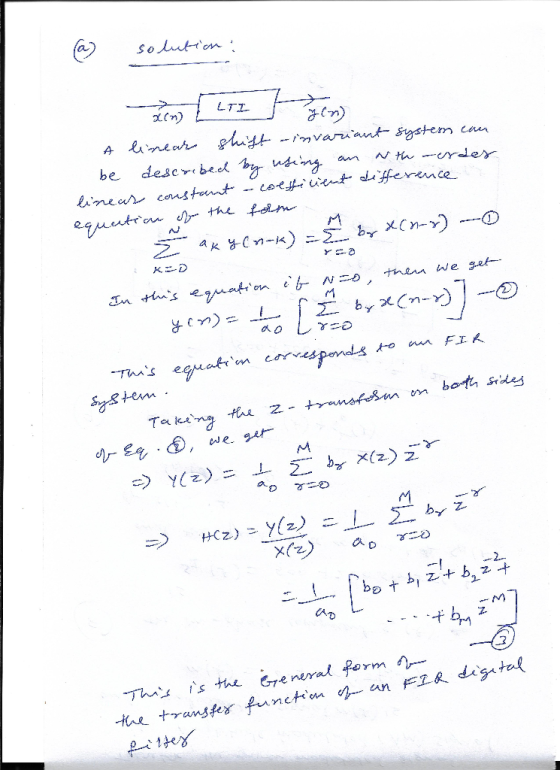
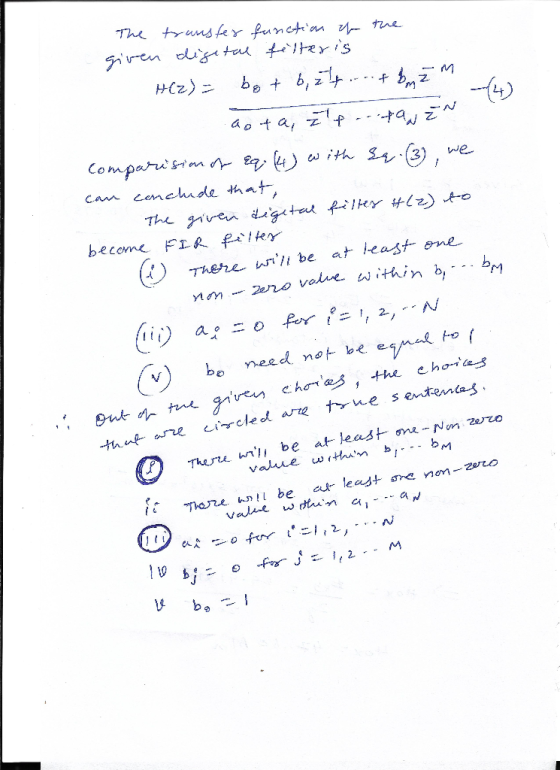
![The transfer function of a digital filter is, H(z) - ao t a1z-1+ .avz-M (a) [5 points] For a Finite Impulse Response (FIR) fi](http://img.homeworklib.com/questions/a1f3d0c0-b1f4-11ea-8f77-efebabf2088b.png?x-oss-process=image/resize,w_560)
Homework Answers
Add Answer to:
The transfer function of a digital filter is, H(z) - ao t a1z-1+ .avz-M (a) [5...
Question 3 a) A linear-phase, Finite Impulse Response (FIR) digital filter with the transfer func...
 Thanks
Question 3 a) A linear-phase, Finite Impulse Response (FIR) digital filter with the transfer function H() shown as follow is desired: (4 marks) (3 marks) iii) Based on (a)(ii), determine the truncated impulse response ha(n) for a 5-tap FIR filter by i) Sketch the spectrum of the transfer function H (w). ii) Determine the impulse response h(n) from H() using rectangular window method. (6 marks) iv) Calculate all the filter coefficient of ha (n). (5 marks)
Question 3 a)...
Thanks
Question 3 a) A linear-phase, Finite Impulse Response (FIR) digital filter with the transfer function H() shown as follow is desired: (4 marks) (3 marks) iii) Based on (a)(ii), determine the truncated impulse response ha(n) for a 5-tap FIR filter by i) Sketch the spectrum of the transfer function H (w). ii) Determine the impulse response h(n) from H() using rectangular window method. (6 marks) iv) Calculate all the filter coefficient of ha (n). (5 marks)
Question 3 a)...
QUESTION 28 3 points Save The Siter coefficients of a second-order digital IR filter are: ao-1,a1-2, a2-2, bo-1. b1-1/2, b2 1/8. (a's are numerator coetficients and b's are the denom...
 QUESTION 28 3 points Save The Siter coefficients of a second-order digital IR filter are: ao-1,a1-2, a2-2, bo-1. b1-1/2, b2 1/8. (a's are numerator coetficients and b's are the denominator coefficients). Determine the value of the impulse response N4? QUESTION 29 6 points Save Answer An image is to be sampled with a signal-to-quantisation ratio of at least 55 dB. The image samples are non-negative. The image sample values fall within the range from 0 to 1. How many bits...
a) The transfer function of an ideal low-pass filter is and its impulse response is where...
 a) The transfer function of an ideal low-pass filter is and its impulse response is where oc is the cut-off frequency i) Is hLP[n] a finite impulse response (FIR) filter or an infinite impulse response filter (IIR)? Explain your answer ii Is hLP[n] a causal or a non-causal filter? Explain your answer iii) If ae-0. IT, plot the magnitude responses for the following impulse responses b) i) Let the five impulse response samples of a causal FIR filter be given...
QUESTION 6 Зро Design a second-order IIR digital low-pass filter using Butterworth approximation....
 QUESTION 6 Зро Design a second-order IIR digital low-pass filter using Butterworth approximation. Use the bilinear transformation to convert the analogue fiter to a digital one (choose the sampling period T- 2 s and the cut-off frequency as 1 rad/'s). Express the digital transfer function of the filter H(z) as: In the box below, provide the numerical answer for b1. [Note: Don't normalise the transfer func on, i.e. b0 # 1). r98111acontentid1837836_1&step QUESTION 7 Windowing based FIR filter design techniques...
5. Consider the digital filter in Figure 3. (a) Assuming all delay units are cleared, find the transfer function for the filter (b) Write the difference equation for the filter. (c) Find the i...
 5. Consider the digital filter in Figure 3. (a) Assuming all delay units are cleared, find the transfer function for the filter (b) Write the difference equation for the filter. (c) Find the impulse response for this filter. (d) Now assume that delay unit 1 (D1) initially has a value 1 stored and the other delay units are cleared. Find 2 D3 4 D2 2 DS Figure 3: Question 5
5. Consider the digital filter in Figure 3. (a) Assuming...
5. Consider the digital filter in Figure 3. (a) Assuming all delay units are cleared, find the transfer function for the filter (b) Write the difference equation for the filter. (c) Find the impulse response for this filter. (d) Now assume that delay unit 1 (D1) initially has a value 1 stored and the other delay units are cleared. Find 2 D3 4 D2 2 DS Figure 3: Question 5
5. Consider the digital filter in Figure 3. (a) Assuming...
Question 2 (10 points) Show all your work) inear time-invariant filter has the following transfer function: 1-3z H(z) 221리> 1+z-z 2 a) Is this filter an IIR or FIR? Explain. b) (1 point) What is...
 Question 2 (10 points) Show all your work) inear time-invariant filter has the following transfer function: 1-3z H(z) 221리> 1+z-z 2 a) Is this filter an IIR or FIR? Explain. b) (1 point) What is the order of this filter? (1 point) (1 point) 5 points) c) Is this filter stable? Explain. d) Determine the impulse response of the system. e) Determine the difference-equation description for the system. (2 points) nd order
Question 2 (10 points) Show all your work)...
Question 2 (10 points) Show all your work) inear time-invariant filter has the following transfer function: 1-3z H(z) 221리> 1+z-z 2 a) Is this filter an IIR or FIR? Explain. b) (1 point) What is the order of this filter? (1 point) (1 point) 5 points) c) Is this filter stable? Explain. d) Determine the impulse response of the system. e) Determine the difference-equation description for the system. (2 points) nd order
Question 2 (10 points) Show all your work)...
QUESTION 1 Characterise the following systems as being either causal on anticausal: yn)-ePyn-1)+u...
 QUESTION 1 Characterise the following systems as being either causal on anticausal: yn)-ePyn-1)+u/n), where u/h) is the unit step and B is an arbitrary constant (B>0), Take y-1)-0. Answer with either causal or 'anticausal only QUESTION 2 For the following system: yn) -yn-1Va -x(n), for a 0.9, find y(10), assuming y(n) - o, for ns -1.Hint: find a closed form for yin) and use it to find the required output sample. (xin)-1 for n>-0) QUESTION 3 A filter has the...
Digital Signal Processing QUESTION SIX A digital filter system has a transfer function given by 1-0.4z-1 T(z) = 1 + 0.2z-2 a) Draw the z-domain version of the block diagram for the filter 110) Der...
 Digital Signal Processing
QUESTION SIX A digital filter system has a transfer function given by 1-0.4z-1 T(z) = 1 + 0.2z-2 a) Draw the z-domain version of the block diagram for the filter 110) Derive an expression for the output sequence yin], in terms of the input b) sequence, xla], and delayed input and output sequences 10 151 e) Find the unit sample response for the filter (first three terms only)
QUESTION SIX A digital filter system has a transfer...
Digital Signal Processing
QUESTION SIX A digital filter system has a transfer function given by 1-0.4z-1 T(z) = 1 + 0.2z-2 a) Draw the z-domain version of the block diagram for the filter 110) Derive an expression for the output sequence yin], in terms of the input b) sequence, xla], and delayed input and output sequences 10 151 e) Find the unit sample response for the filter (first three terms only)
QUESTION SIX A digital filter system has a transfer...
(c) A digital filter has transfer function 1 Н(2) z 1/2 Evaluate the response function of...
 (c) A digital filter has transfer function 1 Н(2) z 1/2 Evaluate the response function of the filter, Y(z)= X(z)H(z), for the sequence (i 2* x(n)a. (Use the geometric series 1-c k 0 (ii By using partial fractions, determine the response of the filter, y(n), to the input x(п) %— а". (iii What is the response to the input data x(n) (1)"? [Note: the Z- transform of a sequence x(n) is defined as X(z) x(n)z. The n-0 inverse Z- transform...
Answer the following questions for a causal digital filter with the following system function H(z) 23-2+0.64z-0.64 1-1. (0.5 point) Locate the poles and zeros of H(z) on the z-plane. (sol) 1-2. (...
 Answer the following questions for a causal digital filter with the following system function H(z) 23-2+0.64z-0.64 1-1. (0.5 point) Locate the poles and zeros of H(z) on the z-plane. (sol) 1-2. (1.5 point) Sketch the magnitude spectrum, H(e i), of the filter. Find the exact values of lH(eml. IH(efr/2)I, and IH(e") , (sol) 1-3. (1 point) Relocate only one pole so that 9 s Hle)s 10 (sol) 1-4 (1 point) Take the inverse Z-transform on H(z) to find the impulse...
 Thanks
Question 3 a) A linear-phase, Finite Impulse Response (FIR) digital filter with the transfer function H() shown as follow is desired: (4 marks) (3 marks) iii) Based on (a)(ii), determine the truncated impulse response ha(n) for a 5-tap FIR filter by i) Sketch the spectrum of the transfer function H (w). ii) Determine the impulse response h(n) from H() using rectangular window method. (6 marks) iv) Calculate all the filter coefficient of ha (n). (5 marks)
Question 3 a)...
Thanks
Question 3 a) A linear-phase, Finite Impulse Response (FIR) digital filter with the transfer function H() shown as follow is desired: (4 marks) (3 marks) iii) Based on (a)(ii), determine the truncated impulse response ha(n) for a 5-tap FIR filter by i) Sketch the spectrum of the transfer function H (w). ii) Determine the impulse response h(n) from H() using rectangular window method. (6 marks) iv) Calculate all the filter coefficient of ha (n). (5 marks)
Question 3 a)...
 QUESTION 28 3 points Save The Siter coefficients of a second-order digital IR filter are: ao-1,a1-2, a2-2, bo-1. b1-1/2, b2 1/8. (a's are numerator coetficients and b's are the denominator coefficients). Determine the value of the impulse response N4? QUESTION 29 6 points Save Answer An image is to be sampled with a signal-to-quantisation ratio of at least 55 dB. The image samples are non-negative. The image sample values fall within the range from 0 to 1. How many bits...
 a) The transfer function of an ideal low-pass filter is and its impulse response is where oc is the cut-off frequency i) Is hLP[n] a finite impulse response (FIR) filter or an infinite impulse response filter (IIR)? Explain your answer ii Is hLP[n] a causal or a non-causal filter? Explain your answer iii) If ae-0. IT, plot the magnitude responses for the following impulse responses b) i) Let the five impulse response samples of a causal FIR filter be given...
 QUESTION 6 Зро Design a second-order IIR digital low-pass filter using Butterworth approximation. Use the bilinear transformation to convert the analogue fiter to a digital one (choose the sampling period T- 2 s and the cut-off frequency as 1 rad/'s). Express the digital transfer function of the filter H(z) as: In the box below, provide the numerical answer for b1. [Note: Don't normalise the transfer func on, i.e. b0 # 1). r98111acontentid1837836_1&step QUESTION 7 Windowing based FIR filter design techniques...
 5. Consider the digital filter in Figure 3. (a) Assuming all delay units are cleared, find the transfer function for the filter (b) Write the difference equation for the filter. (c) Find the impulse response for this filter. (d) Now assume that delay unit 1 (D1) initially has a value 1 stored and the other delay units are cleared. Find 2 D3 4 D2 2 DS Figure 3: Question 5
5. Consider the digital filter in Figure 3. (a) Assuming...
5. Consider the digital filter in Figure 3. (a) Assuming all delay units are cleared, find the transfer function for the filter (b) Write the difference equation for the filter. (c) Find the impulse response for this filter. (d) Now assume that delay unit 1 (D1) initially has a value 1 stored and the other delay units are cleared. Find 2 D3 4 D2 2 DS Figure 3: Question 5
5. Consider the digital filter in Figure 3. (a) Assuming...
 Question 2 (10 points) Show all your work) inear time-invariant filter has the following transfer function: 1-3z H(z) 221리> 1+z-z 2 a) Is this filter an IIR or FIR? Explain. b) (1 point) What is the order of this filter? (1 point) (1 point) 5 points) c) Is this filter stable? Explain. d) Determine the impulse response of the system. e) Determine the difference-equation description for the system. (2 points) nd order
Question 2 (10 points) Show all your work)...
Question 2 (10 points) Show all your work) inear time-invariant filter has the following transfer function: 1-3z H(z) 221리> 1+z-z 2 a) Is this filter an IIR or FIR? Explain. b) (1 point) What is the order of this filter? (1 point) (1 point) 5 points) c) Is this filter stable? Explain. d) Determine the impulse response of the system. e) Determine the difference-equation description for the system. (2 points) nd order
Question 2 (10 points) Show all your work)...
 QUESTION 1 Characterise the following systems as being either causal on anticausal: yn)-ePyn-1)+u/n), where u/h) is the unit step and B is an arbitrary constant (B>0), Take y-1)-0. Answer with either causal or 'anticausal only QUESTION 2 For the following system: yn) -yn-1Va -x(n), for a 0.9, find y(10), assuming y(n) - o, for ns -1.Hint: find a closed form for yin) and use it to find the required output sample. (xin)-1 for n>-0) QUESTION 3 A filter has the...
 Digital Signal Processing
QUESTION SIX A digital filter system has a transfer function given by 1-0.4z-1 T(z) = 1 + 0.2z-2 a) Draw the z-domain version of the block diagram for the filter 110) Derive an expression for the output sequence yin], in terms of the input b) sequence, xla], and delayed input and output sequences 10 151 e) Find the unit sample response for the filter (first three terms only)
QUESTION SIX A digital filter system has a transfer...
Digital Signal Processing
QUESTION SIX A digital filter system has a transfer function given by 1-0.4z-1 T(z) = 1 + 0.2z-2 a) Draw the z-domain version of the block diagram for the filter 110) Derive an expression for the output sequence yin], in terms of the input b) sequence, xla], and delayed input and output sequences 10 151 e) Find the unit sample response for the filter (first three terms only)
QUESTION SIX A digital filter system has a transfer...
 (c) A digital filter has transfer function 1 Н(2) z 1/2 Evaluate the response function of the filter, Y(z)= X(z)H(z), for the sequence (i 2* x(n)a. (Use the geometric series 1-c k 0 (ii By using partial fractions, determine the response of the filter, y(n), to the input x(п) %— а". (iii What is the response to the input data x(n) (1)"? [Note: the Z- transform of a sequence x(n) is defined as X(z) x(n)z. The n-0 inverse Z- transform...
 Answer the following questions for a causal digital filter with the following system function H(z) 23-2+0.64z-0.64 1-1. (0.5 point) Locate the poles and zeros of H(z) on the z-plane. (sol) 1-2. (1.5 point) Sketch the magnitude spectrum, H(e i), of the filter. Find the exact values of lH(eml. IH(efr/2)I, and IH(e") , (sol) 1-3. (1 point) Relocate only one pole so that 9 s Hle)s 10 (sol) 1-4 (1 point) Take the inverse Z-transform on H(z) to find the impulse...
Most questions answered within 3 hours.
-
Where is the error in this code sequence?
String s1 = "Hello";
String s2 = "ello";...
asked 10 months ago -
Financial data for Joel de Paris, Inc., for last year
follow:
Joel de Paris, Inc.
Balance...
asked 10 months ago -
Consider this reaction:
Al2(SO4)3 (aq)+ BaCl3
(aq) Al2Cl6 (aq)- +
3BaSO4(s) . What is the...
asked 10 months ago -
Suppose that Savneet is considering increasing her
recent random sample from 20 car rentals to 40...
asked 10 months ago -
Trucks arrive at an unloading terminal at an average rate of 120
per hour.
Trucks arrive...
asked 10 months ago -
Why are methanol and ethanol completely soluble in water while
octanol is not very little soluble....
asked 10 months ago -
A facilities manager at a university reads in a research report
that the mean amount of...
asked 10 months ago -
When the CuSO4 is rehydrated by adding water to the anhydrous
compound, is this an endothermic...
asked 10 months ago -
A ray of sunlight is passing from diamond into crown glass; the
angle of incidence is...
asked 10 months ago -
A block of mass 0.249 kg is placed on top of a light, vertical
spring of...
asked 10 months ago -
how do the kidneys compensate in the presences of acidosis
a) trigger hyperventilate
b) reserve acid...
asked 10 months ago -
Question 501 pts
The rental rate of capital to the firm increases. Which of the
following...
asked 10 months ago