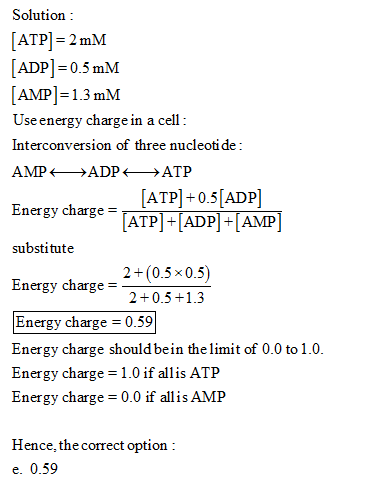
What is the energy charge in a cell when [ATP] = 2 mM, [ADP] = 0.5...
What is the energy charge in a cell when [ATP] = 2 mM, [ADP] = 0.5 mM, and [AMP] = 1.3 mM?
a. 0.36. b. 0.71. c. 0.14. d. 0.80. e. 0.59. I want an explanation on how to solve this. Thanks
Homework Answers
Add Answer to:
What is the energy charge in a cell when [ATP] = 2 mM, [ADP] =
0.5...
QUESTION 4 The adenylate pool (ATP+ADP+AMP) for two cell types is shown below. Calculate the energy...
 QUESTION 4 The adenylate pool (ATP+ADP+AMP) for two cell types is shown below. Calculate the energy charge of each and determine which is the more anabolic cell type. liver cells cancer cells ATP 3.4 mm 1.25 mm ADP 1.3 mm 0.35 mM AMP 0.3 mm 0.12 mm energy charge metabolic state 0.81 0.83 0.85 0.87 0.89 0.91 Less anabolic More anabolic QUESTION 5 Adenylate kinase is a ubiquitous en through B-phosphoryl transfer from aintain short term ATP pools during high...
QUESTION 5 Energy charge takes into account the total adenine nucleotide pool. Determine the energy charge...
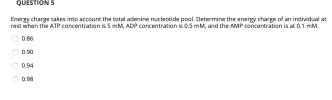 QUESTION 5 Energy charge takes into account the total adenine nucleotide pool. Determine the energy charge of an individual at rest when the ATP concentration is 5 mM, ADP concentration is 0.5 mm, and the AMP concentration is at 0.1 mM. O 0.86 O 0.90 O 0.94 O 0.98
Consider the hydrolysis of ATP: ATP(aq) + H2O(l) → ADP(aq) + Pi(aq). This reaction has ΔH°=...
Consider the hydrolysis of ATP: ATP(aq) + H2O(l) → ADP(aq) + Pi(aq). This reaction has ΔH°= −24.3 kJ/mol and ΔS°= +21.6 J/mol-K. The actual concentrations of ATP, ADP, and Pi are not 1 M in a biological cell. How much energy can the conversion of ATP to ADP supply when it occurs at physiological conditions in E. coli where the temperature is 37°C and the approximate concentrations are ATP = 11.2 mM, ADP = 1.52 mM, Pi = 20.0 mM?...
Question 11 1 pts Consider the hydrolysis of ATP: ATP(aq) + H2O(1) - ADP(aq) + P(aq). This reaction has AH°= -24.3...
 Question 11 1 pts Consider the hydrolysis of ATP: ATP(aq) + H2O(1) - ADP(aq) + P(aq). This reaction has AH°= -24.3 kJ/mol and AS - +21.6 J/mol-K. The actual concentrations of ATP, ADP, and Pi are not 1 Min a biological cell. How much energy can the conversion of ATP to ADP supply when it occurs at physiological conditions in E.coli where the temperature is 37°C and the approximate concentrations are ATP - 14.8 mM, ADP - 3.65 MM, P,...
We have seen all term that cells use the hydrolysis of high energy phosphate from ATP...
We have seen all term that cells use the hydrolysis of high energy phosphate from ATP to make metabolic reactions thermodynamically favorable. Whereas most enzymes that utilize ATP hydrolyze between the b and g phosphates (yielding ADP + Pi), some enzymes hydrolyze ATP between the a and b phosphates (yielding AMP and PPi). ∆G°’ of phosphate hydrolysis is -31 kJ/mol for ATP + H2O --> ADP + Pi, and ∆G°’ of phosphate hydrolysis is -46.5 kJ/mol for ATP + H2O...
When a plant performs photosynthesis, where is it storing energy? A) ATP enters a chloroplast to...
When a plant performs photosynthesis, where is it storing energy? A) ATP enters a chloroplast to release its stored energy. B) A phosphate group separates from ATP and ATP becomes ADP. C) ATP releases its energy through an endergonic reaction. Give me an answer and a brief explanation that is 1-2 sentences in complete sentences. Avoid repeating the answer choice as your explanation.
D Question 9 0.59 pts 2 mM ATP 5 3- C21 nM AMPK-AMP Kinase Which of the following best explains what is happening in this graph? e There is a negative correlation between substrate concentration and...
 D Question 9 0.59 pts 2 mM ATP 5 3- C21 nM AMPK-AMP Kinase Which of the following best explains what is happening in this graph? e There is a negative correlation between substrate concentration and AMPK activity. ATP acts as an allosteric activator when concentration of substrate is at least 10 nM. AMPK is not active without the presence of the substrate at 10 nM or greater concentration.
D Question 9 0.59 pts 2 mM ATP 5 3- C21...
D Question 9 0.59 pts 2 mM ATP 5 3- C21 nM AMPK-AMP Kinase Which of the following best explains what is happening in this graph? e There is a negative correlation between substrate concentration and AMPK activity. ATP acts as an allosteric activator when concentration of substrate is at least 10 nM. AMPK is not active without the presence of the substrate at 10 nM or greater concentration.
D Question 9 0.59 pts 2 mM ATP 5 3- C21...
The homeostasis of ATP in a cell is dependent on the maintenance of energy status that...
The homeostasis of ATP in a cell is dependent on the maintenance of energy status that is mainly determined by the ATP to AMP ratio, as well as the maintenance of the adenine nucleotide pool. a) What is the biochemical mechanism that prevents the overproduction of ATP by glycolysis? (4 marks) Page 4 of 7 b) By referring to the metabolic pathways for the de novo synthesis of purine nucleotides, discuss how this biochemical process is regulated by: i) The...
When your cells need energy, they extract it from adenosine triphosphate(ATP). But how did the energy...
When your cells need energy, they extract it from adenosine triphosphate(ATP). But how did the energy get into the ATP? A) Energy was extracted from the food I ate by photosynthesis and store into ATP. B) ATP is a carbohydrate, which makes it a good source of energy. C) Energy was extracted from the food I ate by cellular respiration and stored into ATP. Give me an answer and a brief explanation that is 1-2 sentences in complete sentences. Avoid...
How does the hydrolysis of ATP (to ADP+P) alter proteins in a muscle cell to allow...
How does the hydrolysis of ATP (to ADP+P) alter proteins in a muscle cell to allow for contraction? A) Hydrolysis results in activation of myosin to the extended “ready” position. B) Hydrolysis results in activation of myosin to the flexed “bent” position. C) Hydrolysis results in the movement of tropomyosin so that actin active sites are revealed. D) Hydrolysis results in the breakage of cross bridges between actin and myosin.
 QUESTION 4 The adenylate pool (ATP+ADP+AMP) for two cell types is shown below. Calculate the energy charge of each and determine which is the more anabolic cell type. liver cells cancer cells ATP 3.4 mm 1.25 mm ADP 1.3 mm 0.35 mM AMP 0.3 mm 0.12 mm energy charge metabolic state 0.81 0.83 0.85 0.87 0.89 0.91 Less anabolic More anabolic QUESTION 5 Adenylate kinase is a ubiquitous en through B-phosphoryl transfer from aintain short term ATP pools during high...
 QUESTION 5 Energy charge takes into account the total adenine nucleotide pool. Determine the energy charge of an individual at rest when the ATP concentration is 5 mM, ADP concentration is 0.5 mm, and the AMP concentration is at 0.1 mM. O 0.86 O 0.90 O 0.94 O 0.98
 Question 11 1 pts Consider the hydrolysis of ATP: ATP(aq) + H2O(1) - ADP(aq) + P(aq). This reaction has AH°= -24.3 kJ/mol and AS - +21.6 J/mol-K. The actual concentrations of ATP, ADP, and Pi are not 1 Min a biological cell. How much energy can the conversion of ATP to ADP supply when it occurs at physiological conditions in E.coli where the temperature is 37°C and the approximate concentrations are ATP - 14.8 mM, ADP - 3.65 MM, P,...
 D Question 9 0.59 pts 2 mM ATP 5 3- C21 nM AMPK-AMP Kinase Which of the following best explains what is happening in this graph? e There is a negative correlation between substrate concentration and AMPK activity. ATP acts as an allosteric activator when concentration of substrate is at least 10 nM. AMPK is not active without the presence of the substrate at 10 nM or greater concentration.
D Question 9 0.59 pts 2 mM ATP 5 3- C21...
D Question 9 0.59 pts 2 mM ATP 5 3- C21 nM AMPK-AMP Kinase Which of the following best explains what is happening in this graph? e There is a negative correlation between substrate concentration and AMPK activity. ATP acts as an allosteric activator when concentration of substrate is at least 10 nM. AMPK is not active without the presence of the substrate at 10 nM or greater concentration.
D Question 9 0.59 pts 2 mM ATP 5 3- C21...
Most questions answered within 3 hours.
-
Where is the error in this code sequence?
String s1 = "Hello";
String s2 = "ello";...
asked 11 months ago -
Financial data for Joel de Paris, Inc., for last year
follow:
Joel de Paris, Inc.
Balance...
asked 11 months ago -
Consider this reaction:
Al2(SO4)3 (aq)+ BaCl3
(aq) Al2Cl6 (aq)- +
3BaSO4(s) . What is the...
asked 11 months ago -
Suppose that Savneet is considering increasing her
recent random sample from 20 car rentals to 40...
asked 11 months ago -
Trucks arrive at an unloading terminal at an average rate of 120
per hour.
Trucks arrive...
asked 11 months ago -
Why are methanol and ethanol completely soluble in water while
octanol is not very little soluble....
asked 11 months ago -
A facilities manager at a university reads in a research report
that the mean amount of...
asked 11 months ago -
When the CuSO4 is rehydrated by adding water to the anhydrous
compound, is this an endothermic...
asked 11 months ago -
A ray of sunlight is passing from diamond into crown glass; the
angle of incidence is...
asked 11 months ago -
A block of mass 0.249 kg is placed on top of a light, vertical
spring of...
asked 11 months ago -
how do the kidneys compensate in the presences of acidosis
a) trigger hyperventilate
b) reserve acid...
asked 11 months ago -
Question 501 pts
The rental rate of capital to the firm increases. Which of the
following...
asked 11 months ago