![Q3. At 20 °C, the osmotic pressure of a polycarbonate was measured in chlorobenzene solution with the following results: Concentration (g/L) 1.95 2.93 3.915.86 Height of chlorobenzene (cm 0.20 0.36 0.53 0.98 Solvent density = 1.10 g/cm, polymer density = 1.20 g/cm3] Estimate the number average molecular weight Mn [Rz 8314 x 107 erg mol-1KY. (10 marks)](http://img.homeworklib.com/questions/a844f9a0-bf86-11ea-afd2-45a7ef7168db.png?x-oss-process=image/resize,w_560)
Homework Answers
We will follow the following relation
π / c = RT / M + A2c
Where
π = osmotic pressure = height of chlorobenzene X density X acceleration due to gravity = hrg
g = acceleration due to gravity = 980 cm / second2
c = concentration (g / L)
R= gas constant = 8.314 X 10⁷ erg / mol K
M = molar mass of polymer = ?
T = temperature = 293 K
A2= viral coeffecient
Therefore
Or
so if we plot a graph between h/c v/s c we will get intercept =
From which we can calculate the molar mass
| concentration (g/L) | conce (g/mL) | height | h/c |
| 1.95 | 0.00195 | 0.2 | 102.5641 |
| 2.93 | 0.00293 | 0.36 | 122.8669 |
| 3.91 | 0.00391 | 0.53 | 135.5499 |
| 5.86 | 0.00586 | 0.98 | 167.2355 |
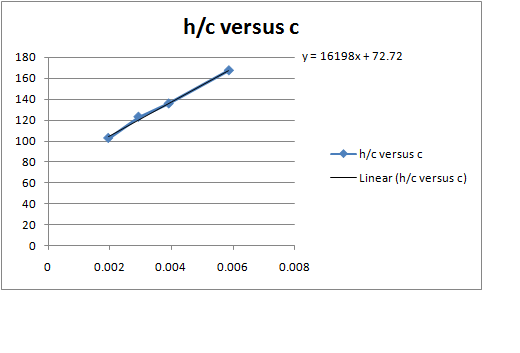
The equation is
y = 16198x + 72.72
Here intercept = 72.72 =
Molar mass = 8.314 X 107 X 293 / 1.10 X 9.8 X 102 X 72.72
Molar mass = 310745.61 g / mole
Add Answer to:
Q3. At 20 °C, the osmotic pressure of a polycarbonate was measured in chlorobenzene solution with...
2) The osmotic pressure of solutions of polystyrene in toluene were measured at 25 °C and...
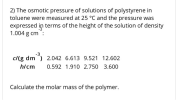 2) The osmotic pressure of solutions of polystyrene in toluene were measured at 25 °C and the pressure was expressed in terms of the height of the solution of density 1.004 g cm 3 c/(g dm ) 2.042 6.613 9.521 12.602 h/cm 0.592 1.910 2.750 3.600 Calculate the molar mass of the polymer.
 2) The osmotic pressure of solutions of polystyrene in toluene were measured at 25 °C and the pressure was expressed in terms of the height of the solution of density 1.004 g cm 3 c/(g dm ) 2.042 6.613 9.521 12.602 h/cm 0.592 1.910 2.750 3.600 Calculate the molar mass of the polymer.
Most questions answered within 3 hours.
-
Where is the error in this code sequence?
String s1 = "Hello";
String s2 = "ello";...
asked 11 months ago -
Financial data for Joel de Paris, Inc., for last year
follow:
Joel de Paris, Inc.
Balance...
asked 11 months ago -
Consider this reaction:
Al2(SO4)3 (aq)+ BaCl3
(aq) Al2Cl6 (aq)- +
3BaSO4(s) . What is the...
asked 11 months ago -
Suppose that Savneet is considering increasing her
recent random sample from 20 car rentals to 40...
asked 11 months ago -
Trucks arrive at an unloading terminal at an average rate of 120
per hour.
Trucks arrive...
asked 11 months ago -
Why are methanol and ethanol completely soluble in water while
octanol is not very little soluble....
asked 11 months ago -
A facilities manager at a university reads in a research report
that the mean amount of...
asked 11 months ago -
When the CuSO4 is rehydrated by adding water to the anhydrous
compound, is this an endothermic...
asked 11 months ago -
A ray of sunlight is passing from diamond into crown glass; the
angle of incidence is...
asked 11 months ago -
A block of mass 0.249 kg is placed on top of a light, vertical
spring of...
asked 11 months ago -
how do the kidneys compensate in the presences of acidosis
a) trigger hyperventilate
b) reserve acid...
asked 11 months ago -
Question 501 pts
The rental rate of capital to the firm increases. Which of the
following...
asked 11 months ago