
Homework Answers
Add Answer to:
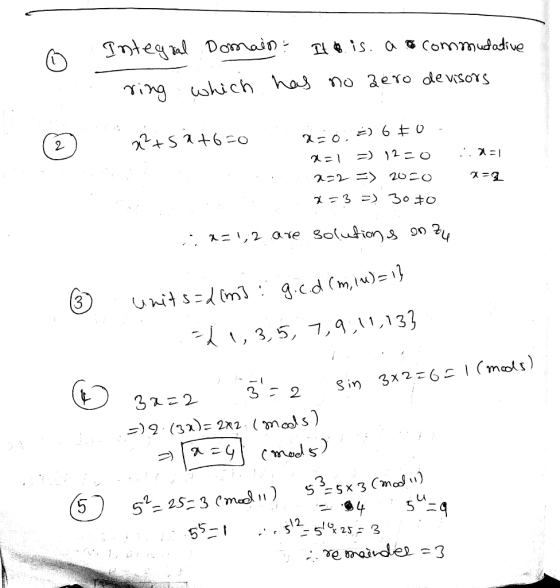
(1) Define what an integral domain is. (2) Find all solutions to r? + 5x +...
Please show question 1 (all parts). Thank you! 1. Using the Euclidean algorithm to find the...
 Please show question 1 (all parts). Thank
you!
1. Using the Euclidean algorithm to find the ged of following pairs. Write down the ged as a linear combination of given pairs (a) 524 and 148 in Z (b)33 + 2r +1 and 2 +1 in Zs[] (c) 3 +2r +1 and 1 n Z[] 2. Compute 42001 in Z5 3. Use principal of induction show that 10" 1 mod 9 4. Show that every odd integer is congruent to 1...
Please show question 1 (all parts). Thank
you!
1. Using the Euclidean algorithm to find the ged of following pairs. Write down the ged as a linear combination of given pairs (a) 524 and 148 in Z (b)33 + 2r +1 and 2 +1 in Zs[] (c) 3 +2r +1 and 1 n Z[] 2. Compute 42001 in Z5 3. Use principal of induction show that 10" 1 mod 9 4. Show that every odd integer is congruent to 1...
Prove that x=+,- 1 are the only solutions to the equation x^2=1 in an integral domain....
Prove that x=+,- 1 are the only solutions to the equation x^2=1 in an integral domain. Find a ring in which the equation x^2=1 has more than two solutions.
Please solve the above 4 questions. 1. Using the extended Euclidean Algorithm, find all solutions of the linear congrue...
 Please solve the above 4 questions.
1. Using the extended Euclidean Algorithm, find all solutions of the linear congruence 217x 133 (mod 329), where 0 x < 329 (Eg. if 5n, n 0,. ,6) 24 + 5n, п %3D 0, 1, . .., 6, type 24 + x< 11 2. Find all solutions of the congruence 7x = 5 (mod 11) where 0 (Eg. if 4,7 10, 13, type 4,7,10,13, none. or if there are no solutions, type I 3....
Please solve the above 4 questions.
1. Using the extended Euclidean Algorithm, find all solutions of the linear congruence 217x 133 (mod 329), where 0 x < 329 (Eg. if 5n, n 0,. ,6) 24 + 5n, п %3D 0, 1, . .., 6, type 24 + x< 11 2. Find all solutions of the congruence 7x = 5 (mod 11) where 0 (Eg. if 4,7 10, 13, type 4,7,10,13, none. or if there are no solutions, type I 3....
12. Find all solutions with 0 <I<27: sec r = -2 13. Find all real solutions:...
 12. Find all solutions with 0 <I<27: sec r = -2 13. Find all real solutions: sin r 2 14. Find all real solutions: 3 tan (3x) + 1 = 0
B3 a. Solve for x in this equation: 2x + 11 = 2 (mod 4). b....
 B3 a. Solve for x in this equation: 2x + 11 = 2 (mod 4). b. What are the sets of units and zero divisors in the ring of integers modulo 22? (Specify at least the smaller set using set-roster notation.) c. Find a formula for the quotient and the exact remainder when 534 is divided by 8. Hint: find the remainder first by modular arithmetic. Then subtract the remainder from the power and divide to find the quotient.
1. Find all solutions to this trigonometric equation. Use radians. sin(3z-.15) 9128 2. Find all solutions...
 1. Find all solutions to this trigonometric equation. Use radians. sin(3z-.15) 9128 2. Find all solutions to this trigonometric equation. Use radians or degrees, your choice. tan (2r)-10 3tan(2r) 3. Solve the triangle whose three sides have lengths a 4, 8, c =11. a- 4 c 11 4. Solve the triangle where one angle α 30°, the opposite side 4, and one of the other sides is 7 (make it b). a α 300 b=7
please answer all the questions. question 1 to question 5 Given an integral domain R we...
 please answer all the questions.
question 1 to question 5
Given an integral domain R we define the relatic n~on Rx (R (0]) by (a, b)~(c, d) means ad bc. We also define the following operations on R x (R\o) (a, b) + (c, d) (ad + be, bd) and (a, b) (c,d) (ac, bd). 1. Prove that ~ is an equivalence relation. 2. Prove that ~is compatible with +and . (Therefore, ~is a congru- 3. Conclude that the following...
please answer all the questions.
question 1 to question 5
Given an integral domain R we define the relatic n~on Rx (R (0]) by (a, b)~(c, d) means ad bc. We also define the following operations on R x (R\o) (a, b) + (c, d) (ad + be, bd) and (a, b) (c,d) (ac, bd). 1. Prove that ~ is an equivalence relation. 2. Prove that ~is compatible with +and . (Therefore, ~is a congru- 3. Conclude that the following...
Please help me with understandable solutions for question 6(a), 7, 8 and 10. ( Use Chinese...
 Please help me with understandable solutions for question 6(a), 7,
8 and 10. ( Use Chinese remainder theorem where applicable).
78 CHAPTER 5. THE CHINESE REMAINDER THEOREM 6. (a) Let m mi,m2 Then r a (mod mi), ag (mod m2) can be solved if and only if (m, m2) | a1-a2. The solution, when it exists, is unique modulo m. (b) Using part (a) prove the Chinese remainder theorem by induction. 7. There is a number. It has no remainder...
Please help me with understandable solutions for question 6(a), 7,
8 and 10. ( Use Chinese remainder theorem where applicable).
78 CHAPTER 5. THE CHINESE REMAINDER THEOREM 6. (a) Let m mi,m2 Then r a (mod mi), ag (mod m2) can be solved if and only if (m, m2) | a1-a2. The solution, when it exists, is unique modulo m. (b) Using part (a) prove the Chinese remainder theorem by induction. 7. There is a number. It has no remainder...
Problem 1 Use the Chinese remainder theorem, find all integers x such that: (20 pts) x...
 Problem 1 Use the Chinese remainder theorem, find all integers x such that: (20 pts) x = 1 (mod 5) r = 2 (mod 7) x = 3 (mod 9) I= 4 mod 11) Answer,
Find all solutions using exact values cos 3x + cos 5x = 0 sec 2.c sec...
 Find all solutions using exact values cos 3x + cos 5x = 0 sec 2.c sec 6.r = 0.
 Please show question 1 (all parts). Thank
you!
1. Using the Euclidean algorithm to find the ged of following pairs. Write down the ged as a linear combination of given pairs (a) 524 and 148 in Z (b)33 + 2r +1 and 2 +1 in Zs[] (c) 3 +2r +1 and 1 n Z[] 2. Compute 42001 in Z5 3. Use principal of induction show that 10" 1 mod 9 4. Show that every odd integer is congruent to 1...
Please show question 1 (all parts). Thank
you!
1. Using the Euclidean algorithm to find the ged of following pairs. Write down the ged as a linear combination of given pairs (a) 524 and 148 in Z (b)33 + 2r +1 and 2 +1 in Zs[] (c) 3 +2r +1 and 1 n Z[] 2. Compute 42001 in Z5 3. Use principal of induction show that 10" 1 mod 9 4. Show that every odd integer is congruent to 1...
 Please solve the above 4 questions.
1. Using the extended Euclidean Algorithm, find all solutions of the linear congruence 217x 133 (mod 329), where 0 x < 329 (Eg. if 5n, n 0,. ,6) 24 + 5n, п %3D 0, 1, . .., 6, type 24 + x< 11 2. Find all solutions of the congruence 7x = 5 (mod 11) where 0 (Eg. if 4,7 10, 13, type 4,7,10,13, none. or if there are no solutions, type I 3....
Please solve the above 4 questions.
1. Using the extended Euclidean Algorithm, find all solutions of the linear congruence 217x 133 (mod 329), where 0 x < 329 (Eg. if 5n, n 0,. ,6) 24 + 5n, п %3D 0, 1, . .., 6, type 24 + x< 11 2. Find all solutions of the congruence 7x = 5 (mod 11) where 0 (Eg. if 4,7 10, 13, type 4,7,10,13, none. or if there are no solutions, type I 3....
 12. Find all solutions with 0 <I<27: sec r = -2 13. Find all real solutions: sin r 2 14. Find all real solutions: 3 tan (3x) + 1 = 0
 B3 a. Solve for x in this equation: 2x + 11 = 2 (mod 4). b. What are the sets of units and zero divisors in the ring of integers modulo 22? (Specify at least the smaller set using set-roster notation.) c. Find a formula for the quotient and the exact remainder when 534 is divided by 8. Hint: find the remainder first by modular arithmetic. Then subtract the remainder from the power and divide to find the quotient.
 1. Find all solutions to this trigonometric equation. Use radians. sin(3z-.15) 9128 2. Find all solutions to this trigonometric equation. Use radians or degrees, your choice. tan (2r)-10 3tan(2r) 3. Solve the triangle whose three sides have lengths a 4, 8, c =11. a- 4 c 11 4. Solve the triangle where one angle α 30°, the opposite side 4, and one of the other sides is 7 (make it b). a α 300 b=7
 please answer all the questions.
question 1 to question 5
Given an integral domain R we define the relatic n~on Rx (R (0]) by (a, b)~(c, d) means ad bc. We also define the following operations on R x (R\o) (a, b) + (c, d) (ad + be, bd) and (a, b) (c,d) (ac, bd). 1. Prove that ~ is an equivalence relation. 2. Prove that ~is compatible with +and . (Therefore, ~is a congru- 3. Conclude that the following...
please answer all the questions.
question 1 to question 5
Given an integral domain R we define the relatic n~on Rx (R (0]) by (a, b)~(c, d) means ad bc. We also define the following operations on R x (R\o) (a, b) + (c, d) (ad + be, bd) and (a, b) (c,d) (ac, bd). 1. Prove that ~ is an equivalence relation. 2. Prove that ~is compatible with +and . (Therefore, ~is a congru- 3. Conclude that the following...
 Please help me with understandable solutions for question 6(a), 7,
8 and 10. ( Use Chinese remainder theorem where applicable).
78 CHAPTER 5. THE CHINESE REMAINDER THEOREM 6. (a) Let m mi,m2 Then r a (mod mi), ag (mod m2) can be solved if and only if (m, m2) | a1-a2. The solution, when it exists, is unique modulo m. (b) Using part (a) prove the Chinese remainder theorem by induction. 7. There is a number. It has no remainder...
Please help me with understandable solutions for question 6(a), 7,
8 and 10. ( Use Chinese remainder theorem where applicable).
78 CHAPTER 5. THE CHINESE REMAINDER THEOREM 6. (a) Let m mi,m2 Then r a (mod mi), ag (mod m2) can be solved if and only if (m, m2) | a1-a2. The solution, when it exists, is unique modulo m. (b) Using part (a) prove the Chinese remainder theorem by induction. 7. There is a number. It has no remainder...
 Problem 1 Use the Chinese remainder theorem, find all integers x such that: (20 pts) x = 1 (mod 5) r = 2 (mod 7) x = 3 (mod 9) I= 4 mod 11) Answer,
 Find all solutions using exact values cos 3x + cos 5x = 0 sec 2.c sec 6.r = 0.
Most questions answered within 3 hours.
-
Where is the error in this code sequence?
String s1 = "Hello";
String s2 = "ello";...
asked 11 months ago -
Financial data for Joel de Paris, Inc., for last year
follow:
Joel de Paris, Inc.
Balance...
asked 11 months ago -
Consider this reaction:
Al2(SO4)3 (aq)+ BaCl3
(aq) Al2Cl6 (aq)- +
3BaSO4(s) . What is the...
asked 11 months ago -
Suppose that Savneet is considering increasing her
recent random sample from 20 car rentals to 40...
asked 11 months ago -
Trucks arrive at an unloading terminal at an average rate of 120
per hour.
Trucks arrive...
asked 11 months ago -
Why are methanol and ethanol completely soluble in water while
octanol is not very little soluble....
asked 11 months ago -
A facilities manager at a university reads in a research report
that the mean amount of...
asked 11 months ago -
When the CuSO4 is rehydrated by adding water to the anhydrous
compound, is this an endothermic...
asked 11 months ago -
A ray of sunlight is passing from diamond into crown glass; the
angle of incidence is...
asked 11 months ago -
A block of mass 0.249 kg is placed on top of a light, vertical
spring of...
asked 11 months ago -
how do the kidneys compensate in the presences of acidosis
a) trigger hyperventilate
b) reserve acid...
asked 11 months ago -
Question 501 pts
The rental rate of capital to the firm increases. Which of the
following...
asked 11 months ago