
Homework Answers
Add Answer to:
Please provide explanation
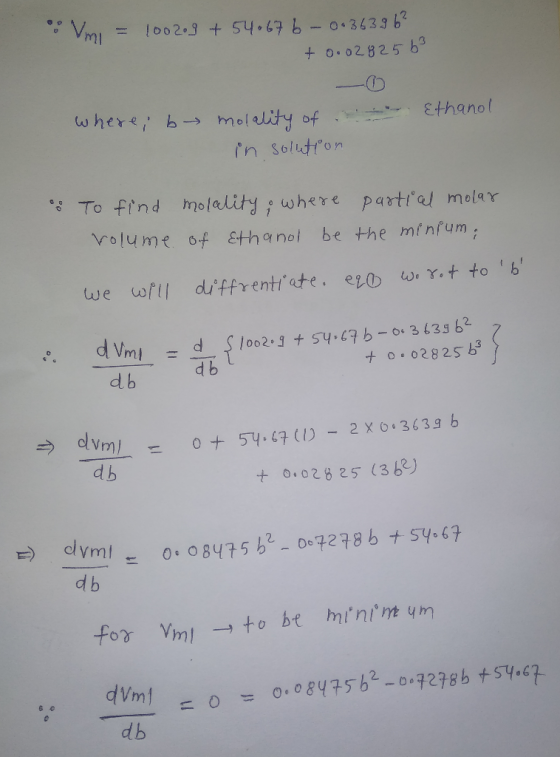
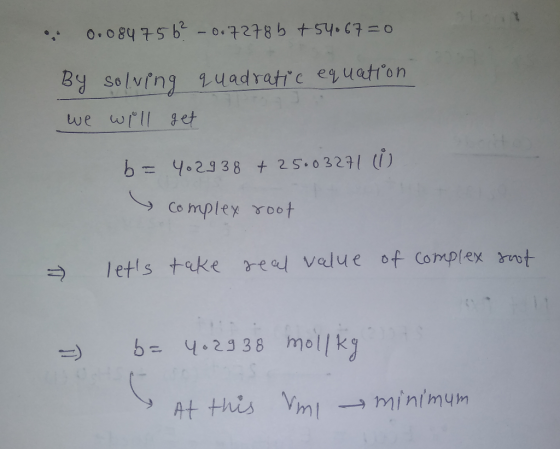
5. The total volume of an ethanol solution at 25 °C containing 1.000...
At 18C the total volume of a solution formed from MgSO4 and 1.00kg of water fits...
 At 18C the total volume of a solution formed from MgSO4 and
1.00kg of water fits the expression:
b is understood to be the molaitu of B/b. Calculate the
partial molar volumes of the salt and the solvent when in a
solution of 0.50 Mol/kg
1. at 18° C the total volume of a solution formed from MgSO4 and 1.00 kg of water fits the expression: V(cm2) 1001.21 +34.96 (b-0.070) where b is understood to be molality in terms of...
At 18C the total volume of a solution formed from MgSO4 and
1.00kg of water fits the expression:
b is understood to be the molaitu of B/b. Calculate the
partial molar volumes of the salt and the solvent when in a
solution of 0.50 Mol/kg
1. at 18° C the total volume of a solution formed from MgSO4 and 1.00 kg of water fits the expression: V(cm2) 1001.21 +34.96 (b-0.070) where b is understood to be molality in terms of...
A) Calculate the osmotic pressure of a solution containing 16.75 mg of hemoglobin in 15.7 mL...
A) Calculate the osmotic pressure of a solution containing 16.75 mg of hemoglobin in 15.7 mL of solution at 22 ∘C . The molar mass of hemoglobin is 6.5×10⁴ g/mol. B) A 2.400×10⁻²M solution of NaCl in water is at 20.0∘C. The sample was created by dissolving a sample of NaCl in water and then bringing the volume up to 1.000 L. It was determined that the volume of water needed to do this was 999.4 mL . The density...
Please answer all of these questions [TURN OVERI 5 PCH241P OCT/NOV 2018 Question 4 (a) Differentiate...
 Please answer all of these questions
[TURN OVERI 5 PCH241P OCT/NOV 2018 Question 4 (a) Differentiate between a weak electrolyte and a strong electrolyte by providing an example of each (4) (b) The pOH of a sample of baking soda in water is 5 74 at 25°C Is this solution acidic or basic? What is the pH for this solution? (2) (c) Anline, CsH3NH2, is a much weaker base and has a dissociation constant Ko = 4 3 x 10-...
Please answer all of these questions
[TURN OVERI 5 PCH241P OCT/NOV 2018 Question 4 (a) Differentiate between a weak electrolyte and a strong electrolyte by providing an example of each (4) (b) The pOH of a sample of baking soda in water is 5 74 at 25°C Is this solution acidic or basic? What is the pH for this solution? (2) (c) Anline, CsH3NH2, is a much weaker base and has a dissociation constant Ko = 4 3 x 10-...
Find the Laplace Transformation (10 points) u(t) (10 points) eu(t) (10 points) 30 cos wt u(t)...
 Find the Laplace Transformation (10 points) u(t) (10 points) eu(t) (10 points) 30 cos wt u(t) Use this ental infor- vorewo Pekes 1e of 500 K. Obtain a numerical value, includ- ing units, for each of the following partial derivatives for this gas. he values which the concentration of the andioen- antibody complex will be equal to the concen- tration of the unbound antibody. perimen- plies that consider- aG (b) (a) aT 19. The isomerization of glucose-6-phosphate G6P) to fructose-6-phosphate...
 At 18C the total volume of a solution formed from MgSO4 and
1.00kg of water fits the expression:
b is understood to be the molaitu of B/b. Calculate the
partial molar volumes of the salt and the solvent when in a
solution of 0.50 Mol/kg
1. at 18° C the total volume of a solution formed from MgSO4 and 1.00 kg of water fits the expression: V(cm2) 1001.21 +34.96 (b-0.070) where b is understood to be molality in terms of...
At 18C the total volume of a solution formed from MgSO4 and
1.00kg of water fits the expression:
b is understood to be the molaitu of B/b. Calculate the
partial molar volumes of the salt and the solvent when in a
solution of 0.50 Mol/kg
1. at 18° C the total volume of a solution formed from MgSO4 and 1.00 kg of water fits the expression: V(cm2) 1001.21 +34.96 (b-0.070) where b is understood to be molality in terms of...
 Please answer all of these questions
[TURN OVERI 5 PCH241P OCT/NOV 2018 Question 4 (a) Differentiate between a weak electrolyte and a strong electrolyte by providing an example of each (4) (b) The pOH of a sample of baking soda in water is 5 74 at 25°C Is this solution acidic or basic? What is the pH for this solution? (2) (c) Anline, CsH3NH2, is a much weaker base and has a dissociation constant Ko = 4 3 x 10-...
Please answer all of these questions
[TURN OVERI 5 PCH241P OCT/NOV 2018 Question 4 (a) Differentiate between a weak electrolyte and a strong electrolyte by providing an example of each (4) (b) The pOH of a sample of baking soda in water is 5 74 at 25°C Is this solution acidic or basic? What is the pH for this solution? (2) (c) Anline, CsH3NH2, is a much weaker base and has a dissociation constant Ko = 4 3 x 10-...
 Find the Laplace Transformation (10 points) u(t) (10 points) eu(t) (10 points) 30 cos wt u(t) Use this ental infor- vorewo Pekes 1e of 500 K. Obtain a numerical value, includ- ing units, for each of the following partial derivatives for this gas. he values which the concentration of the andioen- antibody complex will be equal to the concen- tration of the unbound antibody. perimen- plies that consider- aG (b) (a) aT 19. The isomerization of glucose-6-phosphate G6P) to fructose-6-phosphate...
Most questions answered within 3 hours.
-
Where is the error in this code sequence?
String s1 = "Hello";
String s2 = "ello";...
asked 10 months ago -
Financial data for Joel de Paris, Inc., for last year
follow:
Joel de Paris, Inc.
Balance...
asked 10 months ago -
Consider this reaction:
Al2(SO4)3 (aq)+ BaCl3
(aq) Al2Cl6 (aq)- +
3BaSO4(s) . What is the...
asked 10 months ago -
Suppose that Savneet is considering increasing her
recent random sample from 20 car rentals to 40...
asked 10 months ago -
Trucks arrive at an unloading terminal at an average rate of 120
per hour.
Trucks arrive...
asked 10 months ago -
Why are methanol and ethanol completely soluble in water while
octanol is not very little soluble....
asked 10 months ago -
A facilities manager at a university reads in a research report
that the mean amount of...
asked 10 months ago -
When the CuSO4 is rehydrated by adding water to the anhydrous
compound, is this an endothermic...
asked 10 months ago -
A ray of sunlight is passing from diamond into crown glass; the
angle of incidence is...
asked 10 months ago -
A block of mass 0.249 kg is placed on top of a light, vertical
spring of...
asked 10 months ago -
how do the kidneys compensate in the presences of acidosis
a) trigger hyperventilate
b) reserve acid...
asked 10 months ago -
Question 501 pts
The rental rate of capital to the firm increases. Which of the
following...
asked 10 months ago