In a cycling road race consisting of a flat section and an uphill section, a particular...
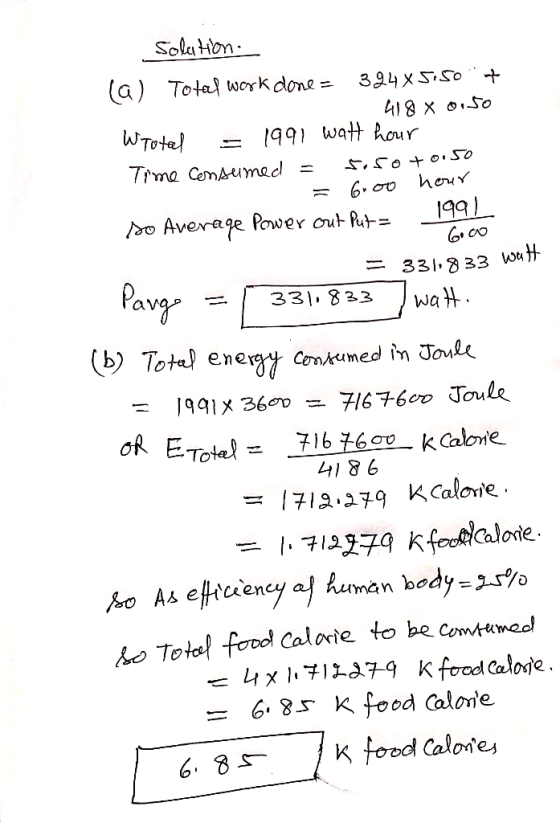
In a cycling road race consisting of a flat section and an uphill section, a particular cyclist pedals with an average power of 324 Watts for 5.50 hours on the flat section of the course, and an average power of 418 Watts for 30.0 minutes while climbing the uphill section, which has an average grade of 6%. Potentially useful information: Power = Energy/time; 1 Watt = 1 Joule/sec; 1 kcal = 4186 J (Note, 1 kcal = 1 food Calorie)
(a) Calculate the average mechanical power output of the cyclist over the whole race.
(b) Given that the human body has an efficiency of 25.0% at converting food energy into mechanical output, how many kcal of food energy must the cyclist consume to replace the mechanical energy expended during the race?
Homework Answers
Add Answer to:
In a cycling road race consisting of a flat section and an
uphill section, a particular...
1) In a cycling road race consisting of a flat section and an uphill section, a...
1) In a cycling road race consisting of a flat section and an uphill section, a particular cyclist pedals with an average power of 324 Watts for 5.50 hours on the flat section of the course, and an average power of 418 Watts for 30.0 minutes while climbing the uphill section, which has an average grade of 6%. Potentially useful information: Power = Energy/time; 1 Watt = 1 Joule/sec; 1 kcal = 4186 J (Note, 1 kcal = 1 food...
Useful conversions: 1 BTU ~103 J; 1 kcal ~ 4 x 10³ J; 1 food calorie...
Useful conversions: 1 BTU ~103 J; 1 kcal ~ 4 x 10³ J; 1 food calorie = 1 kcal The average US citizen uses 1 million BTUs per day as a member of our industrialized society. Assume this energy is provided entirely by a group of laborers, each capable of generating a steady 200 W of power (generous assumption) for an 8 hour shift. How many laborers does an average citizen require? Assume your laborers are 100% efficient at converting...
10) Bob is pushing horizontally on a 19 kg crate on a flat surface with kinetic...
10) Bob is pushing horizontally on a 19 kg crate on a flat surface with kinetic friction coefficient µk = 0.65, maintaining a constant speed of 1.2 m/s. a) Do a free-body diagram for the crate, and use Newton’s First Law to find the force Bob is doing on the crate. b) Find Bob’s power output. c) Find the total work he did over a distance of 130 m. d) One gummy bear provides approximately 7.5 Calories of energy (1...
Could I get some help on this question please? Also show your work if possible and...
 Could I get some help on this question please?
Also show your work if possible and have a wonderful day!
< Review of Energy and Work (Chapters 9 and 10) Problem 9.62 34 ot 38> Part A When you ride a bicycle at constant speed, nearly all the energy you expend goes into the work you do against the drag force of the air. Model a cyclist as having cross-section area 0.42 m2 and, because the human body is not...
Could I get some help on this question please?
Also show your work if possible and have a wonderful day!
< Review of Energy and Work (Chapters 9 and 10) Problem 9.62 34 ot 38> Part A When you ride a bicycle at constant speed, nearly all the energy you expend goes into the work you do against the drag force of the air. Model a cyclist as having cross-section area 0.42 m2 and, because the human body is not...
Problem 2: Pedal Power Many villages in the developing world lack access to electricity. One proposed...
 Problem 2: Pedal Power
Many villages in the developing world lack access to electricity.
One proposed solution is the ‘Free Electric’ bicycle, which is a
stationary bike hooked up to a generator and battery. Pedaling the
bike powers the generator, which creates electricity that is stored
in the battery. The inventor claims that 1 hour on the bike can
produce a whole day of electricity. Let’s put it to the test!
Assume the following: The human body is 25%...
Problem 2: Pedal Power
Many villages in the developing world lack access to electricity.
One proposed solution is the ‘Free Electric’ bicycle, which is a
stationary bike hooked up to a generator and battery. Pedaling the
bike powers the generator, which creates electricity that is stored
in the battery. The inventor claims that 1 hour on the bike can
produce a whole day of electricity. Let’s put it to the test!
Assume the following: The human body is 25%...
Need help on part D & E Problem 2: Pedal Power Many villages in the developing...
 Need help on part D & E
Problem 2: Pedal Power
Many villages in the developing world lack access to electricity.
One proposed solution is the ‘Free Electric’ bicycle, which is a
stationary bike hooked up to a generator and battery. Pedaling the
bike powers the generator, which creates electricity that is stored
in the battery. The inventor claims that 1 hour on the bike can
produce a whole day of electricity. Let’s put it to the test!
Assume the...
Need help on part D & E
Problem 2: Pedal Power
Many villages in the developing world lack access to electricity.
One proposed solution is the ‘Free Electric’ bicycle, which is a
stationary bike hooked up to a generator and battery. Pedaling the
bike powers the generator, which creates electricity that is stored
in the battery. The inventor claims that 1 hour on the bike can
produce a whole day of electricity. Let’s put it to the test!
Assume the...
 Could I get some help on this question please?
Also show your work if possible and have a wonderful day!
< Review of Energy and Work (Chapters 9 and 10) Problem 9.62 34 ot 38> Part A When you ride a bicycle at constant speed, nearly all the energy you expend goes into the work you do against the drag force of the air. Model a cyclist as having cross-section area 0.42 m2 and, because the human body is not...
Could I get some help on this question please?
Also show your work if possible and have a wonderful day!
< Review of Energy and Work (Chapters 9 and 10) Problem 9.62 34 ot 38> Part A When you ride a bicycle at constant speed, nearly all the energy you expend goes into the work you do against the drag force of the air. Model a cyclist as having cross-section area 0.42 m2 and, because the human body is not...
 Problem 2: Pedal Power
Many villages in the developing world lack access to electricity.
One proposed solution is the ‘Free Electric’ bicycle, which is a
stationary bike hooked up to a generator and battery. Pedaling the
bike powers the generator, which creates electricity that is stored
in the battery. The inventor claims that 1 hour on the bike can
produce a whole day of electricity. Let’s put it to the test!
Assume the following: The human body is 25%...
Problem 2: Pedal Power
Many villages in the developing world lack access to electricity.
One proposed solution is the ‘Free Electric’ bicycle, which is a
stationary bike hooked up to a generator and battery. Pedaling the
bike powers the generator, which creates electricity that is stored
in the battery. The inventor claims that 1 hour on the bike can
produce a whole day of electricity. Let’s put it to the test!
Assume the following: The human body is 25%...
 Need help on part D & E
Problem 2: Pedal Power
Many villages in the developing world lack access to electricity.
One proposed solution is the ‘Free Electric’ bicycle, which is a
stationary bike hooked up to a generator and battery. Pedaling the
bike powers the generator, which creates electricity that is stored
in the battery. The inventor claims that 1 hour on the bike can
produce a whole day of electricity. Let’s put it to the test!
Assume the...
Need help on part D & E
Problem 2: Pedal Power
Many villages in the developing world lack access to electricity.
One proposed solution is the ‘Free Electric’ bicycle, which is a
stationary bike hooked up to a generator and battery. Pedaling the
bike powers the generator, which creates electricity that is stored
in the battery. The inventor claims that 1 hour on the bike can
produce a whole day of electricity. Let’s put it to the test!
Assume the...
Most questions answered within 3 hours.
-
Where is the error in this code sequence?
String s1 = "Hello";
String s2 = "ello";...
asked 11 months ago -
Financial data for Joel de Paris, Inc., for last year
follow:
Joel de Paris, Inc.
Balance...
asked 11 months ago -
Consider this reaction:
Al2(SO4)3 (aq)+ BaCl3
(aq) Al2Cl6 (aq)- +
3BaSO4(s) . What is the...
asked 11 months ago -
Suppose that Savneet is considering increasing her
recent random sample from 20 car rentals to 40...
asked 11 months ago -
Trucks arrive at an unloading terminal at an average rate of 120
per hour.
Trucks arrive...
asked 11 months ago -
Why are methanol and ethanol completely soluble in water while
octanol is not very little soluble....
asked 11 months ago -
A facilities manager at a university reads in a research report
that the mean amount of...
asked 11 months ago -
When the CuSO4 is rehydrated by adding water to the anhydrous
compound, is this an endothermic...
asked 11 months ago -
A ray of sunlight is passing from diamond into crown glass; the
angle of incidence is...
asked 11 months ago -
A block of mass 0.249 kg is placed on top of a light, vertical
spring of...
asked 11 months ago -
how do the kidneys compensate in the presences of acidosis
a) trigger hyperventilate
b) reserve acid...
asked 11 months ago -
Question 501 pts
The rental rate of capital to the firm increases. Which of the
following...
asked 11 months ago