
Homework Answers
Add Answer to:
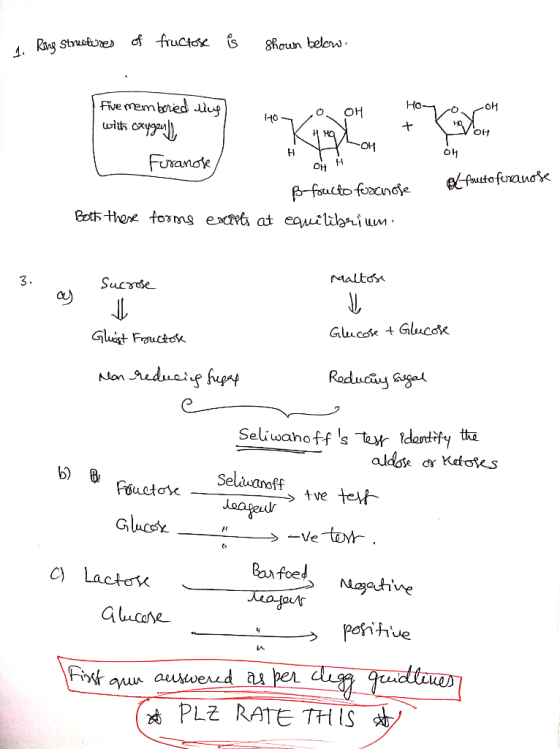
PRE-LABORATORY ASSIGNMENT Carbohydrates 1. Draw the structures of fructose (ring structures) present in a solution at...
oup e i ent i S caPapie to act as n veducin s enown 6. Draw the ring structures for (-D-fructose and for e-bsfructoseS 7. An unknown carbohydrate gave a red precipitate when tested with Fehling&#...
 oup e i ent i S caPapie to act as n veducin s enown 6. Draw the ring structures for (-D-fructose and for e-bsfructoseS 7. An unknown carbohydrate gave a red precipitate when tested with Fehling's reagent, turned red when reacted with Seliwanoff's reagent, and quickly gave a red precipitate when reacted with Barfoed's reagent. What conclusions can be made about this carbohydrate? 9. What test could be used to differentiate between sucrose and lactose? Explain.
oup e i ent...
oup e i ent i S caPapie to act as n veducin s enown 6. Draw the ring structures for (-D-fructose and for e-bsfructoseS 7. An unknown carbohydrate gave a red precipitate when tested with Fehling's reagent, turned red when reacted with Seliwanoff's reagent, and quickly gave a red precipitate when reacted with Barfoed's reagent. What conclusions can be made about this carbohydrate? 9. What test could be used to differentiate between sucrose and lactose? Explain.
oup e i ent...
oup e i ent i S caPapie to act as n veducin s enown 6. Draw...
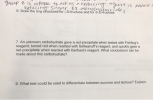 oup e i ent i S caPapie to act as n veducin s enown 6. Draw the ring structures for (-D-fructose and for e-bsfructoseS 7. An unknown carbohydrate gave a red precipitate when tested with Fehling's reagent, turned red when reacted with Seliwanoff's reagent, and quickly gave a red precipitate when reacted with Barfoed's reagent. What conclusions can be made about this carbohydrate? 9. What test could be used to differentiate between sucrose and lactose? Explain.
CHM 380 Laboratory Manual Name: Lab #4: Pre-Lab Assignment Complete in advance and turn in at...
 CHM 380 Laboratory Manual Name: Lab #4: Pre-Lab Assignment Complete in advance and turn in at the beginning of class. 1. For each of the following sugars, answer the questions by filling in the table. (You may use the textbook or any other source for help on this.) Carbohydrate Is it a Reducing Sugar (has a free anomeric carbon)? Monosaccharide or Disaccharide? Aldose or ketose sugar (or both)? Glucose Fructose Sucrose Lactose 2. Based on those results, and the information...
1. Show the chemical reaction that takes place when Benedict's reagent (Cu") reacts with glucose (use...
 1. Show the chemical reaction that takes place when Benedict's reagent (Cu") reacts with glucose (use open chain Fisher projection). 2. Do you expect fructose to give a positive reaction with Barfoed's reagent? Explain why or why not. Indicate which of the test carbohydrates (glucose, fructose, lactose, sucrose, starch) would give 5- hydroxymethylfurfural when heated with hydrochloric acid. (See description of reactions for Barfoed's reagent and Seliwanoffs reagent). 3. 121
Please, fill in first table for Seliwanoff's Test for Ketoses. Additional info is found in the...
 Please, fill in first table for Seliwanoff's Test for Ketoses.
Additional info is found in the images following table. (Second
table is info and image following).
Part C: Seliwanoff's Test for Ketoses Seliwanoff's Test Results Test Tube Sample Prediction Ketose? (Y/N) Observations Distilled water Peach / no change Glucose Peach to red slowly Fructose deep red solution very quickly Sucrose deep red solution quickly Lactose Peach to red slowly Starch Peach to red very slowly Mystery sample Peach to red...
Please, fill in first table for Seliwanoff's Test for Ketoses.
Additional info is found in the images following table. (Second
table is info and image following).
Part C: Seliwanoff's Test for Ketoses Seliwanoff's Test Results Test Tube Sample Prediction Ketose? (Y/N) Observations Distilled water Peach / no change Glucose Peach to red slowly Fructose deep red solution very quickly Sucrose deep red solution quickly Lactose Peach to red slowly Starch Peach to red very slowly Mystery sample Peach to red...
Question : Making use of the tests for carbohydrates outlined in experiment number (5 and 6),...
 Question : Making use of the tests for carbohydrates outlined in experiment number (5 and 6), design your own scheme for the identification of different classes of carbohydrates (eg: Mono, di, polysaccharides). Starch, Sucrose, Galactose, Glucose, Fructose, Pentose, Lactose, Maltose Test Reagents Positive results Indication Distilled water Formation of precipitate or cloudiness. Differentiate between mono/disaccharides & polysaccharides Solubility Appearance of reddish-brown colour Differentiate between starch and glycogen (branching effect) Differentiate between reducing& non-reducing sugars. Differentiate between reducing& non-reducing sugars. General...
1. Which of the following carbohydrates contain ketohexoses? a. starch b. sucrose c. cellulose d. fructose...
1. Which of the following carbohydrates contain ketohexoses? a. starch b. sucrose c. cellulose d. fructose d. lactose 2. Which of the following functional groups in a carbohydrate are able to be oxidized to carboxylic acids? a. ketones that are rearranged in solution b. ketones that are not rearranged in solution c. aldehydes d. alcohols 3. Which of the following carbohydrates were reducing sugars? a. lactose b. sucrose c. fructose d. starch e. cellulose 4. Why does lactose give a...
help! Question 1 (1.25 points) Which of the following carbohydrates contain ketohexoses? (Select all that apply.)...
 help!
Question 1 (1.25 points) Which of the following carbohydrates contain ketohexoses? (Select all that apply.) Sucrose Fructose Lactose Starch Cellulose Question 2 (1.25 points) Which of the following functional groups in a carbohydrate are able to be oxidized to carboxylic acids? (Select all that apply.) Alcohols Ketones that are rearranged in solution. Aldehydes Ketones that are not rearranged in solution. Question 3 (1.25 points) Which of the following carbohydrates were reducing sugars? (Select all that apply.) Sucrose Cellulose Starch...
help!
Question 1 (1.25 points) Which of the following carbohydrates contain ketohexoses? (Select all that apply.) Sucrose Fructose Lactose Starch Cellulose Question 2 (1.25 points) Which of the following functional groups in a carbohydrate are able to be oxidized to carboxylic acids? (Select all that apply.) Alcohols Ketones that are rearranged in solution. Aldehydes Ketones that are not rearranged in solution. Question 3 (1.25 points) Which of the following carbohydrates were reducing sugars? (Select all that apply.) Sucrose Cellulose Starch...
TIL. PRE-LAB QUESTIONS - Experiment 8 1. a) Complete the table below. X1/ Xy/ 2 14...
 TIL. PRE-LAB QUESTIONS - Experiment 8 1. a) Complete the table below. X1/ Xy/ 2 14 8 25 16 b) On graph paper plot y vs. x (appropriately labeling all axes as well as graphing the best fitting line/curve to the data points). c) Is the relationship between the y and x data pairs linear or non-linear? d) Is the relationship between the y and x data pairs direct or inverse? e) Which expression of k (k=y/x or k=xy) corresponds...
1-10 help!!! 1) A carbohydrate that gives two molecules when it is completely hydrolyzed is known...
 1-10 help!!!
1) A carbohydrate that gives two molecules when it is completely hydrolyzed is known as a A) monosaccharide. B) disaccharide. C) polysaccharide. D) starch. 2) A reducing sugar gives a precipitate of silver metal with Benedict's reagent. a. True b. False 3) Cellulose will give a positive Benedict's test. Sa TrueS b. False 4) The product of oxidation of an aldose is a carboxylic acid. Sa True b. False 5) Maltose is a reducing sugar. a. True b....
1-10 help!!!
1) A carbohydrate that gives two molecules when it is completely hydrolyzed is known as a A) monosaccharide. B) disaccharide. C) polysaccharide. D) starch. 2) A reducing sugar gives a precipitate of silver metal with Benedict's reagent. a. True b. False 3) Cellulose will give a positive Benedict's test. Sa TrueS b. False 4) The product of oxidation of an aldose is a carboxylic acid. Sa True b. False 5) Maltose is a reducing sugar. a. True b....
 oup e i ent i S caPapie to act as n veducin s enown 6. Draw the ring structures for (-D-fructose and for e-bsfructoseS 7. An unknown carbohydrate gave a red precipitate when tested with Fehling's reagent, turned red when reacted with Seliwanoff's reagent, and quickly gave a red precipitate when reacted with Barfoed's reagent. What conclusions can be made about this carbohydrate? 9. What test could be used to differentiate between sucrose and lactose? Explain.
oup e i ent...
oup e i ent i S caPapie to act as n veducin s enown 6. Draw the ring structures for (-D-fructose and for e-bsfructoseS 7. An unknown carbohydrate gave a red precipitate when tested with Fehling's reagent, turned red when reacted with Seliwanoff's reagent, and quickly gave a red precipitate when reacted with Barfoed's reagent. What conclusions can be made about this carbohydrate? 9. What test could be used to differentiate between sucrose and lactose? Explain.
oup e i ent...
 oup e i ent i S caPapie to act as n veducin s enown 6. Draw the ring structures for (-D-fructose and for e-bsfructoseS 7. An unknown carbohydrate gave a red precipitate when tested with Fehling's reagent, turned red when reacted with Seliwanoff's reagent, and quickly gave a red precipitate when reacted with Barfoed's reagent. What conclusions can be made about this carbohydrate? 9. What test could be used to differentiate between sucrose and lactose? Explain.
 CHM 380 Laboratory Manual Name: Lab #4: Pre-Lab Assignment Complete in advance and turn in at the beginning of class. 1. For each of the following sugars, answer the questions by filling in the table. (You may use the textbook or any other source for help on this.) Carbohydrate Is it a Reducing Sugar (has a free anomeric carbon)? Monosaccharide or Disaccharide? Aldose or ketose sugar (or both)? Glucose Fructose Sucrose Lactose 2. Based on those results, and the information...
 1. Show the chemical reaction that takes place when Benedict's reagent (Cu") reacts with glucose (use open chain Fisher projection). 2. Do you expect fructose to give a positive reaction with Barfoed's reagent? Explain why or why not. Indicate which of the test carbohydrates (glucose, fructose, lactose, sucrose, starch) would give 5- hydroxymethylfurfural when heated with hydrochloric acid. (See description of reactions for Barfoed's reagent and Seliwanoffs reagent). 3. 121
 Please, fill in first table for Seliwanoff's Test for Ketoses.
Additional info is found in the images following table. (Second
table is info and image following).
Part C: Seliwanoff's Test for Ketoses Seliwanoff's Test Results Test Tube Sample Prediction Ketose? (Y/N) Observations Distilled water Peach / no change Glucose Peach to red slowly Fructose deep red solution very quickly Sucrose deep red solution quickly Lactose Peach to red slowly Starch Peach to red very slowly Mystery sample Peach to red...
Please, fill in first table for Seliwanoff's Test for Ketoses.
Additional info is found in the images following table. (Second
table is info and image following).
Part C: Seliwanoff's Test for Ketoses Seliwanoff's Test Results Test Tube Sample Prediction Ketose? (Y/N) Observations Distilled water Peach / no change Glucose Peach to red slowly Fructose deep red solution very quickly Sucrose deep red solution quickly Lactose Peach to red slowly Starch Peach to red very slowly Mystery sample Peach to red...
 Question : Making use of the tests for carbohydrates outlined in experiment number (5 and 6), design your own scheme for the identification of different classes of carbohydrates (eg: Mono, di, polysaccharides). Starch, Sucrose, Galactose, Glucose, Fructose, Pentose, Lactose, Maltose Test Reagents Positive results Indication Distilled water Formation of precipitate or cloudiness. Differentiate between mono/disaccharides & polysaccharides Solubility Appearance of reddish-brown colour Differentiate between starch and glycogen (branching effect) Differentiate between reducing& non-reducing sugars. Differentiate between reducing& non-reducing sugars. General...
 help!
Question 1 (1.25 points) Which of the following carbohydrates contain ketohexoses? (Select all that apply.) Sucrose Fructose Lactose Starch Cellulose Question 2 (1.25 points) Which of the following functional groups in a carbohydrate are able to be oxidized to carboxylic acids? (Select all that apply.) Alcohols Ketones that are rearranged in solution. Aldehydes Ketones that are not rearranged in solution. Question 3 (1.25 points) Which of the following carbohydrates were reducing sugars? (Select all that apply.) Sucrose Cellulose Starch...
help!
Question 1 (1.25 points) Which of the following carbohydrates contain ketohexoses? (Select all that apply.) Sucrose Fructose Lactose Starch Cellulose Question 2 (1.25 points) Which of the following functional groups in a carbohydrate are able to be oxidized to carboxylic acids? (Select all that apply.) Alcohols Ketones that are rearranged in solution. Aldehydes Ketones that are not rearranged in solution. Question 3 (1.25 points) Which of the following carbohydrates were reducing sugars? (Select all that apply.) Sucrose Cellulose Starch...
 TIL. PRE-LAB QUESTIONS - Experiment 8 1. a) Complete the table below. X1/ Xy/ 2 14 8 25 16 b) On graph paper plot y vs. x (appropriately labeling all axes as well as graphing the best fitting line/curve to the data points). c) Is the relationship between the y and x data pairs linear or non-linear? d) Is the relationship between the y and x data pairs direct or inverse? e) Which expression of k (k=y/x or k=xy) corresponds...
 1-10 help!!!
1) A carbohydrate that gives two molecules when it is completely hydrolyzed is known as a A) monosaccharide. B) disaccharide. C) polysaccharide. D) starch. 2) A reducing sugar gives a precipitate of silver metal with Benedict's reagent. a. True b. False 3) Cellulose will give a positive Benedict's test. Sa TrueS b. False 4) The product of oxidation of an aldose is a carboxylic acid. Sa True b. False 5) Maltose is a reducing sugar. a. True b....
1-10 help!!!
1) A carbohydrate that gives two molecules when it is completely hydrolyzed is known as a A) monosaccharide. B) disaccharide. C) polysaccharide. D) starch. 2) A reducing sugar gives a precipitate of silver metal with Benedict's reagent. a. True b. False 3) Cellulose will give a positive Benedict's test. Sa TrueS b. False 4) The product of oxidation of an aldose is a carboxylic acid. Sa True b. False 5) Maltose is a reducing sugar. a. True b....
Most questions answered within 3 hours.
-
Where is the error in this code sequence?
String s1 = "Hello";
String s2 = "ello";...
asked 10 months ago -
Financial data for Joel de Paris, Inc., for last year
follow:
Joel de Paris, Inc.
Balance...
asked 10 months ago -
Consider this reaction:
Al2(SO4)3 (aq)+ BaCl3
(aq) Al2Cl6 (aq)- +
3BaSO4(s) . What is the...
asked 10 months ago -
Suppose that Savneet is considering increasing her
recent random sample from 20 car rentals to 40...
asked 10 months ago -
Trucks arrive at an unloading terminal at an average rate of 120
per hour.
Trucks arrive...
asked 10 months ago -
Why are methanol and ethanol completely soluble in water while
octanol is not very little soluble....
asked 10 months ago -
A facilities manager at a university reads in a research report
that the mean amount of...
asked 10 months ago -
When the CuSO4 is rehydrated by adding water to the anhydrous
compound, is this an endothermic...
asked 10 months ago -
A ray of sunlight is passing from diamond into crown glass; the
angle of incidence is...
asked 10 months ago -
A block of mass 0.249 kg is placed on top of a light, vertical
spring of...
asked 10 months ago -
how do the kidneys compensate in the presences of acidosis
a) trigger hyperventilate
b) reserve acid...
asked 10 months ago -
Question 501 pts
The rental rate of capital to the firm increases. Which of the
following...
asked 10 months ago