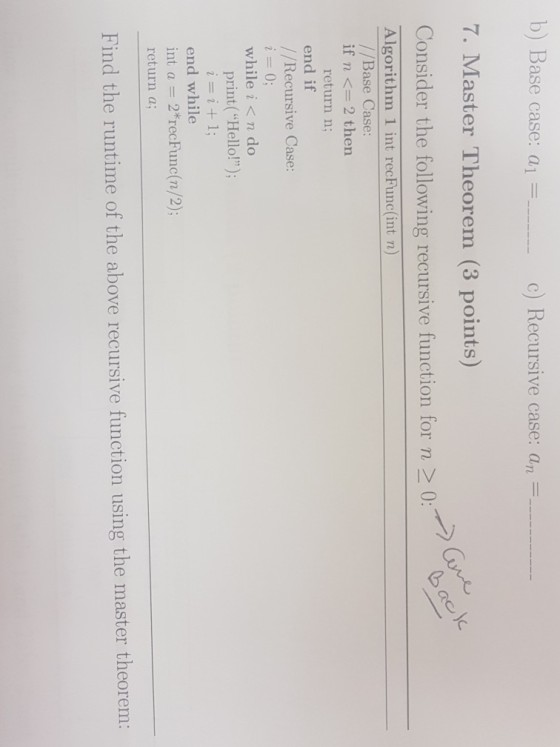
please also explain how the answer came about if possible
Homework Answers
Let T(n) be the time taken for input n
Base Case is T(1) = 1
One while loop which runs for n time and One recursive call of
2*RecursiveCall(n/2)
T(n) = 2*T(n/2) + n
We Can solve the using Master's theorem :-
a = 2 , b = 2, f(n) = n
g(n) = nlogb a = nlog
22 = n
We can see f(n) = g(n) , Hence T(n) = O(nlogb
a log n) =>
T(n) = O(nlog n)
Add Answer to:
please also explain how the answer came about if
possible
b) Base 7. Master Theorem (3...
3. Recursive Program (6 points) Consider the following recursive function for n 1: Algorithm 1 int...
 3. Recursive Program (6 points) Consider the following recursive function for n 1: Algorithm 1 int recurseFunc(int n) If n 0, return 1. If n 1, return 1 while i< n do while j <n do print("hi") j 1 end while i i 1 end while int a recurse Func(n/9); int b recurse Func (n/9) int c recurse Func (n/9) return a b c (1) Set up a runtime recurrence for the runtime T n) of this algorithm. (2) Solve...
6. Consider the following algorithm, where P is an array containing random numbers. The function swap(v1,v2)...
 6. Consider the following algorithm, where P is an array containing random numbers. The function swap(v1,v2) will swap the values stored in the variables v1 and v2. Note that % is the modulus operation, and will return the integer remainder r of a/b, i.e., r-a%b Require: Array P with n > 0 values 1: i-1, j-n-l 2: while i<=j do for a=i to j by i do 4: 5: 6: 7: if Pla>Pat 11 and Pla]%2--0 then swap(Plal, Pla+1l) end...
3) [16 points totall Consider the following algorithm: int SillyCalc (int n) { int i; int Num, answer; if (n <...
 3) [16 points totall Consider the following algorithm: int SillyCalc (int n) { int i; int Num, answer; if (n < 4) 10; return n+ else f SillyCalc(Ln/4) answer Num Num 10 for (i-2; i<=n-1; i++) Num + = answer + answer; answer return answer } Do a worst case analysis of this algorithm, counting additions only (but not loop counter additions) as the basic operation counted, and assuming that n is a power of 2, i.e. that n- 2*...
Explain please II. (7 points) Consider the following bit of pseudocode: for (int k = 1; ks Ign; k++) (for (int i = 1; i r: i++) Print "Hello World"; for (int j-1;jsn:j++) Print "Hello Worl...
 Explain please
II. (7 points) Consider the following bit of pseudocode: for (int k = 1; ks Ign; k++) (for (int i = 1; i r: i++) Print "Hello World"; for (int j-1;jsn:j++) Print "Hello World" when n = 2, how many times will "Hello World" be printed? When n 4, how many times will "Hello World be printed? O Assuming that the print is the basic operation, what is the complexity function of this pseudocode?
II. (7 points) Consider...
Explain please
II. (7 points) Consider the following bit of pseudocode: for (int k = 1; ks Ign; k++) (for (int i = 1; i r: i++) Print "Hello World"; for (int j-1;jsn:j++) Print "Hello World" when n = 2, how many times will "Hello World" be printed? When n 4, how many times will "Hello World be printed? O Assuming that the print is the basic operation, what is the complexity function of this pseudocode?
II. (7 points) Consider...
III. ASSIGNMENT 2.1 As discussed in class, the example program enumerates all possible strings (or if...
III. ASSIGNMENT 2.1 As discussed in class, the example program enumerates all possible strings (or if we interpret as numbers, numbers) of base-b and a given length, say l. The number of strings enumerated is b l . Now if we interpret the outputs as strings, or lists, rather than base-b numbers and decide that we only want to enumerate those strings that have unique members, the number of possible strings reduces from b l to b!. Furthermore, consider a...
1-Is it possible to run a program without a main() function? Yes No 2- How many...
1-Is it possible to run a program without a main() function? Yes No 2- How many main() functions can one have in a program? 2 This depends on what compiler you use. As many as you like 1 3- What does the following code fragment leave in x? char a = 'A'; int x = sizeof (a); 1 Depends on what compiler you use. 4 2 4- True or false: In a C program I can have two functions with...
T2(N) = Θ(N') Which algorithm is the least preferred one? a) Algorithm 1 b) Algorithm 2...
 T2(N) = Θ(N') Which algorithm is the least preferred one? a) Algorithm 1 b) Algorithm 2 ) Algorithm 3 Algorithm 1 and 3 2. Given the following function: (10 points) int F(int N) if (N0lIN1) return 2; else return N *FON-2); Show steps to find out F(5) Also give the runtime
1. Order following function by growth rate: N, √N, N1.5, N log (N), log (log (N)),...
1. Order following function by growth rate: N, √N, N1.5, N log (N), log (log (N)), log (N) log (N), N2, 2N, 200, NN 2. Give a useful Θ (big Theta) estimation for each of following function t(n). a. t(n) = 122 * 212 b. t(n) = 2log2(n2) + log4(n ) + (log2 n) 2 + (log2 (202)) 2 c. t(n) = 3t(n/2) + n d. t(n) = 3t(n/2) + (n+1)(n-1) e. t(n) = 4t(n/2) + (n2 + n-1) f....
Here is a recursive algorithm that answers the same question as posed on Group HW3, finding...
 Here is a recursive algorithm that answers the same question as posed on Group HW3, finding the number of people who are taller than everyone before them in line. NumCanSeeRec(a1,... , an : list of n 2 1 distinct heights) (a) ifn -1 then (b return 1 (c) c= ŅumCanSeeRee(a1, , an-1) d) for i:- 1 ton- 1 (e) if a, an then return c (g) return c+1 Answer the following questions about this algorithm. Please show your work. (a)...
3) [16 points total] Consider the following algorithm int SillyCalc (int n) int i; int Num, answer; if (n <=...
 3) [16 points total] Consider the following algorithm int SillyCalc (int n) int i; int Num, answer; if (n <= 4) return n 10; else { Num-SillyCalcl n/4) answer = Num + Num + 10; for (i-2; i<-n-1; ++) answer- answer+ answer; return answer; Do a worst case analysis of this algorithm, counting additions only (but not loop counter additions) as the basic operation counted, and assuming that n is a power of 2, i.e. that n- 2* for some...
 3. Recursive Program (6 points) Consider the following recursive function for n 1: Algorithm 1 int recurseFunc(int n) If n 0, return 1. If n 1, return 1 while i< n do while j <n do print("hi") j 1 end while i i 1 end while int a recurse Func(n/9); int b recurse Func (n/9) int c recurse Func (n/9) return a b c (1) Set up a runtime recurrence for the runtime T n) of this algorithm. (2) Solve...
 6. Consider the following algorithm, where P is an array containing random numbers. The function swap(v1,v2) will swap the values stored in the variables v1 and v2. Note that % is the modulus operation, and will return the integer remainder r of a/b, i.e., r-a%b Require: Array P with n > 0 values 1: i-1, j-n-l 2: while i<=j do for a=i to j by i do 4: 5: 6: 7: if Pla>Pat 11 and Pla]%2--0 then swap(Plal, Pla+1l) end...
 3) [16 points totall Consider the following algorithm: int SillyCalc (int n) { int i; int Num, answer; if (n < 4) 10; return n+ else f SillyCalc(Ln/4) answer Num Num 10 for (i-2; i<=n-1; i++) Num + = answer + answer; answer return answer } Do a worst case analysis of this algorithm, counting additions only (but not loop counter additions) as the basic operation counted, and assuming that n is a power of 2, i.e. that n- 2*...
 Explain please
II. (7 points) Consider the following bit of pseudocode: for (int k = 1; ks Ign; k++) (for (int i = 1; i r: i++) Print "Hello World"; for (int j-1;jsn:j++) Print "Hello World" when n = 2, how many times will "Hello World" be printed? When n 4, how many times will "Hello World be printed? O Assuming that the print is the basic operation, what is the complexity function of this pseudocode?
II. (7 points) Consider...
Explain please
II. (7 points) Consider the following bit of pseudocode: for (int k = 1; ks Ign; k++) (for (int i = 1; i r: i++) Print "Hello World"; for (int j-1;jsn:j++) Print "Hello World" when n = 2, how many times will "Hello World" be printed? When n 4, how many times will "Hello World be printed? O Assuming that the print is the basic operation, what is the complexity function of this pseudocode?
II. (7 points) Consider...
 T2(N) = Θ(N') Which algorithm is the least preferred one? a) Algorithm 1 b) Algorithm 2 ) Algorithm 3 Algorithm 1 and 3 2. Given the following function: (10 points) int F(int N) if (N0lIN1) return 2; else return N *FON-2); Show steps to find out F(5) Also give the runtime
 Here is a recursive algorithm that answers the same question as posed on Group HW3, finding the number of people who are taller than everyone before them in line. NumCanSeeRec(a1,... , an : list of n 2 1 distinct heights) (a) ifn -1 then (b return 1 (c) c= ŅumCanSeeRee(a1, , an-1) d) for i:- 1 ton- 1 (e) if a, an then return c (g) return c+1 Answer the following questions about this algorithm. Please show your work. (a)...
 3) [16 points total] Consider the following algorithm int SillyCalc (int n) int i; int Num, answer; if (n <= 4) return n 10; else { Num-SillyCalcl n/4) answer = Num + Num + 10; for (i-2; i<-n-1; ++) answer- answer+ answer; return answer; Do a worst case analysis of this algorithm, counting additions only (but not loop counter additions) as the basic operation counted, and assuming that n is a power of 2, i.e. that n- 2* for some...
Most questions answered within 3 hours.
-
Where is the error in this code sequence?
String s1 = "Hello";
String s2 = "ello";...
asked 10 months ago -
Financial data for Joel de Paris, Inc., for last year
follow:
Joel de Paris, Inc.
Balance...
asked 10 months ago -
Consider this reaction:
Al2(SO4)3 (aq)+ BaCl3
(aq) Al2Cl6 (aq)- +
3BaSO4(s) . What is the...
asked 10 months ago -
Suppose that Savneet is considering increasing her
recent random sample from 20 car rentals to 40...
asked 10 months ago -
Trucks arrive at an unloading terminal at an average rate of 120
per hour.
Trucks arrive...
asked 10 months ago -
Why are methanol and ethanol completely soluble in water while
octanol is not very little soluble....
asked 10 months ago -
A facilities manager at a university reads in a research report
that the mean amount of...
asked 10 months ago -
When the CuSO4 is rehydrated by adding water to the anhydrous
compound, is this an endothermic...
asked 10 months ago -
A ray of sunlight is passing from diamond into crown glass; the
angle of incidence is...
asked 10 months ago -
A block of mass 0.249 kg is placed on top of a light, vertical
spring of...
asked 10 months ago -
how do the kidneys compensate in the presences of acidosis
a) trigger hyperventilate
b) reserve acid...
asked 10 months ago -
Question 501 pts
The rental rate of capital to the firm increases. Which of the
following...
asked 10 months ago