Which of the following expressions correctly computes the midpoint of an ArrayQueue? int mid = (first...
Which of the following expressions correctly computes the midpoint of an ArrayQueue?
int mid = (first % data.length + size % data.length) / 2;
int mid = (first + size) % data.length / 2;
int mid = (first + size) / 2 % data.length;
int mid = (first + size / 2) % data.length;
which one is the correct option ?
Homework Answers
The expressions which correctly computes the midpoint of an ArrayQueue is
int mid = (first + size) / 2 % data.length
Explanation: Here, first refers to the location of first element, size refers to size of the ArrayQueue. The expression: data.length refers to the length of the array up to which data is present.
Add Answer to:
Which of the following expressions correctly computes the
midpoint of an ArrayQueue?
int mid = (first...
Int partition(int arr[], int first, int last) {int mid = first; int pivot = arr[first]; for...
 Int partition(int arr[], int first, int last) {int mid = first; int pivot = arr[first]; for (int sweep = first+1; sweep <= last; sweep++) {//Assertion:. .. if (arr[sweep] < pivot) {int tmp = arr[sweep]; arr[sweep] = arr[mid+l]; arr[mid+l] = tmp; mid++;}}//Post:. .. arr[first] = arr[mid]; arr[mid] = pivot; return mid;} The focus for this problem will be the main loop of partition. You will make arguments about what it attempts to accomplish. a) The diagram depicts what we hope is...
void merge(Card[] cardArray, int first, int mid, int last) This is a helper method for the...
void merge(Card[] cardArray, int first, int mid, int last) This is a helper method for the merge sort. It takes as parameters a card array, the first index, the middle index, and the end index. The method merges two adjacent sorted arrays into a single sorted one. The first array begins with the element at first and ends with the element at mid. The second array begins with the element at mid + 1 and ends with the element at...
Given the binary search function, answer following question: int binarySearch(int a[], int size, int target, int...
 Given the binary search function, answer following question: int binarySearch(int a[], int size, int target, int low, int high) { while (low <= high) { int mid = (low + high) / 2; if (a[mid] == target) return mid; else if (a[mid] < target) low = mid + 1; else high = mid 1: } return -1; } 1) If array a[] = {4, 5, 18, 25, 66, 70, 78}, size = 7, target = 71, low = 0, high...
Given the function definition, which of the following are correct? int func(int n, double d) {...
Given the function definition, which of the following are correct? int func(int n, double d) { int j = n; double sum = 0; while( j >= 0) { sum += d; -j; } return sum; } It compiles but computes none of these returns 7+2 returns 7! returns 7*2
please write this in "MARIE assembly language" #include <iostream> using namespace std; int DivideByTwo(int, int); //...
please write this in "MARIE assembly language" #include <iostream> using namespace std; int DivideByTwo(int, int); // Data section int Data[] = { 0x0102, 0x0105, 0x0106, 0x0108, 0x011A, 0x0120, 0x0225, 0x0230, 0x0231, 0x0238, 0x0339, 0x0350, 0x0459, 0x055F, 0x066A, 0x0790, 0x08AB, 0x09AF, 0x0AB9, 0x0BBD, 0x0CC1, 0x0DCA, 0x0EFE, 0x0FFE }; int main() { int* BAddr = &Data[0]; int* EAddr = &Data[23]; int Count = 24; // the number of Data int Ffff = 0xffff; // value for "not found" int num; // input...
Which one of the following expressions correctly gives the relationship between the speed of sound v...
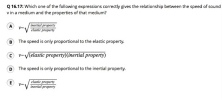 Which one of the following expressions correctly gives the relationship between the speed of sound v in a medium and the properties of that medium? A v ~ Squareroot inertial property/elastic property B The speed is only proportional to the elastic property C v ~ Squareroot (elastic property) (inertial property) D The speed is only proportional to the inertial property. E v ~ Squareroot elastic property/inertial property
C++ programming terms please The following program computes value of 6th Fibonacci number: int f(int n)...
 C++ programming terms please
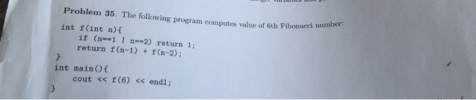
The following program computes value of 6th Fibonacci number: int f(int n) { if (n= =1 | n= = 2) return 1; return f(n-1) + f(n-2); } int main () { cout < < f(6) << endl; }
C++ programming terms please
The following program computes value of 6th Fibonacci number: int f(int n) { if (n= =1 | n= = 2) return 1; return f(n-1) + f(n-2); } int main () { cout < < f(6) << endl; }
Q2. Which of the following expressions correctly describes the impedance of the circuit shown below? I...
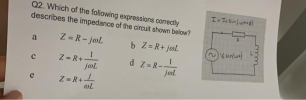 Q2. Which of the following expressions correctly describes the impedance of the circuit shown below? I - Ie Sinw+6) a Z=R-jol b Z = R+ jol ( sun/wt) Z=R+ 1 jol Z=R+ i d Z=R- jol OZ
Suppose you are given the following two lines of code: int a = 3; int b...
 Suppose you are given the following two lines of code:
int a = 3;
int b = a;
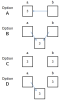
Given the following image, which option is correct?
bi Option Option Option
Suppose you are given the following two lines of code:
int a = 3;
int b = a;
Given the following image, which option is correct?
bi Option Option Option
Let T(n) be the runtime of the following RaiseToPower() function that computes baseVal raised to the...
 Let T(n) be the runtime of the following RaiseToPower() function that computes baseVal raised to the n-th power. int RaiseToPower (int baseval, int n){ int resultval; if (n == 0) { resultval = 1; } else { resultval = baseval - RaiseToPower (baseval, n-1 ); return resultval; } Which of the following is correct about T(n)? There are more than one correct answers. Select one or more: a. T(n) = CO, if n=0. (CO is a small constant variable.) b....
 Int partition(int arr[], int first, int last) {int mid = first; int pivot = arr[first]; for (int sweep = first+1; sweep <= last; sweep++) {//Assertion:. .. if (arr[sweep] < pivot) {int tmp = arr[sweep]; arr[sweep] = arr[mid+l]; arr[mid+l] = tmp; mid++;}}//Post:. .. arr[first] = arr[mid]; arr[mid] = pivot; return mid;} The focus for this problem will be the main loop of partition. You will make arguments about what it attempts to accomplish. a) The diagram depicts what we hope is...
 Given the binary search function, answer following question: int binarySearch(int a[], int size, int target, int low, int high) { while (low <= high) { int mid = (low + high) / 2; if (a[mid] == target) return mid; else if (a[mid] < target) low = mid + 1; else high = mid 1: } return -1; } 1) If array a[] = {4, 5, 18, 25, 66, 70, 78}, size = 7, target = 71, low = 0, high...
 Which one of the following expressions correctly gives the relationship between the speed of sound v in a medium and the properties of that medium? A v ~ Squareroot inertial property/elastic property B The speed is only proportional to the elastic property C v ~ Squareroot (elastic property) (inertial property) D The speed is only proportional to the inertial property. E v ~ Squareroot elastic property/inertial property
 C++ programming terms please
The following program computes value of 6th Fibonacci number: int f(int n) { if (n= =1 | n= = 2) return 1; return f(n-1) + f(n-2); } int main () { cout < < f(6) << endl; }
C++ programming terms please
The following program computes value of 6th Fibonacci number: int f(int n) { if (n= =1 | n= = 2) return 1; return f(n-1) + f(n-2); } int main () { cout < < f(6) << endl; }
 Q2. Which of the following expressions correctly describes the impedance of the circuit shown below? I - Ie Sinw+6) a Z=R-jol b Z = R+ jol ( sun/wt) Z=R+ 1 jol Z=R+ i d Z=R- jol OZ
 Suppose you are given the following two lines of code:
int a = 3;
int b = a;
Given the following image, which option is correct?
bi Option Option Option
Suppose you are given the following two lines of code:
int a = 3;
int b = a;
Given the following image, which option is correct?
bi Option Option Option
 Let T(n) be the runtime of the following RaiseToPower() function that computes baseVal raised to the n-th power. int RaiseToPower (int baseval, int n){ int resultval; if (n == 0) { resultval = 1; } else { resultval = baseval - RaiseToPower (baseval, n-1 ); return resultval; } Which of the following is correct about T(n)? There are more than one correct answers. Select one or more: a. T(n) = CO, if n=0. (CO is a small constant variable.) b....
Most questions answered within 3 hours.
-
Where is the error in this code sequence?
String s1 = "Hello";
String s2 = "ello";...
asked 10 months ago -
Financial data for Joel de Paris, Inc., for last year
follow:
Joel de Paris, Inc.
Balance...
asked 10 months ago -
Consider this reaction:
Al2(SO4)3 (aq)+ BaCl3
(aq) Al2Cl6 (aq)- +
3BaSO4(s) . What is the...
asked 10 months ago -
Suppose that Savneet is considering increasing her
recent random sample from 20 car rentals to 40...
asked 10 months ago -
Trucks arrive at an unloading terminal at an average rate of 120
per hour.
Trucks arrive...
asked 10 months ago -
Why are methanol and ethanol completely soluble in water while
octanol is not very little soluble....
asked 10 months ago -
A facilities manager at a university reads in a research report
that the mean amount of...
asked 10 months ago -
When the CuSO4 is rehydrated by adding water to the anhydrous
compound, is this an endothermic...
asked 10 months ago -
A ray of sunlight is passing from diamond into crown glass; the
angle of incidence is...
asked 10 months ago -
A block of mass 0.249 kg is placed on top of a light, vertical
spring of...
asked 10 months ago -
how do the kidneys compensate in the presences of acidosis
a) trigger hyperventilate
b) reserve acid...
asked 10 months ago -
Question 501 pts
The rental rate of capital to the firm increases. Which of the
following...
asked 10 months ago