
Homework Answers
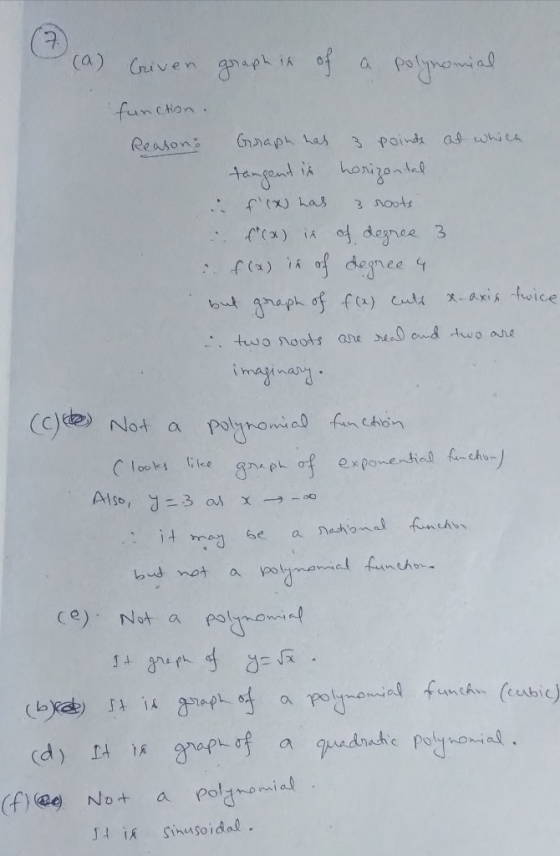
From given graphs, we can't tell the exact equation of the curve.
Add Answer to:
Crown Academy 7. (8 points)(K(U), A) Determine which graphs represent polynomial functions. Explain how you know....
Determine if the graph can represent a polynomial function. If so, assume the end behavior and...
 Determine if the graph can represent a polynomial function. If so, assume the end behavior and all turning points are represented on the graph. 7) 7) - 4+ 3+ a. Determine the minimum degree of the polynomial based on the number of tuming points. b. Determine whether the leading coefficient is positive or negative based on the end behavior and whether the degree of the polynomial is odd or even. c. Approximate the real zeros of the function, and determine...
Determine if the graph can represent a polynomial function. If so, assume the end behavior and...
 Determine if the graph can represent a polynomial function. If so, assume the end behavior and all turning points are represented on the graph 7) 7) 2 a. Determine the minimum degree of the polynomial based on the number of turning points. b. Determine whether the leading coefficient is positive or negative based on the end behavior and whether the degree of the polynomial is odd or even c. Approximate the real zeros of the function, and determine if their...
4. [25 POINTS]Use separate graphs to draw indifference curves for each of the following utility functions: (a) 6 POINTS...
 4. [25 POINTS]Use separate graphs to draw indifference curves for each of the following utility functions: (a) 6 POINTS] U (x, y) = min{2x + y, 2y + x}. (b) [6 PoINts] U (x,y) = max{2.x + y, 2y + x}. (c) 6 POINTS] U (x,y) = x + min {x, y}. (d) 7 POINTS] In which of these cases are preferences convex?
4. [25 POINTS]Use separate graphs to draw indifference curves for each of the following utility functions: (a)...
4. [25 POINTS]Use separate graphs to draw indifference curves for each of the following utility functions: (a) 6 POINTS] U (x, y) = min{2x + y, 2y + x}. (b) [6 PoINts] U (x,y) = max{2.x + y, 2y + x}. (c) 6 POINTS] U (x,y) = x + min {x, y}. (d) 7 POINTS] In which of these cases are preferences convex?
4. [25 POINTS]Use separate graphs to draw indifference curves for each of the following utility functions: (a)...
question #5 (b) Suggest two distinct utility functions that represent such preterences. (Hint: Think about monotonic...
 question #5
(b) Suggest two distinct utility functions that represent such preterences. (Hint: Think about monotonic transformations.) (c) Find MRS analytically. How does MRS depend on the values of (1, 72). Intuitively explain why (d) She spends her total income of $100 paying pi $2 for each Red Delicious and p2 $1 for each Gala. Find her optimal demand and show it on the graph. (e) Describe Kate's optimal choice(s) when p $1. Consumer Demand 5. For each of the...
question #5
(b) Suggest two distinct utility functions that represent such preterences. (Hint: Think about monotonic transformations.) (c) Find MRS analytically. How does MRS depend on the values of (1, 72). Intuitively explain why (d) She spends her total income of $100 paying pi $2 for each Red Delicious and p2 $1 for each Gala. Find her optimal demand and show it on the graph. (e) Describe Kate's optimal choice(s) when p $1. Consumer Demand 5. For each of the...
# 7. & if you know the last part of 8 that would be awesome. 7....
 # 7. & if you
know the last part of 8 that would be awesome.
7. The equipotential surfaces are drawn around the point charge as shown. (see p (see p. 466) レ, ; (a) Is the charge shown at the center a positive charge or a negative charge? (b) How much work would be needed to push a charge ofa- l џС from B to A?- (c) How much work would be needed to push a charge of +1...
# 7. & if you
know the last part of 8 that would be awesome.
7. The equipotential surfaces are drawn around the point charge as shown. (see p (see p. 466) レ, ; (a) Is the charge shown at the center a positive charge or a negative charge? (b) How much work would be needed to push a charge ofa- l џС from B to A?- (c) How much work would be needed to push a charge of +1...
1. Determine the polynomial function whose graph passes through the points (0, 10), (1, 7), (3,...
 1. Determine the polynomial function whose graph passes through the points (0, 10), (1, 7), (3, -11), and (4, -14). Be sure to include a sketch of the polynomial functions, showing the points. Solve using the Gauss-Jordan method or Gaussian elimination with back substitution. Show the matrix and rovw operation used for each step. 2. The figure below shows the flow of traffic (in vehicles per hour) through a network of streets. 300 200 100 500 YA Y 600 400...
3. Below you are given the graphs of the functions f and g. Suppose that: u(x)-f(g(x)), v(x)-f(x) g(x), and w(x)-g(f(x)) Use the graphs to find the indicated derivatives. If the indicated derivative...
 3. Below you are given the graphs of the functions f and g. Suppose that: u(x)-f(g(x)), v(x)-f(x) g(x), and w(x)-g(f(x)) Use the graphs to find the indicated derivatives. If the indicated derivative does not exist, write "D.N.E." in the space provided. Be sure to include work that shows how you arrived at your answer. 20 a) u'3) b) v-4) c) wl)
3. Below you are given the graphs of the functions f and g. Suppose that: u(x)-f(g(x)), v(x)-f(x) g(x), and...
3. Below you are given the graphs of the functions f and g. Suppose that: u(x)-f(g(x)), v(x)-f(x) g(x), and w(x)-g(f(x)) Use the graphs to find the indicated derivatives. If the indicated derivative does not exist, write "D.N.E." in the space provided. Be sure to include work that shows how you arrived at your answer. 20 a) u'3) b) v-4) c) wl)
3. Below you are given the graphs of the functions f and g. Suppose that: u(x)-f(g(x)), v(x)-f(x) g(x), and...
Part A-Multiple Choice K/U-20 marks] 1. If the leading coefficient of an odd-degree polynomial function is...
 Part A-Multiple Choice K/U-20 marks] 1. If the leading coefficient of an odd-degree polynomial function is positive, then the function extends from the third quadrant to the first quadrant; that is, as * , y -co and as →-co, y → b. * →-co, y → and as x 0, y →-60 * →-co, y →-co and as x 0, y → d. X-CO, y -co and as x, y →-00 a. c. c. c. 6 2. Which polynomial function...
need help with this problem. please explain, thank you. 8. Consider a particle encountering a barrier...
 need help with this problem. please explain, thank you.
8. Consider a particle encountering a barrier with potential U = U, >0 between x = -a and x = a with incoming energy E > U. a) Write the symbolic wave functions before and after passing through the barrier (i.e., for xs-a and x>a; regions I and III). UN b) Write down the Schrodinger equation for the wave function in the middle (region II) where the potential is non-zero i.e.,...
need help with this problem. please explain, thank you.
8. Consider a particle encountering a barrier with potential U = U, >0 between x = -a and x = a with incoming energy E > U. a) Write the symbolic wave functions before and after passing through the barrier (i.e., for xs-a and x>a; regions I and III). UN b) Write down the Schrodinger equation for the wave function in the middle (region II) where the potential is non-zero i.e.,...
How do I find the parts and graph? 7. Graph the polynomial function by finding the...
 How
do I find the parts and graph?
7. Graph the polynomial function by finding the following: f(x)x3x a) Leading coefficient term to determine end behavior of the function. (1 points) Real zeros and their multiplicity (these zeros are called x-intercepts), also determine whether these zeros touch or cross the x -axis.(2 points) b) c) Find the y-intercept (1 points) d) Find additional points (1 points)
How
do I find the parts and graph?
7. Graph the polynomial function by finding the following: f(x)x3x a) Leading coefficient term to determine end behavior of the function. (1 points) Real zeros and their multiplicity (these zeros are called x-intercepts), also determine whether these zeros touch or cross the x -axis.(2 points) b) c) Find the y-intercept (1 points) d) Find additional points (1 points)
 Determine if the graph can represent a polynomial function. If so, assume the end behavior and all turning points are represented on the graph. 7) 7) - 4+ 3+ a. Determine the minimum degree of the polynomial based on the number of tuming points. b. Determine whether the leading coefficient is positive or negative based on the end behavior and whether the degree of the polynomial is odd or even. c. Approximate the real zeros of the function, and determine...
 Determine if the graph can represent a polynomial function. If so, assume the end behavior and all turning points are represented on the graph 7) 7) 2 a. Determine the minimum degree of the polynomial based on the number of turning points. b. Determine whether the leading coefficient is positive or negative based on the end behavior and whether the degree of the polynomial is odd or even c. Approximate the real zeros of the function, and determine if their...
 4. [25 POINTS]Use separate graphs to draw indifference curves for each of the following utility functions: (a) 6 POINTS] U (x, y) = min{2x + y, 2y + x}. (b) [6 PoINts] U (x,y) = max{2.x + y, 2y + x}. (c) 6 POINTS] U (x,y) = x + min {x, y}. (d) 7 POINTS] In which of these cases are preferences convex?
4. [25 POINTS]Use separate graphs to draw indifference curves for each of the following utility functions: (a)...
4. [25 POINTS]Use separate graphs to draw indifference curves for each of the following utility functions: (a) 6 POINTS] U (x, y) = min{2x + y, 2y + x}. (b) [6 PoINts] U (x,y) = max{2.x + y, 2y + x}. (c) 6 POINTS] U (x,y) = x + min {x, y}. (d) 7 POINTS] In which of these cases are preferences convex?
4. [25 POINTS]Use separate graphs to draw indifference curves for each of the following utility functions: (a)...
 question #5
(b) Suggest two distinct utility functions that represent such preterences. (Hint: Think about monotonic transformations.) (c) Find MRS analytically. How does MRS depend on the values of (1, 72). Intuitively explain why (d) She spends her total income of $100 paying pi $2 for each Red Delicious and p2 $1 for each Gala. Find her optimal demand and show it on the graph. (e) Describe Kate's optimal choice(s) when p $1. Consumer Demand 5. For each of the...
question #5
(b) Suggest two distinct utility functions that represent such preterences. (Hint: Think about monotonic transformations.) (c) Find MRS analytically. How does MRS depend on the values of (1, 72). Intuitively explain why (d) She spends her total income of $100 paying pi $2 for each Red Delicious and p2 $1 for each Gala. Find her optimal demand and show it on the graph. (e) Describe Kate's optimal choice(s) when p $1. Consumer Demand 5. For each of the...
 # 7. & if you
know the last part of 8 that would be awesome.
7. The equipotential surfaces are drawn around the point charge as shown. (see p (see p. 466) レ, ; (a) Is the charge shown at the center a positive charge or a negative charge? (b) How much work would be needed to push a charge ofa- l џС from B to A?- (c) How much work would be needed to push a charge of +1...
# 7. & if you
know the last part of 8 that would be awesome.
7. The equipotential surfaces are drawn around the point charge as shown. (see p (see p. 466) レ, ; (a) Is the charge shown at the center a positive charge or a negative charge? (b) How much work would be needed to push a charge ofa- l џС from B to A?- (c) How much work would be needed to push a charge of +1...
 1. Determine the polynomial function whose graph passes through the points (0, 10), (1, 7), (3, -11), and (4, -14). Be sure to include a sketch of the polynomial functions, showing the points. Solve using the Gauss-Jordan method or Gaussian elimination with back substitution. Show the matrix and rovw operation used for each step. 2. The figure below shows the flow of traffic (in vehicles per hour) through a network of streets. 300 200 100 500 YA Y 600 400...
 3. Below you are given the graphs of the functions f and g. Suppose that: u(x)-f(g(x)), v(x)-f(x) g(x), and w(x)-g(f(x)) Use the graphs to find the indicated derivatives. If the indicated derivative does not exist, write "D.N.E." in the space provided. Be sure to include work that shows how you arrived at your answer. 20 a) u'3) b) v-4) c) wl)
3. Below you are given the graphs of the functions f and g. Suppose that: u(x)-f(g(x)), v(x)-f(x) g(x), and...
3. Below you are given the graphs of the functions f and g. Suppose that: u(x)-f(g(x)), v(x)-f(x) g(x), and w(x)-g(f(x)) Use the graphs to find the indicated derivatives. If the indicated derivative does not exist, write "D.N.E." in the space provided. Be sure to include work that shows how you arrived at your answer. 20 a) u'3) b) v-4) c) wl)
3. Below you are given the graphs of the functions f and g. Suppose that: u(x)-f(g(x)), v(x)-f(x) g(x), and...
 Part A-Multiple Choice K/U-20 marks] 1. If the leading coefficient of an odd-degree polynomial function is positive, then the function extends from the third quadrant to the first quadrant; that is, as * , y -co and as →-co, y → b. * →-co, y → and as x 0, y →-60 * →-co, y →-co and as x 0, y → d. X-CO, y -co and as x, y →-00 a. c. c. c. 6 2. Which polynomial function...
 need help with this problem. please explain, thank you.
8. Consider a particle encountering a barrier with potential U = U, >0 between x = -a and x = a with incoming energy E > U. a) Write the symbolic wave functions before and after passing through the barrier (i.e., for xs-a and x>a; regions I and III). UN b) Write down the Schrodinger equation for the wave function in the middle (region II) where the potential is non-zero i.e.,...
need help with this problem. please explain, thank you.
8. Consider a particle encountering a barrier with potential U = U, >0 between x = -a and x = a with incoming energy E > U. a) Write the symbolic wave functions before and after passing through the barrier (i.e., for xs-a and x>a; regions I and III). UN b) Write down the Schrodinger equation for the wave function in the middle (region II) where the potential is non-zero i.e.,...
 How
do I find the parts and graph?
7. Graph the polynomial function by finding the following: f(x)x3x a) Leading coefficient term to determine end behavior of the function. (1 points) Real zeros and their multiplicity (these zeros are called x-intercepts), also determine whether these zeros touch or cross the x -axis.(2 points) b) c) Find the y-intercept (1 points) d) Find additional points (1 points)
How
do I find the parts and graph?
7. Graph the polynomial function by finding the following: f(x)x3x a) Leading coefficient term to determine end behavior of the function. (1 points) Real zeros and their multiplicity (these zeros are called x-intercepts), also determine whether these zeros touch or cross the x -axis.(2 points) b) c) Find the y-intercept (1 points) d) Find additional points (1 points)
Most questions answered within 3 hours.
-
Where is the error in this code sequence?
String s1 = "Hello";
String s2 = "ello";...
asked 10 months ago -
Financial data for Joel de Paris, Inc., for last year
follow:
Joel de Paris, Inc.
Balance...
asked 10 months ago -
Consider this reaction:
Al2(SO4)3 (aq)+ BaCl3
(aq) Al2Cl6 (aq)- +
3BaSO4(s) . What is the...
asked 10 months ago -
Suppose that Savneet is considering increasing her
recent random sample from 20 car rentals to 40...
asked 10 months ago -
Trucks arrive at an unloading terminal at an average rate of 120
per hour.
Trucks arrive...
asked 10 months ago -
Why are methanol and ethanol completely soluble in water while
octanol is not very little soluble....
asked 10 months ago -
A facilities manager at a university reads in a research report
that the mean amount of...
asked 10 months ago -
When the CuSO4 is rehydrated by adding water to the anhydrous
compound, is this an endothermic...
asked 10 months ago -
A ray of sunlight is passing from diamond into crown glass; the
angle of incidence is...
asked 10 months ago -
A block of mass 0.249 kg is placed on top of a light, vertical
spring of...
asked 10 months ago -
how do the kidneys compensate in the presences of acidosis
a) trigger hyperventilate
b) reserve acid...
asked 10 months ago -
Question 501 pts
The rental rate of capital to the firm increases. Which of the
following...
asked 10 months ago