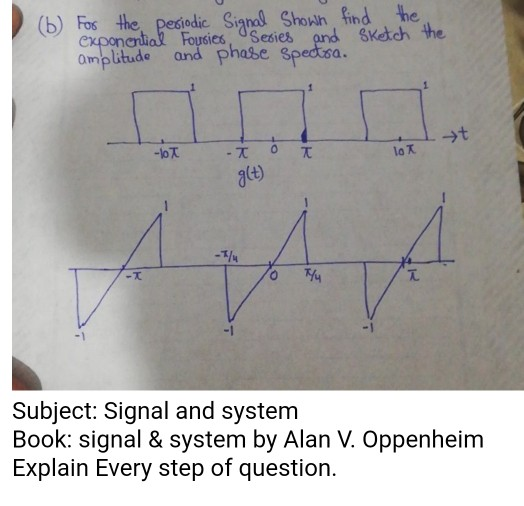
Please explain every step and writing must be accurate.
Homework Answers
A signal having a period
can be expressed as
for
where is the complex
Fourier series coefficient and is given by
for
Part-1
For the first signal, the period is
The exponential Fourier series coefficient is given by
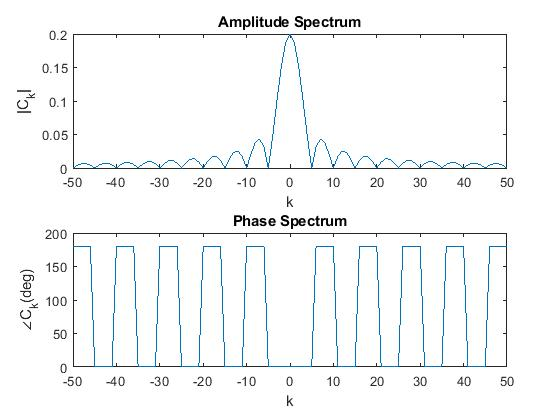
The amplitude and phase spectra are generated using MATLAB for
Below is the MATLAB code
k=-50:50;
C=zeros(1,length(k));
for m=1:length(k)
C(m)=1/(k(m)*pi)*sin(k(m)*pi/5);
end
C(k==0)=1/5;
figure(1)
subplot(2,1,1)
plot(k,abs(C))
xlabel('k')
ylabel('|C_k|')
title('Amplitude Spectrum')
subplot(2,1,2)
plot(k,angle(C)*180/pi)
xlabel('k')
ylabel('\angleC_k(deg)')
title('Phase Spectrum')
the Output plot is
Part-2
For the second signal, the time period is
The exponential Fourier series coefficient is given by
Now lets find
Integrating by parts
So,
The amplitude and phase spectra are generated using MATLAB for
k=-10:10;
C=zeros(1,length(k));
for m=1:length(k)
C(m)=-8*j/(k(m)^2*pi^2);
end
C(k==0)=2/pi;
figure(1)
subplot(2,1,1)
plot(k,abs(C))
xlabel('k')
ylabel('|C_k|')
title('Amplitude Spectrum')
subplot(2,1,2)
plot(k,angle(C)*180/pi)
xlabel('k')
ylabel('\angleC_k(deg)')
title('Phase Spectrum')
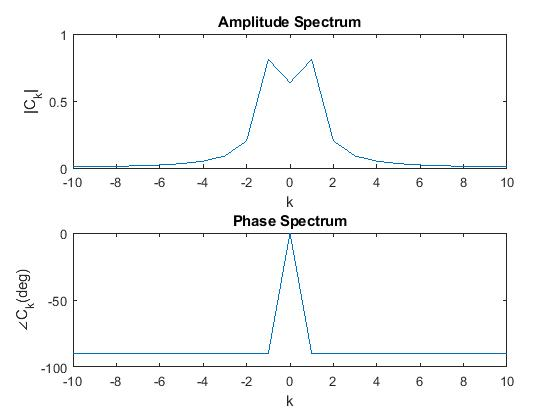
Note: For the sake of proper legibility in the graphs, they are generated using MATLAB. You can refer them and create your hand-drawn plots if required. You can also change the range of 'k' if required just by modifying line-1 in the above given codes.
Add Answer to:
Please explain every step and writing must be accurate.
(b) Fos the pesiedic Siannl Showl ind...
Please try to show/explain every step! 22. Complete the following reactions by clearly writing out the...
 Please try to show/explain every step!
22. Complete the following reactions by clearly writing out the products and state if the product is a water soluble molecule or not. (3 pts cach/15 pts total) HO NH,Br. H,804 HAPO, 200 °C HBE No peroxides CH,CH 23. Complete the following reactions and show the mechanism of how the reaction occurred. You must identify at least one nucleophile and one electrophile in cach mechanism that you draw. Only do ONE of the two...
Please try to show/explain every step!
22. Complete the following reactions by clearly writing out the products and state if the product is a water soluble molecule or not. (3 pts cach/15 pts total) HO NH,Br. H,804 HAPO, 200 °C HBE No peroxides CH,CH 23. Complete the following reactions and show the mechanism of how the reaction occurred. You must identify at least one nucleophile and one electrophile in cach mechanism that you draw. Only do ONE of the two...
please solve me these two questions and please solve it step by step and you get thumbs up, explain every detail especially the question 2 SIGNALS AND SYSTEMS 1. Find the rgonometric Fourier Series e...
 please solve me these two questions and please solve it step by
step and you get thumbs up, explain every detail especially the
question 2
SIGNALS AND SYSTEMS 1. Find the rgonometric Fourier Series expansion of the following signal: (15 M) -A Q2. Find the complex Fourier series representation of an impulse train given as: (15 M) x(t) δ(t-2m) Which frequency coefficient Cn has the largest power? Plot x(O and Gr
SIGNALS AND SYSTEMS 1. Find the rgonometric Fourier Series...
please solve me these two questions and please solve it step by
step and you get thumbs up, explain every detail especially the
question 2
SIGNALS AND SYSTEMS 1. Find the rgonometric Fourier Series expansion of the following signal: (15 M) -A Q2. Find the complex Fourier series representation of an impulse train given as: (15 M) x(t) δ(t-2m) Which frequency coefficient Cn has the largest power? Plot x(O and Gr
SIGNALS AND SYSTEMS 1. Find the rgonometric Fourier Series...
Please provide step by step details for the answers from parts (a) and (b). Thumps up...
 Please provide step by step details for the answers from parts
(a) and (b). Thumps up for a well explain and sketch answer.
50000 5. (12 pts) Consider the transfer function T (s) = 7 (1+1000) a. Use hand calculations (show all your work) to obtain asymptotic equations for all regions of the Bode magnitude response of the system. Sketch (by hand) the Bode magnitude plot indicating the slope of the various segments. b. Analyze the system phase response and...
Please provide step by step details for the answers from parts
(a) and (b). Thumps up for a well explain and sketch answer.
50000 5. (12 pts) Consider the transfer function T (s) = 7 (1+1000) a. Use hand calculations (show all your work) to obtain asymptotic equations for all regions of the Bode magnitude response of the system. Sketch (by hand) the Bode magnitude plot indicating the slope of the various segments. b. Analyze the system phase response and...
Please only answer if answe ALL PARTS NEAT WRITING ONLY please show EVERY STEP AND SHOW...
 Please only answer if answe ALL PARTS
NEAT WRITING ONLY
please show EVERY STEP AND SHOW DETAILED WORK
THANK YOU
3. Suppose someone is distribution with parameter A-i ng random numbers in R uning a function that is based on a Poisson a. What is the from the mean? probablity the function will output a number more than one standard deviation b. Suppose a new value of A is choeen, and through some experimentation, you find tbe random number generator...
Please only answer if answe ALL PARTS
NEAT WRITING ONLY
please show EVERY STEP AND SHOW DETAILED WORK
THANK YOU
3. Suppose someone is distribution with parameter A-i ng random numbers in R uning a function that is based on a Poisson a. What is the from the mean? probablity the function will output a number more than one standard deviation b. Suppose a new value of A is choeen, and through some experimentation, you find tbe random number generator...
Will someone please solve this and explain every single step? I keep getting lost. Thank you!...
 Will someone please solve this and explain every single step? I
keep getting lost. Thank you!
The figure shows the magnetic flux through a single loop coil as a function of time. If phi_0 = 2 times 10^-2 Wb, calculate the induced emf in the coil at the following times. t = 0.05 s Your response differs from the correct answer by more than 10%. Double check your calculations. V t = 0.15 s t = 0.5 s V
Will someone please solve this and explain every single step? I
keep getting lost. Thank you!
The figure shows the magnetic flux through a single loop coil as a function of time. If phi_0 = 2 times 10^-2 Wb, calculate the induced emf in the coil at the following times. t = 0.05 s Your response differs from the correct answer by more than 10%. Double check your calculations. V t = 0.15 s t = 0.5 s V
Can someone solve by details please explain each step. Thanks Problem 5.9 2. Below is the...
 Can someone solve by details please explain each step.
Thanks
Problem 5.9 2. Below is the frequency response of a dynamic system Bode Diagram 40 20 100 160 135 45 45-- Frequency (radisec) a. What are the corner frequencies? .. b. How many poles in the system? c. How many zeros in the system? d. For the input signal shown in the Figure below find (at steady-state situation): i. The output signal amplitude. i. The output signal phase (in degrees...
Can someone solve by details please explain each step.
Thanks
Problem 5.9 2. Below is the frequency response of a dynamic system Bode Diagram 40 20 100 160 135 45 45-- Frequency (radisec) a. What are the corner frequencies? .. b. How many poles in the system? c. How many zeros in the system? d. For the input signal shown in the Figure below find (at steady-state situation): i. The output signal amplitude. i. The output signal phase (in degrees...
please explain every step. thanks Consider the following system of linear equations ri (a) For what...
 please explain every step. thanks
Consider the following system of linear equations ri (a) For what values of r and s is this system of linear equations inconsistent? (b) For what values of and s does this system of linear equations have infinitely many solutions? (ey For what values of and s does this system of linear equations have a unique solution?
please explain every step. thanks
Consider the following system of linear equations ri (a) For what values of r and s is this system of linear equations inconsistent? (b) For what values of and s does this system of linear equations have infinitely many solutions? (ey For what values of and s does this system of linear equations have a unique solution?
Communication System Solve with ALL steps Please QUESTION 3 Briefly explain the following Analog Pulse Modulation...
 Communication System
Solve with ALL steps Please
QUESTION 3 Briefly explain the following Analog Pulse Modulation (APM): (i) Pulse Amplitude Modulation (PAM) Pulse Width Modulation (PWM) (iii) Pulse Position Modulation (PPM) (2 marks) (2 marks) (2 marks) b) There are several digital modulations techniques used to modulate digital signal. For a binary data 10111011, sketch the output waveform if the following modulator is used: Amplitude Shift Keying (ASK) (2 marks) Frequency Shift Keying(FSK) (2 marks) (iii) Phase Shift Keying (PSK)...
Communication System
Solve with ALL steps Please
QUESTION 3 Briefly explain the following Analog Pulse Modulation (APM): (i) Pulse Amplitude Modulation (PAM) Pulse Width Modulation (PWM) (iii) Pulse Position Modulation (PPM) (2 marks) (2 marks) (2 marks) b) There are several digital modulations techniques used to modulate digital signal. For a binary data 10111011, sketch the output waveform if the following modulator is used: Amplitude Shift Keying (ASK) (2 marks) Frequency Shift Keying(FSK) (2 marks) (iii) Phase Shift Keying (PSK)...
Show and explain every step for every part please! Problem 4. Walking along a plank on...
 Show and explain every step for every part please!
Problem 4. Walking along a plank on a frozen lake [25 points] A 52.0-kg girl is standing on a 173-kg plank. The plank, originally at rest, is free to slide on a frozen lake, which is a flat, frictionless surface. The girl begins to walk along the plank at a constant velocity of 1.38 m/s to the right relative to the plank. (a) [6 points Write down the total momentum of...
Show and explain every step for every part please!
Problem 4. Walking along a plank on a frozen lake [25 points] A 52.0-kg girl is standing on a 173-kg plank. The plank, originally at rest, is free to slide on a frozen lake, which is a flat, frictionless surface. The girl begins to walk along the plank at a constant velocity of 1.38 m/s to the right relative to the plank. (a) [6 points Write down the total momentum of...
please explain your answer with steps so it is understandable every step please thanks Problem 6:...
 please explain your answer with steps so it is
understandable every step please
thanks
Problem 6: Water flows from the bottom of one hour (ie.Osts 60 min). a) Find the amount of water that for hand and then round to the nearest tenth of a liter. bottom of a storage tank at a rate of ) - 10 e- liters per minute for a period nt of water that flows from the tank in the last thirty minutes. Set up...
please explain your answer with steps so it is
understandable every step please
thanks
Problem 6: Water flows from the bottom of one hour (ie.Osts 60 min). a) Find the amount of water that for hand and then round to the nearest tenth of a liter. bottom of a storage tank at a rate of ) - 10 e- liters per minute for a period nt of water that flows from the tank in the last thirty minutes. Set up...
 Please try to show/explain every step!
22. Complete the following reactions by clearly writing out the products and state if the product is a water soluble molecule or not. (3 pts cach/15 pts total) HO NH,Br. H,804 HAPO, 200 °C HBE No peroxides CH,CH 23. Complete the following reactions and show the mechanism of how the reaction occurred. You must identify at least one nucleophile and one electrophile in cach mechanism that you draw. Only do ONE of the two...
Please try to show/explain every step!
22. Complete the following reactions by clearly writing out the products and state if the product is a water soluble molecule or not. (3 pts cach/15 pts total) HO NH,Br. H,804 HAPO, 200 °C HBE No peroxides CH,CH 23. Complete the following reactions and show the mechanism of how the reaction occurred. You must identify at least one nucleophile and one electrophile in cach mechanism that you draw. Only do ONE of the two...
 please solve me these two questions and please solve it step by
step and you get thumbs up, explain every detail especially the
question 2
SIGNALS AND SYSTEMS 1. Find the rgonometric Fourier Series expansion of the following signal: (15 M) -A Q2. Find the complex Fourier series representation of an impulse train given as: (15 M) x(t) δ(t-2m) Which frequency coefficient Cn has the largest power? Plot x(O and Gr
SIGNALS AND SYSTEMS 1. Find the rgonometric Fourier Series...
please solve me these two questions and please solve it step by
step and you get thumbs up, explain every detail especially the
question 2
SIGNALS AND SYSTEMS 1. Find the rgonometric Fourier Series expansion of the following signal: (15 M) -A Q2. Find the complex Fourier series representation of an impulse train given as: (15 M) x(t) δ(t-2m) Which frequency coefficient Cn has the largest power? Plot x(O and Gr
SIGNALS AND SYSTEMS 1. Find the rgonometric Fourier Series...
 Please provide step by step details for the answers from parts
(a) and (b). Thumps up for a well explain and sketch answer.
50000 5. (12 pts) Consider the transfer function T (s) = 7 (1+1000) a. Use hand calculations (show all your work) to obtain asymptotic equations for all regions of the Bode magnitude response of the system. Sketch (by hand) the Bode magnitude plot indicating the slope of the various segments. b. Analyze the system phase response and...
Please provide step by step details for the answers from parts
(a) and (b). Thumps up for a well explain and sketch answer.
50000 5. (12 pts) Consider the transfer function T (s) = 7 (1+1000) a. Use hand calculations (show all your work) to obtain asymptotic equations for all regions of the Bode magnitude response of the system. Sketch (by hand) the Bode magnitude plot indicating the slope of the various segments. b. Analyze the system phase response and...
 Please only answer if answe ALL PARTS
NEAT WRITING ONLY
please show EVERY STEP AND SHOW DETAILED WORK
THANK YOU
3. Suppose someone is distribution with parameter A-i ng random numbers in R uning a function that is based on a Poisson a. What is the from the mean? probablity the function will output a number more than one standard deviation b. Suppose a new value of A is choeen, and through some experimentation, you find tbe random number generator...
Please only answer if answe ALL PARTS
NEAT WRITING ONLY
please show EVERY STEP AND SHOW DETAILED WORK
THANK YOU
3. Suppose someone is distribution with parameter A-i ng random numbers in R uning a function that is based on a Poisson a. What is the from the mean? probablity the function will output a number more than one standard deviation b. Suppose a new value of A is choeen, and through some experimentation, you find tbe random number generator...
 Will someone please solve this and explain every single step? I
keep getting lost. Thank you!
The figure shows the magnetic flux through a single loop coil as a function of time. If phi_0 = 2 times 10^-2 Wb, calculate the induced emf in the coil at the following times. t = 0.05 s Your response differs from the correct answer by more than 10%. Double check your calculations. V t = 0.15 s t = 0.5 s V
Will someone please solve this and explain every single step? I
keep getting lost. Thank you!
The figure shows the magnetic flux through a single loop coil as a function of time. If phi_0 = 2 times 10^-2 Wb, calculate the induced emf in the coil at the following times. t = 0.05 s Your response differs from the correct answer by more than 10%. Double check your calculations. V t = 0.15 s t = 0.5 s V
 Can someone solve by details please explain each step.
Thanks
Problem 5.9 2. Below is the frequency response of a dynamic system Bode Diagram 40 20 100 160 135 45 45-- Frequency (radisec) a. What are the corner frequencies? .. b. How many poles in the system? c. How many zeros in the system? d. For the input signal shown in the Figure below find (at steady-state situation): i. The output signal amplitude. i. The output signal phase (in degrees...
Can someone solve by details please explain each step.
Thanks
Problem 5.9 2. Below is the frequency response of a dynamic system Bode Diagram 40 20 100 160 135 45 45-- Frequency (radisec) a. What are the corner frequencies? .. b. How many poles in the system? c. How many zeros in the system? d. For the input signal shown in the Figure below find (at steady-state situation): i. The output signal amplitude. i. The output signal phase (in degrees...
 please explain every step. thanks
Consider the following system of linear equations ri (a) For what values of r and s is this system of linear equations inconsistent? (b) For what values of and s does this system of linear equations have infinitely many solutions? (ey For what values of and s does this system of linear equations have a unique solution?
please explain every step. thanks
Consider the following system of linear equations ri (a) For what values of r and s is this system of linear equations inconsistent? (b) For what values of and s does this system of linear equations have infinitely many solutions? (ey For what values of and s does this system of linear equations have a unique solution?
 Communication System
Solve with ALL steps Please
QUESTION 3 Briefly explain the following Analog Pulse Modulation (APM): (i) Pulse Amplitude Modulation (PAM) Pulse Width Modulation (PWM) (iii) Pulse Position Modulation (PPM) (2 marks) (2 marks) (2 marks) b) There are several digital modulations techniques used to modulate digital signal. For a binary data 10111011, sketch the output waveform if the following modulator is used: Amplitude Shift Keying (ASK) (2 marks) Frequency Shift Keying(FSK) (2 marks) (iii) Phase Shift Keying (PSK)...
Communication System
Solve with ALL steps Please
QUESTION 3 Briefly explain the following Analog Pulse Modulation (APM): (i) Pulse Amplitude Modulation (PAM) Pulse Width Modulation (PWM) (iii) Pulse Position Modulation (PPM) (2 marks) (2 marks) (2 marks) b) There are several digital modulations techniques used to modulate digital signal. For a binary data 10111011, sketch the output waveform if the following modulator is used: Amplitude Shift Keying (ASK) (2 marks) Frequency Shift Keying(FSK) (2 marks) (iii) Phase Shift Keying (PSK)...
 Show and explain every step for every part please!
Problem 4. Walking along a plank on a frozen lake [25 points] A 52.0-kg girl is standing on a 173-kg plank. The plank, originally at rest, is free to slide on a frozen lake, which is a flat, frictionless surface. The girl begins to walk along the plank at a constant velocity of 1.38 m/s to the right relative to the plank. (a) [6 points Write down the total momentum of...
Show and explain every step for every part please!
Problem 4. Walking along a plank on a frozen lake [25 points] A 52.0-kg girl is standing on a 173-kg plank. The plank, originally at rest, is free to slide on a frozen lake, which is a flat, frictionless surface. The girl begins to walk along the plank at a constant velocity of 1.38 m/s to the right relative to the plank. (a) [6 points Write down the total momentum of...
 please explain your answer with steps so it is
understandable every step please
thanks
Problem 6: Water flows from the bottom of one hour (ie.Osts 60 min). a) Find the amount of water that for hand and then round to the nearest tenth of a liter. bottom of a storage tank at a rate of ) - 10 e- liters per minute for a period nt of water that flows from the tank in the last thirty minutes. Set up...
please explain your answer with steps so it is
understandable every step please
thanks
Problem 6: Water flows from the bottom of one hour (ie.Osts 60 min). a) Find the amount of water that for hand and then round to the nearest tenth of a liter. bottom of a storage tank at a rate of ) - 10 e- liters per minute for a period nt of water that flows from the tank in the last thirty minutes. Set up...
Most questions answered within 3 hours.
-
Where is the error in this code sequence?
String s1 = "Hello";
String s2 = "ello";...
asked 10 months ago -
Financial data for Joel de Paris, Inc., for last year
follow:
Joel de Paris, Inc.
Balance...
asked 10 months ago -
Consider this reaction:
Al2(SO4)3 (aq)+ BaCl3
(aq) Al2Cl6 (aq)- +
3BaSO4(s) . What is the...
asked 10 months ago -
Suppose that Savneet is considering increasing her
recent random sample from 20 car rentals to 40...
asked 10 months ago -
Trucks arrive at an unloading terminal at an average rate of 120
per hour.
Trucks arrive...
asked 10 months ago -
Why are methanol and ethanol completely soluble in water while
octanol is not very little soluble....
asked 10 months ago -
A facilities manager at a university reads in a research report
that the mean amount of...
asked 10 months ago -
When the CuSO4 is rehydrated by adding water to the anhydrous
compound, is this an endothermic...
asked 10 months ago -
A ray of sunlight is passing from diamond into crown glass; the
angle of incidence is...
asked 10 months ago -
A block of mass 0.249 kg is placed on top of a light, vertical
spring of...
asked 10 months ago -
how do the kidneys compensate in the presences of acidosis
a) trigger hyperventilate
b) reserve acid...
asked 10 months ago -
Question 501 pts
The rental rate of capital to the firm increases. Which of the
following...
asked 10 months ago