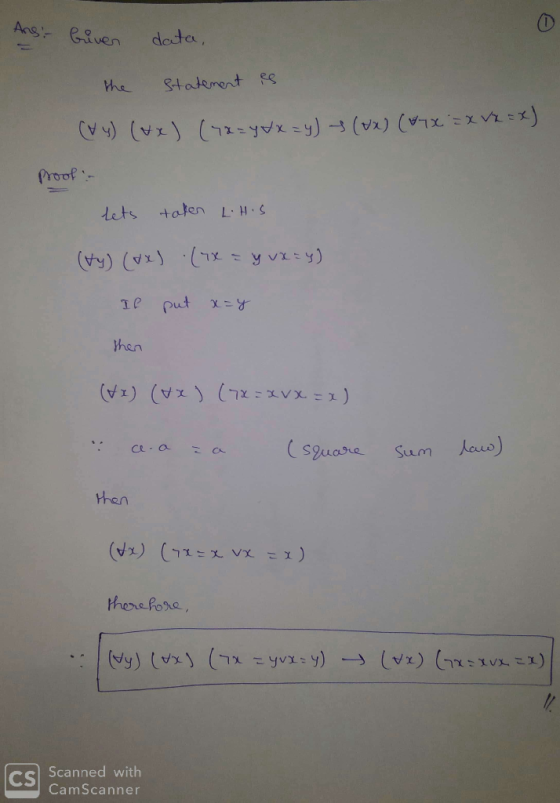
Is (∀??)(∀??) (¬?? = ?? ∨ ?? = ??) → (∀??)(¬?? = ?? ∨ ?? = ??) an instance of Ax2? Why?
![[5 marks] Is (Vy)(Vx)(-x = y Vx y) (Vx)(x x Vx = x) an instance of Ax2? Why?](http://img.homeworklib.com/questions/01a928a0-b662-11ea-b074-f55e3e3cfa2b.png?x-oss-process=image/resize,w_560)
Homework Answers
Vector V is 8.5 units long and points at 600 to the positive x axis. What...
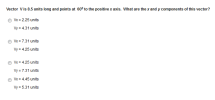 Vector V is 8.5 units long and points at 600 to the positive x axis. What are the x and y components of this vector? Vx 2.25 units Vy 4.31 units Vx-7.31 units Vy 4.25 units Vx 4.25 units Vy 7.31 units Vx 4.45 units Vy 5.31 units
please solve this question showing all the steps clearly Question 1) (3 marks) Sketch the region...
 please solve this question showing all the steps clearly
Question 1) (3 marks) Sketch the region of integration on the x- y plane and find the volume of the region R in the first quadrant, bounded between followings: From above by Vy? +1 and from below by the lines: x = 0, y = 1, y = Vx.
please solve this question showing all the steps clearly
Question 1) (3 marks) Sketch the region of integration on the x- y plane and find the volume of the region R in the first quadrant, bounded between followings: From above by Vy? +1 and from below by the lines: x = 0, y = 1, y = Vx.
1. Given a vector V with x- and y- components Vx = -6.2 and Vy =...
1. Given a vector V with x- and y- components Vx = -6.2 and Vy = 2.9. What is the magnitude of vector V? 2. Given a vector V with x- and y- components Vx = -4.5 and Vy = 3. What is the direction of vector V with respect to the +x-axis counterclockwise?
For each wff, find an interpretation in which it is true and one in which it is false. Please an...
 For each wff, find an interpretation in which it is true and one
in which it is false.
Please answer both a and c
8. For each wff, find an interpretation in which it is true and one in which it is false. a. ( x)[A(x)Л (Vy)B(x,y)] b. [(Vx)A(x) -> (Vx)B(x)]-(Vx)[A(a) >B(x) c. (3x)[P(x) V Q(x)] /\ (Vx)[P(x)- Q(x)]
8. For each wff, find an interpretation in which it is true and one in which it is false. a. (...
For each wff, find an interpretation in which it is true and one
in which it is false.
Please answer both a and c
8. For each wff, find an interpretation in which it is true and one in which it is false. a. ( x)[A(x)Л (Vy)B(x,y)] b. [(Vx)A(x) -> (Vx)B(x)]-(Vx)[A(a) >B(x) c. (3x)[P(x) V Q(x)] /\ (Vx)[P(x)- Q(x)]
8. For each wff, find an interpretation in which it is true and one in which it is false. a. (...
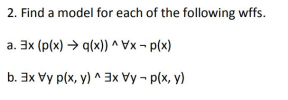
Need help please 2. Find a model for each of the following wffs. a. 3x (p(x)...
 Need help please
2. Find a model for each of the following wffs. a. 3x (p(x) — 9(x))^VX - p(x) b. 3x Vy p(x, y) ^ 3x Vy - p(x, y)
Need help please
2. Find a model for each of the following wffs. a. 3x (p(x) — 9(x))^VX - p(x) b. 3x Vy p(x, y) ^ 3x Vy - p(x, y)
Use the rules of deduction in the Predicate Calculus (but avoiding derived rules) to find formal proofs for the following sequents: (a) x) F)~(Vx)~ F(x) (b) (Vz) ~ F(x) B) F() (3x)(G(z) Л (Vy) (F(y)...
 Use the rules of deduction in the Predicate Calculus (but avoiding derived rules) to find formal proofs for the following sequents: (a) x) F)~(Vx)~ F(x) (b) (Vz) ~ F(x) B) F() (3x)(G(z) Л (Vy) (F(y) H(y, z))) (e)
Use the rules of deduction in the Predicate Calculus (but avoiding derived rules) to find formal proofs for the following sequents: (a) x) F)~(Vx)~ F(x) (b) (Vz) ~ F(x) B) F() (3x)(G(z) Л (Vy) (F(y) H(y, z))) (e)
Use the rules of deduction in the Predicate Calculus (but avoiding derived rules) to find formal proofs for the following sequents: (a) x) F)~(Vx)~ F(x) (b) (Vz) ~ F(x) B) F() (3x)(G(z) Л (Vy) (F(y) H(y, z))) (e)
In matlab I have created the following function that calculates the distance a projectile travels when...
In matlab I have created the following function that calculates the distance a projectile travels when shot from a cannon given initial velocity and theta. function [distance, xplot, yplot] = Cannon_lab8(V, theta) g = -9.81; % gravity m/s^2 k = 0.35; % drag coefficient Vx = V*cos(theta); %velovity in x-direction Vy = V*sin(theta); %velovity in y-direction dt = 0.01; % seconds, time step x = 0; y = 0; xplot(1) = 0; yplot(1) = 0; i = 2; while y...
In matlab I have created the following function function [distance, xplot, yplot] = Cannon_lab8(V, theta) %...
In matlab I have created the following function function [distance, xplot, yplot] = Cannon_lab8(V, theta) % the function calculates the distance a projectile travels when shot from % a cannon given initial velocity and theta. g = -9.81; % m/s^2 k = 0.35; % drag coefficient Vx = V*cos(theta); Vy = V*sin(theta); dt = 0.01; % seconds x = 0; y = 0; xplot(1) = 0; yplot(1) = 0; i = 2; while y >= 0 ax = -k*Vx; ay...
1 15 oints) Deterine if the following propositions are TRUE or FALSE. Note that p, q...
 1 15 oints) Deterine if the following propositions are TRUE or FALSE. Note that p, q r are propositi Px) and P(x.y) are predicates. RUE or FALSE.Note that p, q, r are propositions. (a).TNE 1f2小5or I + 1-3, then 10+2-3or 2 + 2-4. (b).TRvE+1 0 if and only if 2+ 2 5. (d). _ p v T Ξ T, where p is a proposition and T is tautology. V x Px) is equivalent to Vx - Px) (g). ㅡㅡㅡ, y...
Determine whether the function is a linear transformation. T: R2 R3, T(x,y) = (Vx, 5xy, vy)...
 Determine whether the function is a linear transformation. T: R2 R3, T(x,y) = (Vx, 5xy, vy) O linear transformation not a linear transformation
 Vector V is 8.5 units long and points at 600 to the positive x axis. What are the x and y components of this vector? Vx 2.25 units Vy 4.31 units Vx-7.31 units Vy 4.25 units Vx 4.25 units Vy 7.31 units Vx 4.45 units Vy 5.31 units
 please solve this question showing all the steps clearly
Question 1) (3 marks) Sketch the region of integration on the x- y plane and find the volume of the region R in the first quadrant, bounded between followings: From above by Vy? +1 and from below by the lines: x = 0, y = 1, y = Vx.
please solve this question showing all the steps clearly
Question 1) (3 marks) Sketch the region of integration on the x- y plane and find the volume of the region R in the first quadrant, bounded between followings: From above by Vy? +1 and from below by the lines: x = 0, y = 1, y = Vx.
 For each wff, find an interpretation in which it is true and one
in which it is false.
Please answer both a and c
8. For each wff, find an interpretation in which it is true and one in which it is false. a. ( x)[A(x)Л (Vy)B(x,y)] b. [(Vx)A(x) -> (Vx)B(x)]-(Vx)[A(a) >B(x) c. (3x)[P(x) V Q(x)] /\ (Vx)[P(x)- Q(x)]
8. For each wff, find an interpretation in which it is true and one in which it is false. a. (...
For each wff, find an interpretation in which it is true and one
in which it is false.
Please answer both a and c
8. For each wff, find an interpretation in which it is true and one in which it is false. a. ( x)[A(x)Л (Vy)B(x,y)] b. [(Vx)A(x) -> (Vx)B(x)]-(Vx)[A(a) >B(x) c. (3x)[P(x) V Q(x)] /\ (Vx)[P(x)- Q(x)]
8. For each wff, find an interpretation in which it is true and one in which it is false. a. (...
 Need help please
2. Find a model for each of the following wffs. a. 3x (p(x) — 9(x))^VX - p(x) b. 3x Vy p(x, y) ^ 3x Vy - p(x, y)
Need help please
2. Find a model for each of the following wffs. a. 3x (p(x) — 9(x))^VX - p(x) b. 3x Vy p(x, y) ^ 3x Vy - p(x, y)
 Use the rules of deduction in the Predicate Calculus (but avoiding derived rules) to find formal proofs for the following sequents: (a) x) F)~(Vx)~ F(x) (b) (Vz) ~ F(x) B) F() (3x)(G(z) Л (Vy) (F(y) H(y, z))) (e)
Use the rules of deduction in the Predicate Calculus (but avoiding derived rules) to find formal proofs for the following sequents: (a) x) F)~(Vx)~ F(x) (b) (Vz) ~ F(x) B) F() (3x)(G(z) Л (Vy) (F(y) H(y, z))) (e)
Use the rules of deduction in the Predicate Calculus (but avoiding derived rules) to find formal proofs for the following sequents: (a) x) F)~(Vx)~ F(x) (b) (Vz) ~ F(x) B) F() (3x)(G(z) Л (Vy) (F(y) H(y, z))) (e)
 1 15 oints) Deterine if the following propositions are TRUE or FALSE. Note that p, q r are propositi Px) and P(x.y) are predicates. RUE or FALSE.Note that p, q, r are propositions. (a).TNE 1f2小5or I + 1-3, then 10+2-3or 2 + 2-4. (b).TRvE+1 0 if and only if 2+ 2 5. (d). _ p v T Ξ T, where p is a proposition and T is tautology. V x Px) is equivalent to Vx - Px) (g). ㅡㅡㅡ, y...
 Determine whether the function is a linear transformation. T: R2 R3, T(x,y) = (Vx, 5xy, vy) O linear transformation not a linear transformation
Most questions answered within 3 hours.
-
Where is the error in this code sequence?
String s1 = "Hello";
String s2 = "ello";...
asked 11 months ago -
Financial data for Joel de Paris, Inc., for last year
follow:
Joel de Paris, Inc.
Balance...
asked 11 months ago -
Consider this reaction:
Al2(SO4)3 (aq)+ BaCl3
(aq) Al2Cl6 (aq)- +
3BaSO4(s) . What is the...
asked 11 months ago -
Suppose that Savneet is considering increasing her
recent random sample from 20 car rentals to 40...
asked 11 months ago -
Trucks arrive at an unloading terminal at an average rate of 120
per hour.
Trucks arrive...
asked 11 months ago -
Why are methanol and ethanol completely soluble in water while
octanol is not very little soluble....
asked 11 months ago -
A facilities manager at a university reads in a research report
that the mean amount of...
asked 11 months ago -
When the CuSO4 is rehydrated by adding water to the anhydrous
compound, is this an endothermic...
asked 11 months ago -
A ray of sunlight is passing from diamond into crown glass; the
angle of incidence is...
asked 11 months ago -
A block of mass 0.249 kg is placed on top of a light, vertical
spring of...
asked 11 months ago -
how do the kidneys compensate in the presences of acidosis
a) trigger hyperventilate
b) reserve acid...
asked 11 months ago -
Question 501 pts
The rental rate of capital to the firm increases. Which of the
following...
asked 11 months ago