![Problem 10. Derive an expression for the contact ratio between an internal gear in contact with a pinion. [5 Points]](http://img.homeworklib.com/questions/718bb630-b674-11ea-aaa3-e3e893cd1e98.png?x-oss-process=image/resize,w_560)
don't answer if not very sure pls
Homework Answers

Add Answer to:
don't answer if not very sure pls
Problem 10. Derive an expression for the contact ratio...
Pls point the option for the questions QUESTION 4 2 points Save Answer A pair of...
 Pls point the option for the questions
QUESTION 4 2 points Save Answer A pair of gears with 20°, full-depth, involute teeth transmits 20 hp while the pinion rotates at 1500 rpm. The module is 6 mm, and the quality number is A11. The pinion has 17 teeth, and the gear has 77 teeth. The face width is 50mm. The input power is from an electric motor, and the load is a vibrating screen. The drive is a commercial enclosed...
Pls point the option for the questions
QUESTION 4 2 points Save Answer A pair of gears with 20°, full-depth, involute teeth transmits 20 hp while the pinion rotates at 1500 rpm. The module is 6 mm, and the quality number is A11. The pinion has 17 teeth, and the gear has 77 teeth. The face width is 50mm. The input power is from an electric motor, and the load is a vibrating screen. The drive is a commercial enclosed...
QUICK ANSWER PLS What is the result of the following prefix expression? + 10 + 54
 QUICK ANSWER PLS
What is the result of the following prefix expression? + 10 + 54
QUICK ANSWER PLS
What is the result of the following prefix expression? + 10 + 54
Pls, answer correctly. Skip if you don't know correct answer. Problem 10 - Simple and Compound...
 Pls, answer correctly. Skip if you don't know correct
answer.
Problem 10 - Simple and Compound Interest Find the following effective rates of interest: a) Under simple interest rate of 4%. The effective rate of interest in the 9 th year is ig = b) Under simple interest rate of 4%. The effective rate of interest in the 13 th year is ia = %3D c) Under compound interest rate of 4%. The effective rate of interest in the 9...
Pls, answer correctly. Skip if you don't know correct
answer.
Problem 10 - Simple and Compound Interest Find the following effective rates of interest: a) Under simple interest rate of 4%. The effective rate of interest in the 9 th year is ig = b) Under simple interest rate of 4%. The effective rate of interest in the 13 th year is ia = %3D c) Under compound interest rate of 4%. The effective rate of interest in the 9...
Please answer both parts fully. Attached is the answer key. Please make sure the answer matches for both parts 10-17 (a) Derive an expression for the temperature dependence of the thermal con ductivi...
 Please answer both parts fully. Attached is the answer key.
Please make sure the answer matches for both parts
10-17 (a) Derive an expression for the temperature dependence of the thermal con ductivity of an ideal gas. (b) Calculate the thermal conductivity of helium (considered as an ideal gas) at 300 K Tia. (b) 0.058 J K-1 m-1 s-1. 10-17 (a) λ
10-17 (a) Derive an expression for the temperature dependence of the thermal con ductivity of an ideal gas....
Please answer both parts fully. Attached is the answer key.
Please make sure the answer matches for both parts
10-17 (a) Derive an expression for the temperature dependence of the thermal con ductivity of an ideal gas. (b) Calculate the thermal conductivity of helium (considered as an ideal gas) at 300 K Tia. (b) 0.058 J K-1 m-1 s-1. 10-17 (a) λ
10-17 (a) Derive an expression for the temperature dependence of the thermal con ductivity of an ideal gas....
kinematics please answer ASAP 2 (20 points) Design a compound, reverted, 20° standard spur gear train for a gear ratio of 70:1 . (a) Specify the teeth numbers (2 18 for the pinions); (b) With the...
 kinematics please
answer ASAP
2 (20 points) Design a compound, reverted, 20° standard spur gear train for a gear ratio of 70:1 . (a) Specify the teeth numbers (2 18 for the pinions); (b) With the diametral pitch of 10 for all gears, calculate their outside diameters and the contact ratio for the pair with the larger gear ratio.
2 (20 points) Design a compound, reverted, 20° standard spur gear train for a gear ratio of 70:1 . (a) Specify...
kinematics please
answer ASAP
2 (20 points) Design a compound, reverted, 20° standard spur gear train for a gear ratio of 70:1 . (a) Specify the teeth numbers (2 18 for the pinions); (b) With the diametral pitch of 10 for all gears, calculate their outside diameters and the contact ratio for the pair with the larger gear ratio.
2 (20 points) Design a compound, reverted, 20° standard spur gear train for a gear ratio of 70:1 . (a) Specify...
Two 20° involute full depth spur gears are used to transmit the power and speeds shown....
 Two 20° involute full depth spur gears are used to transmit the power and speeds shown. The material for both pinion and gear is specified as through- hardened steel tempered to 300 BHN surface hardness. Both pinion and gear are precision cut for "very accurate” gearing. For a factor of safety of 2 and assuming a diametral pitch, Pof 9. specify face widths of the pinion and gear using only the AGMA bending fatigue analysis. State all assumptions used to...
Two 20° involute full depth spur gears are used to transmit the power and speeds shown....
 Two 20° involute full depth spur gears are used to transmit the power and speeds shown. The material for both pinion and gear is specified as through-hardened steel tempered to 300 BHN surface hardness. Both pinion and gear are precision cut for "very accurate" gearing. For a factor of safety of 2 and assuming a diametral pitch, Prof 9, specify face widths of the pinion and gear using only the AGMA bending fatigue analysis. State all assumptions used to determine...
1. Starting with one of Newton's laws and your free body diagram, derive an expression for...
 1. Starting with one of Newton's laws and your free body
diagram, derive an expression for the normal force exerted on the
block by floor.
- Assess you answer in the following way: If you
let \(\theta\) = 0, what does your
solution predict for the normal force? Does this make physical
sense?
2. Starting with one of Newton's laws and your free body
diagram, derive an expression for the coefficient of kinetic
friction \(\mu_{k}\) between the
block and the...
1. Starting with one of Newton's laws and your free body
diagram, derive an expression for the normal force exerted on the
block by floor.
- Assess you answer in the following way: If you
let \(\theta\) = 0, what does your
solution predict for the normal force? Does this make physical
sense?
2. Starting with one of Newton's laws and your free body
diagram, derive an expression for the coefficient of kinetic
friction \(\mu_{k}\) between the
block and the...
Please solve this for me, if you're pretty sure about the solution Problem 5. (20 points)...
 Please solve this for me, if you're pretty sure about the
solution
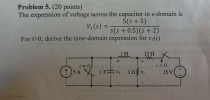
Problem 5. (20 points) The expression of voltage across the capacitor in s-domain is V1(s) = s(s +0.5) (s + 2) For t0, derive the time-domain expression for vi(t) 1 H 15? 15 v
Please solve this for me, if you're pretty sure about the
solution
Problem 5. (20 points) The expression of voltage across the capacitor in s-domain is V1(s) = s(s +0.5) (s + 2) For t0, derive the time-domain expression for vi(t) 1 H 15? 15 v
NOTE: please don't answer unless you are very sure about your answer and tell me WHY...
NOTE: please don't answer unless you are very sure about your answer and tell me WHY you chose this answer If Special Relativity is correct, the Michelson-Morley experiment with equal arms of length L parallel and perpendicular to the earth’s motion should have transit times of: a. greater than 2L/c in both arms b. greater than 2L/c only in the parallel arm c. greater than 2L/c only in the perpendicular arm d. 2L/c in each arm e. less than 2L/c...
 Pls point the option for the questions
QUESTION 4 2 points Save Answer A pair of gears with 20°, full-depth, involute teeth transmits 20 hp while the pinion rotates at 1500 rpm. The module is 6 mm, and the quality number is A11. The pinion has 17 teeth, and the gear has 77 teeth. The face width is 50mm. The input power is from an electric motor, and the load is a vibrating screen. The drive is a commercial enclosed...
Pls point the option for the questions
QUESTION 4 2 points Save Answer A pair of gears with 20°, full-depth, involute teeth transmits 20 hp while the pinion rotates at 1500 rpm. The module is 6 mm, and the quality number is A11. The pinion has 17 teeth, and the gear has 77 teeth. The face width is 50mm. The input power is from an electric motor, and the load is a vibrating screen. The drive is a commercial enclosed...
 QUICK ANSWER PLS
What is the result of the following prefix expression? + 10 + 54
QUICK ANSWER PLS
What is the result of the following prefix expression? + 10 + 54
 Pls, answer correctly. Skip if you don't know correct
answer.
Problem 10 - Simple and Compound Interest Find the following effective rates of interest: a) Under simple interest rate of 4%. The effective rate of interest in the 9 th year is ig = b) Under simple interest rate of 4%. The effective rate of interest in the 13 th year is ia = %3D c) Under compound interest rate of 4%. The effective rate of interest in the 9...
Pls, answer correctly. Skip if you don't know correct
answer.
Problem 10 - Simple and Compound Interest Find the following effective rates of interest: a) Under simple interest rate of 4%. The effective rate of interest in the 9 th year is ig = b) Under simple interest rate of 4%. The effective rate of interest in the 13 th year is ia = %3D c) Under compound interest rate of 4%. The effective rate of interest in the 9...
 Please answer both parts fully. Attached is the answer key.
Please make sure the answer matches for both parts
10-17 (a) Derive an expression for the temperature dependence of the thermal con ductivity of an ideal gas. (b) Calculate the thermal conductivity of helium (considered as an ideal gas) at 300 K Tia. (b) 0.058 J K-1 m-1 s-1. 10-17 (a) λ
10-17 (a) Derive an expression for the temperature dependence of the thermal con ductivity of an ideal gas....
Please answer both parts fully. Attached is the answer key.
Please make sure the answer matches for both parts
10-17 (a) Derive an expression for the temperature dependence of the thermal con ductivity of an ideal gas. (b) Calculate the thermal conductivity of helium (considered as an ideal gas) at 300 K Tia. (b) 0.058 J K-1 m-1 s-1. 10-17 (a) λ
10-17 (a) Derive an expression for the temperature dependence of the thermal con ductivity of an ideal gas....
 kinematics please
answer ASAP
2 (20 points) Design a compound, reverted, 20° standard spur gear train for a gear ratio of 70:1 . (a) Specify the teeth numbers (2 18 for the pinions); (b) With the diametral pitch of 10 for all gears, calculate their outside diameters and the contact ratio for the pair with the larger gear ratio.
2 (20 points) Design a compound, reverted, 20° standard spur gear train for a gear ratio of 70:1 . (a) Specify...
kinematics please
answer ASAP
2 (20 points) Design a compound, reverted, 20° standard spur gear train for a gear ratio of 70:1 . (a) Specify the teeth numbers (2 18 for the pinions); (b) With the diametral pitch of 10 for all gears, calculate their outside diameters and the contact ratio for the pair with the larger gear ratio.
2 (20 points) Design a compound, reverted, 20° standard spur gear train for a gear ratio of 70:1 . (a) Specify...
 Two 20° involute full depth spur gears are used to transmit the power and speeds shown. The material for both pinion and gear is specified as through- hardened steel tempered to 300 BHN surface hardness. Both pinion and gear are precision cut for "very accurate” gearing. For a factor of safety of 2 and assuming a diametral pitch, Pof 9. specify face widths of the pinion and gear using only the AGMA bending fatigue analysis. State all assumptions used to...
 Two 20° involute full depth spur gears are used to transmit the power and speeds shown. The material for both pinion and gear is specified as through-hardened steel tempered to 300 BHN surface hardness. Both pinion and gear are precision cut for "very accurate" gearing. For a factor of safety of 2 and assuming a diametral pitch, Prof 9, specify face widths of the pinion and gear using only the AGMA bending fatigue analysis. State all assumptions used to determine...
 1. Starting with one of Newton's laws and your free body
diagram, derive an expression for the normal force exerted on the
block by floor.
- Assess you answer in the following way: If you
let \(\theta\) = 0, what does your
solution predict for the normal force? Does this make physical
sense?
2. Starting with one of Newton's laws and your free body
diagram, derive an expression for the coefficient of kinetic
friction \(\mu_{k}\) between the
block and the...
1. Starting with one of Newton's laws and your free body
diagram, derive an expression for the normal force exerted on the
block by floor.
- Assess you answer in the following way: If you
let \(\theta\) = 0, what does your
solution predict for the normal force? Does this make physical
sense?
2. Starting with one of Newton's laws and your free body
diagram, derive an expression for the coefficient of kinetic
friction \(\mu_{k}\) between the
block and the...
 Please solve this for me, if you're pretty sure about the
solution
Problem 5. (20 points) The expression of voltage across the capacitor in s-domain is V1(s) = s(s +0.5) (s + 2) For t0, derive the time-domain expression for vi(t) 1 H 15? 15 v
Please solve this for me, if you're pretty sure about the
solution
Problem 5. (20 points) The expression of voltage across the capacitor in s-domain is V1(s) = s(s +0.5) (s + 2) For t0, derive the time-domain expression for vi(t) 1 H 15? 15 v
Most questions answered within 3 hours.
-
Where is the error in this code sequence?
String s1 = "Hello";
String s2 = "ello";...
asked 10 months ago -
Financial data for Joel de Paris, Inc., for last year
follow:
Joel de Paris, Inc.
Balance...
asked 10 months ago -
Consider this reaction:
Al2(SO4)3 (aq)+ BaCl3
(aq) Al2Cl6 (aq)- +
3BaSO4(s) . What is the...
asked 10 months ago -
Suppose that Savneet is considering increasing her
recent random sample from 20 car rentals to 40...
asked 10 months ago -
Trucks arrive at an unloading terminal at an average rate of 120
per hour.
Trucks arrive...
asked 10 months ago -
Why are methanol and ethanol completely soluble in water while
octanol is not very little soluble....
asked 10 months ago -
A facilities manager at a university reads in a research report
that the mean amount of...
asked 10 months ago -
When the CuSO4 is rehydrated by adding water to the anhydrous
compound, is this an endothermic...
asked 10 months ago -
A ray of sunlight is passing from diamond into crown glass; the
angle of incidence is...
asked 10 months ago -
A block of mass 0.249 kg is placed on top of a light, vertical
spring of...
asked 10 months ago -
how do the kidneys compensate in the presences of acidosis
a) trigger hyperventilate
b) reserve acid...
asked 10 months ago -
Question 501 pts
The rental rate of capital to the firm increases. Which of the
following...
asked 10 months ago