A diatomic gas consists of molecules with 27 amu at 1 atm pressure and 0 deg...
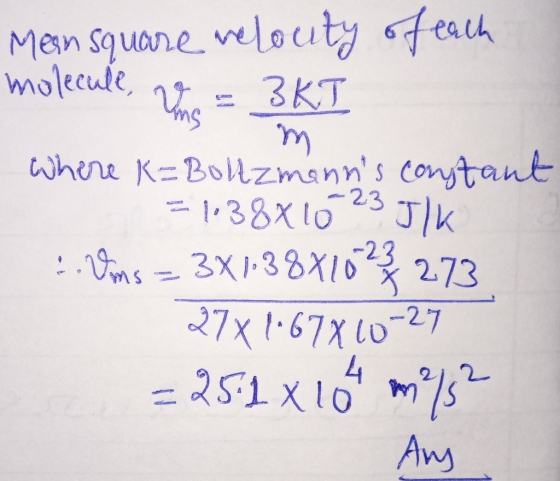
A diatomic gas consists of molecules with 27 amu at 1 atm pressure and 0 deg C.
What is the Mean Square Velocity of the individual molecules of this gas, in m/s?
Homework Answers
Add Answer to:
A diatomic gas consists of molecules with 27 amu at 1 atm
pressure and 0 deg...
Considering the nature of a diatomic molecule, a (6.00) L cylinder contains nitrogen gas at (20.0...
Considering the nature of a diatomic molecule, a (6.00) L cylinder contains nitrogen gas at (20.0 ) C and a pressure of (2.30)) atm. Find the root mean square speed of the molecules. The mass of one nitrogen gas molecule is 4.65 × 10⁻²⁶ kg Give your answer in m/s with 3 significant figures.
Part A A 1.00-mol sample of an ideal diatomic gas, originally at 1.00 atm and 27°C,...
 Part A A 1.00-mol sample of an ideal diatomic gas, originally at 1.00 atm and 27°C, expands adiabatically to 1.85 times its initial volume. What are the final pressure for the gas? (Assume no molecular vibration.) 0 AM O O ? Pf= atm Submit Request Answer Part B What are the final temperature for the gas? Express your answer using two significant figures. 10 ADC 0 2 ? T;
Determine the following speeds (in m/s) for molecules of the diatomic gas hydrogen at a temperature...
 Determine the following speeds (in m/s) for molecules of the diatomic gas hydrogen at a temperature of 815 K. Use 2.02 x 10⁻³ kg/mole as the molar mass for hydrogen molecules. (a) root mean square speed 3176 m/s (b) average speed Check your text for an expression which will allow you to determine the average speed of the gas molecules. Enter the temperature in degrees kelvin, take into consideration that we are dealing with a diatomic gas, and be sure...
If the partial pressure of the diatomic gas is 0.690 atm, what is the total pressure?
 Consider this molecular-level representation of a mixture of gases. If the partial pressure of the diatomic gas is 0.690 atm, what is the total pressure?
A heat engine consists of 0.85 moles of diatomic gas following three steps. Expansion from 0.03...
A heat engine consists of 0.85 moles of diatomic gas following three steps. Expansion from 0.03 m^3 to 0.1 m^3 at a constant pressure of 0.7 atm. Then, the pressure is reduced at constant volume. Finally, it returns to the original point by following an isothermal path in a PV diagram. What is the change in entropy of the gas for one cycle? What is the change in entropy of the universe if the hot reservoir is 1200 K and...
physical chemistry problem Consider a sample of CO₂ a pressure of I atm. For mass is...
 physical chemistry problem
Consider a sample of CO₂ a pressure of I atm. For mass is 0.044 kg/mol. gas the at a con temperature of 298 K and 0 = 5.21019 m² and the molar (a) calculate the average velocity of the molecules in the gas. 6) Calculate the mean free path of the coa molecules. (c) Calculate the total number of colisions Zil of the gas molectes.
physical chemistry problem
Consider a sample of CO₂ a pressure of I atm. For mass is 0.044 kg/mol. gas the at a con temperature of 298 K and 0 = 5.21019 m² and the molar (a) calculate the average velocity of the molecules in the gas. 6) Calculate the mean free path of the coa molecules. (c) Calculate the total number of colisions Zil of the gas molectes.
10. A closed, diatomic gas system, m=0.0968kg, has an initial pressure, P=250kPa and volume of 5.501,...
 10. A closed, diatomic gas system, m=0.0968kg, has an initial pressure, P=250kPa and volume of 5.501, at 273.OK. At this temperature, the root-mean-squared speed of the molecules is 206.4m/s. a. Calculate the average mass per gas particle. 8 8. 8 8 b. Determine the total thermal energy of the gas system. 00 8 8 8 8 C. Estimate the isobaric specific heat capacity of the gas.
2.00 mol diatomic perfect gas molecules, for which Cp = 7/2R, is changed from 25°C and...
2.00 mol diatomic perfect gas molecules, for which Cp = 7/2R, is changed from 25°C and 1.50 atm to 135°C and 7.00 atm. Without doing any calculations, is the change in temperature or the change in pressure more important in determining the overall change in entropy (of the system)? Why? What can you conclude about the sign of ΔSsys . Calculate ΔSsys for the change.
A 2.00 mol sample of a diatomic ideal gas expands slowly and adiabatically from a pressure...
 A 2.00 mol sample of a diatomic ideal gas expands slowly and adiabatically from a pressure of 5.04 atm and a volume of L2 Lto a final volume of 30.8 L (a) What is the final pressure of the gas? 1.44 atm (b) What are the initial and final temperatures? initial 385.72 final 269.39 (c) Find Qfor the gas during this process. 0 (d) Find ??¡nt for the gas during this process. What is the relationship between the internal energy...
A gas mixture has a total pressure of 0.51 atm and consists of He and Ne....
A gas mixture has a total pressure of 0.51 atm and consists of He and Ne. If the partial pressure of He in the mixture is 0.34 atm, what is the partial pressure of the Ne in the mixture?
 Part A A 1.00-mol sample of an ideal diatomic gas, originally at 1.00 atm and 27°C, expands adiabatically to 1.85 times its initial volume. What are the final pressure for the gas? (Assume no molecular vibration.) 0 AM O O ? Pf= atm Submit Request Answer Part B What are the final temperature for the gas? Express your answer using two significant figures. 10 ADC 0 2 ? T;
 Determine the following speeds (in m/s) for molecules of the diatomic gas hydrogen at a temperature of 815 K. Use 2.02 x 10⁻³ kg/mole as the molar mass for hydrogen molecules. (a) root mean square speed 3176 m/s (b) average speed Check your text for an expression which will allow you to determine the average speed of the gas molecules. Enter the temperature in degrees kelvin, take into consideration that we are dealing with a diatomic gas, and be sure...
 physical chemistry problem
Consider a sample of CO₂ a pressure of I atm. For mass is 0.044 kg/mol. gas the at a con temperature of 298 K and 0 = 5.21019 m² and the molar (a) calculate the average velocity of the molecules in the gas. 6) Calculate the mean free path of the coa molecules. (c) Calculate the total number of colisions Zil of the gas molectes.
physical chemistry problem
Consider a sample of CO₂ a pressure of I atm. For mass is 0.044 kg/mol. gas the at a con temperature of 298 K and 0 = 5.21019 m² and the molar (a) calculate the average velocity of the molecules in the gas. 6) Calculate the mean free path of the coa molecules. (c) Calculate the total number of colisions Zil of the gas molectes.
 10. A closed, diatomic gas system, m=0.0968kg, has an initial pressure, P=250kPa and volume of 5.501, at 273.OK. At this temperature, the root-mean-squared speed of the molecules is 206.4m/s. a. Calculate the average mass per gas particle. 8 8. 8 8 b. Determine the total thermal energy of the gas system. 00 8 8 8 8 C. Estimate the isobaric specific heat capacity of the gas.
 A 2.00 mol sample of a diatomic ideal gas expands slowly and adiabatically from a pressure of 5.04 atm and a volume of L2 Lto a final volume of 30.8 L (a) What is the final pressure of the gas? 1.44 atm (b) What are the initial and final temperatures? initial 385.72 final 269.39 (c) Find Qfor the gas during this process. 0 (d) Find ??¡nt for the gas during this process. What is the relationship between the internal energy...
Most questions answered within 3 hours.
-
Where is the error in this code sequence?
String s1 = "Hello";
String s2 = "ello";...
asked 11 months ago -
Financial data for Joel de Paris, Inc., for last year
follow:
Joel de Paris, Inc.
Balance...
asked 11 months ago -
Consider this reaction:
Al2(SO4)3 (aq)+ BaCl3
(aq) Al2Cl6 (aq)- +
3BaSO4(s) . What is the...
asked 11 months ago -
Suppose that Savneet is considering increasing her
recent random sample from 20 car rentals to 40...
asked 11 months ago -
Trucks arrive at an unloading terminal at an average rate of 120
per hour.
Trucks arrive...
asked 11 months ago -
Why are methanol and ethanol completely soluble in water while
octanol is not very little soluble....
asked 11 months ago -
A facilities manager at a university reads in a research report
that the mean amount of...
asked 11 months ago -
When the CuSO4 is rehydrated by adding water to the anhydrous
compound, is this an endothermic...
asked 11 months ago -
A ray of sunlight is passing from diamond into crown glass; the
angle of incidence is...
asked 11 months ago -
A block of mass 0.249 kg is placed on top of a light, vertical
spring of...
asked 11 months ago -
how do the kidneys compensate in the presences of acidosis
a) trigger hyperventilate
b) reserve acid...
asked 11 months ago -
Question 501 pts
The rental rate of capital to the firm increases. Which of the
following...
asked 11 months ago