
Homework Answers
Solution is attached in the image posted below.
Hope it helps.
If you have any query please comment in the comment box.
A positive response from your side will very helpful.
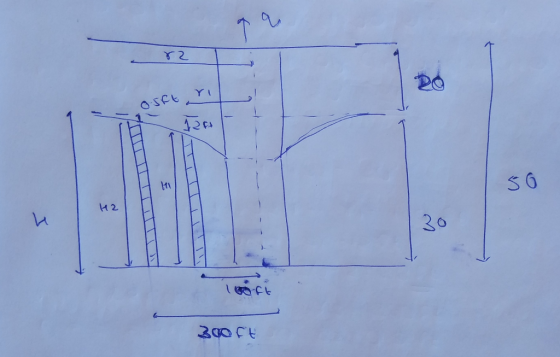
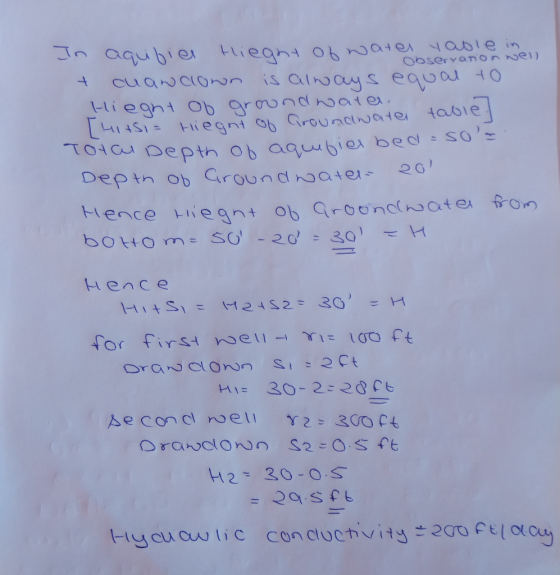
![q=KT [H2²_HP] 2.303 logior 8 ) - 2000 ft/day T [ 29.52-282] 2.303 Tug [300] = 4a319.22 ft3 laay yes maximum pumping Rate has](http://img.homeworklib.com/questions/5a307780-b6fd-11ea-8756-419ceaefabc7.png?x-oss-process=image/resize,w_560)
Add Answer to:
An engineer has been asked to investigate illegal pumping of groundwater from an unconfined aquifer. The...
For an unconfined aquifer with uniform recharge problem, the initial water table is 10 meters abo...
 For an unconfined aquifer with uniform recharge problem, the
initial water table is 10 meters above the confining layer. Given
recharge rate from rainfall 50 cm/year, pumping rate 1000 m^3 /day,
aquifer hydraulic conductivity 10 m/day, calculate the effective
radius and calculate steady-state groundwater head at 100 meters
away from the pumping well.
Con-inh odias
Con-inh odias
For an unconfined aquifer with uniform recharge problem, the
initial water table is 10 meters above the confining layer. Given
recharge rate from rainfall 50 cm/year, pumping rate 1000 m^3 /day,
aquifer hydraulic conductivity 10 m/day, calculate the effective
radius and calculate steady-state groundwater head at 100 meters
away from the pumping well.
Con-inh odias
Con-inh odias
After a long period of pumping from an unconfined aquifer at a constant rate of 850...
After a long period of pumping from an unconfined aquifer at a constant rate of 850 m3/day, head is measured in the pumping well (r = 0.4 m, H = 9.9 m) and in a nearby monitoring well (r = 50 m, H = 18.4 m). The initial saturated thickness of the aquifer is 20 m. Assuming steady-state conditions, compute the hydraulic conductivity of the aquifer using Darcy's law. State your assumptions.
A well is constructed in a confined aquifer. The aquifer has a uniform thickness of 50...
A well is constructed in a confined aquifer. The aquifer has a uniform thickness of 50 ft overlain by a aquitard and the bottom is 115 ft below ground surface (bgs). A pumping test weas used to determine the hydraulic conductivity of the aquifer. The initial piezometric (potentiometric) surface of the confined aquifer was 49 ft bgs at the pumping well and the observation wells. After water was pumped at a rate of 0.46 cu ft/sec for several days, the...
Question 5: (25 marks) A fully penetrating pumping well is located in a confined aquifer that can be considered to have an infinite extent in all directions. There is no recharge to the aquifer a...
 Question 5: (25 marks) A fully penetrating pumping well is located in a confined aquifer that can be considered to have an infinite extent in all directions. There is no recharge to the aquifer and no other pumping wells in the area. There are two observation wells located at 100 and 500 m, respectively, from the pumping wells. The aquifer and the pumping well have the following properties: Depth to top of aquifer: 50 m Aquifer thickness: 5 m Aquifer...
A groundwater extraction well is installed in an aquifer (hydraulic conductivity = 2,000 gpd/ft2, gradient =...
A groundwater extraction well is installed in an aquifer (hydraulic conductivity = 2,000 gpd/ft2, gradient = 0.01, and aquifer thickness = 50 ft). The design pumping rate is 60 gpm. Delineate the capture zone of this recovery well by specifying the following characteristic distances of the capture zone: A) the side-stream distance from the well to the envelop of the capture zone at the line of the pumping well, B) the down-stream distance from the well to stagnation point of...
Use the diagram of the unconfined (water-table) aquifer on the next page for the following questions....
 Use the diagram of the unconfined (water-table) aquifer on the next page for the following questions. A. This area receives 116 cm/yr of rainfall. It is not vegetated. Evaporation, as measured 2. by pan experiments, totals 90 cm/yr. The hydraulic conductivity of the aquifer unit is homogeneous and isotropic, and has been measured at 0.32 f/day. Where is the groundwater divide in the unconfined aquifer? B. What is the maximum height of the water table? C. What is the water...
6.124pts) Giselle has installed a water production well in an unconfined aquifer, She is concerne...
 please explain the answer for part D.
6.124pts) Giselle has installed a water production well in an unconfined aquifer, She is concerned about the possibility that when the well is in use drawdown will ower the piezometric and that the water will stop flowing. She has asked for your help in the analysis well surface to the bottom of the Currently, the drawdown at observation well A, 120.0 m from the pumped well, s 12.0m. Observation at 80.0 meters is...
please explain the answer for part D.
6.124pts) Giselle has installed a water production well in an unconfined aquifer, She is concerned about the possibility that when the well is in use drawdown will ower the piezometric and that the water will stop flowing. She has asked for your help in the analysis well surface to the bottom of the Currently, the drawdown at observation well A, 120.0 m from the pumped well, s 12.0m. Observation at 80.0 meters is...
When groundwater is withdrawn substantially through a well from an unconfined aquifer, the water table around...
When groundwater is withdrawn substantially through a well from an unconfined aquifer, the water table around the well will rise expand fall remain unchanged
An aquifer test with a constant pumping rate of 200 gpm was conducted in a confined aquifer with ...
 An aquifer test with a constant pumping rate of 200 gpm was conducted in a confined aquifer with a saturated thickness of 12 m. Head measurements in an observation well located 76.2 m (250 ft) from the pumping well yields the following plot. Use the Cooper-Jacob (1946) straight-line method to compute transmissivity [m/d], hydraulic conductivity [m/d and m/s], storativity and specific storage m ] of the aquifer 0 0.2 0.4 0.6 0.8 1.2 0.1 10 100 1000 Time (min)
An...
An aquifer test with a constant pumping rate of 200 gpm was conducted in a confined aquifer with a saturated thickness of 12 m. Head measurements in an observation well located 76.2 m (250 ft) from the pumping well yields the following plot. Use the Cooper-Jacob (1946) straight-line method to compute transmissivity [m/d], hydraulic conductivity [m/d and m/s], storativity and specific storage m ] of the aquifer 0 0.2 0.4 0.6 0.8 1.2 0.1 10 100 1000 Time (min)
An...
An unconfined aquifer has an initial thickness of 15.80 m. The initial water table is horizontal...
An unconfined aquifer has an initial thickness of 15.80 m. The initial water table is horizontal and located 4.7 m below the ground surface. A 15-cm diameter well is driven to the bottom of the aquifer and pumped at 3000 Lpm until steady state conditions are achieved. At this time the drawdown at the well is 4.35 m and the drawdown in an observation well located 850 m away is 0.12 m. (a) Make a sketch that defines the problem....
 For an unconfined aquifer with uniform recharge problem, the
initial water table is 10 meters above the confining layer. Given
recharge rate from rainfall 50 cm/year, pumping rate 1000 m^3 /day,
aquifer hydraulic conductivity 10 m/day, calculate the effective
radius and calculate steady-state groundwater head at 100 meters
away from the pumping well.
Con-inh odias
Con-inh odias
For an unconfined aquifer with uniform recharge problem, the
initial water table is 10 meters above the confining layer. Given
recharge rate from rainfall 50 cm/year, pumping rate 1000 m^3 /day,
aquifer hydraulic conductivity 10 m/day, calculate the effective
radius and calculate steady-state groundwater head at 100 meters
away from the pumping well.
Con-inh odias
Con-inh odias
 Question 5: (25 marks) A fully penetrating pumping well is located in a confined aquifer that can be considered to have an infinite extent in all directions. There is no recharge to the aquifer and no other pumping wells in the area. There are two observation wells located at 100 and 500 m, respectively, from the pumping wells. The aquifer and the pumping well have the following properties: Depth to top of aquifer: 50 m Aquifer thickness: 5 m Aquifer...
 Use the diagram of the unconfined (water-table) aquifer on the next page for the following questions. A. This area receives 116 cm/yr of rainfall. It is not vegetated. Evaporation, as measured 2. by pan experiments, totals 90 cm/yr. The hydraulic conductivity of the aquifer unit is homogeneous and isotropic, and has been measured at 0.32 f/day. Where is the groundwater divide in the unconfined aquifer? B. What is the maximum height of the water table? C. What is the water...
 please explain the answer for part D.
6.124pts) Giselle has installed a water production well in an unconfined aquifer, She is concerned about the possibility that when the well is in use drawdown will ower the piezometric and that the water will stop flowing. She has asked for your help in the analysis well surface to the bottom of the Currently, the drawdown at observation well A, 120.0 m from the pumped well, s 12.0m. Observation at 80.0 meters is...
please explain the answer for part D.
6.124pts) Giselle has installed a water production well in an unconfined aquifer, She is concerned about the possibility that when the well is in use drawdown will ower the piezometric and that the water will stop flowing. She has asked for your help in the analysis well surface to the bottom of the Currently, the drawdown at observation well A, 120.0 m from the pumped well, s 12.0m. Observation at 80.0 meters is...
 An aquifer test with a constant pumping rate of 200 gpm was conducted in a confined aquifer with a saturated thickness of 12 m. Head measurements in an observation well located 76.2 m (250 ft) from the pumping well yields the following plot. Use the Cooper-Jacob (1946) straight-line method to compute transmissivity [m/d], hydraulic conductivity [m/d and m/s], storativity and specific storage m ] of the aquifer 0 0.2 0.4 0.6 0.8 1.2 0.1 10 100 1000 Time (min)
An...
An aquifer test with a constant pumping rate of 200 gpm was conducted in a confined aquifer with a saturated thickness of 12 m. Head measurements in an observation well located 76.2 m (250 ft) from the pumping well yields the following plot. Use the Cooper-Jacob (1946) straight-line method to compute transmissivity [m/d], hydraulic conductivity [m/d and m/s], storativity and specific storage m ] of the aquifer 0 0.2 0.4 0.6 0.8 1.2 0.1 10 100 1000 Time (min)
An...
Most questions answered within 3 hours.
-
Where is the error in this code sequence?
String s1 = "Hello";
String s2 = "ello";...
asked 10 months ago -
Financial data for Joel de Paris, Inc., for last year
follow:
Joel de Paris, Inc.
Balance...
asked 10 months ago -
Consider this reaction:
Al2(SO4)3 (aq)+ BaCl3
(aq) Al2Cl6 (aq)- +
3BaSO4(s) . What is the...
asked 10 months ago -
Suppose that Savneet is considering increasing her
recent random sample from 20 car rentals to 40...
asked 10 months ago -
Trucks arrive at an unloading terminal at an average rate of 120
per hour.
Trucks arrive...
asked 10 months ago -
Why are methanol and ethanol completely soluble in water while
octanol is not very little soluble....
asked 10 months ago -
A facilities manager at a university reads in a research report
that the mean amount of...
asked 10 months ago -
When the CuSO4 is rehydrated by adding water to the anhydrous
compound, is this an endothermic...
asked 10 months ago -
A ray of sunlight is passing from diamond into crown glass; the
angle of incidence is...
asked 10 months ago -
A block of mass 0.249 kg is placed on top of a light, vertical
spring of...
asked 10 months ago -
how do the kidneys compensate in the presences of acidosis
a) trigger hyperventilate
b) reserve acid...
asked 10 months ago -
Question 501 pts
The rental rate of capital to the firm increases. Which of the
following...
asked 10 months ago