Which of the following molecules is nonpolar? a. H2 b. HF c. HCl d. HI e....
Which of the following molecules is nonpolar?
a. H2
b. HF
c. HCl
d. HI
e. HBr
Which of the following molecules can participate in Hydrogen bonding?
a. HF
b. CO2
c. CH4
d. H2S
Which of the following molecules is polar?
a. H2O
b. CO2
c. CH4
d. N2
e. None of the above
In lab, temperature changes caused by ________________ of liquids will be related to the strength of intermolecular forces.
a. Evaporation
b. Mass
c. Density
d. pH
Which one of the following substances has London dispersion forces as its only intermolecular force? (No hydrogen bonding, no dipole-dipole forces.)
a.CH3OH
b. NH3
c. H2S
d. CH4
Homework Answers
Request Answer!
We need at least 10 more requests to produce the answer.
0 / 10 have requested this problem solution
The more requests, the faster the answer.
Add Answer to:
Which of the following molecules is nonpolar?
a. H2
b. HF
c. HCl
d. HI
e....
select all types of intermolecular forces found between the following pair of molecules: HI and HCl...
 select all types of intermolecular forces found between the
following pair of molecules: HI and HCl
Select all types of intermolecular forces found between the following pairs of molecules: HI HCL and A) Hydrogen Bonding B) lon - Dipole forces C) London Dispersion forces D) Dipole - Dipole forces
select all types of intermolecular forces found between the
following pair of molecules: HI and HCl
Select all types of intermolecular forces found between the following pairs of molecules: HI HCL and A) Hydrogen Bonding B) lon - Dipole forces C) London Dispersion forces D) Dipole - Dipole forces
Draw the Best Lewis Dot Structure Is it polar or nonpolar. Is it predominant intermolecular force...
Draw the Best Lewis Dot Structure Is it polar or nonpolar. Is it predominant intermolecular force (H-bonding, dipole-dipole forces, dispersion forces,) Answer the questions above for CO2, CH3OH, Br2, HF, CF2H2, NH3
QUESTION 1 Identify the most important type of intermolecular force that would exist between neighboring molecules...
 QUESTION 1 Identify the most important type of intermolecular force that would exist between neighboring molecules in CH3CH2COOH A. London dispersion forces B. Dipole-dipole forces OC. Hydrogen bonding QUESTION 2 Identify the most important type of intermolecular force that would exist between neighboring molecules in NF3 O A. London dispersion forces B. Dipole-dipole forces OC. Hydrogen bonding QUESTION 3 Identify the most important type of intermolecular force that would exist between neighboring molecules in SO3 A. London dispersion forces B....
Which of the following compounds will only have London dispersion intermolecular attractions? {Hint: look for non-polar...
 Which of the following compounds will only have London dispersion intermolecular attractions? {Hint: look for non-polar molecules). O CO2 O CH3F O CH3OH O OCI2 O Naci QUESTION 4 What is the strongest (most attractive) intermolecular force in CH3F? O hydrogen bonding O London dispersion forces O ion-dipole attraction O jonic bonding O dipole-dipole attraction
2. Identify the strongest type of intermolecular forces in acetone, ethanol, water and hexane. (Structures listed...
 2. Identify the strongest type of intermolecular forces in acetone, ethanol, water and hexane. (Structures listed on page 15.) Experiment 2 Intermolecular Forces There are three general types of intermolecular forces. All substances exhibit London Dispersion Forces (LDF), and they are generally the weakest of the three types. These London forces are due to the attractions between small, temporary dipoles that arise from the constant, random movement of the electrons in a substance. As molar mass increases, the size of...
The gases CO,(9) and NH, (9) can be liquefied at 20°C by compressing them to sufficiently...
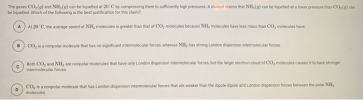 The gases CO,(9) and NH, (9) can be liquefied at 20°C by compressing them to sufficiently high pressures. A student claims that NH,) can be liquefied at a lower pressure than C0,G) can be liquefied. Which of the following is the best justification for this claim? A) At 20°C, the average speed of NH3 molecules is greater than that of CO, molecules because NH, molecules have less mass than Co, molecules have. (B) Co, is a nonpolar molecule that has...
What intermolecular forces of attraction are present among two molecules of N-methylethanamine? a. London Dispersion only...
 What intermolecular forces of attraction are present among two molecules of N-methylethanamine? a. London Dispersion only b. London Dispersion and Dipole-Dipole c. Dipole-Dipole only d. Hydrogen Bonding only e. London Dispersion and Hydrogen Bonding f. Dipole-Dipole and Hydrogen Bonding g. London Dispersion, Dipole-Dipole and Hydrogen Bonding
what would be the strongest and second strongest bond or force for number 3? (CsH12) molecules...
 what would be the strongest and second strongest bond or force for
number 3?
(CsH12) molecules arise from B carbon-carbon bonds C) dipole-dipole forces. ion-dipole interactions. E) London dispersion forces ment or answers the question. ULTIPLE CHOICE. Choose the one alternative that best completes the state 3) 3) In hydrogen iodide are the most important intermolecular forces A) covalent bonds B) dipole-dipole forces C) hydrogen bonding D) London dispersion forces E) polar covalent bonds MATCHING. Choose the item in column...
what would be the strongest and second strongest bond or force for
number 3?
(CsH12) molecules arise from B carbon-carbon bonds C) dipole-dipole forces. ion-dipole interactions. E) London dispersion forces ment or answers the question. ULTIPLE CHOICE. Choose the one alternative that best completes the state 3) 3) In hydrogen iodide are the most important intermolecular forces A) covalent bonds B) dipole-dipole forces C) hydrogen bonding D) London dispersion forces E) polar covalent bonds MATCHING. Choose the item in column...
We discussed the different types of intermolecular forces in this lesson. Which type would you expect...
We discussed the different types of intermolecular forces in this lesson. Which type would you expect to see in all polar molecules, but not in non-polar ones? A. hydrogen bonding B. ion-dipole forces C. dipole-dipole forces D. London dispersion forces
Question 9 0.2 pts Which one of the following substances has London dispersion forces as its...
 Question 9 0.2 pts Which one of the following substances has London dispersion forces as its only intermolecular force? (No hydrogen bonding, no dipole-dipole forces.) о сезон NH3 H2S O CH4 Question 10 0.2 pts True or False. Most of the substances used in this investigation are extremely volatile (easily evaporate) and should be used with care in a fume hood. True O False Question 11 O pts True or False. To avoid fainting or feeling light-headed in the lab...
 select all types of intermolecular forces found between the
following pair of molecules: HI and HCl
Select all types of intermolecular forces found between the following pairs of molecules: HI HCL and A) Hydrogen Bonding B) lon - Dipole forces C) London Dispersion forces D) Dipole - Dipole forces
select all types of intermolecular forces found between the
following pair of molecules: HI and HCl
Select all types of intermolecular forces found between the following pairs of molecules: HI HCL and A) Hydrogen Bonding B) lon - Dipole forces C) London Dispersion forces D) Dipole - Dipole forces
 QUESTION 1 Identify the most important type of intermolecular force that would exist between neighboring molecules in CH3CH2COOH A. London dispersion forces B. Dipole-dipole forces OC. Hydrogen bonding QUESTION 2 Identify the most important type of intermolecular force that would exist between neighboring molecules in NF3 O A. London dispersion forces B. Dipole-dipole forces OC. Hydrogen bonding QUESTION 3 Identify the most important type of intermolecular force that would exist between neighboring molecules in SO3 A. London dispersion forces B....
 Which of the following compounds will only have London dispersion intermolecular attractions? {Hint: look for non-polar molecules). O CO2 O CH3F O CH3OH O OCI2 O Naci QUESTION 4 What is the strongest (most attractive) intermolecular force in CH3F? O hydrogen bonding O London dispersion forces O ion-dipole attraction O jonic bonding O dipole-dipole attraction
 2. Identify the strongest type of intermolecular forces in acetone, ethanol, water and hexane. (Structures listed on page 15.) Experiment 2 Intermolecular Forces There are three general types of intermolecular forces. All substances exhibit London Dispersion Forces (LDF), and they are generally the weakest of the three types. These London forces are due to the attractions between small, temporary dipoles that arise from the constant, random movement of the electrons in a substance. As molar mass increases, the size of...
 The gases CO,(9) and NH, (9) can be liquefied at 20°C by compressing them to sufficiently high pressures. A student claims that NH,) can be liquefied at a lower pressure than C0,G) can be liquefied. Which of the following is the best justification for this claim? A) At 20°C, the average speed of NH3 molecules is greater than that of CO, molecules because NH, molecules have less mass than Co, molecules have. (B) Co, is a nonpolar molecule that has...
 What intermolecular forces of attraction are present among two molecules of N-methylethanamine? a. London Dispersion only b. London Dispersion and Dipole-Dipole c. Dipole-Dipole only d. Hydrogen Bonding only e. London Dispersion and Hydrogen Bonding f. Dipole-Dipole and Hydrogen Bonding g. London Dispersion, Dipole-Dipole and Hydrogen Bonding
 what would be the strongest and second strongest bond or force for
number 3?
(CsH12) molecules arise from B carbon-carbon bonds C) dipole-dipole forces. ion-dipole interactions. E) London dispersion forces ment or answers the question. ULTIPLE CHOICE. Choose the one alternative that best completes the state 3) 3) In hydrogen iodide are the most important intermolecular forces A) covalent bonds B) dipole-dipole forces C) hydrogen bonding D) London dispersion forces E) polar covalent bonds MATCHING. Choose the item in column...
what would be the strongest and second strongest bond or force for
number 3?
(CsH12) molecules arise from B carbon-carbon bonds C) dipole-dipole forces. ion-dipole interactions. E) London dispersion forces ment or answers the question. ULTIPLE CHOICE. Choose the one alternative that best completes the state 3) 3) In hydrogen iodide are the most important intermolecular forces A) covalent bonds B) dipole-dipole forces C) hydrogen bonding D) London dispersion forces E) polar covalent bonds MATCHING. Choose the item in column...
 Question 9 0.2 pts Which one of the following substances has London dispersion forces as its only intermolecular force? (No hydrogen bonding, no dipole-dipole forces.) о сезон NH3 H2S O CH4 Question 10 0.2 pts True or False. Most of the substances used in this investigation are extremely volatile (easily evaporate) and should be used with care in a fume hood. True O False Question 11 O pts True or False. To avoid fainting or feeling light-headed in the lab...
Most questions answered within 3 hours.
-
Where is the error in this code sequence?
String s1 = "Hello";
String s2 = "ello";...
asked 11 months ago -
Financial data for Joel de Paris, Inc., for last year
follow:
Joel de Paris, Inc.
Balance...
asked 11 months ago -
Consider this reaction:
Al2(SO4)3 (aq)+ BaCl3
(aq) Al2Cl6 (aq)- +
3BaSO4(s) . What is the...
asked 11 months ago -
Suppose that Savneet is considering increasing her
recent random sample from 20 car rentals to 40...
asked 11 months ago -
Trucks arrive at an unloading terminal at an average rate of 120
per hour.
Trucks arrive...
asked 11 months ago -
Why are methanol and ethanol completely soluble in water while
octanol is not very little soluble....
asked 11 months ago -
A facilities manager at a university reads in a research report
that the mean amount of...
asked 11 months ago -
When the CuSO4 is rehydrated by adding water to the anhydrous
compound, is this an endothermic...
asked 11 months ago -
A ray of sunlight is passing from diamond into crown glass; the
angle of incidence is...
asked 11 months ago -
A block of mass 0.249 kg is placed on top of a light, vertical
spring of...
asked 11 months ago -
how do the kidneys compensate in the presences of acidosis
a) trigger hyperventilate
b) reserve acid...
asked 11 months ago -
Question 501 pts
The rental rate of capital to the firm increases. Which of the
following...
asked 11 months ago