

Homework Answers
Add Answer to:
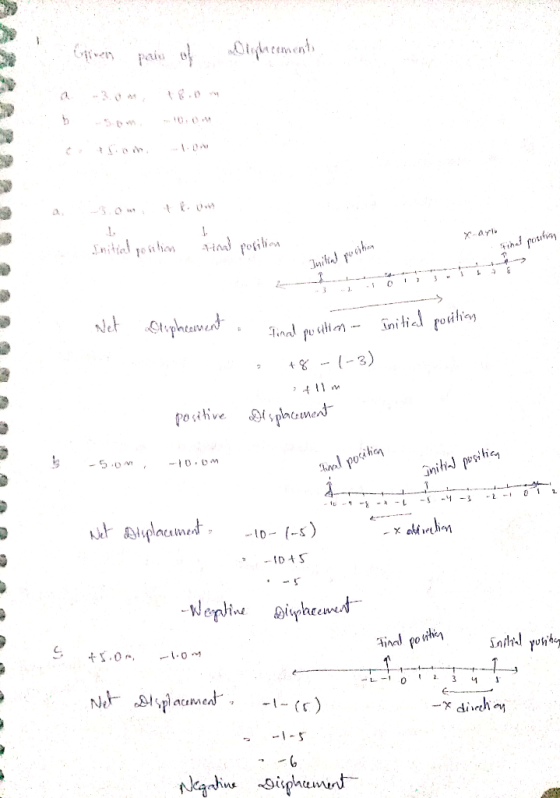
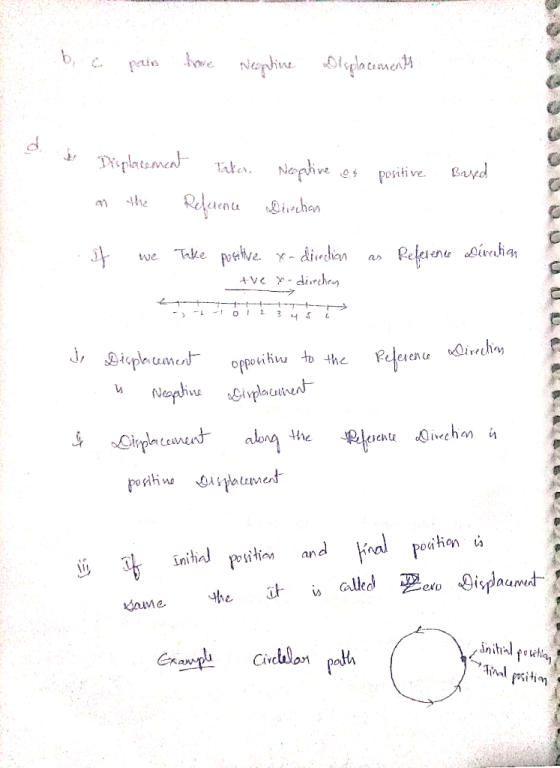
1. Here are three pairs of initial and final positions, respectively, along an x-axis. Which pairs...
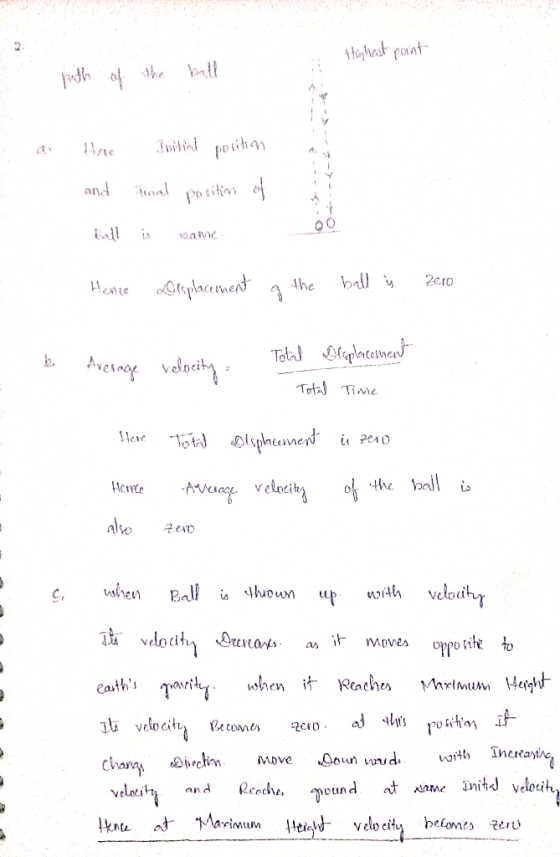
St.A balis thrown directy upward and experiences no air resistance. Which one of the following statements...
 St.A balis thrown directy upward and experiences no air resistance. Which one of the following statements about its motion is correct? a. The velocity of the ball is downward while it is traveling up and upward while it is traveling down. b. The velocity of the ball is upward while it is traveling up and downward while it is traveling down but is zero at the highest point when the ball stops. c. The velocity of the ball is downward...
1) A particle moves along the x-axis with an increasing speed. During the time for which...
1) A particle moves along the x-axis with an increasing speed. During the time for which this occurs, what MAY be the signs of the velocity and acceleration, respectively: A) positive and zero B) negative and negative C) positive and negative D) negative and zero E) negative and positive 2) After a ball is thrown upward and is in the air, what will its acceleration do? A) decrease and then increase B) decrease C) increase D) remain the same E)...
1. The graph in the figure shows the position of an object as a function of...
 1. The graph in the figure shows the position of an object as a function of time. The letters H-L represent particular moments of time. At which moments shown (H, I, etc.) is the speed of the object (a) the greatest? (b) the smallest? oi- Time 2. A car accelerates from 10m/s to 30 m/'s at a rate of 3 m/s. How far does the car travel while accelerating? Answer: x = 133 m 3. A ball is thrown directly...
The position of a particle moving along the x axis is given by x= 6.0.-1.0p, where...
 The position of a particle moving along the x axis is given by x= 6.0.-1.0p, where x is in meters and ria seconds. What is the position of the particle when it achieves its maximum speed in the positive x direction? a. 32m b. 12m c. 16 m d. 24 m c. 2.0m 12. 13. The position of a particle moving along the x axis is given by x (21 +221-6.0)m, where t is in s. What is the average...
1. A baseball player hits a home run over the left-field fence, which is 104 m...
1. A baseball player hits a home run over the left-field fence, which is 104 m from home plate. The ball is hit at a point 1.06 m directly above home plate, with an initial velocity directed 30.5° above the horizontal. By what distance does the baseball clear the 3.00 m high fence, if it passes over it 2.95 s after being hit? 2. A ball is thrown upward. It leaves the hand with a velocity of 16.4 m/s, having...
Student Name 1. A particle confined to motion along the x axis moves with constant acceleration...
 Student Name 1. A particle confined to motion along the x axis moves with constant acceleration fromx = 2.0 m to x 8.0 m during a 2.5-s time interval. The velocity of the particle at x - 8.0 m is 2.8 m/s. What is the acceleration during this time interval? 2. The polar coordinates of a point are r=5.50 m and Angle 240°. What are the Cartesian coordinates of this point? 3. On occasion, the notation A= [A, O] will...
14. Two masses are connected by a string which passes over a pulley with negligible mass...
 14. Two masses are connected by a string which passes over a pulley with negligible mass and friction. One mass hangs vertically and one mass slides on a frictionless 30.0 degree incline. The vertically hanging mass is 6.00 kg and the mass on the incline is 4.00 kg. The magnitude of the acceleration of the 4.00 kg mass is 15. Two masses are connected by a string which passes over a pulley with negligible mass and friction. One mass hangs...
An object moving in the *x direction experience an acceleration of *2.0 m/s^2- This mean the...
 An object moving in the *x direction experience an acceleration of *2.0 m/s^2- This mean the object is increasing its velocity by 2.0 m/s every second. travels 2.0 m In every second. is traveling at 2.0 m/s. is decreasing its velocity by 2.0 m/s every second. Suppose that an object is moving with a constant velocity. Which statement concerning Its acceleration must be correct? The acceleration is constantly increasing. The acceleration is a constant non-zero value. The acceleration is constantly...
Free-fall notion 1. A ball is thrown vertically upward at an initial speed of 49 m/s....
 Free-fall notion 1. A ball is thrown vertically upward at an initial speed of 49 m/s. Assume that the ball leaves the hand when it is 15 m above the ground (about the height of Kirkbride), and that the effects of air resistance can be ignored. Choose your landmark to be the ground; then at t -0, yo- +15 m, Vyo +49 m/s a. 5 pts) How fast is the launch speed in mph? Do you think this is a...
Directions: Read the questions carefully and write your answers in the space 1. Which of the...
 Directions: Read the questions carefully and write your answers in the space 1. Which of the following is the negation of the vector 12 cmi+0 cmj. a) (12 cm,0°) c) (12 cm, 180) b) (12 cm, 90) d) (-12 cm, 1809) 2. Which of the following is the vector (8 cm, 60°) in rectangular coordinates. a) 4 3i+4j c)8i+oj d) 4i+ 4v3j 3. The velocity of a projectile at its highest point is always (o) a Negative c Zero b...
 St.A balis thrown directy upward and experiences no air resistance. Which one of the following statements about its motion is correct? a. The velocity of the ball is downward while it is traveling up and upward while it is traveling down. b. The velocity of the ball is upward while it is traveling up and downward while it is traveling down but is zero at the highest point when the ball stops. c. The velocity of the ball is downward...
 1. The graph in the figure shows the position of an object as a function of time. The letters H-L represent particular moments of time. At which moments shown (H, I, etc.) is the speed of the object (a) the greatest? (b) the smallest? oi- Time 2. A car accelerates from 10m/s to 30 m/'s at a rate of 3 m/s. How far does the car travel while accelerating? Answer: x = 133 m 3. A ball is thrown directly...
 The position of a particle moving along the x axis is given by x= 6.0.-1.0p, where x is in meters and ria seconds. What is the position of the particle when it achieves its maximum speed in the positive x direction? a. 32m b. 12m c. 16 m d. 24 m c. 2.0m 12. 13. The position of a particle moving along the x axis is given by x (21 +221-6.0)m, where t is in s. What is the average...
 Student Name 1. A particle confined to motion along the x axis moves with constant acceleration fromx = 2.0 m to x 8.0 m during a 2.5-s time interval. The velocity of the particle at x - 8.0 m is 2.8 m/s. What is the acceleration during this time interval? 2. The polar coordinates of a point are r=5.50 m and Angle 240°. What are the Cartesian coordinates of this point? 3. On occasion, the notation A= [A, O] will...
 14. Two masses are connected by a string which passes over a pulley with negligible mass and friction. One mass hangs vertically and one mass slides on a frictionless 30.0 degree incline. The vertically hanging mass is 6.00 kg and the mass on the incline is 4.00 kg. The magnitude of the acceleration of the 4.00 kg mass is 15. Two masses are connected by a string which passes over a pulley with negligible mass and friction. One mass hangs...
 An object moving in the *x direction experience an acceleration of *2.0 m/s^2- This mean the object is increasing its velocity by 2.0 m/s every second. travels 2.0 m In every second. is traveling at 2.0 m/s. is decreasing its velocity by 2.0 m/s every second. Suppose that an object is moving with a constant velocity. Which statement concerning Its acceleration must be correct? The acceleration is constantly increasing. The acceleration is a constant non-zero value. The acceleration is constantly...
 Free-fall notion 1. A ball is thrown vertically upward at an initial speed of 49 m/s. Assume that the ball leaves the hand when it is 15 m above the ground (about the height of Kirkbride), and that the effects of air resistance can be ignored. Choose your landmark to be the ground; then at t -0, yo- +15 m, Vyo +49 m/s a. 5 pts) How fast is the launch speed in mph? Do you think this is a...
 Directions: Read the questions carefully and write your answers in the space 1. Which of the following is the negation of the vector 12 cmi+0 cmj. a) (12 cm,0°) c) (12 cm, 180) b) (12 cm, 90) d) (-12 cm, 1809) 2. Which of the following is the vector (8 cm, 60°) in rectangular coordinates. a) 4 3i+4j c)8i+oj d) 4i+ 4v3j 3. The velocity of a projectile at its highest point is always (o) a Negative c Zero b...
Most questions answered within 3 hours.
-
Where is the error in this code sequence?
String s1 = "Hello";
String s2 = "ello";...
asked 10 months ago -
Financial data for Joel de Paris, Inc., for last year
follow:
Joel de Paris, Inc.
Balance...
asked 10 months ago -
Consider this reaction:
Al2(SO4)3 (aq)+ BaCl3
(aq) Al2Cl6 (aq)- +
3BaSO4(s) . What is the...
asked 10 months ago -
Suppose that Savneet is considering increasing her
recent random sample from 20 car rentals to 40...
asked 10 months ago -
Trucks arrive at an unloading terminal at an average rate of 120
per hour.
Trucks arrive...
asked 10 months ago -
Why are methanol and ethanol completely soluble in water while
octanol is not very little soluble....
asked 10 months ago -
A facilities manager at a university reads in a research report
that the mean amount of...
asked 10 months ago -
When the CuSO4 is rehydrated by adding water to the anhydrous
compound, is this an endothermic...
asked 10 months ago -
A ray of sunlight is passing from diamond into crown glass; the
angle of incidence is...
asked 10 months ago -
A block of mass 0.249 kg is placed on top of a light, vertical
spring of...
asked 10 months ago -
how do the kidneys compensate in the presences of acidosis
a) trigger hyperventilate
b) reserve acid...
asked 10 months ago -
Question 501 pts
The rental rate of capital to the firm increases. Which of the
following...
asked 10 months ago