
Homework Answers
Cost minimization is a basic rule used by producers to determine what mix of labour and capital produces output at lowest cost .in other words what the most cost effective method of delivering goods and services would be while maintaining a desired level of quality
An essential financial strategy it is important to understand why cost minimization is important and how it works
short run: q= f(L)
long run: q=(K,L)
in the long run a producers has the flexibility over all aspects of production how many workers to hire how big of a factory to have what technology to use and so on. in more specific economic terms a producers can vary both amount of capital and the amount of labour it uses in the long run
therefore the long run production function has 2 inputs capital (K) and labour (L).in the table provided here q represents the quantity of output that is created
choices of production function:
short run : q=f(L)
long run : q=f(K,L)
in many business there are a number of ways in which a particular quantity of output can get created .if your business is making sweaters for example you could sweaters either by hiring people and buying knitting needles or by buying or renting some automated knitting machinery
in economic terms ,the first process uses a small quantity of labour (I.e labour sensitive) wheras the second process uses a large quantity of capital and a quantity of labor (i.e is capital intensive).you could even choose a process that is in between these 2 extremes.
given that there are often a number of different ways to produce a given quantity of output ,how can a company deside what mix of capital and labour to use not surprisingly companies ARE GENERALLY going to want to choose combination that produces a given quantity of output at the lowest cost
one opetion would be to map out all of the combinations of labour and capital that would yield the desired quantity of iutput calculate the cost of each of these options and then choose the option with the lowest cost unfortunately this can get pretty tedious and is in some cases not feasible
luckily there is a simple condition that companies can uses to determine whether can used to determine wheather their mix of capital and labour is cost" MINIMIZING"
2.MC stands for marginal (extra) cost incurred by a firm when its production raises by one unit .MR stands for marginal (extra)revenue a firm receives from producing one extra unit of output . as a firm is trying to maximise its profits ,it needs to consider what happens when it changes its production by one unit .the firm will of course incure an extra cost from producing an extra cost from producving an extra unit. if the marginal cost is bigger than the marginal cost is bigger than the fiurm should realise that producing an extra unit of output was not profitable .the firm should thus cut down some of its production .if the marginal cost is smaller than the marginal revenue then it is profitable for the firm to produces an extra unit of output. the firm to produce extra units of output as long as the marginal revenue it receives from that unit exceeds the marginal cost. the firm should continue doing this until exceeds the marginal cost. the firm should continue doing this until MC=MR a point at which they should keep production constant because producing an extra unit beyong this point creates a higher marginal cost for the firm that it creates marginal revenue.
Add Answer to:
2. With the help of calculus, prove the following. w MP a. The condition for cost...
1. Find out the following values from the graph: profit, total costs, labor cost, capital cost....
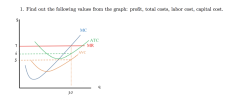 1. Find out the following values from the graph: profit, total costs, labor cost, capital cost. MC ATC -MR - AVC 30
A cost minimizing firm’s production function is Q=2KL. The price of labor, w, is currently $4,...
A cost minimizing firm’s production function is Q=2KL. The price of labor, w, is currently $4, and the price of capital, r, is currently $1. At the firm’s current level of output, it has total costs of $160. Input prices change such that the wage rate is now 8 times the rental rate. The firm adjusts its input combination, but leaves total output unchanged. Answer the questions below as you solve for the cost - minimizing input combination after the...
The following formula shows that the firm’s “markup” over marginal cost depends inversely on the elasticity...
 The following formula shows that the firm’s “markup” over
marginal cost depends inversely on the elasticity of market demand,
which is called "Lerner Index". Prove this formula step by step
from a monopoly's profit-maximization problem.
The following formula shows that the firm's “markup” over marginal cost depends inversely on the elasticity of market demand, which is called "Lerner Index". Prove this formula step by step from a monopoly's profit-maximization problem. Pm – MC 1 1 Pm CDP
The following formula shows that the firm’s “markup” over
marginal cost depends inversely on the elasticity of market demand,
which is called "Lerner Index". Prove this formula step by step
from a monopoly's profit-maximization problem.
The following formula shows that the firm's “markup” over marginal cost depends inversely on the elasticity of market demand, which is called "Lerner Index". Prove this formula step by step from a monopoly's profit-maximization problem. Pm – MC 1 1 Pm CDP
3. Consider a firm with the production function F(KL)=1/31/3 You will be solving the profit maximization...
 3. Consider a firm with the production function F(KL)=1/31/3 You will be solving the profit maximization for this firm with both the two step and I step methods and proving that the final answers are identical. This big problem is broken up into the following smaller parts: (a) Setup and solve the long run cost minimization problem for the long run optimal amount of capital K*(w,,9) and labor L*(w,r.9), and the long run minimized cost C*(w, 5,9). (Hint: reduce the...
Help with 14-16 please. 14. A Monopoly: A. Will realize an economic profit if price exceeds...
 Help with 14-16 please.
14. A Monopoly: A. Will realize an economic profit if price exceeds ATC at the profit-maximizing/loss-minimizing level of output. B. Will realize an economic profit if ATC exceeds MR at the profit-maximizing/loss-minimizing level of output c. Will realize an economic loss if MC intersects the down-sloping portion of MR D. Always realizes an economic profit. MC ATC AVC 15. At equilibrium, the profit-maximizing monopolist facing the situation shown in the graph above will face: A. Average...
Help with 14-16 please.
14. A Monopoly: A. Will realize an economic profit if price exceeds ATC at the profit-maximizing/loss-minimizing level of output. B. Will realize an economic profit if ATC exceeds MR at the profit-maximizing/loss-minimizing level of output c. Will realize an economic loss if MC intersects the down-sloping portion of MR D. Always realizes an economic profit. MC ATC AVC 15. At equilibrium, the profit-maximizing monopolist facing the situation shown in the graph above will face: A. Average...
. Chapter 15/Monopoly > 647 Ans X10* Table 15-3 George has the following demand curve for...
 . Chapter 15/Monopoly > 647 Ans X10* Table 15-3 George has the following demand curve for selling vegemite: TR MR Price Quantity $10.00 S8.00 S6.00 3 $4.00 $2.00 MRE ME LP a proke In addition, George has a marginal cost of $3.00 per unit 146. Refer to Table 15-3. What is George's profit-maximizing level of output? a. 1 b. 2 What is Georges Pois minimizing level of operating H Q 41 MRT 1861 MR="MR Y TR d. 4 ANS: B...
1. Suppose a firm is producing output according to Q=1001KL. A. Draw a sketch of this...
 1. Suppose a firm is producing output according to Q=1001KL. A. Draw a sketch of this firm's isoquant map B. What equation do you use to find a cost-minimizing combination of inputs for a certain output level Q.? K C. The marginal products of labor and capital are given by MP, = 50, and L MPK = 50, L respectively. The price of labor is $5 per unit, and the price of K capital is $20 per unit. What is...
2. Assume that a firm needs to produce 500 units of output and it has ability...
 2. Assume that a firm needs to produce 500 units of output and it has ability to choose how much capital and labor to use as inputs. Firm's production function and marginal products of factors are 2VL, and MPK 100L ых 100K . Use this information to answer the following questions. In your computations keep at least three decimal places. (a) If initial wage w is $12.50 and rental rate of capital, r, is $17.50, find the cost-minimizing labor- capital...
4. Suppose the production function is given by (a) For a given set of prices w and v, find the conditional demands for...
 4. Suppose the production function is given by (a) For a given set of prices w and v, find the conditional demands for capital 1 labor. Also compute the cost function and (b) Compute the long run profit maximization quantity and the resulting profits (c) Solve for the unconditional demands for capital and labor (d) Show that the quantity produced and the profits from the unconditional demands are the same as the ones you got in part b
4. Suppose...
4. Suppose the production function is given by (a) For a given set of prices w and v, find the conditional demands for capital 1 labor. Also compute the cost function and (b) Compute the long run profit maximization quantity and the resulting profits (c) Solve for the unconditional demands for capital and labor (d) Show that the quantity produced and the profits from the unconditional demands are the same as the ones you got in part b
4. Suppose...
LO10-2 7. The following table summarizes the W News, p. 223)? Price Total Quantity Demanded hizes...
 LO10-2 7. The following table summarizes the W News, p. 223)? Price Total Quantity Demanded hizes the weekly sales and cost situation confronting a monopolist: Average Total Marginal Revenue Revenue Cost Cost Cost noted Total Marginal Total cost $22 20 $4 18 16 14 12 WNO 8 13 19 27 10 37 51 69 (a) Complete the table. (b) Graph the demand, MR. and MC curves on the following graph. (c) At what rate of out At what rate of...
 1. Find out the following values from the graph: profit, total costs, labor cost, capital cost. MC ATC -MR - AVC 30
 The following formula shows that the firm’s “markup” over
marginal cost depends inversely on the elasticity of market demand,
which is called "Lerner Index". Prove this formula step by step
from a monopoly's profit-maximization problem.
The following formula shows that the firm's “markup” over marginal cost depends inversely on the elasticity of market demand, which is called "Lerner Index". Prove this formula step by step from a monopoly's profit-maximization problem. Pm – MC 1 1 Pm CDP
The following formula shows that the firm’s “markup” over
marginal cost depends inversely on the elasticity of market demand,
which is called "Lerner Index". Prove this formula step by step
from a monopoly's profit-maximization problem.
The following formula shows that the firm's “markup” over marginal cost depends inversely on the elasticity of market demand, which is called "Lerner Index". Prove this formula step by step from a monopoly's profit-maximization problem. Pm – MC 1 1 Pm CDP
 3. Consider a firm with the production function F(KL)=1/31/3 You will be solving the profit maximization for this firm with both the two step and I step methods and proving that the final answers are identical. This big problem is broken up into the following smaller parts: (a) Setup and solve the long run cost minimization problem for the long run optimal amount of capital K*(w,,9) and labor L*(w,r.9), and the long run minimized cost C*(w, 5,9). (Hint: reduce the...
 Help with 14-16 please.
14. A Monopoly: A. Will realize an economic profit if price exceeds ATC at the profit-maximizing/loss-minimizing level of output. B. Will realize an economic profit if ATC exceeds MR at the profit-maximizing/loss-minimizing level of output c. Will realize an economic loss if MC intersects the down-sloping portion of MR D. Always realizes an economic profit. MC ATC AVC 15. At equilibrium, the profit-maximizing monopolist facing the situation shown in the graph above will face: A. Average...
Help with 14-16 please.
14. A Monopoly: A. Will realize an economic profit if price exceeds ATC at the profit-maximizing/loss-minimizing level of output. B. Will realize an economic profit if ATC exceeds MR at the profit-maximizing/loss-minimizing level of output c. Will realize an economic loss if MC intersects the down-sloping portion of MR D. Always realizes an economic profit. MC ATC AVC 15. At equilibrium, the profit-maximizing monopolist facing the situation shown in the graph above will face: A. Average...
 . Chapter 15/Monopoly > 647 Ans X10* Table 15-3 George has the following demand curve for selling vegemite: TR MR Price Quantity $10.00 S8.00 S6.00 3 $4.00 $2.00 MRE ME LP a proke In addition, George has a marginal cost of $3.00 per unit 146. Refer to Table 15-3. What is George's profit-maximizing level of output? a. 1 b. 2 What is Georges Pois minimizing level of operating H Q 41 MRT 1861 MR="MR Y TR d. 4 ANS: B...
 1. Suppose a firm is producing output according to Q=1001KL. A. Draw a sketch of this firm's isoquant map B. What equation do you use to find a cost-minimizing combination of inputs for a certain output level Q.? K C. The marginal products of labor and capital are given by MP, = 50, and L MPK = 50, L respectively. The price of labor is $5 per unit, and the price of K capital is $20 per unit. What is...
 2. Assume that a firm needs to produce 500 units of output and it has ability to choose how much capital and labor to use as inputs. Firm's production function and marginal products of factors are 2VL, and MPK 100L ых 100K . Use this information to answer the following questions. In your computations keep at least three decimal places. (a) If initial wage w is $12.50 and rental rate of capital, r, is $17.50, find the cost-minimizing labor- capital...
 4. Suppose the production function is given by (a) For a given set of prices w and v, find the conditional demands for capital 1 labor. Also compute the cost function and (b) Compute the long run profit maximization quantity and the resulting profits (c) Solve for the unconditional demands for capital and labor (d) Show that the quantity produced and the profits from the unconditional demands are the same as the ones you got in part b
4. Suppose...
4. Suppose the production function is given by (a) For a given set of prices w and v, find the conditional demands for capital 1 labor. Also compute the cost function and (b) Compute the long run profit maximization quantity and the resulting profits (c) Solve for the unconditional demands for capital and labor (d) Show that the quantity produced and the profits from the unconditional demands are the same as the ones you got in part b
4. Suppose...
 LO10-2 7. The following table summarizes the W News, p. 223)? Price Total Quantity Demanded hizes the weekly sales and cost situation confronting a monopolist: Average Total Marginal Revenue Revenue Cost Cost Cost noted Total Marginal Total cost $22 20 $4 18 16 14 12 WNO 8 13 19 27 10 37 51 69 (a) Complete the table. (b) Graph the demand, MR. and MC curves on the following graph. (c) At what rate of out At what rate of...
Most questions answered within 3 hours.
-
Where is the error in this code sequence?
String s1 = "Hello";
String s2 = "ello";...
asked 11 months ago -
Financial data for Joel de Paris, Inc., for last year
follow:
Joel de Paris, Inc.
Balance...
asked 11 months ago -
Consider this reaction:
Al2(SO4)3 (aq)+ BaCl3
(aq) Al2Cl6 (aq)- +
3BaSO4(s) . What is the...
asked 11 months ago -
Suppose that Savneet is considering increasing her
recent random sample from 20 car rentals to 40...
asked 11 months ago -
Trucks arrive at an unloading terminal at an average rate of 120
per hour.
Trucks arrive...
asked 11 months ago -
Why are methanol and ethanol completely soluble in water while
octanol is not very little soluble....
asked 11 months ago -
A facilities manager at a university reads in a research report
that the mean amount of...
asked 11 months ago -
When the CuSO4 is rehydrated by adding water to the anhydrous
compound, is this an endothermic...
asked 11 months ago -
A ray of sunlight is passing from diamond into crown glass; the
angle of incidence is...
asked 11 months ago -
A block of mass 0.249 kg is placed on top of a light, vertical
spring of...
asked 11 months ago -
how do the kidneys compensate in the presences of acidosis
a) trigger hyperventilate
b) reserve acid...
asked 11 months ago -
Question 501 pts
The rental rate of capital to the firm increases. Which of the
following...
asked 11 months ago