
Homework Answers
Add Answer to:
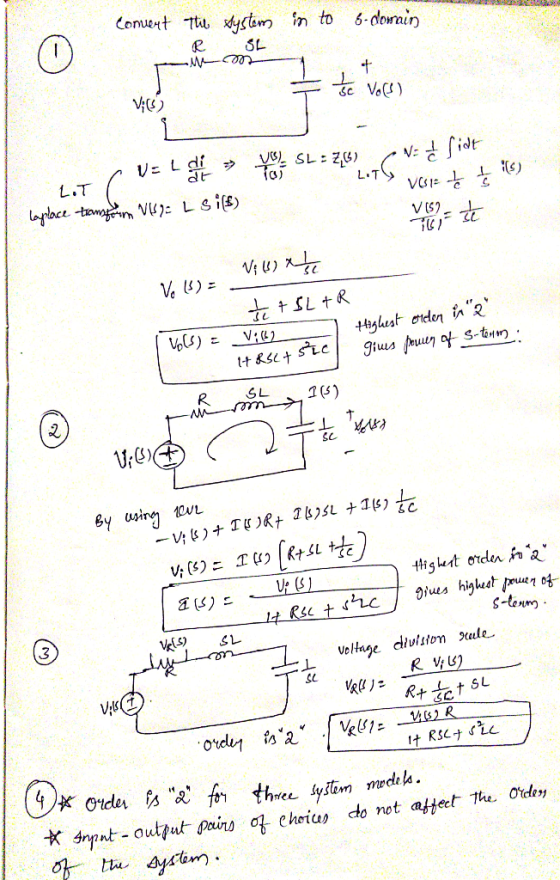
(25 pts) In this problem we will review the modeling procedure for the RLC circuit as...
System Modeling and Laplace transform: In this problem we will review the modeling proce- dure for the RLC circuit as shown below, and how to find the corresponding transfer function and step respons...
 System Modeling and Laplace transform: In this problem we will review the modeling proce- dure for the RLC circuit as shown below, and how to find the corresponding transfer function and step response Ri R2 Cv0) i2) i,(0) 3.1 Considering the input to be V(t) and the output to be Ve(t), find the transfer function of the system. To do that, first derive the differential equations for al the three loops and then take the Laplace transforms of them. 3.2...
Problem 1. (40 pts): A student in ME 345 shows you the following circuit with R=1.0...
 Problem 1. (40 pts): A student in ME 345 shows you the following circuit with R=1.0 k 2 and C = 1.0 uF Vout Vin c= a. What kind of circuit is this? What is the order of this dynamic system? b. Using KVL/KCL, derive the differential equation and put in standard form. What is the static sensitivity K of this system? c. What is the cutoff frequency (@c) of this circuit? What is the time constant (c)? How are...
1. Use Laplace Transforms to determine the function modeling the current in an RLC circuit with L 10 Henries, R 20 ohms...
 1. Use Laplace Transforms to determine the function modeling the current in an RLC circuit with L 10 Henries, R 20 ohms, C = 0.02 Farads, the initial charge is Q(0) = 0, the initial current is I(0) = 0, there is an electromotive force forcing the RLC circuit via the voltage function E(t) letting the current alternate naturally through the circuit. Use the fact the differential 10 sin (t), nd then, at t = 2T seconds, the battery is...
2. (14 marks total) This question deals with the series RLC circuit discussed in the classroom...
 2. (14 marks total) This question deals with the series RLC circuit discussed in the classroom and in the labs. Assume that the voltage source is arbitrary and there is a non-zero charge, g(0), on the capacitor at time t 0 when a switch is closed to start current flow. For this question assume variable R, L and C values. (a) Write down the differential equation that describes the charge on the capacitor as a function of time. (2 marks)...
Derive the ODE for the RLC circuit provided using Kirchoff's voltage and current laws. Indicate the...
 Derive the ODE for the RLC circuit provided using Kirchoff's
voltage and current laws. Indicate the order of the equation and
what conditions are required for a unique and completely defined
solution to existing. You should solve for the voltage across the
capacitor as the output, y(t), due to the excitation of the input
voltage, x(t), and the initial conditions, y(0) = c0 and
y'(0)=c1.
Compute the homogeneous solution to the ordinary differential
equation for unknown values of R, L...
Derive the ODE for the RLC circuit provided using Kirchoff's
voltage and current laws. Indicate the order of the equation and
what conditions are required for a unique and completely defined
solution to existing. You should solve for the voltage across the
capacitor as the output, y(t), due to the excitation of the input
voltage, x(t), and the initial conditions, y(0) = c0 and
y'(0)=c1.
Compute the homogeneous solution to the ordinary differential
equation for unknown values of R, L...
2. This problem is about an RLC circuit, which involves a resistor (of resistance R ohms),...
 2. This problem is about an RLC circuit, which involves a resistor (of resistance R ohms), an inductor (of L henries), and a capacitor (of C farads). There is also a voltage source (such as a battery) providing E(t) volts at time t. 0 Switch When the switch is closed there is a current of I(t) amperes. With the help of Kirchhoff's laws one can derive an ODE for I = I(t): LI" + RI' + + I = E'(t)...
2-a)-RLC components connected in series in a circuit supplied by a variable dc voltage can be described by the following differential equations: di(t) wherei@ is the loop current and V1(t) İs the vol...
 2-a)-RLC components connected in series in a circuit supplied by a variable dc voltage can be described by the following differential equations: di(t) wherei@ is the loop current and V1(t) İs the voltage drop across the inductor.+' The voltage drop across the resistor is given by Ohm's law vR(t) R i(t) and the voltage drop across the capacitor vc(t) is given by i(t) dt For a series circuit ye)t vit)t velt) v(t) where v(t) is applied voltage: Figure 3: RLC...
Problem 1 An RLC circuit (as shown in page 79 in the textbook) has a resistor...
 Problem 1 An RLC circuit (as shown in page 79 in the textbook) has a resistor of Rohms, an inductor with an inductance of 2 henries, and a capacitor with a capacitance of 0.5 farads. A battery is connected to the circuit giving a voltage V(1) = 2 cos(31) in volts) where 1 is given in seconds. 1) Write the differential equation satisfied by the charge Q(1) (in Coulombs) on the capacitor at time t. Answer: ii) Let $R=1$. Use...
3. (35 pts) Consider a standard RLC circuit with a resistor R, inductor L and capacitor C all in ...
 3. (35 pts) Consider a standard RLC circuit with a resistor R, inductor L and capacitor C all in series driven by a voltage source v(t). The voltage source gives pulses of 5 volts that last 1 msec every 10 msec, i.e. a square wave with period 10. We are interested in the output y(t) which is the current flowing through the circuit at time t. (a) Find a general expression for the frequency response H(jw) of this system (b)...
We want to analyze the following electrical circuit R + + C C R y The...
 We want to analyze the following electrical circuit R + + C C R y The output is the voltage across the resistor R,. We assign the state variables like this voltage across C xcurrent through L x3 = voltage across C, Then the state vector is x 1) Obtain the state-space representation of the system 2) Determine the observability of the state equation obtained in (1) 3) Let x(0) [x (0)x,(0) x,(0) =[1 0 o] Derive a control input...
 System Modeling and Laplace transform: In this problem we will review the modeling proce- dure for the RLC circuit as shown below, and how to find the corresponding transfer function and step response Ri R2 Cv0) i2) i,(0) 3.1 Considering the input to be V(t) and the output to be Ve(t), find the transfer function of the system. To do that, first derive the differential equations for al the three loops and then take the Laplace transforms of them. 3.2...
 Problem 1. (40 pts): A student in ME 345 shows you the following circuit with R=1.0 k 2 and C = 1.0 uF Vout Vin c= a. What kind of circuit is this? What is the order of this dynamic system? b. Using KVL/KCL, derive the differential equation and put in standard form. What is the static sensitivity K of this system? c. What is the cutoff frequency (@c) of this circuit? What is the time constant (c)? How are...
 1. Use Laplace Transforms to determine the function modeling the current in an RLC circuit with L 10 Henries, R 20 ohms, C = 0.02 Farads, the initial charge is Q(0) = 0, the initial current is I(0) = 0, there is an electromotive force forcing the RLC circuit via the voltage function E(t) letting the current alternate naturally through the circuit. Use the fact the differential 10 sin (t), nd then, at t = 2T seconds, the battery is...
 2. (14 marks total) This question deals with the series RLC circuit discussed in the classroom and in the labs. Assume that the voltage source is arbitrary and there is a non-zero charge, g(0), on the capacitor at time t 0 when a switch is closed to start current flow. For this question assume variable R, L and C values. (a) Write down the differential equation that describes the charge on the capacitor as a function of time. (2 marks)...
 Derive the ODE for the RLC circuit provided using Kirchoff's
voltage and current laws. Indicate the order of the equation and
what conditions are required for a unique and completely defined
solution to existing. You should solve for the voltage across the
capacitor as the output, y(t), due to the excitation of the input
voltage, x(t), and the initial conditions, y(0) = c0 and
y'(0)=c1.
Compute the homogeneous solution to the ordinary differential
equation for unknown values of R, L...
Derive the ODE for the RLC circuit provided using Kirchoff's
voltage and current laws. Indicate the order of the equation and
what conditions are required for a unique and completely defined
solution to existing. You should solve for the voltage across the
capacitor as the output, y(t), due to the excitation of the input
voltage, x(t), and the initial conditions, y(0) = c0 and
y'(0)=c1.
Compute the homogeneous solution to the ordinary differential
equation for unknown values of R, L...
 2. This problem is about an RLC circuit, which involves a resistor (of resistance R ohms), an inductor (of L henries), and a capacitor (of C farads). There is also a voltage source (such as a battery) providing E(t) volts at time t. 0 Switch When the switch is closed there is a current of I(t) amperes. With the help of Kirchhoff's laws one can derive an ODE for I = I(t): LI" + RI' + + I = E'(t)...
 2-a)-RLC components connected in series in a circuit supplied by a variable dc voltage can be described by the following differential equations: di(t) wherei@ is the loop current and V1(t) İs the voltage drop across the inductor.+' The voltage drop across the resistor is given by Ohm's law vR(t) R i(t) and the voltage drop across the capacitor vc(t) is given by i(t) dt For a series circuit ye)t vit)t velt) v(t) where v(t) is applied voltage: Figure 3: RLC...
 Problem 1 An RLC circuit (as shown in page 79 in the textbook) has a resistor of Rohms, an inductor with an inductance of 2 henries, and a capacitor with a capacitance of 0.5 farads. A battery is connected to the circuit giving a voltage V(1) = 2 cos(31) in volts) where 1 is given in seconds. 1) Write the differential equation satisfied by the charge Q(1) (in Coulombs) on the capacitor at time t. Answer: ii) Let $R=1$. Use...
 3. (35 pts) Consider a standard RLC circuit with a resistor R, inductor L and capacitor C all in series driven by a voltage source v(t). The voltage source gives pulses of 5 volts that last 1 msec every 10 msec, i.e. a square wave with period 10. We are interested in the output y(t) which is the current flowing through the circuit at time t. (a) Find a general expression for the frequency response H(jw) of this system (b)...
 We want to analyze the following electrical circuit R + + C C R y The output is the voltage across the resistor R,. We assign the state variables like this voltage across C xcurrent through L x3 = voltage across C, Then the state vector is x 1) Obtain the state-space representation of the system 2) Determine the observability of the state equation obtained in (1) 3) Let x(0) [x (0)x,(0) x,(0) =[1 0 o] Derive a control input...
Most questions answered within 3 hours.
-
Where is the error in this code sequence?
String s1 = "Hello";
String s2 = "ello";...
asked 10 months ago -
Financial data for Joel de Paris, Inc., for last year
follow:
Joel de Paris, Inc.
Balance...
asked 10 months ago -
Consider this reaction:
Al2(SO4)3 (aq)+ BaCl3
(aq) Al2Cl6 (aq)- +
3BaSO4(s) . What is the...
asked 10 months ago -
Suppose that Savneet is considering increasing her
recent random sample from 20 car rentals to 40...
asked 10 months ago -
Trucks arrive at an unloading terminal at an average rate of 120
per hour.
Trucks arrive...
asked 10 months ago -
Why are methanol and ethanol completely soluble in water while
octanol is not very little soluble....
asked 10 months ago -
A facilities manager at a university reads in a research report
that the mean amount of...
asked 10 months ago -
When the CuSO4 is rehydrated by adding water to the anhydrous
compound, is this an endothermic...
asked 10 months ago -
A ray of sunlight is passing from diamond into crown glass; the
angle of incidence is...
asked 10 months ago -
A block of mass 0.249 kg is placed on top of a light, vertical
spring of...
asked 10 months ago -
how do the kidneys compensate in the presences of acidosis
a) trigger hyperventilate
b) reserve acid...
asked 10 months ago -
Question 501 pts
The rental rate of capital to the firm increases. Which of the
following...
asked 10 months ago