Problem 2
The cavity shown here is in the form of a conic section, as shown in the drawing. The radii of the top and bottom surfaces are 10 cm and 20 cm, respectively. The height of the cavity is 15 cm. The temperature of the bottom surface is maintained at 1,350 K using electric heating. The top, which is open, is exposed to black surroundings at 275 K. The black side wall is insulated. If the heated bottom surface is black, obtain the power input to the electric heater and find the sidewall temperature.

Homework Answers


Add Answer to:
Problem 2
The cavity shown here is in the form of a conic section, as
shown...
A furnace has the form of a truncated conical section, perfectly insulated with an emissivity of...
 A furnace has the form of a truncated conical section, perfectly insulated with an emissivity of 0.3. Assume that all the surfaces are diffuse-gray. s shown in the schematic. The floor of the furnace hasa emissivity of e 0.7 and is maintained at 1000 K with a heat flux of 2200 W/m2, The lateral wall is D 20 mm A L 50 mm A D, 40 mm (a) Determine the temperature of the upper surface, T, if its emissivity is...
*Problem 13.056 An electric furnace consisting of two heater sections, top and bottom, is used to...
 *Problem 13.056 An electric furnace consisting of two heater sections, top and bottom, is used to heat treat a coating that is applied to both surfaces of a thin metal plate inserted midway between the heaters. Heater - Plate Sidewalls L L L LLLLLLLLL ||||||||| Heater The heaters and the plate are 2 m x 2 m on a side, and each heater is separated from the plate by a distance of L = 0.5 m. Each heater is well...
A circular plate of 500-mm diameter is maintained at T1 = 600 K and is positioned...
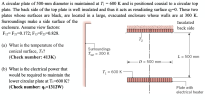 A circular plate of 500-mm diameter is maintained at T1 = 600 K and is positioned coaxial to a circular top plate. The back side of the top plate is well insulated and thus it acts as reradiating surface q2=0. These two plates whose surfaces are black, are located in a large, evacuated enclosure whose walls are at 300 K. Surroundings make a side surface of the Insulated enclosure. Assume view factors: back side F12= F21=0.172; F13=F23=0.828. T2 (a) What...
A flat plate test section, designed for a boundary-layer measurement experiment, is 0.5 m wide an...
 A flat plate test section, designed for a boundary-layer
measurement experiment, is 0.5 m wide and has an electrically
heated surface installed 0.5 m away from the leading edge (see
figure below). The electrically heated strip is 10 cm long and 5mm
deep. It is insulated at its bottom surface as well as both
wide-end edges. If the surface of this electrical heater strip is
to be maintained at a uniform temperature of 120°C when the
atmospheric pressure air at...
A flat plate test section, designed for a boundary-layer
measurement experiment, is 0.5 m wide and has an electrically
heated surface installed 0.5 m away from the leading edge (see
figure below). The electrically heated strip is 10 cm long and 5mm
deep. It is insulated at its bottom surface as well as both
wide-end edges. If the surface of this electrical heater strip is
to be maintained at a uniform temperature of 120°C when the
atmospheric pressure air at...
Q4 04(12%) Water is to be heated from 10°C to 80°C as it flows through a 2-cm-internal-diameter, 7-m-long tube. The tub...
 Q4
04(12%) Water is to be heated from 10°C to 80°C as it flows through a 2-cm-internal-diameter, 7-m-long tube. The tube is equipped with an electric resistance heater, which provides uniform heating throughout the surface of the tube. The outer surface of the heater is well insulated, so that in steady op eration all the heat generated in the heater is transferred to the water in the tube. If the system is to provide hot water at a rate of...
Q4
04(12%) Water is to be heated from 10°C to 80°C as it flows through a 2-cm-internal-diameter, 7-m-long tube. The tube is equipped with an electric resistance heater, which provides uniform heating throughout the surface of the tube. The outer surface of the heater is well insulated, so that in steady op eration all the heat generated in the heater is transferred to the water in the tube. If the system is to provide hot water at a rate of...
Q1) Inner surface of a side wall is used for heating of ambient-room air as shown...
 Q1) Inner surface of a side wall is used for heating of ambient-room air as shown below. There is an electrical heater with 10 W/m2 heat flux generation between a layer of insulation and 2 cm thick marble exposed to ambient-room air at T-20 °C with h-20 W/m2K. k-0.04 W/mK Marble with a thickness of 2 cm Ts= 10 ℃ outside Ambient-room air at To Electrical heating layer (negligible thickness) of temperature T-? Insulation with a thickness of 5 cm...
Problem 7: A special surface coating on a square panel that is 5m x5 m on...
 Problem 7: A special surface coating on a square panel that is 5m x5 m on a side is cured by placing the panel directly under a radiant heat source having the same dimensions. The heat source is diffuse and gray and operates with a power input of 75 kW. The top surface of the heater, as well as the bottom surface of the panel, may be assumed to be well insulated, and the arrangement exists in a large room...
A large wall made of 10-cm-thick solid brick (k = 0.8 W/m.K, p 2000 kg/m3, and p 800 J/kg.K) is o...
 Heat transfer question.
A large wall made of 10-cm-thick solid brick (k = 0.8 W/m.K, p 2000 kg/m3, and p 800 J/kg.K) is originally at a uniform temperature of 30°C. The wall is adiabatic (well insulated) on one side as shown in the figure. The other surface is suddenly exposed to convection air flow at 10°C, resulting in a heat transfer coefficient h=40W/m2.K. Fluid (4.1) Determine the temperature of both surfaces Gr 0 and x 10 cm) after 5 hr...
Heat transfer question.
A large wall made of 10-cm-thick solid brick (k = 0.8 W/m.K, p 2000 kg/m3, and p 800 J/kg.K) is originally at a uniform temperature of 30°C. The wall is adiabatic (well insulated) on one side as shown in the figure. The other surface is suddenly exposed to convection air flow at 10°C, resulting in a heat transfer coefficient h=40W/m2.K. Fluid (4.1) Determine the temperature of both surfaces Gr 0 and x 10 cm) after 5 hr...
Problem 3 (30 Points) Consider a specific application where a synthetic engine oil is used as...
 Problem 3 (30 Points) Consider a specific application where a synthetic engine oil is used as a working fluid in a journal bearing with a gap between the top & bottom surfaces of L=0.6 mm. Here, the top surface moves to the left with a constant velocity (Vr) of 16 m/s, while at the same time the bottom surface moves to the right with a constant velocity (Vb) of 9 m/s. The top surface is isothermal as it is maintained...
Please help to answer all sections. please also write neatly and clearly , i got a...
 Please help to answer all sections. please also write neatly
and clearly , i got a hard time reading curvsy
handwriting.thanks
Question 3 A fish tank in a house has the following internal dimensions: it is 75 cm long, 30 cm wide and 35 cm deep. It is made of glass 4 mm thick and is filled with water to the top. Both its top and its bottom are sufficiently well insulated that it can be assumed that no heat...
Please help to answer all sections. please also write neatly
and clearly , i got a hard time reading curvsy
handwriting.thanks
Question 3 A fish tank in a house has the following internal dimensions: it is 75 cm long, 30 cm wide and 35 cm deep. It is made of glass 4 mm thick and is filled with water to the top. Both its top and its bottom are sufficiently well insulated that it can be assumed that no heat...
 A furnace has the form of a truncated conical section, perfectly insulated with an emissivity of 0.3. Assume that all the surfaces are diffuse-gray. s shown in the schematic. The floor of the furnace hasa emissivity of e 0.7 and is maintained at 1000 K with a heat flux of 2200 W/m2, The lateral wall is D 20 mm A L 50 mm A D, 40 mm (a) Determine the temperature of the upper surface, T, if its emissivity is...
 *Problem 13.056 An electric furnace consisting of two heater sections, top and bottom, is used to heat treat a coating that is applied to both surfaces of a thin metal plate inserted midway between the heaters. Heater - Plate Sidewalls L L L LLLLLLLLL ||||||||| Heater The heaters and the plate are 2 m x 2 m on a side, and each heater is separated from the plate by a distance of L = 0.5 m. Each heater is well...
 A circular plate of 500-mm diameter is maintained at T1 = 600 K and is positioned coaxial to a circular top plate. The back side of the top plate is well insulated and thus it acts as reradiating surface q2=0. These two plates whose surfaces are black, are located in a large, evacuated enclosure whose walls are at 300 K. Surroundings make a side surface of the Insulated enclosure. Assume view factors: back side F12= F21=0.172; F13=F23=0.828. T2 (a) What...
 A flat plate test section, designed for a boundary-layer
measurement experiment, is 0.5 m wide and has an electrically
heated surface installed 0.5 m away from the leading edge (see
figure below). The electrically heated strip is 10 cm long and 5mm
deep. It is insulated at its bottom surface as well as both
wide-end edges. If the surface of this electrical heater strip is
to be maintained at a uniform temperature of 120°C when the
atmospheric pressure air at...
A flat plate test section, designed for a boundary-layer
measurement experiment, is 0.5 m wide and has an electrically
heated surface installed 0.5 m away from the leading edge (see
figure below). The electrically heated strip is 10 cm long and 5mm
deep. It is insulated at its bottom surface as well as both
wide-end edges. If the surface of this electrical heater strip is
to be maintained at a uniform temperature of 120°C when the
atmospheric pressure air at...
 Q4
04(12%) Water is to be heated from 10°C to 80°C as it flows through a 2-cm-internal-diameter, 7-m-long tube. The tube is equipped with an electric resistance heater, which provides uniform heating throughout the surface of the tube. The outer surface of the heater is well insulated, so that in steady op eration all the heat generated in the heater is transferred to the water in the tube. If the system is to provide hot water at a rate of...
Q4
04(12%) Water is to be heated from 10°C to 80°C as it flows through a 2-cm-internal-diameter, 7-m-long tube. The tube is equipped with an electric resistance heater, which provides uniform heating throughout the surface of the tube. The outer surface of the heater is well insulated, so that in steady op eration all the heat generated in the heater is transferred to the water in the tube. If the system is to provide hot water at a rate of...
 Q1) Inner surface of a side wall is used for heating of ambient-room air as shown below. There is an electrical heater with 10 W/m2 heat flux generation between a layer of insulation and 2 cm thick marble exposed to ambient-room air at T-20 °C with h-20 W/m2K. k-0.04 W/mK Marble with a thickness of 2 cm Ts= 10 ℃ outside Ambient-room air at To Electrical heating layer (negligible thickness) of temperature T-? Insulation with a thickness of 5 cm...
 Problem 7: A special surface coating on a square panel that is 5m x5 m on a side is cured by placing the panel directly under a radiant heat source having the same dimensions. The heat source is diffuse and gray and operates with a power input of 75 kW. The top surface of the heater, as well as the bottom surface of the panel, may be assumed to be well insulated, and the arrangement exists in a large room...
 Heat transfer question.
A large wall made of 10-cm-thick solid brick (k = 0.8 W/m.K, p 2000 kg/m3, and p 800 J/kg.K) is originally at a uniform temperature of 30°C. The wall is adiabatic (well insulated) on one side as shown in the figure. The other surface is suddenly exposed to convection air flow at 10°C, resulting in a heat transfer coefficient h=40W/m2.K. Fluid (4.1) Determine the temperature of both surfaces Gr 0 and x 10 cm) after 5 hr...
Heat transfer question.
A large wall made of 10-cm-thick solid brick (k = 0.8 W/m.K, p 2000 kg/m3, and p 800 J/kg.K) is originally at a uniform temperature of 30°C. The wall is adiabatic (well insulated) on one side as shown in the figure. The other surface is suddenly exposed to convection air flow at 10°C, resulting in a heat transfer coefficient h=40W/m2.K. Fluid (4.1) Determine the temperature of both surfaces Gr 0 and x 10 cm) after 5 hr...
 Problem 3 (30 Points) Consider a specific application where a synthetic engine oil is used as a working fluid in a journal bearing with a gap between the top & bottom surfaces of L=0.6 mm. Here, the top surface moves to the left with a constant velocity (Vr) of 16 m/s, while at the same time the bottom surface moves to the right with a constant velocity (Vb) of 9 m/s. The top surface is isothermal as it is maintained...
 Please help to answer all sections. please also write neatly
and clearly , i got a hard time reading curvsy
handwriting.thanks
Question 3 A fish tank in a house has the following internal dimensions: it is 75 cm long, 30 cm wide and 35 cm deep. It is made of glass 4 mm thick and is filled with water to the top. Both its top and its bottom are sufficiently well insulated that it can be assumed that no heat...
Please help to answer all sections. please also write neatly
and clearly , i got a hard time reading curvsy
handwriting.thanks
Question 3 A fish tank in a house has the following internal dimensions: it is 75 cm long, 30 cm wide and 35 cm deep. It is made of glass 4 mm thick and is filled with water to the top. Both its top and its bottom are sufficiently well insulated that it can be assumed that no heat...
Most questions answered within 3 hours.
-
Where is the error in this code sequence?
String s1 = "Hello";
String s2 = "ello";...
asked 10 months ago -
Financial data for Joel de Paris, Inc., for last year
follow:
Joel de Paris, Inc.
Balance...
asked 10 months ago -
Consider this reaction:
Al2(SO4)3 (aq)+ BaCl3
(aq) Al2Cl6 (aq)- +
3BaSO4(s) . What is the...
asked 10 months ago -
Suppose that Savneet is considering increasing her
recent random sample from 20 car rentals to 40...
asked 10 months ago -
Trucks arrive at an unloading terminal at an average rate of 120
per hour.
Trucks arrive...
asked 10 months ago -
Why are methanol and ethanol completely soluble in water while
octanol is not very little soluble....
asked 10 months ago -
A facilities manager at a university reads in a research report
that the mean amount of...
asked 10 months ago -
When the CuSO4 is rehydrated by adding water to the anhydrous
compound, is this an endothermic...
asked 10 months ago -
A ray of sunlight is passing from diamond into crown glass; the
angle of incidence is...
asked 10 months ago -
A block of mass 0.249 kg is placed on top of a light, vertical
spring of...
asked 10 months ago -
how do the kidneys compensate in the presences of acidosis
a) trigger hyperventilate
b) reserve acid...
asked 10 months ago -
Question 501 pts
The rental rate of capital to the firm increases. Which of the
following...
asked 10 months ago