Describe the alveolar structure and the respiratory membrane Please be detailed.
Describe the alveolar structure and the respiratory membrane
Please be detailed.
Homework Answers
Respiratory membrane is also called air-blood barrier.
Simple squamous epithelium of alveoli attached to a thin, elastic basement membrane which borders the endothelial membrane of capillaries, together (alveoli and capillary membranes) forms the respiratory membrane. It is approximately 0.5mm in thick. Respiratory membrane allows gases to cross the membrane by simple diffusion. It allows oxygen picked up by blood and CO2 to be released into air of the alveoli. Respiratory membrane can be thickened by certain factors like fluid in the lungs, fibrosis or scarring of the lungs.
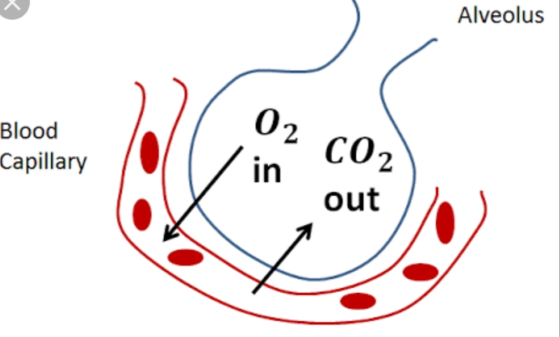
Alveoli: It is a tiny ballon shaped structure and the smallest passage way in the respiratory system. Alveoli is only one cell thick, allowing easy passage of oxygen and carbon dioxide between alveoli and capillaries. These are present at the end of the respiratory tree arranged in clusters throughout the lungs. Alveoli are made up of two types of cells
Type 1 pneumocytes which are responsible for gases exchange and type 2 pneumocytes that are responsible for repairing damage to alveolar lining and secrete surfactant.

Alveoli
Add Answer to:
Describe the alveolar structure and the respiratory membrane
Please be detailed.
1. Which of the following is NOT a component of the respiratory membrane? a. alveolar basement...
1. Which of the following is NOT a component of the respiratory membrane? a. alveolar basement membrane b. alveolar wall epithelium c. interstitial fluid d. capillary endothelium 2. Which of the following is NOT a correct match of normal (quiet) breathing phase and normal muscle movements. a. inhalation: diaphragm contracts b. exhalation: diaphragm relaxes c. exhalation: external intercostals relax d. inhalation: sternocleidomastoid contracts 3. In terms of Boyle's gas law, which of the following is a correctly matched explanation for...
RESPIRATION 2 1. Which are the factors that affect diffusion of gases across the alveolar membrane? 2. Describe diff...
 RESPIRATION 2 1. Which are the factors that affect diffusion of gases across the alveolar membrane? 2. Describe different respiratory units in terms of ventilation/perfusion ratio. 3. How are Oxygen and CO2 transported in blood? 4. What is physiological dead space? Know the formula for calculation alveolar ventilation rate. 5. Describe location of chemoreceptors. Which stimuli affect their activity? 6. Describe all lung receptors. What are the effects of sympathetic and parasympathetic nervous system on respiration? OBSTRUCTIVE & RESTRICTIVE DISEASES...
1) Respiratory gases cross the respiratory membrane by____ A) simple diffusion B) active transport C) osmosis...
1) Respiratory gases cross the respiratory membrane by____ A) simple diffusion B) active transport C) osmosis D) facilitated diffusion 2) Which environment separated by the respiratory membrane would display the highest oxygen partial pressure? A) alveolar air B) pulmonary capillary blood
Describe the components of the upper respiratory tract? What is the difference between the conducting portion...
Describe the components of the upper respiratory tract? What is the difference between the conducting portion of the respiratory system and the respiratory portion? What is the function of the cartilage rings in the conducting portion of the respiratory system? What is the function of the mucosa? What is the name of the layer of loose connective tissue present throughout the respiratory system? In which structure in the lungs does the gas exchange take place? What are cilia and what...
drag the appropriate labels to their respective targets respiratory
 Match the following terms to their definitions. Drag the appropriate labels to their respective targets. Terms may be used more than once. Reset Help Alveolar duct Respiratory bronchioles Type I cells Type ll cells Segmental bronchi No exchange of gases occurs here. Secrete a fluid containing surfactant. Where the respiratory zone of the lungs begins. Form a simple squamous epithelium in the alveoli ei. Terminates in alveoli. Are cuboidal cells. 7. The respiratory membrane consists of 3 layers: capillary endothelium,...
The plasma membrane is very important to the cell. a. Draw and describe the structure and...
The plasma membrane is very important to the cell. a. Draw and describe the structure and function of the plasma membrane. b. What is the chemical explanation for the structure of the plasma membrane? c. Diagram and four different transport mechanisms across the membrane, and then compare and contrast the benefits and drawbacks of each mechanism to the cell:
both questions please Describe the fluid- mosaic model of membrane structure. Define all the components and...
 both questions please
Describe the fluid- mosaic model of membrane structure. Define all the components and explain why the liquid crystal consistency is important. TT T Arial - 3(120) T E . . 25 Pathep Words QUESTION 5 Why can't larger polar molecules and ions diffuse through the plasma membrane? Explain. Would it be advantageous to the cell if they could? Explain.
both questions please
Describe the fluid- mosaic model of membrane structure. Define all the components and explain why the liquid crystal consistency is important. TT T Arial - 3(120) T E . . 25 Pathep Words QUESTION 5 Why can't larger polar molecules and ions diffuse through the plasma membrane? Explain. Would it be advantageous to the cell if they could? Explain.
draw and label the conducting and respiratory zones (from nasal cavity to respiratory membrane) Draw and...
 draw and label the conducting and respiratory zones
(from nasal cavity to respiratory membrane)
Draw and label the conducting and respiratory zones from nasal cavity to respiratory membrane)
draw and label the conducting and respiratory zones
(from nasal cavity to respiratory membrane)
Draw and label the conducting and respiratory zones from nasal cavity to respiratory membrane)
What is the difference between the conducting portion of the respiratory system and the respiratory portion?...
What is the difference between the conducting portion of the respiratory system and the respiratory portion? What is the function of the cartilage rings in the conducting portion of the respiratory system? What is the function of the mucosa? What is the name of the layer of loose connective tissue present throughout the respiratory system? In which structure in the lungs does the gas exchange take place? What are cilia and what is their function in the trachea? In which...
18. Describe the fluid mosaic model of the membrane structure. 19. What factors limit membrane protein...
 18. Describe the fluid mosaic model of the membrane structure. 19. What factors limit membrane protein motility?
 RESPIRATION 2 1. Which are the factors that affect diffusion of gases across the alveolar membrane? 2. Describe different respiratory units in terms of ventilation/perfusion ratio. 3. How are Oxygen and CO2 transported in blood? 4. What is physiological dead space? Know the formula for calculation alveolar ventilation rate. 5. Describe location of chemoreceptors. Which stimuli affect their activity? 6. Describe all lung receptors. What are the effects of sympathetic and parasympathetic nervous system on respiration? OBSTRUCTIVE & RESTRICTIVE DISEASES...
 Match the following terms to their definitions. Drag the appropriate labels to their respective targets. Terms may be used more than once. Reset Help Alveolar duct Respiratory bronchioles Type I cells Type ll cells Segmental bronchi No exchange of gases occurs here. Secrete a fluid containing surfactant. Where the respiratory zone of the lungs begins. Form a simple squamous epithelium in the alveoli ei. Terminates in alveoli. Are cuboidal cells. 7. The respiratory membrane consists of 3 layers: capillary endothelium,...
 both questions please
Describe the fluid- mosaic model of membrane structure. Define all the components and explain why the liquid crystal consistency is important. TT T Arial - 3(120) T E . . 25 Pathep Words QUESTION 5 Why can't larger polar molecules and ions diffuse through the plasma membrane? Explain. Would it be advantageous to the cell if they could? Explain.
both questions please
Describe the fluid- mosaic model of membrane structure. Define all the components and explain why the liquid crystal consistency is important. TT T Arial - 3(120) T E . . 25 Pathep Words QUESTION 5 Why can't larger polar molecules and ions diffuse through the plasma membrane? Explain. Would it be advantageous to the cell if they could? Explain.
 draw and label the conducting and respiratory zones
(from nasal cavity to respiratory membrane)
Draw and label the conducting and respiratory zones from nasal cavity to respiratory membrane)
draw and label the conducting and respiratory zones
(from nasal cavity to respiratory membrane)
Draw and label the conducting and respiratory zones from nasal cavity to respiratory membrane)
 18. Describe the fluid mosaic model of the membrane structure. 19. What factors limit membrane protein motility?
Most questions answered within 3 hours.
-
Where is the error in this code sequence?
String s1 = "Hello";
String s2 = "ello";...
asked 10 months ago -
Financial data for Joel de Paris, Inc., for last year
follow:
Joel de Paris, Inc.
Balance...
asked 10 months ago -
Consider this reaction:
Al2(SO4)3 (aq)+ BaCl3
(aq) Al2Cl6 (aq)- +
3BaSO4(s) . What is the...
asked 10 months ago -
Suppose that Savneet is considering increasing her
recent random sample from 20 car rentals to 40...
asked 10 months ago -
Trucks arrive at an unloading terminal at an average rate of 120
per hour.
Trucks arrive...
asked 10 months ago -
Why are methanol and ethanol completely soluble in water while
octanol is not very little soluble....
asked 10 months ago -
A facilities manager at a university reads in a research report
that the mean amount of...
asked 10 months ago -
When the CuSO4 is rehydrated by adding water to the anhydrous
compound, is this an endothermic...
asked 10 months ago -
A ray of sunlight is passing from diamond into crown glass; the
angle of incidence is...
asked 10 months ago -
A block of mass 0.249 kg is placed on top of a light, vertical
spring of...
asked 10 months ago -
how do the kidneys compensate in the presences of acidosis
a) trigger hyperventilate
b) reserve acid...
asked 10 months ago -
Question 501 pts
The rental rate of capital to the firm increases. Which of the
following...
asked 10 months ago