The rolling resistance for steel on steel is quite low; the coefficient of rolling friction is...
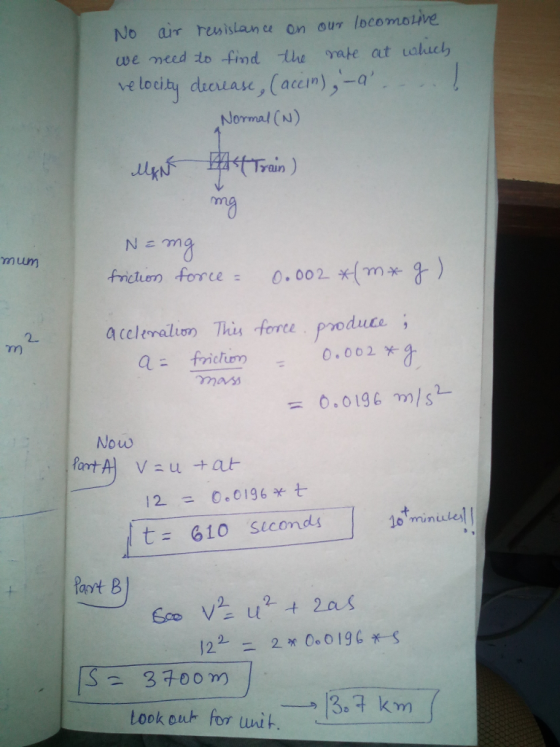
The rolling resistance for steel on steel is quite low; the coefficient of rolling friction is typically μr=0.002. Suppose a 180,000 kg locomotive is rolling at 12 m/son level rails.
You may want to review (Pages 138 - 142) .
Part A
If the engineer disengages the engine, how much time will it take the locomotive to coast to a stop?
Express your answer using two significant figures.
|
|
||||
| Δt = | s |
SubmitRequest Answer
Part B
How far will the locomotive move during this time?
Express your answer to two significant figures and include the appropriate units.
|
|
|||
| Δx = |
SubmitRequest Answer
Provide Feedback
Homework Answers
Add Answer to:
The rolling resistance for steel on steel is quite low; the
coefficient of rolling friction is...
The rolling resistance for steel on steel is quite low; the coefficient of rolling friction is...
The rolling resistance for steel on steel is quite low; the coefficient of rolling friction is typically ? r =0.002 . Suppose a 180,000 kg locomotive is rolling at 25 m/s on level rails. Part A If the engineer disengages the engine, how much time will it take the locomotive to coast to a stop? Express your answer using two significant figures. Part B How far will the locomotive move during this time? Express your answer to two significant figures...
The rolling resistance of steel is typically mu_r = .002. If a train weighing 160,000 kg...
 The rolling resistance of steel is typically mu_r = .002. If a train weighing 160,000 kg is rolling at 12m/s and the engineer turns off the engine to let the train cruise to a stop, how much time will it take to come to a stop? How far will the train move during this time? What is the drag force on a 1.5 m wide, 1.8 m high car traveling at 20 m/s? A 22 cm diameter bowling ball has...
Problem 11.64 Constants Driving on asphalt roads entails very little rolling resistance, so most of the...
 Problem 11.64 Constants Driving on asphalt roads entails very little rolling resistance, so most of the energy of the engine goes to overcoming air resistance. But driving slowly in dry sand is another story. Ifa 1600 kg car is driven in sand at 5.8 m/s, the coefficient of rolling friction is 0.06. In this case, nearly all of the energy that the car uses to move goes to overcoming rolling friction, so you can ignore air drag in this problem...
 The rolling resistance of steel is typically mu_r = .002. If a train weighing 160,000 kg is rolling at 12m/s and the engineer turns off the engine to let the train cruise to a stop, how much time will it take to come to a stop? How far will the train move during this time? What is the drag force on a 1.5 m wide, 1.8 m high car traveling at 20 m/s? A 22 cm diameter bowling ball has...
 Problem 11.64 Constants Driving on asphalt roads entails very little rolling resistance, so most of the energy of the engine goes to overcoming air resistance. But driving slowly in dry sand is another story. Ifa 1600 kg car is driven in sand at 5.8 m/s, the coefficient of rolling friction is 0.06. In this case, nearly all of the energy that the car uses to move goes to overcoming rolling friction, so you can ignore air drag in this problem...
Most questions answered within 3 hours.
-
Where is the error in this code sequence?
String s1 = "Hello";
String s2 = "ello";...
asked 11 months ago -
Financial data for Joel de Paris, Inc., for last year
follow:
Joel de Paris, Inc.
Balance...
asked 11 months ago -
Consider this reaction:
Al2(SO4)3 (aq)+ BaCl3
(aq) Al2Cl6 (aq)- +
3BaSO4(s) . What is the...
asked 11 months ago -
Suppose that Savneet is considering increasing her
recent random sample from 20 car rentals to 40...
asked 11 months ago -
Trucks arrive at an unloading terminal at an average rate of 120
per hour.
Trucks arrive...
asked 11 months ago -
Why are methanol and ethanol completely soluble in water while
octanol is not very little soluble....
asked 11 months ago -
A facilities manager at a university reads in a research report
that the mean amount of...
asked 11 months ago -
When the CuSO4 is rehydrated by adding water to the anhydrous
compound, is this an endothermic...
asked 11 months ago -
A ray of sunlight is passing from diamond into crown glass; the
angle of incidence is...
asked 11 months ago -
A block of mass 0.249 kg is placed on top of a light, vertical
spring of...
asked 11 months ago -
how do the kidneys compensate in the presences of acidosis
a) trigger hyperventilate
b) reserve acid...
asked 11 months ago -
Question 501 pts
The rental rate of capital to the firm increases. Which of the
following...
asked 11 months ago