I have a project where I have to expla
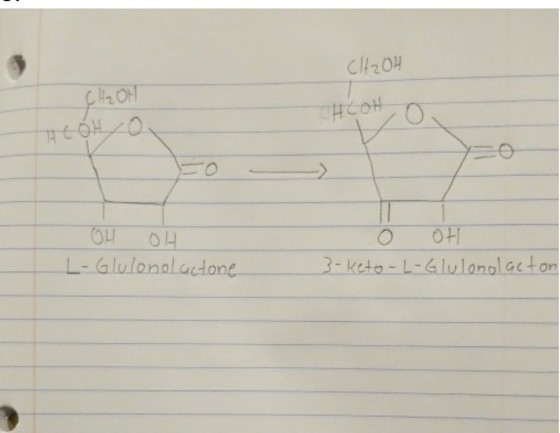
in a "fake" theoretical proposed mechanism reaction.
Using simple reagents how would I get from L-Glulonolactone to
3-Keto-L-glulonolactone? Please explain how the double bond would
form and the H would be removed. Please include a sketch with
curved arrows, and the name of the reaction used to make the single
bonded OH into a double bonded O.
Note: reaction does not have to be realistic or true.
Homework Answers
 Here chromic acid is a
oxidising agent. It oxidise alcohol to ketone via removable of
hydrogen from oxygen which is in 3rd position of structure.
Here chromic acid is a
oxidising agent. It oxidise alcohol to ketone via removable of
hydrogen from oxygen which is in 3rd position of structure.
Add Answer to:
I have a project where I have to expla
in a "fake" theoretical proposed mechanism reaction....
I have a project where I have to explain a "fake" theoretical proposed mechanism reaction. Using...
 I have a project where I have to explain a "fake"
theoretical proposed mechanism reaction. Using any reagents how
would I get from ferulic acid to vanillin? Please include a sketch
with curved arrows. This reactuon doesnt have to be realistic,
reasonable, or true. it's just theoretical.
Co Olt to Vanillin ?/
I have a project where I have to explain a "fake"
theoretical proposed mechanism reaction. Using any reagents how
would I get from ferulic acid to vanillin? Please include a sketch
with curved arrows. This reactuon doesnt have to be realistic,
reasonable, or true. it's just theoretical.
Co Olt to Vanillin ?/
PLEASE WRITE OUT A MECHANISM SHOWING ARROWS (NUCLEOPHILES AND ELECTROPHILES) FOR THIS REACTION. I HAVE INCLUDED...
 PLEASE WRITE OUT A MECHANISM SHOWING ARROWS
(NUCLEOPHILES AND ELECTROPHILES) FOR THIS REACTION.
I HAVE INCLUDED THE REACTANTS, REAGENTS AND THE PRODUCT AS WELL
IN THIS PICTURE.
> Mechanisms OH TG HIGO (produt) Br mgbr -H bryetgo Dry Etao
PLEASE WRITE OUT A MECHANISM SHOWING ARROWS
(NUCLEOPHILES AND ELECTROPHILES) FOR THIS REACTION.
I HAVE INCLUDED THE REACTANTS, REAGENTS AND THE PRODUCT AS WELL
IN THIS PICTURE.
> Mechanisms OH TG HIGO (produt) Br mgbr -H bryetgo Dry Etao
Draw the complete mechanism for the following reaction showing how the products are formed from the...
 Draw the complete mechanism for the following reaction showing
how the products are formed from the given reagents. Show all
reaction intermediates and use proper electron flow arrows
throughout.
a) Here is the overall reaction: HO I have drawn the first two arrows to guide you... please complete the mechanism (6 marks).:
Draw the complete mechanism for the following reaction showing
how the products are formed from the given reagents. Show all
reaction intermediates and use proper electron flow arrows
throughout.
a) Here is the overall reaction: HO I have drawn the first two arrows to guide you... please complete the mechanism (6 marks).:
4. (15 Points) Pericyclic Reactions: The transformation below can be described as a pericyclic reaction followed by a polar-acidic mechanism, where the acid is not shown because it is picked up from...
 4. (15 Points) Pericyclic Reactions: The transformation below can be described as a pericyclic reaction followed by a polar-acidic mechanism, where the acid is not shown because it is picked up from the environment. (a) Start by redrawing the starting material below, and show how the pericyclic reaction occurs with curved arrows. (b) Specify the type of pericyclic reaction it represents and the name reaction. (c) If you've done the pericyclic reaction correctly, your product will be an enol. From...
Please explain. I need both part a and b. thank you. 2. Alcohol Reaction Mechanism Fill...
 Please explain. I
need both part a and b. thank you.
2. Alcohol Reaction Mechanism Fill in the major organic product and draw a complete curved-arrow mechanism a. H-Br OH b. How would the above reaction change if sulfuric acid were used instead? Why?
Please explain. I
need both part a and b. thank you.
2. Alcohol Reaction Mechanism Fill in the major organic product and draw a complete curved-arrow mechanism a. H-Br OH b. How would the above reaction change if sulfuric acid were used instead? Why?
Only have iodine. Not H2O2 The following mechanism has been proposed for this reaction: HO+ I...
 Only have iodine. Not H2O2
The following mechanism has been proposed for this reaction: HO+ I IO+ HO H.O, + IO + HO + O If this mechanism is correct, which step must be the rate-determining step? Explain.
Only have iodine. Not H2O2
The following mechanism has been proposed for this reaction: HO+ I IO+ HO H.O, + IO + HO + O If this mechanism is correct, which step must be the rate-determining step? Explain.
In many addition reactions we have to think about the regiochemical preference of how the two...
 In many addition reactions we have to think about the regiochemical preference of how the two new groups will add across a double bond. Draw the major product of each transformation. HBr HBr ΒΡΟ For each transformation, which set of reagents would produce each product shown below in the highest yield? - In the box below, draw a curved-arrow reaction mechanism for the following reaction. Show all bond cleavage and formation steps. Your answer should be written in the box...
a) Draw the mechanism (with curved arrows) for the reaction of the conjugate base of p?hydroxybenzaldehyde...
 a) Draw the mechanism (with curved
arrows) for the reaction of the conjugate base of
p?hydroxybenzaldehyde with methyl
p?toluenesulfonate.
b) What ether would you obtain from
the reaction of CH3CH2O- with
1?iodopentane? Draw the structure of the product.
c) Explain in general how TBAS
(Bu4N+HSO4-) works as a phase transfer catalyst in this reaction.
What anion does Bu4N+ shuttle into the organic layer?
d) p-Hydroxybenzaldehyde has four
signals in the NMR, with the following chemical shifts and
multiplicities. Assign each...
a) Draw the mechanism (with curved
arrows) for the reaction of the conjugate base of
p?hydroxybenzaldehyde with methyl
p?toluenesulfonate.
b) What ether would you obtain from
the reaction of CH3CH2O- with
1?iodopentane? Draw the structure of the product.
c) Explain in general how TBAS
(Bu4N+HSO4-) works as a phase transfer catalyst in this reaction.
What anion does Bu4N+ shuttle into the organic layer?
d) p-Hydroxybenzaldehyde has four
signals in the NMR, with the following chemical shifts and
multiplicities. Assign each...
Student Name: Instructor Name: EXP #4: POST-LAB 1. A proposed mechanism for the iodine clock reaction...
 Student Name: Instructor Name: EXP #4: POST-LAB 1. A proposed mechanism for the iodine clock reaction is shown below: Iodine Clock Reaction Mechanism: 1 HSoS0+HIO2 ki-2.95 x 10⁻¹M-'s-1 2-2.0 x 10¹⁰ AM-2s-1 ka 1.0 x 10⁵ M-'s-1 ka-3.0 x 10⁵ M-3s-1 HIO2+I +H+2HOI HIO2+ HOI IO +I + 2H+ IO I+2H HIO2 + HOI HOI+I+H I2+H20 ks 3.0 x 10¹²M-2s-1 I+ H20 HOI+ I +H ke -2.2s-1 I2+HSO+H20+21 +SO- +3H+ -1.0 x 100 M-1-1 where the values of k are...
Please help! For the reaction in step 2, how do i find the theoretical yield of...
 Please help! For the reaction
in step 2, how do i find the theoretical yield of the product for
this reaction? 0.07 moles of the reactant (ethyl acetoacetate
ethylene ketal) was used. What is that keto alcohol product
(circled) called? what is the molar mass of that circled product??
thank you!!
(TsOH) as catalyst. . Check your organic textbook for the mechanism- acid-catalvzed addition of alcohol to aldehydes or ketones to form acetals or ketals. The ketone carbonyl, significantly more...
Please help! For the reaction
in step 2, how do i find the theoretical yield of the product for
this reaction? 0.07 moles of the reactant (ethyl acetoacetate
ethylene ketal) was used. What is that keto alcohol product
(circled) called? what is the molar mass of that circled product??
thank you!!
(TsOH) as catalyst. . Check your organic textbook for the mechanism- acid-catalvzed addition of alcohol to aldehydes or ketones to form acetals or ketals. The ketone carbonyl, significantly more...
 I have a project where I have to explain a "fake"
theoretical proposed mechanism reaction. Using any reagents how
would I get from ferulic acid to vanillin? Please include a sketch
with curved arrows. This reactuon doesnt have to be realistic,
reasonable, or true. it's just theoretical.
Co Olt to Vanillin ?/
I have a project where I have to explain a "fake"
theoretical proposed mechanism reaction. Using any reagents how
would I get from ferulic acid to vanillin? Please include a sketch
with curved arrows. This reactuon doesnt have to be realistic,
reasonable, or true. it's just theoretical.
Co Olt to Vanillin ?/
 PLEASE WRITE OUT A MECHANISM SHOWING ARROWS
(NUCLEOPHILES AND ELECTROPHILES) FOR THIS REACTION.
I HAVE INCLUDED THE REACTANTS, REAGENTS AND THE PRODUCT AS WELL
IN THIS PICTURE.
> Mechanisms OH TG HIGO (produt) Br mgbr -H bryetgo Dry Etao
PLEASE WRITE OUT A MECHANISM SHOWING ARROWS
(NUCLEOPHILES AND ELECTROPHILES) FOR THIS REACTION.
I HAVE INCLUDED THE REACTANTS, REAGENTS AND THE PRODUCT AS WELL
IN THIS PICTURE.
> Mechanisms OH TG HIGO (produt) Br mgbr -H bryetgo Dry Etao
 Draw the complete mechanism for the following reaction showing
how the products are formed from the given reagents. Show all
reaction intermediates and use proper electron flow arrows
throughout.
a) Here is the overall reaction: HO I have drawn the first two arrows to guide you... please complete the mechanism (6 marks).:
Draw the complete mechanism for the following reaction showing
how the products are formed from the given reagents. Show all
reaction intermediates and use proper electron flow arrows
throughout.
a) Here is the overall reaction: HO I have drawn the first two arrows to guide you... please complete the mechanism (6 marks).:
 4. (15 Points) Pericyclic Reactions: The transformation below can be described as a pericyclic reaction followed by a polar-acidic mechanism, where the acid is not shown because it is picked up from the environment. (a) Start by redrawing the starting material below, and show how the pericyclic reaction occurs with curved arrows. (b) Specify the type of pericyclic reaction it represents and the name reaction. (c) If you've done the pericyclic reaction correctly, your product will be an enol. From...
 Please explain. I
need both part a and b. thank you.
2. Alcohol Reaction Mechanism Fill in the major organic product and draw a complete curved-arrow mechanism a. H-Br OH b. How would the above reaction change if sulfuric acid were used instead? Why?
Please explain. I
need both part a and b. thank you.
2. Alcohol Reaction Mechanism Fill in the major organic product and draw a complete curved-arrow mechanism a. H-Br OH b. How would the above reaction change if sulfuric acid were used instead? Why?
 Only have iodine. Not H2O2
The following mechanism has been proposed for this reaction: HO+ I IO+ HO H.O, + IO + HO + O If this mechanism is correct, which step must be the rate-determining step? Explain.
Only have iodine. Not H2O2
The following mechanism has been proposed for this reaction: HO+ I IO+ HO H.O, + IO + HO + O If this mechanism is correct, which step must be the rate-determining step? Explain.
 In many addition reactions we have to think about the regiochemical preference of how the two new groups will add across a double bond. Draw the major product of each transformation. HBr HBr ΒΡΟ For each transformation, which set of reagents would produce each product shown below in the highest yield? - In the box below, draw a curved-arrow reaction mechanism for the following reaction. Show all bond cleavage and formation steps. Your answer should be written in the box...
 a) Draw the mechanism (with curved
arrows) for the reaction of the conjugate base of
p?hydroxybenzaldehyde with methyl
p?toluenesulfonate.
b) What ether would you obtain from
the reaction of CH3CH2O- with
1?iodopentane? Draw the structure of the product.
c) Explain in general how TBAS
(Bu4N+HSO4-) works as a phase transfer catalyst in this reaction.
What anion does Bu4N+ shuttle into the organic layer?
d) p-Hydroxybenzaldehyde has four
signals in the NMR, with the following chemical shifts and
multiplicities. Assign each...
a) Draw the mechanism (with curved
arrows) for the reaction of the conjugate base of
p?hydroxybenzaldehyde with methyl
p?toluenesulfonate.
b) What ether would you obtain from
the reaction of CH3CH2O- with
1?iodopentane? Draw the structure of the product.
c) Explain in general how TBAS
(Bu4N+HSO4-) works as a phase transfer catalyst in this reaction.
What anion does Bu4N+ shuttle into the organic layer?
d) p-Hydroxybenzaldehyde has four
signals in the NMR, with the following chemical shifts and
multiplicities. Assign each...
 Student Name: Instructor Name: EXP #4: POST-LAB 1. A proposed mechanism for the iodine clock reaction is shown below: Iodine Clock Reaction Mechanism: 1 HSoS0+HIO2 ki-2.95 x 10⁻¹M-'s-1 2-2.0 x 10¹⁰ AM-2s-1 ka 1.0 x 10⁵ M-'s-1 ka-3.0 x 10⁵ M-3s-1 HIO2+I +H+2HOI HIO2+ HOI IO +I + 2H+ IO I+2H HIO2 + HOI HOI+I+H I2+H20 ks 3.0 x 10¹²M-2s-1 I+ H20 HOI+ I +H ke -2.2s-1 I2+HSO+H20+21 +SO- +3H+ -1.0 x 100 M-1-1 where the values of k are...
 Please help! For the reaction
in step 2, how do i find the theoretical yield of the product for
this reaction? 0.07 moles of the reactant (ethyl acetoacetate
ethylene ketal) was used. What is that keto alcohol product
(circled) called? what is the molar mass of that circled product??
thank you!!
(TsOH) as catalyst. . Check your organic textbook for the mechanism- acid-catalvzed addition of alcohol to aldehydes or ketones to form acetals or ketals. The ketone carbonyl, significantly more...
Please help! For the reaction
in step 2, how do i find the theoretical yield of the product for
this reaction? 0.07 moles of the reactant (ethyl acetoacetate
ethylene ketal) was used. What is that keto alcohol product
(circled) called? what is the molar mass of that circled product??
thank you!!
(TsOH) as catalyst. . Check your organic textbook for the mechanism- acid-catalvzed addition of alcohol to aldehydes or ketones to form acetals or ketals. The ketone carbonyl, significantly more...
Most questions answered within 3 hours.
-
Where is the error in this code sequence?
String s1 = "Hello";
String s2 = "ello";...
asked 11 months ago -
Financial data for Joel de Paris, Inc., for last year
follow:
Joel de Paris, Inc.
Balance...
asked 11 months ago -
Consider this reaction:
Al2(SO4)3 (aq)+ BaCl3
(aq) Al2Cl6 (aq)- +
3BaSO4(s) . What is the...
asked 11 months ago -
Suppose that Savneet is considering increasing her
recent random sample from 20 car rentals to 40...
asked 11 months ago -
Trucks arrive at an unloading terminal at an average rate of 120
per hour.
Trucks arrive...
asked 11 months ago -
Why are methanol and ethanol completely soluble in water while
octanol is not very little soluble....
asked 11 months ago -
A facilities manager at a university reads in a research report
that the mean amount of...
asked 11 months ago -
When the CuSO4 is rehydrated by adding water to the anhydrous
compound, is this an endothermic...
asked 11 months ago -
A ray of sunlight is passing from diamond into crown glass; the
angle of incidence is...
asked 11 months ago -
A block of mass 0.249 kg is placed on top of a light, vertical
spring of...
asked 11 months ago -
how do the kidneys compensate in the presences of acidosis
a) trigger hyperventilate
b) reserve acid...
asked 11 months ago -
Question 501 pts
The rental rate of capital to the firm increases. Which of the
following...
asked 11 months ago