suggest a precipitation method for the separation of potassium ion from sodium and lithium ions
suggest a precipitation method for the separation of potassium ion from sodium and lithium ions
Homework Answers
Treatment of the solution contains high concentration of K+ with Na+ and Li+ with dilute perchloric acid will form KClO4 which is sparingly soluble in water and it will leave Na+ and Li+ in the solution. Filtration of the KClO4 precipitate will seperate the K+ ion from Na+ and Li+.
Add Answer to:
suggest a precipitation method for the separation of
potassium ion from sodium and lithium ions
ana ion channels. The two ions in questions are Na+ (sodium ion) and K+ (potassium ion)....
 ana ion channels. The two ions in questions are Na+ (sodium ion) and K+ (potassium ion). The on channels/pumps are a) voltage-gated sodium channel, b) voltage-gated potassium channel, and c) sodium/potassium pump. a) Depolarization: b) Repolarization: c) Restoring ion concentrations:
You wish to use precipitation to separate Br− ion from I− ions in a solution that...
You wish to use precipitation to separate Br− ion from I− ions in a solution that is 0.50 M in each. You find Ksp values for the copper(I) salts are 6.3 x 10⁻⁹ for CuBr and 1.3 x 10⁻¹² for CuI at 25°C. If you are required to reduce the value of one ion to 0.10% of its original value for “complete separation,” will selective precipitation by Cu+ work? Show your calculations and justify your answer.
When a lithium ion battery is producing electricity ... O A. lithium ions are passing through...
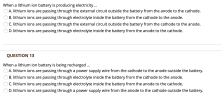 When a lithium ion battery is producing electricity ... O A. lithium ions are passing through the external circuit outside the battery from the anode to the cathode. B. lithium ions are passing through electrolyte inside the battery from the cathode to the anode. OC. lithium ions are passing through the external circuit outside the battery from the cathode to the anode. OD. lithium ions are passing through electrolyte inside the battery from the anode to the cathode. QUESTION 13...
Complete the following sentence: The sodium-potassium pump transports... three sodium ions from the interior to the...
Complete the following sentence: The sodium-potassium pump transports... three sodium ions from the interior to the exterior of the cell and two potassium ions from the exterior to the interior. three sodium ions from the exterior to the interior of the cell and two potassium ions from the interior to the exterior. two sodium ions from the interior to the exterior of the cell and two potassium ions from the exterior to the interior two sodium ions from the interior...
What are the six steps of the cycle of activity of the sodium ion-potassium ion ATPase?...
What are the six steps of the cycle of activity of the sodium ion-potassium ion ATPase? Tell which direction the ions are moved and why you need ATP.
Question 61 The ATP dependent sodium-potassium pump forces potassium ions the cell and sodium ions the...
 Question 61 The ATP dependent sodium-potassium pump forces potassium ions the cell and sodium ions the cell. out of, out of out of into into; out of into: into
Identifying the Group E ion potassium The supernatant liquid remaining after the copper (11) hydroxide separation...
 Identifying the Group E ion potassium The supernatant liquid remaining after the copper (11) hydroxide separation contains the potassium ion. Add acetic acid to make the pH of the solution 4-5. Add sodium bexanikuitecebaltat (l) solution Na:CoNOG or sodium cobaltinitrite. The resultinformation of a yellow precipitate of potassium cobaltinitrite, K-CoNOa)s indicates the presence of potassium ion. x 18e)+ Co/NO:]alles, yellow) + K.Ca(NO)els, yellow)
An ammonium ion selective electrode exhibits interference from lithium ions with a selectivity coefficient of 0.2....
 An ammonium ion selective electrode exhibits interference from lithium ions with a selectivity coefficient of 0.2. If a 0.10 M solution of ammonium has an electrode potential of 0.125 V what is the expected potential in a solution containing both 0.1 M ammonium and 0.1 M lithium? Recall that the Nernst equation for a cation selective electrode with interferent is Ecell L'002 Logho(a + Kb) where a and b are the activities(-concentrations) of the selective ion and interfering ion, respectively.
For which of the following pairs of reactants would a precipitation reaction occur? 1.Lithium hydroxide and...
For which of the following pairs of reactants would a precipitation reaction occur? 1.Lithium hydroxide and potassium carbonate 2.Silver and calcium carbonate 3. Sodium chloride and Sodium nitrate 4.Zinc chloride and Silver nitrate 5.Magnesium and copper(II) sulfate
The sodium potassium uses energy in the form of ATP hydrolysis to move 3 sodium ions...
 The sodium potassium uses energy in the form of ATP hydrolysis
to move 3 sodium ions out of the cell and 2 potassium ions into the
cell. The concentration of sodium inside is 14mM and outside is
143mM. The concentration of potassium inside is 157mM and outside
is 4mM. Membrane potential is -50mV and temperature is 310K.
Demonstrate that hydrolysis of ATP to ADP provides enough energy to
move 3 sodium ions out and 2 potassium ions in to the...
The sodium potassium uses energy in the form of ATP hydrolysis
to move 3 sodium ions out of the cell and 2 potassium ions into the
cell. The concentration of sodium inside is 14mM and outside is
143mM. The concentration of potassium inside is 157mM and outside
is 4mM. Membrane potential is -50mV and temperature is 310K.
Demonstrate that hydrolysis of ATP to ADP provides enough energy to
move 3 sodium ions out and 2 potassium ions in to the...
 ana ion channels. The two ions in questions are Na+ (sodium ion) and K+ (potassium ion). The on channels/pumps are a) voltage-gated sodium channel, b) voltage-gated potassium channel, and c) sodium/potassium pump. a) Depolarization: b) Repolarization: c) Restoring ion concentrations:
 When a lithium ion battery is producing electricity ... O A. lithium ions are passing through the external circuit outside the battery from the anode to the cathode. B. lithium ions are passing through electrolyte inside the battery from the cathode to the anode. OC. lithium ions are passing through the external circuit outside the battery from the cathode to the anode. OD. lithium ions are passing through electrolyte inside the battery from the anode to the cathode. QUESTION 13...
 Question 61 The ATP dependent sodium-potassium pump forces potassium ions the cell and sodium ions the cell. out of, out of out of into into; out of into: into
 Identifying the Group E ion potassium The supernatant liquid remaining after the copper (11) hydroxide separation contains the potassium ion. Add acetic acid to make the pH of the solution 4-5. Add sodium bexanikuitecebaltat (l) solution Na:CoNOG or sodium cobaltinitrite. The resultinformation of a yellow precipitate of potassium cobaltinitrite, K-CoNOa)s indicates the presence of potassium ion. x 18e)+ Co/NO:]alles, yellow) + K.Ca(NO)els, yellow)
 An ammonium ion selective electrode exhibits interference from lithium ions with a selectivity coefficient of 0.2. If a 0.10 M solution of ammonium has an electrode potential of 0.125 V what is the expected potential in a solution containing both 0.1 M ammonium and 0.1 M lithium? Recall that the Nernst equation for a cation selective electrode with interferent is Ecell L'002 Logho(a + Kb) where a and b are the activities(-concentrations) of the selective ion and interfering ion, respectively.
 The sodium potassium uses energy in the form of ATP hydrolysis
to move 3 sodium ions out of the cell and 2 potassium ions into the
cell. The concentration of sodium inside is 14mM and outside is
143mM. The concentration of potassium inside is 157mM and outside
is 4mM. Membrane potential is -50mV and temperature is 310K.
Demonstrate that hydrolysis of ATP to ADP provides enough energy to
move 3 sodium ions out and 2 potassium ions in to the...
The sodium potassium uses energy in the form of ATP hydrolysis
to move 3 sodium ions out of the cell and 2 potassium ions into the
cell. The concentration of sodium inside is 14mM and outside is
143mM. The concentration of potassium inside is 157mM and outside
is 4mM. Membrane potential is -50mV and temperature is 310K.
Demonstrate that hydrolysis of ATP to ADP provides enough energy to
move 3 sodium ions out and 2 potassium ions in to the...
Most questions answered within 3 hours.
-
Where is the error in this code sequence?
String s1 = "Hello";
String s2 = "ello";...
asked 10 months ago -
Financial data for Joel de Paris, Inc., for last year
follow:
Joel de Paris, Inc.
Balance...
asked 10 months ago -
Consider this reaction:
Al2(SO4)3 (aq)+ BaCl3
(aq) Al2Cl6 (aq)- +
3BaSO4(s) . What is the...
asked 10 months ago -
Suppose that Savneet is considering increasing her
recent random sample from 20 car rentals to 40...
asked 10 months ago -
Trucks arrive at an unloading terminal at an average rate of 120
per hour.
Trucks arrive...
asked 10 months ago -
Why are methanol and ethanol completely soluble in water while
octanol is not very little soluble....
asked 10 months ago -
A facilities manager at a university reads in a research report
that the mean amount of...
asked 10 months ago -
When the CuSO4 is rehydrated by adding water to the anhydrous
compound, is this an endothermic...
asked 10 months ago -
A ray of sunlight is passing from diamond into crown glass; the
angle of incidence is...
asked 10 months ago -
A block of mass 0.249 kg is placed on top of a light, vertical
spring of...
asked 10 months ago -
how do the kidneys compensate in the presences of acidosis
a) trigger hyperventilate
b) reserve acid...
asked 10 months ago -
Question 501 pts
The rental rate of capital to the firm increases. Which of the
following...
asked 10 months ago