Two trains are traveling on the same track and in the same direction. The first train,...
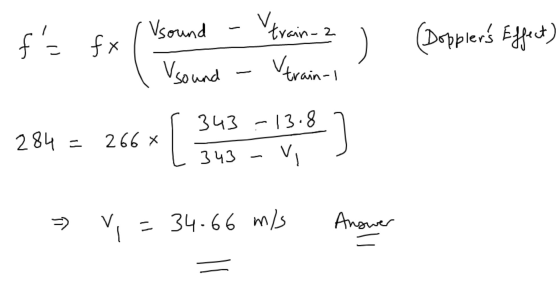
Two trains are traveling on the same track and in the same direction. The first train, which is behind the second train, blows a horn whose frequency is 266 Hz. The second train detects a frequency of 284 Hz. If the speed of the second train is 13.8 m/s, what is the speed of the first train?
Homework Answers
Add Answer to:
Two trains are traveling on the same track and in the same
direction. The first train,...
Two trains are traveling on the same track and in the same direction. The first train,...
 Two trains are traveling on the same track and in the same
direction. The first train, which is behind the second train, blows
a horn whose frequency is 269 Hz. The second train detects a
frequency of 290 Hz. If the speed of the second train is 13.7 m/s,
what is the speed of the first train?
I used the following equation and set Fo to 290Hz and Fs to
269hz. + on top and - on bottom. I figured...
Two trains are traveling on the same track and in the same
direction. The first train, which is behind the second train, blows
a horn whose frequency is 269 Hz. The second train detects a
frequency of 290 Hz. If the speed of the second train is 13.7 m/s,
what is the speed of the first train?
I used the following equation and set Fo to 290Hz and Fs to
269hz. + on top and - on bottom. I figured...
A train on one track moves in the same direction as a second train on the...
 A train on one track moves in the same direction as a second train on the adjacent track. The first train, which is ahead of the second train and moves with a speed of 36.4 m/s, blows a horn whose frequency is 123 Hz. Part A If the frequency heard on the second train is 134 Hz , what is its speed?
Two trains approach each other on separate but adjacent tracks. Train 1 is traveling at a...
Two trains approach each other on separate but adjacent tracks. Train 1 is traveling at a speed of 29.9 m/s and train 2 at a speed of 21.6 m/s. If the engineer of train 1 sounds his horn which has a frequency of 520 Hz, determine the frequency of the sound heard by the engineer of train 2. (Use 343 m/s as the speed of sound. Enter your answer to the nearest Hz.)______ Hz
Two trains approach each other on separate but adjacent tracks. Train 1 is traveling at a...
Two trains approach each other on separate but adjacent tracks. Train 1 is traveling at a speed of 35.9 m/s and train 2 at a speed of 27.6 m/s. If the engineer of train 1 sounds his horn which has a frequency of 520 Hz, determine the frequency of the sound heard by the engineer of train 2. (Use 343 m/s as the speed of sound. Enter your answer to the nearest Hz.)
Two trains on separate tracks move toward one another. Train 1 has a speed of 110...
Two trains on separate tracks move toward one another. Train 1 has a speed of 110 km/h, train 2 a speed of 85.0 km/h. Train 2 blows its horn, emitting a frequency of 500 Hz. What is the frequency heard by the engineer on train 1? (Assume the speed of sound is 345 m/s.)
Two trains on separate tracks move toward each other. Train 1 has a speed of 141...
Two trains on separate tracks move toward each other. Train 1 has a speed of 141 km/h; train 2, a speed of 85.0 km/h. Train 2 blows its horn, emitting a frequency of 500 Hz. What is the frequency heard by the engineer on train 1? Hz
Two trains on separate tracks move toward each other. Train 1 has a speed of 109...
 Two trains on separate tracks move toward each other. Train 1 has a speed of 109 km/h; train 2, a speed of 96.0 km/h. Train 2 blows its horn, emitting a frequency of 500 Hz. What is the frequency heard by the engineer on train 1? Hz
Two trains on separate tracks move toward each other. Train 1 has a speed of 1.30...
Two trains on separate tracks move toward each other. Train 1 has a speed of 1.30 x 10^2 km/h; train 2 a speed of 90.0 km/h. Train 2 blows its horn, emitting a frequency of 5.00 x 10^2 Hz. What is the frequency heard by the engineer on train 1?
.. + -/1 points SerCP10 14.P.025.WI. Two trains on separate tracks move toward each other. Train...
 .. + -/1 points SerCP10 14.P.025.WI. Two trains on separate tracks move toward each other. Train 1 has a speed of 117 km/h; train 2, a speed of 73.0 km/h. Train 2 blows its horn, emitting a frequency of 500 Hz. What is the frequency heard by the engineer on train 1?
A train is moving parallel and adjacent to a highway with a constant speed of 32 m/s.
A train is moving parallel and adjacent to a highway with a constant speed of 32 m/s. A car is traveling in the same direction as the train at 64 m/s. The car's horn sounds at 520 Hz and the train's whistle sounds at 320 Hz. When the car is behind the train what frequency does an occupant of the car observe for the train whistle? The speed of sound is 343 m/s. Answer in units of Hz. When the car is in...
 Two trains are traveling on the same track and in the same
direction. The first train, which is behind the second train, blows
a horn whose frequency is 269 Hz. The second train detects a
frequency of 290 Hz. If the speed of the second train is 13.7 m/s,
what is the speed of the first train?
I used the following equation and set Fo to 290Hz and Fs to
269hz. + on top and - on bottom. I figured...
Two trains are traveling on the same track and in the same
direction. The first train, which is behind the second train, blows
a horn whose frequency is 269 Hz. The second train detects a
frequency of 290 Hz. If the speed of the second train is 13.7 m/s,
what is the speed of the first train?
I used the following equation and set Fo to 290Hz and Fs to
269hz. + on top and - on bottom. I figured...
 A train on one track moves in the same direction as a second train on the adjacent track. The first train, which is ahead of the second train and moves with a speed of 36.4 m/s, blows a horn whose frequency is 123 Hz. Part A If the frequency heard on the second train is 134 Hz , what is its speed?
 Two trains on separate tracks move toward each other. Train 1 has a speed of 109 km/h; train 2, a speed of 96.0 km/h. Train 2 blows its horn, emitting a frequency of 500 Hz. What is the frequency heard by the engineer on train 1? Hz
 .. + -/1 points SerCP10 14.P.025.WI. Two trains on separate tracks move toward each other. Train 1 has a speed of 117 km/h; train 2, a speed of 73.0 km/h. Train 2 blows its horn, emitting a frequency of 500 Hz. What is the frequency heard by the engineer on train 1?
Most questions answered within 3 hours.
-
Where is the error in this code sequence?
String s1 = "Hello";
String s2 = "ello";...
asked 11 months ago -
Financial data for Joel de Paris, Inc., for last year
follow:
Joel de Paris, Inc.
Balance...
asked 11 months ago -
Consider this reaction:
Al2(SO4)3 (aq)+ BaCl3
(aq) Al2Cl6 (aq)- +
3BaSO4(s) . What is the...
asked 11 months ago -
Suppose that Savneet is considering increasing her
recent random sample from 20 car rentals to 40...
asked 11 months ago -
Trucks arrive at an unloading terminal at an average rate of 120
per hour.
Trucks arrive...
asked 11 months ago -
Why are methanol and ethanol completely soluble in water while
octanol is not very little soluble....
asked 11 months ago -
A facilities manager at a university reads in a research report
that the mean amount of...
asked 11 months ago -
When the CuSO4 is rehydrated by adding water to the anhydrous
compound, is this an endothermic...
asked 11 months ago -
A ray of sunlight is passing from diamond into crown glass; the
angle of incidence is...
asked 11 months ago -
A block of mass 0.249 kg is placed on top of a light, vertical
spring of...
asked 11 months ago -
how do the kidneys compensate in the presences of acidosis
a) trigger hyperventilate
b) reserve acid...
asked 11 months ago -
Question 501 pts
The rental rate of capital to the firm increases. Which of the
following...
asked 11 months ago