
Homework Answers
Add Answer to:
solution. Remember that all problems in exams, including graphs, can be hand-calculated and the use of...
hand written solution only (not computerised) if not possible then please refund the question becs i have already re...
 hand written solution only (not computerised) if not
possible then please refund the question becs i have already
recieved a computerised solution from you but i dont
understand.
3In modelling the velocity y of a chain slipping off a horizontal platform, the differential equation y, 10/y-y/x is derived. Suppose the initial condition is y( 1-1 (a) Euler's method for solving yf(x), y(xoyo, is given by yn+n+hf(an,yn), where h is a fixed stepsize, xn xo + nh, and yn y(xn). Apply...
hand written solution only (not computerised) if not
possible then please refund the question becs i have already
recieved a computerised solution from you but i dont
understand.
3In modelling the velocity y of a chain slipping off a horizontal platform, the differential equation y, 10/y-y/x is derived. Suppose the initial condition is y( 1-1 (a) Euler's method for solving yf(x), y(xoyo, is given by yn+n+hf(an,yn), where h is a fixed stepsize, xn xo + nh, and yn y(xn). Apply...
Question 22 1 pts Problem 22: Numerical solution of Ordinary differential equations Consider the following initial...
 Question 22 1 pts Problem 22: Numerical solution of Ordinary differential equations Consider the following initial value problem GE:+15y = 1.C:y(0) -0.5 Carry out two-steps of the modified Euler (trapezoidal) method solution from the initial condition with a time step of At = 0.1. and the predicted solutions is y(0.2)-0.20 None of the above. y(0.2) - -0.75 y(0.2)-1.27 y(0.2)=0.25
Question 21 1 pts Problem 21: Numerical solution of Ordinary differential equations Consider the following initial...
 Question 21 1 pts Problem 21: Numerical solution of Ordinary differential equations Consider the following initial value problem G.EE +15y = 1.C:y(0) - 0.5 Carry out a single step of the modified Euler (trapezoidal) method solution from the initial condition with a time step of At = 0.2, and the predicted solutions is Y(0.2)-0.20 None of the above y(0.2)-1.27 Y(0.2)-0.25 (0.2)--0.75
Please help me do both problems if you can, this is due tonight and this is...
 Please help me do both problems if you can, this is due tonight
and this is my last question for this subscription period. (Thank
you)
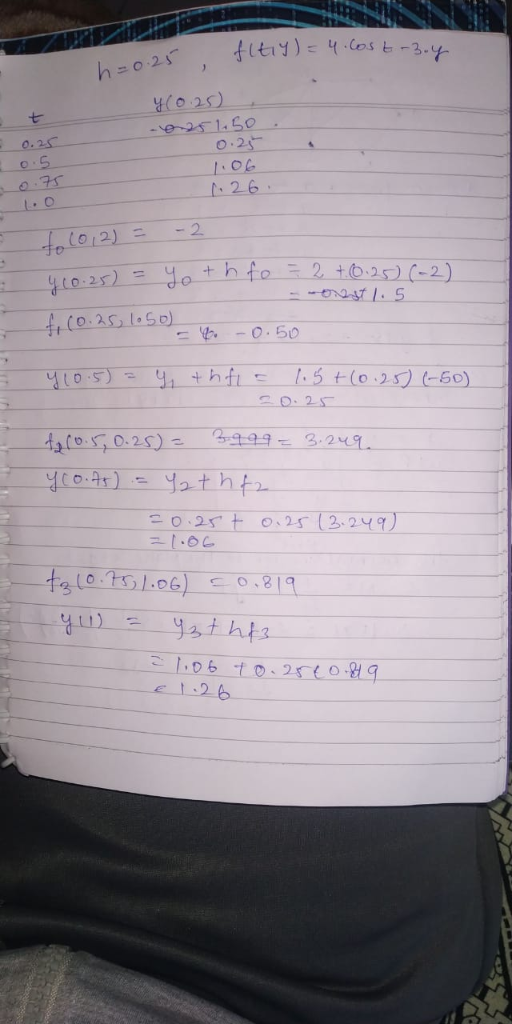
Euler's method for a first order IVP y = f(x,y), y(x) = yo is the the following algorithm. From (20, yo) we define a sequence of approximations to the solution of the differential equation so that at the nth stage, we have In = {n-1 +h, Yn = Yn-1 +h. f(xn-1, Yn-1). In this exercise...
Please help me do both problems if you can, this is due tonight
and this is my last question for this subscription period. (Thank
you)
Euler's method for a first order IVP y = f(x,y), y(x) = yo is the the following algorithm. From (20, yo) we define a sequence of approximations to the solution of the differential equation so that at the nth stage, we have In = {n-1 +h, Yn = Yn-1 +h. f(xn-1, Yn-1). In this exercise...
Question 20 1 pts Problem 20: Numerical solution of Ordinary differential equations Consider the following initial...
 Question 20 1 pts Problem 20: Numerical solution of Ordinary differential equations Consider the following initial value problem GE: H+ 15y =t 1.C:y(0) = 0.5 Carry out two consecutive steps of the Euler solution from the initial condition with a time step of At = 0.2. and the predicted solutions are None of the above. y(0.2)--0.25 and y(0.4)-0.13 (0.2)-0.05 and y(0.4)-0.03 y(0.2) -- 1.00 and y(0.4)-2.04 y(0.2)-0.13 and y(0.4)-0.20
Use Improved Euler for first question, Runge- Katta for 2nd one. Thank you In each of...
 Use Improved Euler for first question, Runge- Katta for 2nd one.
Thank you
In each of Problems 7 through 12, find approximate values of the solution of the given initial value problem at t-0.5,1.0, 1.5, and 2.0 (a) Use the improved Euler method with h 0.025 (b) Use the improved Euler method with h-0.0125 In each of Problems 7 through 12, find approximate values of the solution of the given initial value problem at0.5,1.0, 1.5, and 2.0. Compare the results...
Use Improved Euler for first question, Runge- Katta for 2nd one.
Thank you
In each of Problems 7 through 12, find approximate values of the solution of the given initial value problem at t-0.5,1.0, 1.5, and 2.0 (a) Use the improved Euler method with h 0.025 (b) Use the improved Euler method with h-0.0125 In each of Problems 7 through 12, find approximate values of the solution of the given initial value problem at0.5,1.0, 1.5, and 2.0. Compare the results...
Solve using Matlab Use the forward Euler method, Vi+,-Vi+(4+1-tinti ,Vi) for i= 0,1,2, , taking yo y(to) to be the initial condition, to approximate the solution at t-2 of the IVP y'=y-t2 + 1, 0-...
 Solve using Matlab
Use the forward Euler method, Vi+,-Vi+(4+1-tinti ,Vi) for i= 0,1,2, , taking yo y(to) to be the initial condition, to approximate the solution at t-2 of the IVP y'=y-t2 + 1, 0-t-2, y(0) = 0.5. Use N = 2k, k = 1, 2, , 20 equispaced time steps (so to = 0 and tN-1 = 2). Make a convergence plot, computing the error by comparing with the exact solution, y: t1)2 -exp(t)/2, and plotting the error as...
Solve using Matlab
Use the forward Euler method, Vi+,-Vi+(4+1-tinti ,Vi) for i= 0,1,2, , taking yo y(to) to be the initial condition, to approximate the solution at t-2 of the IVP y'=y-t2 + 1, 0-t-2, y(0) = 0.5. Use N = 2k, k = 1, 2, , 20 equispaced time steps (so to = 0 and tN-1 = 2). Make a convergence plot, computing the error by comparing with the exact solution, y: t1)2 -exp(t)/2, and plotting the error as...
I have all of the answers to this can someone just actually explain this matlab code and the results to me so i can get a better understanding? b) (c) and (d) %% Matlab code %% clc; close all; clear...
 I have all of the answers to this can someone just actually
explain this matlab code and the results to me so i can get a
better understanding?
b)
(c) and (d)
%% Matlab code %%
clc;
close all;
clear all;
format long;
f=@(t,y)y*(1-y);
y(1)=0.01;
%%%% Exact solution
[t1 y1]=ode45(f,[0 9],y(1));
figure;
plot(t1,y1,'*');
hold on
% Eular therom
M=[32 64 128];
T=9;
fprintf(' M Max error \n' );
for n=1:length(M)
k=T/M(n);
t=0:k:T;
for h=1:length(t)-1
y(h+1)=y(h)+k*f(t(h),y(h));
end
plot(t,y);
hold on
%%%...
I have all of the answers to this can someone just actually
explain this matlab code and the results to me so i can get a
better understanding?
b)
(c) and (d)
%% Matlab code %%
clc;
close all;
clear all;
format long;
f=@(t,y)y*(1-y);
y(1)=0.01;
%%%% Exact solution
[t1 y1]=ode45(f,[0 9],y(1));
figure;
plot(t1,y1,'*');
hold on
% Eular therom
M=[32 64 128];
T=9;
fprintf(' M Max error \n' );
for n=1:length(M)
k=T/M(n);
t=0:k:T;
for h=1:length(t)-1
y(h+1)=y(h)+k*f(t(h),y(h));
end
plot(t,y);
hold on
%%%...
Use the backward Euler method with h = 0.1 to find approximate values of the solution...
 Use the backward Euler method with h = 0.1 to find approximate values of the solution of the given initial value problem at t = 0.1, 0.2, 0.3 and 0.4. y' = 0.7 – + + 2y, y(O) = 2. Make all calculations as accurately as possible and round your final answers to two decimal places. In = nh n=1 0.1 n=2 0.2 n=3 0.3 n = 4 0.4
[7] 1. Consider the initial value problem (IVP) y′(t) = −y(t), y(0) = 1 The solution to this IVP ...
[7] 1. Consider the initial value problem (IVP) y′(t) = −y(t), y(0) = 1 The solution to this IVP is y(t) = e−t [1] i) Implement Euler’s method and generate an approximate solution of this IVP over the interval [0,2], using stepsize h = 0.1. (The Google sheet posted on LEARN is set up to carry out precisely this task.) Report the resulting approximation of the value y(2). [1] ii) Repeat part (ii), but use stepsize h = 0.05. Describe...
 hand written solution only (not computerised) if not
possible then please refund the question becs i have already
recieved a computerised solution from you but i dont
understand.
3In modelling the velocity y of a chain slipping off a horizontal platform, the differential equation y, 10/y-y/x is derived. Suppose the initial condition is y( 1-1 (a) Euler's method for solving yf(x), y(xoyo, is given by yn+n+hf(an,yn), where h is a fixed stepsize, xn xo + nh, and yn y(xn). Apply...
hand written solution only (not computerised) if not
possible then please refund the question becs i have already
recieved a computerised solution from you but i dont
understand.
3In modelling the velocity y of a chain slipping off a horizontal platform, the differential equation y, 10/y-y/x is derived. Suppose the initial condition is y( 1-1 (a) Euler's method for solving yf(x), y(xoyo, is given by yn+n+hf(an,yn), where h is a fixed stepsize, xn xo + nh, and yn y(xn). Apply...
 Question 22 1 pts Problem 22: Numerical solution of Ordinary differential equations Consider the following initial value problem GE:+15y = 1.C:y(0) -0.5 Carry out two-steps of the modified Euler (trapezoidal) method solution from the initial condition with a time step of At = 0.1. and the predicted solutions is y(0.2)-0.20 None of the above. y(0.2) - -0.75 y(0.2)-1.27 y(0.2)=0.25
 Question 21 1 pts Problem 21: Numerical solution of Ordinary differential equations Consider the following initial value problem G.EE +15y = 1.C:y(0) - 0.5 Carry out a single step of the modified Euler (trapezoidal) method solution from the initial condition with a time step of At = 0.2, and the predicted solutions is Y(0.2)-0.20 None of the above y(0.2)-1.27 Y(0.2)-0.25 (0.2)--0.75
 Please help me do both problems if you can, this is due tonight
and this is my last question for this subscription period. (Thank
you)
Euler's method for a first order IVP y = f(x,y), y(x) = yo is the the following algorithm. From (20, yo) we define a sequence of approximations to the solution of the differential equation so that at the nth stage, we have In = {n-1 +h, Yn = Yn-1 +h. f(xn-1, Yn-1). In this exercise...
Please help me do both problems if you can, this is due tonight
and this is my last question for this subscription period. (Thank
you)
Euler's method for a first order IVP y = f(x,y), y(x) = yo is the the following algorithm. From (20, yo) we define a sequence of approximations to the solution of the differential equation so that at the nth stage, we have In = {n-1 +h, Yn = Yn-1 +h. f(xn-1, Yn-1). In this exercise...
 Question 20 1 pts Problem 20: Numerical solution of Ordinary differential equations Consider the following initial value problem GE: H+ 15y =t 1.C:y(0) = 0.5 Carry out two consecutive steps of the Euler solution from the initial condition with a time step of At = 0.2. and the predicted solutions are None of the above. y(0.2)--0.25 and y(0.4)-0.13 (0.2)-0.05 and y(0.4)-0.03 y(0.2) -- 1.00 and y(0.4)-2.04 y(0.2)-0.13 and y(0.4)-0.20
 Use Improved Euler for first question, Runge- Katta for 2nd one.
Thank you
In each of Problems 7 through 12, find approximate values of the solution of the given initial value problem at t-0.5,1.0, 1.5, and 2.0 (a) Use the improved Euler method with h 0.025 (b) Use the improved Euler method with h-0.0125 In each of Problems 7 through 12, find approximate values of the solution of the given initial value problem at0.5,1.0, 1.5, and 2.0. Compare the results...
Use Improved Euler for first question, Runge- Katta for 2nd one.
Thank you
In each of Problems 7 through 12, find approximate values of the solution of the given initial value problem at t-0.5,1.0, 1.5, and 2.0 (a) Use the improved Euler method with h 0.025 (b) Use the improved Euler method with h-0.0125 In each of Problems 7 through 12, find approximate values of the solution of the given initial value problem at0.5,1.0, 1.5, and 2.0. Compare the results...
 Solve using Matlab
Use the forward Euler method, Vi+,-Vi+(4+1-tinti ,Vi) for i= 0,1,2, , taking yo y(to) to be the initial condition, to approximate the solution at t-2 of the IVP y'=y-t2 + 1, 0-t-2, y(0) = 0.5. Use N = 2k, k = 1, 2, , 20 equispaced time steps (so to = 0 and tN-1 = 2). Make a convergence plot, computing the error by comparing with the exact solution, y: t1)2 -exp(t)/2, and plotting the error as...
Solve using Matlab
Use the forward Euler method, Vi+,-Vi+(4+1-tinti ,Vi) for i= 0,1,2, , taking yo y(to) to be the initial condition, to approximate the solution at t-2 of the IVP y'=y-t2 + 1, 0-t-2, y(0) = 0.5. Use N = 2k, k = 1, 2, , 20 equispaced time steps (so to = 0 and tN-1 = 2). Make a convergence plot, computing the error by comparing with the exact solution, y: t1)2 -exp(t)/2, and plotting the error as...
 I have all of the answers to this can someone just actually
explain this matlab code and the results to me so i can get a
better understanding?
b)
(c) and (d)
%% Matlab code %%
clc;
close all;
clear all;
format long;
f=@(t,y)y*(1-y);
y(1)=0.01;
%%%% Exact solution
[t1 y1]=ode45(f,[0 9],y(1));
figure;
plot(t1,y1,'*');
hold on
% Eular therom
M=[32 64 128];
T=9;
fprintf(' M Max error \n' );
for n=1:length(M)
k=T/M(n);
t=0:k:T;
for h=1:length(t)-1
y(h+1)=y(h)+k*f(t(h),y(h));
end
plot(t,y);
hold on
%%%...
I have all of the answers to this can someone just actually
explain this matlab code and the results to me so i can get a
better understanding?
b)
(c) and (d)
%% Matlab code %%
clc;
close all;
clear all;
format long;
f=@(t,y)y*(1-y);
y(1)=0.01;
%%%% Exact solution
[t1 y1]=ode45(f,[0 9],y(1));
figure;
plot(t1,y1,'*');
hold on
% Eular therom
M=[32 64 128];
T=9;
fprintf(' M Max error \n' );
for n=1:length(M)
k=T/M(n);
t=0:k:T;
for h=1:length(t)-1
y(h+1)=y(h)+k*f(t(h),y(h));
end
plot(t,y);
hold on
%%%...
 Use the backward Euler method with h = 0.1 to find approximate values of the solution of the given initial value problem at t = 0.1, 0.2, 0.3 and 0.4. y' = 0.7 – + + 2y, y(O) = 2. Make all calculations as accurately as possible and round your final answers to two decimal places. In = nh n=1 0.1 n=2 0.2 n=3 0.3 n = 4 0.4
Most questions answered within 3 hours.
-
Where is the error in this code sequence?
String s1 = "Hello";
String s2 = "ello";...
asked 11 months ago -
Financial data for Joel de Paris, Inc., for last year
follow:
Joel de Paris, Inc.
Balance...
asked 11 months ago -
Consider this reaction:
Al2(SO4)3 (aq)+ BaCl3
(aq) Al2Cl6 (aq)- +
3BaSO4(s) . What is the...
asked 11 months ago -
Suppose that Savneet is considering increasing her
recent random sample from 20 car rentals to 40...
asked 11 months ago -
Trucks arrive at an unloading terminal at an average rate of 120
per hour.
Trucks arrive...
asked 11 months ago -
Why are methanol and ethanol completely soluble in water while
octanol is not very little soluble....
asked 11 months ago -
A facilities manager at a university reads in a research report
that the mean amount of...
asked 11 months ago -
When the CuSO4 is rehydrated by adding water to the anhydrous
compound, is this an endothermic...
asked 11 months ago -
A ray of sunlight is passing from diamond into crown glass; the
angle of incidence is...
asked 11 months ago -
A block of mass 0.249 kg is placed on top of a light, vertical
spring of...
asked 11 months ago -
how do the kidneys compensate in the presences of acidosis
a) trigger hyperventilate
b) reserve acid...
asked 11 months ago -
Question 501 pts
The rental rate of capital to the firm increases. Which of the
following...
asked 11 months ago