


Homework Answers
[1] Answer : [D] 6
![public static void main (String] args) for (int k = 1; k < 10; k++) { if(ke-8) 4 continue; System.out.println(k); if(ke-6) br](http://img.homeworklib.com/questions/4e1658c0-b977-11ea-81f4-550ed0b7bb6a.png?x-oss-process=image/resize,w_560)
[2] Answer : [A]/[C]
Reason : Members who have ‘private’ access modifier can’t be accessed in any other class other than the class in which the private member was declared.
[3] Answer : [D] 3
Reason :
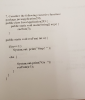
static void smethod() {
Foo.smethod();
//Canont Acces Non Static
Variable at Class Level
System.out.println(Foo.i);
System.out.println(Foo.s);
//Cannot make a static
reference to the non-static field
f.imethod();
//Static Variable Not use
at Object Level
System.out.println(f.s);
}

Add Answer to:
**JAVA*JAVA Question 1 How many k's values will be printed out? public static void main(Stringl args)...
What is the Java output? Part One: class Driver { public static void main(String[] args) {...
What is the Java output? Part One: class Driver { public static void main(String[] args) { int a = 5; int b = 3; if (a < b || a * 2 < b) System.out.print(a - b); System.out.print(b + a); } } Part Two: class Driver { public static void main(String[] args) { int a = 5; int b = 8; if (a < b) if (a * 2 < b) System.out.print("foo"); else System.out.print("bar"); else System.out.print("buz"); } }
7. Consider the following recursive function: package javaapplication293; public class JavaApplication293 public static void main Stringl...
 7. Consider the following recursive function: package javaapplication293; public class JavaApplication293 public static void main Stringl args) recFun(7) public static void recFun int u) if (-= 1 ) System.out. print("Stop! "); else System.out.print("Go "); recFun(u-1);
Java Method Resolution : Consider the following example: What is printed on the console if Main...
Java Method Resolution : Consider the following example: What is printed on the console if Main is executed, and why? How the codes could be improved? public class Main { public static void main(String[] args) throws Exception { A obj = null; obj.foo(); } } public class A { public void foo() { System.out.println(“foo in A”); } }
What output is produced by the following program? public class MysteryNums public static void main(String[] args)...
 What output is produced by the following program? public class MysteryNums public static void main(String[] args) - int x = 12; int y = x - 3; 3, sentence (y, x + y); . public static void sentence (int numi, int num2) { 4: System.out.println(num1 + " + num2);
Given the following Java code: public static void main (String[] args) { int num; System.out.println("Enter a...
Given the following Java code: public static void main (String[] args) { int num; System.out.println("Enter a number"); num = scan.nextInt(); <-first input statement while (num != 0) { System.out.println ("The number is: " + num); System.out.println("Enter a number"); num = scan.nextInt(); } //End While } //End Module The first input statement shown above is called the:
Revision Question Consider the following Java class: { public static void main (String [ ] args)...
Revision Question Consider the following Java class: { public static void main (String [ ] args) { ArrayQueue<Integer> queue; queue = new ArrayQueue<Integer> () ; Integer x, y ; x = 3; y = 6; queue.offer (x) ; queue.offer (12) ; queue.offer (y) ; y = queue.peek () ; queue.poll () ; queue. offer (x - 2) ; queue.offer (x) ; queue.offer (y + 4) ; System.out.println ("Queue Elements: ") ; while (! queue.empty() ) System.out.print (queue.poll () + "...
What are the errors in this ? public class Mystery { public static void main(String[] args)...
What are the errors in this ? public class Mystery { public static void main(String[] args) { double initialSavings = 10000; double interestRate = 0.05; double currSavings = 0; int i; System.out.println("\nAnnual savings 5 years: "); currSavings = initialSavings; for (i = 0, i < 5, ++i); currSavings = (currSavings * interestRate); System.out.println("$" + currSavings); } }
import java.util.Scanner; public class TriangleMaker { public static void main(String[] args) { //...
import java.util.Scanner; public class TriangleMaker { public static void main(String[] args) { // TODO Auto-generated method stub System.out.println("Welcome to the Triangle Maker! Enter the size of the triangle."); Scanner keyboard = new Scanner(System.in); int size = keyboard.nextInt(); for (int i = 1; i <= size; i++) { for (int j = 0; j < i; j++) { System.out.print("*"); } System.out.println(); } for (int...
Consider the following Java 8 code, and select true statements: public interface Functionlnterfac...
 Consider the following Java 8 code, and select true statements: public interface Functionlnterface1 void abstFun1 (int x) public interface Functioninterface2( void abstFun2(int x); public class Main implements Functioninterface2( @Override public void abstFun2(int x) System.out.printin(3'x); public static void main(Stringl args) ( Functioninterface1 fobj (int x)->System.out.printin(2"x) fobj.abstFun1(5); Main me - new Main; me.abstFun2(5); Functioninterface2 fobj2-(int x)->System.out.printin(4%; fobj2.abstFun2(5) 2 in main will not run because abstFun2 was previoudly implemented. O The fobj instance of Functionlnterface1 is created using the lambda at runtime without...
Consider the following sample program: import java.util.Scanner; public class Palindrome { public static void main(String[] args){...
Consider the following sample program: import java.util.Scanner; public class Palindrome { public static void main(String[] args){ Scanner kb = new Scanner(System.in); System.out.println("Enter a word:"); String word = kb.next(); String reverse = ""; for (int i=word.length()-1; i>=0; i--) reverse += word.charAt(i); boolean result = reverse.equalsIgnoreCase(word); if (result) System.out.println("The word " +word+ " is a Palindrome."); else System.out.println("The word " +word+ " is not a Palindrome."); } } Rewrite the program so that the main method is: public static void...
 7. Consider the following recursive function: package javaapplication293; public class JavaApplication293 public static void main Stringl args) recFun(7) public static void recFun int u) if (-= 1 ) System.out. print("Stop! "); else System.out.print("Go "); recFun(u-1);
 What output is produced by the following program? public class MysteryNums public static void main(String[] args) - int x = 12; int y = x - 3; 3, sentence (y, x + y); . public static void sentence (int numi, int num2) { 4: System.out.println(num1 + " + num2);
 Consider the following Java 8 code, and select true statements: public interface Functionlnterface1 void abstFun1 (int x) public interface Functioninterface2( void abstFun2(int x); public class Main implements Functioninterface2( @Override public void abstFun2(int x) System.out.printin(3'x); public static void main(Stringl args) ( Functioninterface1 fobj (int x)->System.out.printin(2"x) fobj.abstFun1(5); Main me - new Main; me.abstFun2(5); Functioninterface2 fobj2-(int x)->System.out.printin(4%; fobj2.abstFun2(5) 2 in main will not run because abstFun2 was previoudly implemented. O The fobj instance of Functionlnterface1 is created using the lambda at runtime without...
Most questions answered within 3 hours.
-
Where is the error in this code sequence?
String s1 = "Hello";
String s2 = "ello";...
asked 11 months ago -
Financial data for Joel de Paris, Inc., for last year
follow:
Joel de Paris, Inc.
Balance...
asked 11 months ago -
Consider this reaction:
Al2(SO4)3 (aq)+ BaCl3
(aq) Al2Cl6 (aq)- +
3BaSO4(s) . What is the...
asked 11 months ago -
Suppose that Savneet is considering increasing her
recent random sample from 20 car rentals to 40...
asked 11 months ago -
Trucks arrive at an unloading terminal at an average rate of 120
per hour.
Trucks arrive...
asked 11 months ago -
Why are methanol and ethanol completely soluble in water while
octanol is not very little soluble....
asked 11 months ago -
A facilities manager at a university reads in a research report
that the mean amount of...
asked 11 months ago -
When the CuSO4 is rehydrated by adding water to the anhydrous
compound, is this an endothermic...
asked 11 months ago -
A ray of sunlight is passing from diamond into crown glass; the
angle of incidence is...
asked 11 months ago -
A block of mass 0.249 kg is placed on top of a light, vertical
spring of...
asked 11 months ago -
how do the kidneys compensate in the presences of acidosis
a) trigger hyperventilate
b) reserve acid...
asked 11 months ago -
Question 501 pts
The rental rate of capital to the firm increases. Which of the
following...
asked 11 months ago