Consider a 3.0 kg mass on a spring on a horizontal surface. The spring has spring constant 45 N/m. The static coefficient of friction between the mass and the surface is µS = 0.30 and the kinetic coefficient of friction is µK = 0.20
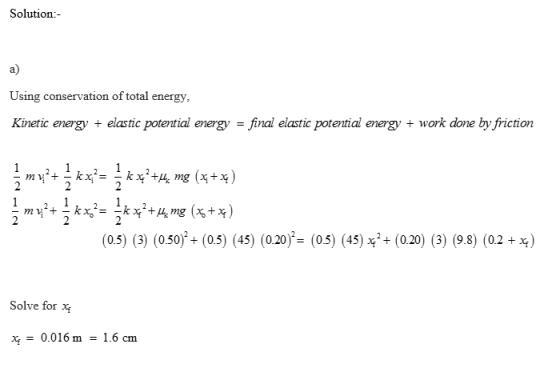
(a) When the mass is at x0 = 20 cm it is moving to the right with speed 50 cm/s. Where does it first come to a stop? [Hint: use energy considerations.]
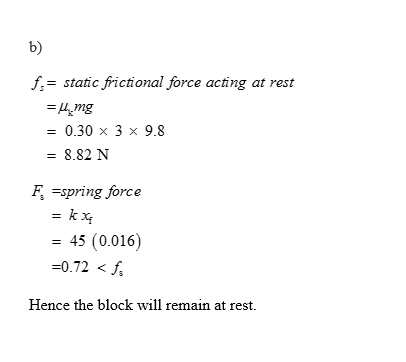
(b) Once the mass stops, does it remain at rest or does it move back to the left? If it moves to the left, what is its initial acceleration? Justify your answer.
![05.3 Consider a 3.0 kg mass on a spring on a horizontal surface. The spring has spring constant 45 N/m. The static coefficient of friction between the mass and the surface is us 0.30 and the kinetic coefficient of friction is uK 0.20 Equilibrium position (a) When the mass is at xo 20 cm it is moving to the right with speed 50 cm/s. Where does it first come to a stop? LHint: use energy considerations.] (b) Once the mass stops, does it remain at rest or does it move back to the left? If it moves to the left, what is its initial acceleration? Justify your answer.](http://img.homeworklib.com/questions/01d6ddf0-bf87-11ea-9cd7-896f557a0d2a.png?x-oss-process=image/resize,w_560)
I just don't know where to begin, or what equations that I should be using.
Homework Answers
Add Answer to:
Consider a 3.0 kg mass on a spring on a horizontal surface. The
spring has spring...
A horizontal force F, of strength 3.0 N, is applied to a block of mass m...
A horizontal force F, of strength 3.0 N, is applied to a block of mass m = 1.0 kg as shown. The coefficient of static friction between the block and the surface is 0.60, and the coefficient of kinetic friction is 0.20. Will the block move? What is the force of friction that acts on the block?
An air-track glider of mass 0.100 kg is attached to the end of a horizontal air track by a spring with force constant 20.0 N/m. Initially the spring is unstreched and the glider is moving at 1.50 m/s...
An air-track glider of mass 0.100 kg is attached to the end of a horizontal air track by a spring with force constant 20.0 N/m. Initially the spring is unstreched and the glider is moving at 1.50 m/s to the right. With the air track turned off, the coefficient of kinetic friction is μk=0.47. It can be shown that with the air track turned off, the glider travels 8.6 cm before it stops instantaneously. How large would the coefficient of...
An experiment is done on a horizontal surface. A block of mass m_1 is initially held...
 An experiment is done on a horizontal surface. A block of mass m_1 is initially held in place compressing a spring with spring constant k by a distance x_0. The other end of the spring is firmly attached to the wall and does not move. What is the final speed of m_1 after it is released and loses contact with the spring? After it reaches its final speed, m_1 collides and sticks to a second block of mass m_2. What...
7: A 60-kg box is placed against a uniform spring with a spring constant (k) of...
 7: A 60-kg box is placed against a uniform spring with a spring constant (k) of 3300 N/m The box is pushed to the right so it compresses the spring 25-cm. When the box is released, it is propelled to the left. (a) What is the velocity of the box as it slides along the flat surface to the left after it loses contact with the spring? 350 (b) How far up the ramp will the box slide while coming...
An air-track glider of mass 0.109 kg is attached to the end of a horizontal air...
An air-track glider of mass 0.109 kg is attached to the end of a horizontal air track by a spring with force constant 24.5 N/m (a) With the air track turned off, the glider travels 8.0 cm before it stops instantaneously. How large would the coefficient of static friction μs have to be to keep the glider from springing back to the left? (b) If the coefficient of static friction between the glider and the track is μs= 0.65, what...
An air-track glider of mass 0.100 kg is attached to the end of a horizontal air...
An air-track glider of mass 0.100 kg is attached to the end of a horizontal air track by a spring with force constant 20.0 N/m. Initially the spring is unstreched and the glider is moving at 1.50 m/s to the right. With the air track turned off, the coefficient of kinetic friction is μk=0.47. It can be shown that with the air track turned off, the glider travels 8.6 cm before it stops instantaneously. If the coefficient of static friction...
A spring with a spring constant of 718 N/m lies on a horizontal surface and that...
A spring with a spring constant of 718 N/m lies on a horizontal surface and that surface is y = 0 m to calculate the gravitational potential energy. A mass of 3 kg is compressed 0.45 meters into the spring and held still. After the mass is released it slides over a horizontal surface in which a 3.4 meter portion of the surface has friction with a coefficient of kinetic friction of 0.30. After the horizontal surface, it travels up...
Cart A (mass 2.0 kg) and Cart B (mass 3.0 kg) are separated by a compressed...
Cart A (mass 2.0 kg) and Cart B (mass 3.0 kg) are separated by a compressed spring and attached to each other by a string. Initially they are sitting at rest on a frictionless surface. When the string is burned, Cart A moves to the left at 1.5 m/s. Cart B moves to the right and encounters a rough surface. Cart B comes to a stop after traveling a distance of 0.35 m on the rough surface. What is the...
3.0 kg block slides down a frictionless ramp of height 3.0 meters starting from rest. it then tra...
 3.0 kg block slides down a frictionless ramp of height 3.0
meters starting from rest. it then traverses a 2.0 metter rough
patch with a coefficient of kinetic friction 0.35 It then gets to a
smooth area where it compresses a horizontal spring of spring
constant 50 n/m.
Please help me Solve the rest of the physics problem
The answers to part A is x= 1.64 meters and part b is 1.58
meters
Problem 1 A 3.0 kg block slides...
3.0 kg block slides down a frictionless ramp of height 3.0
meters starting from rest. it then traverses a 2.0 metter rough
patch with a coefficient of kinetic friction 0.35 It then gets to a
smooth area where it compresses a horizontal spring of spring
constant 50 n/m.
Please help me Solve the rest of the physics problem
The answers to part A is x= 1.64 meters and part b is 1.58
meters
Problem 1 A 3.0 kg block slides...
An object of mass m = 1.70 kg is travelling on a horizontal surface. The coefficient...
 An object of mass m = 1.70 kg is travelling on a horizontal surface. The coefficient of kinetic friction between the object and the surface is muk = 0.200. The object has speed v = 1 .35 m/s when it reaches x = 0 and encounters a spring. The object compresses the spring a distance d/2, stops instantaneously, and then travels back to x = 0 where it stops completely. Eventually you will be asked to find the spring constant,...
 An experiment is done on a horizontal surface. A block of mass m_1 is initially held in place compressing a spring with spring constant k by a distance x_0. The other end of the spring is firmly attached to the wall and does not move. What is the final speed of m_1 after it is released and loses contact with the spring? After it reaches its final speed, m_1 collides and sticks to a second block of mass m_2. What...
 7: A 60-kg box is placed against a uniform spring with a spring constant (k) of 3300 N/m The box is pushed to the right so it compresses the spring 25-cm. When the box is released, it is propelled to the left. (a) What is the velocity of the box as it slides along the flat surface to the left after it loses contact with the spring? 350 (b) How far up the ramp will the box slide while coming...
 3.0 kg block slides down a frictionless ramp of height 3.0
meters starting from rest. it then traverses a 2.0 metter rough
patch with a coefficient of kinetic friction 0.35 It then gets to a
smooth area where it compresses a horizontal spring of spring
constant 50 n/m.
Please help me Solve the rest of the physics problem
The answers to part A is x= 1.64 meters and part b is 1.58
meters
Problem 1 A 3.0 kg block slides...
3.0 kg block slides down a frictionless ramp of height 3.0
meters starting from rest. it then traverses a 2.0 metter rough
patch with a coefficient of kinetic friction 0.35 It then gets to a
smooth area where it compresses a horizontal spring of spring
constant 50 n/m.
Please help me Solve the rest of the physics problem
The answers to part A is x= 1.64 meters and part b is 1.58
meters
Problem 1 A 3.0 kg block slides...
 An object of mass m = 1.70 kg is travelling on a horizontal surface. The coefficient of kinetic friction between the object and the surface is muk = 0.200. The object has speed v = 1 .35 m/s when it reaches x = 0 and encounters a spring. The object compresses the spring a distance d/2, stops instantaneously, and then travels back to x = 0 where it stops completely. Eventually you will be asked to find the spring constant,...
Most questions answered within 3 hours.
-
Where is the error in this code sequence?
String s1 = "Hello";
String s2 = "ello";...
asked 10 months ago -
Financial data for Joel de Paris, Inc., for last year
follow:
Joel de Paris, Inc.
Balance...
asked 10 months ago -
Consider this reaction:
Al2(SO4)3 (aq)+ BaCl3
(aq) Al2Cl6 (aq)- +
3BaSO4(s) . What is the...
asked 10 months ago -
Suppose that Savneet is considering increasing her
recent random sample from 20 car rentals to 40...
asked 10 months ago -
Trucks arrive at an unloading terminal at an average rate of 120
per hour.
Trucks arrive...
asked 10 months ago -
Why are methanol and ethanol completely soluble in water while
octanol is not very little soluble....
asked 10 months ago -
A facilities manager at a university reads in a research report
that the mean amount of...
asked 10 months ago -
When the CuSO4 is rehydrated by adding water to the anhydrous
compound, is this an endothermic...
asked 10 months ago -
A ray of sunlight is passing from diamond into crown glass; the
angle of incidence is...
asked 10 months ago -
A block of mass 0.249 kg is placed on top of a light, vertical
spring of...
asked 10 months ago -
how do the kidneys compensate in the presences of acidosis
a) trigger hyperventilate
b) reserve acid...
asked 10 months ago -
Question 501 pts
The rental rate of capital to the firm increases. Which of the
following...
asked 10 months ago