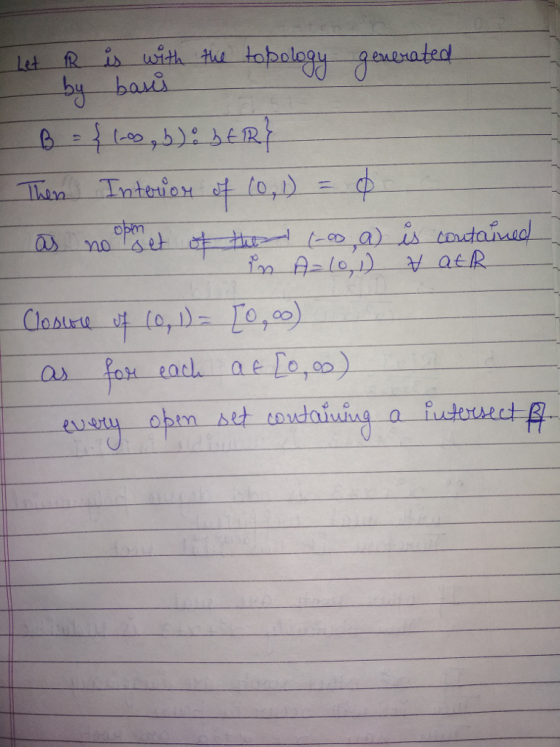
TOPOLOGY We have in the topology generated by the basis , which is not the usual...
TOPOLOGY
We have in the
topology generated by the basis
, which is not the usual topology.
Find the closure and the interior of the set A=(0,1) in this topology.
Homework Answers
Add Answer to:
TOPOLOGY
We have in the
topology generated by the basis
, which is not the usual...
Let S1 be the unit circle with the usual topology, S1 × S1 be the product...
 Let S1 be the unit
circle with the usual topology, S1 × S1 be
the product space, and define the torus T : = [0,1] × [0,1] / ∼ as
a quotient space, where ∼ is the equivalence relation that (1,y) ∼
(0,y) for all y ∈ [0,1] and (x,0) ∼ (x,1) for all x ∈ [0,1]. Prove
that S1 × S1 and T are homeomorphic.
Let Sl be the unit circle with the usual topology, Stx St be the...
Let S1 be the unit
circle with the usual topology, S1 × S1 be
the product space, and define the torus T : = [0,1] × [0,1] / ∼ as
a quotient space, where ∼ is the equivalence relation that (1,y) ∼
(0,y) for all y ∈ [0,1] and (x,0) ∼ (x,1) for all x ∈ [0,1]. Prove
that S1 × S1 and T are homeomorphic.
Let Sl be the unit circle with the usual topology, Stx St be the...
3. (a) Let (R, τe) be the usual topology on R. Find the limit point set...
3. (a) Let (R, τe) be the usual topology on R. Find the limit point set of the following subsets of R (i) A = { n+1 n : n ∈ N} (ii) B = (0, 1] (iii) C = {x : x ∈ (0, 1), x is a rational number (b) Let X denote the indiscrete topology. Find the limit point set A 0 of any subset A of X. (c) Prove that a subset D of X is...
4. Let A = [0,1) CR, where R is endowed with its usual metric. (a) What...
 4. Let A = [0,1) CR, where R is endowed with its usual metric. (a) What is the interior of A? Prove your answer. (b) What is the closure of A? Prove your answer.
Prove that in R^n with the usual topology, if a set is closed and bounded then it is compact.
Prove that in R^n with the usual topology, if a set is closed and bounded then it is compact.
topology Note: Symbols have their usual meanings. 1. Show that every indiscrete topological space is locally...
 topology
Note: Symbols have their usual meanings. 1. Show that every indiscrete topological space is locally connected. 2. Give an example of locally connected topological space which is not connected. 3. Show that the intersection of any collection of closed compact subsets of a topological space is closed and compact. (2)
topology
Note: Symbols have their usual meanings. 1. Show that every indiscrete topological space is locally connected. 2. Give an example of locally connected topological space which is not connected. 3. Show that the intersection of any collection of closed compact subsets of a topological space is closed and compact. (2)
Topology Sort Which traversal do we use for Topology Sort of a di-graph? Given the following Di-G...
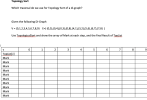 Topology Sort Which traversal do we use for Topology Sort of a di-graph? Given the following Di-Graph Use TopologicalSort and show the array of Mark at each step, and the final Result of Toplist 0 1 4 5 6 9 TopList v Mark Mark Mark Mark Mark Mark Mark Mark Mark Mark
Topology Sort Which traversal do we use for Topology Sort of a di-graph? Given the following Di-Graph Use TopologicalSort and show the array of Mark at each step,...
Topology Sort Which traversal do we use for Topology Sort of a di-graph? Given the following Di-Graph Use TopologicalSort and show the array of Mark at each step, and the final Result of Toplist 0 1 4 5 6 9 TopList v Mark Mark Mark Mark Mark Mark Mark Mark Mark Mark
Topology Sort Which traversal do we use for Topology Sort of a di-graph? Given the following Di-Graph Use TopologicalSort and show the array of Mark at each step,...
8. Let T be the topology on N which consists of Ø and all subsets of...
 8. Let T be the topology on N which consists of Ø and all subsets of N of the form An={n, n+1, n + 2,...} where n EN (i) Determine the closed subsets of (N, T) (ii) Determine the closure of the sets {7, 24, 47,85} and {3,6,9, 12} (iii) Determine those subsets of N which are dense in N
A random variable X is generated as follows. We flip a coin. With probability p ,...
A random variable X is generated as follows. We flip a coin. With probability p , the result is Heads, and then X is generated according to a PDF f X|H which is uniform on [0,1] . With probability 1−p the result is Tails, and then X is generated according to a PDF f X|T of the form f X|T (x)=2x,if x∈[0,1]. (The PDF is zero everywhere else.) 1. What is the (unconditional) PDF f X (x) of X ?...
1- Mendel generated 580 offspring peas. He claimed that 75%, or 435, of them, would have...
1- Mendel generated 580 offspring peas. He claimed that 75%, or 435, of them, would have green pods. The actual experiment resulted in 428 peas with green pods. a) Assuming that groups of 580 offspring peas are generated, find the mean and standard deviation for the number of peas with green pods. b) Use the range of thumb to find the minimum usual number and the maximum usual number of peas with green pods. Based on those numbers, can we...
Draw or find a network diagram, identify the topology, and describe the type of cabling used...
Draw or find a network diagram, identify the topology, and describe the type of cabling used in its configuration. Tell us when to use the topology and when we should not use it. Instructions In your initial response, address the following points: Draw or link a diagram of a network topology. Describe how your network topology works. Which types of cables would you use in its configuration? How do your choices affect speed, network congestion, and performance? When would you...
 Let S1 be the unit
circle with the usual topology, S1 × S1 be
the product space, and define the torus T : = [0,1] × [0,1] / ∼ as
a quotient space, where ∼ is the equivalence relation that (1,y) ∼
(0,y) for all y ∈ [0,1] and (x,0) ∼ (x,1) for all x ∈ [0,1]. Prove
that S1 × S1 and T are homeomorphic.
Let Sl be the unit circle with the usual topology, Stx St be the...
Let S1 be the unit
circle with the usual topology, S1 × S1 be
the product space, and define the torus T : = [0,1] × [0,1] / ∼ as
a quotient space, where ∼ is the equivalence relation that (1,y) ∼
(0,y) for all y ∈ [0,1] and (x,0) ∼ (x,1) for all x ∈ [0,1]. Prove
that S1 × S1 and T are homeomorphic.
Let Sl be the unit circle with the usual topology, Stx St be the...
 4. Let A = [0,1) CR, where R is endowed with its usual metric. (a) What is the interior of A? Prove your answer. (b) What is the closure of A? Prove your answer.
 topology
Note: Symbols have their usual meanings. 1. Show that every indiscrete topological space is locally connected. 2. Give an example of locally connected topological space which is not connected. 3. Show that the intersection of any collection of closed compact subsets of a topological space is closed and compact. (2)
topology
Note: Symbols have their usual meanings. 1. Show that every indiscrete topological space is locally connected. 2. Give an example of locally connected topological space which is not connected. 3. Show that the intersection of any collection of closed compact subsets of a topological space is closed and compact. (2)
 Topology Sort Which traversal do we use for Topology Sort of a di-graph? Given the following Di-Graph Use TopologicalSort and show the array of Mark at each step, and the final Result of Toplist 0 1 4 5 6 9 TopList v Mark Mark Mark Mark Mark Mark Mark Mark Mark Mark
Topology Sort Which traversal do we use for Topology Sort of a di-graph? Given the following Di-Graph Use TopologicalSort and show the array of Mark at each step,...
Topology Sort Which traversal do we use for Topology Sort of a di-graph? Given the following Di-Graph Use TopologicalSort and show the array of Mark at each step, and the final Result of Toplist 0 1 4 5 6 9 TopList v Mark Mark Mark Mark Mark Mark Mark Mark Mark Mark
Topology Sort Which traversal do we use for Topology Sort of a di-graph? Given the following Di-Graph Use TopologicalSort and show the array of Mark at each step,...
 8. Let T be the topology on N which consists of Ø and all subsets of N of the form An={n, n+1, n + 2,...} where n EN (i) Determine the closed subsets of (N, T) (ii) Determine the closure of the sets {7, 24, 47,85} and {3,6,9, 12} (iii) Determine those subsets of N which are dense in N
Most questions answered within 3 hours.
-
Where is the error in this code sequence?
String s1 = "Hello";
String s2 = "ello";...
asked 11 months ago -
Financial data for Joel de Paris, Inc., for last year
follow:
Joel de Paris, Inc.
Balance...
asked 11 months ago -
Consider this reaction:
Al2(SO4)3 (aq)+ BaCl3
(aq) Al2Cl6 (aq)- +
3BaSO4(s) . What is the...
asked 11 months ago -
Suppose that Savneet is considering increasing her
recent random sample from 20 car rentals to 40...
asked 11 months ago -
Trucks arrive at an unloading terminal at an average rate of 120
per hour.
Trucks arrive...
asked 11 months ago -
Why are methanol and ethanol completely soluble in water while
octanol is not very little soluble....
asked 11 months ago -
A facilities manager at a university reads in a research report
that the mean amount of...
asked 11 months ago -
When the CuSO4 is rehydrated by adding water to the anhydrous
compound, is this an endothermic...
asked 11 months ago -
A ray of sunlight is passing from diamond into crown glass; the
angle of incidence is...
asked 11 months ago -
A block of mass 0.249 kg is placed on top of a light, vertical
spring of...
asked 11 months ago -
how do the kidneys compensate in the presences of acidosis
a) trigger hyperventilate
b) reserve acid...
asked 11 months ago -
Question 501 pts
The rental rate of capital to the firm increases. Which of the
following...
asked 11 months ago