need help with homework
please explain steps
TIA
Homework Answers
When diluting solutions, we use the equation M1V1 = M2V2,
where M1 is the initial molarity in mol/L, (mol/L is denoted as M)
M2 is the final molarity in mol/L
V1 is the initial volume in Liters
V2 is the final volume in Liters.
Known
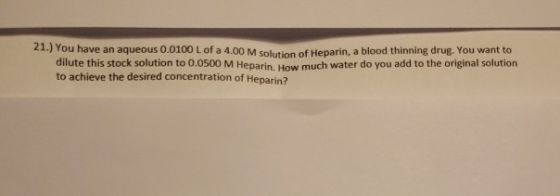
M1 = 4 mol/L heparin
V1 = 0.0100 L
M2 = 0.0500 mol/L heparin
Unknown V2
Solution
Rearrange the equation to isolate V2. Substitute the known values
into the equation and solve.
V2 = M1V1/M2
V2 = 4M×0.0100L /0.0500M = 0.8 L
In order to obtain a volume of 0.8L ,0.79 Litre (0.8 L - 0.0100 L) of water must be added to the original solution of 0.0100 L
Add Answer to:
need help with homework
please explain steps
TIA
21.) You have an aqueous 0.0100 L of...
1) You need to make an aqueous solution of 0.209 M potassium fluoride for an experiment...
1) You need to make an aqueous solution of 0.209 M potassium fluoride for an experiment in lab, using a 300 mL volumetric flask. How much solid potassium fluoride should you add? grams 2)How many milliliters of an aqueous solution of 0.244 M zinc acetate is needed to obtain 11.1 grams of the salt? mL 3) In the laboratory you dissolve 13.9 g of copper(II) chloride in a volumetric flask and add water to a total volume of 125 ....
Imagine that you are in chemistry lab and need to make 1.00 L of a solution with a pH of 2.40. You have in front of you...
Imagine that you are in chemistry lab and need to make 1.00 L of a solution with a pH of 2.40. You have in front of you 100 mL of 7.00×10⁻² M HCl, 100 mL of 5.00×10⁻² M NaOH, and plenty of distilled water. You start to add HCl to a beaker of water when someone asks you a question. When you return to your dilution, you accidentally grab the wrong cylinder and add some NaOH. Once you realize your...
Imagine that you are in chemistry lab and need to make 1.00 L of a solution...
Imagine that you are in chemistry lab and need to make 1.00 L of a solution with a pH of 2.80. You have in front of you 100 mL of 6.00×10⁻² M HCl, 100 mL of 5.00×10⁻² M NaOH, and plenty of distilled water. You start to add HCl to a beaker of water when someone asks you a question. When you return to your dilution, you accidentally grab the wrong cylinder and add some NaOH. Once you realize your...
Imagine that you are in chemistry lab and need to make 1.00 L of a solution...
Imagine that you are in chemistry lab and need to make 1.00 L of a solution with a pH of 2.40. You have in front of you 100 mL of 6.00×10⁻² M HCl, 100 mL of 5.00×10⁻² M NaOH, and plenty of distilled water. You start to add HCl to a beaker of water when someone asks you a question. When you return to your dilution, you accidentally grab the wrong cylinder and add some NaOH. Once you realize your...
Imagine that you are in chemistry lab and need to make 1.00 L of a solution...
Imagine that you are in chemistry lab and need to make 1.00 L of a solution with a pH of 2.50. You have in front of you 100 mL of 7.00×10⁻² M HCl, 100 mL of 5.00×10⁻² M NaOH, and plenty of distilled water. You start to add HCl to a beaker of water when someone asks you a question. When you return to your dilution, you accidentally grab the wrong cylinder and add some NaOH. Once you realize your...
Imagine that you are in chemistry lab and need to make 1.00 L of a solution...
Imagine that you are in chemistry lab and need to make 1.00 L of a solution with a pH of 2.80. You have in front of you 100 mL of 7.00×10⁻² M HCl, 100 mL of 5.00×10⁻² M NaOH, and plenty of distilled water. You start to add HCl to a beaker of water when someone asks you a question. When you return to your dilution, you accidentally grab the wrong cylinder and add some NaOH. Once you realize your...
Imagine that you are in chemistry lab and need to make 1.00 L of a solution...
Imagine that you are in chemistry lab and need to make 1.00 L of a solution with a pH of 2.80. You have in front of you 100 mL of 7.00×10⁻²mol L−1 HCl, 100 mL of 5.00×10⁻²mol L−1 NaOH, and plenty of distilled water. You start to add HCl to a beaker of water when someone asks you a question. When you return to your dilution, you accidentally grab the wrong cylinder and add some NaOH. Once you realize your...
Imagine that you are in chemistry lab and need to make 1.00 L of a solution...
Imagine that you are in chemistry lab and need to make 1.00 L of a solution with a pH of 2.40. You have in front of you 100 mL of 6.00×10⁻²M HCl, 100 mL of 5.00×10⁻²M NaOH, and plenty of distilled water. You start to add HCl to a beaker of water when someone asks you a question. When you return to your dilution, you accidentally grab the wrong cylinder and add some NaOH. Once you realize your error, you...
Imagine that you are in chemistry lab and need to make 1.00 L of a solution...
Imagine that you are in chemistry lab and need to make 1.00 L of a solution with a pH of 2.70. You have in front of you 100 mL of 6.00×10⁻²M HCl, 100 mL of 5.00×10⁻²M NaOH, and plenty of distilled water. You start to add HCl to a beaker of water when someone asks you a question. When you return to your dilution, you accidentally grab the wrong cylinder and add some NaOH. Once you realize your error, you...
Please I need help with number 54 and 61 please An aqueous NaCl solution is made...
 Please I need help with number 54 and 61 please
An aqueous NaCl solution is made using 112 g of NaCl diluted to a total solution volume of 1.00 L. Calculate the molarity, molality, and mass percent of the solution. (Assume a density of 1 08 g/mL for the solution.) An aqueous KNO_3 solution is made using 72.5 g of KNO_3 diluted to a total solution volume of 2.00 L. Calculate the molarity, molality, and mass percent of the solution....
Please I need help with number 54 and 61 please
An aqueous NaCl solution is made using 112 g of NaCl diluted to a total solution volume of 1.00 L. Calculate the molarity, molality, and mass percent of the solution. (Assume a density of 1 08 g/mL for the solution.) An aqueous KNO_3 solution is made using 72.5 g of KNO_3 diluted to a total solution volume of 2.00 L. Calculate the molarity, molality, and mass percent of the solution....
 Please I need help with number 54 and 61 please
An aqueous NaCl solution is made using 112 g of NaCl diluted to a total solution volume of 1.00 L. Calculate the molarity, molality, and mass percent of the solution. (Assume a density of 1 08 g/mL for the solution.) An aqueous KNO_3 solution is made using 72.5 g of KNO_3 diluted to a total solution volume of 2.00 L. Calculate the molarity, molality, and mass percent of the solution....
Please I need help with number 54 and 61 please
An aqueous NaCl solution is made using 112 g of NaCl diluted to a total solution volume of 1.00 L. Calculate the molarity, molality, and mass percent of the solution. (Assume a density of 1 08 g/mL for the solution.) An aqueous KNO_3 solution is made using 72.5 g of KNO_3 diluted to a total solution volume of 2.00 L. Calculate the molarity, molality, and mass percent of the solution....
Most questions answered within 3 hours.
-
Where is the error in this code sequence?
String s1 = "Hello";
String s2 = "ello";...
asked 10 months ago -
Financial data for Joel de Paris, Inc., for last year
follow:
Joel de Paris, Inc.
Balance...
asked 10 months ago -
Consider this reaction:
Al2(SO4)3 (aq)+ BaCl3
(aq) Al2Cl6 (aq)- +
3BaSO4(s) . What is the...
asked 10 months ago -
Suppose that Savneet is considering increasing her
recent random sample from 20 car rentals to 40...
asked 10 months ago -
Trucks arrive at an unloading terminal at an average rate of 120
per hour.
Trucks arrive...
asked 10 months ago -
Why are methanol and ethanol completely soluble in water while
octanol is not very little soluble....
asked 10 months ago -
A facilities manager at a university reads in a research report
that the mean amount of...
asked 10 months ago -
When the CuSO4 is rehydrated by adding water to the anhydrous
compound, is this an endothermic...
asked 10 months ago -
A ray of sunlight is passing from diamond into crown glass; the
angle of incidence is...
asked 10 months ago -
A block of mass 0.249 kg is placed on top of a light, vertical
spring of...
asked 10 months ago -
how do the kidneys compensate in the presences of acidosis
a) trigger hyperventilate
b) reserve acid...
asked 10 months ago -
Question 501 pts
The rental rate of capital to the firm increases. Which of the
following...
asked 10 months ago