Answer the following in a mathematically sound argument (proof) using combinations of English / symbols as needed.

Homework Answers
Let  be a random sample taken from
  .
.
The density function is given by

Then the joint density function of these n random variables is given by,
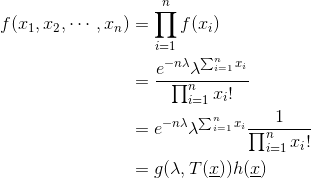
where  is a function of
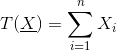
  and statistic
and  is a function which doesnot depends on
.
is a function which doesnot depends on
.
Using Neyman- Factorization theorem, if the density  can be factorized in to the product of two functions
  such that one is a function of parameter and sample through a
statistic
such that one is a function of parameter and sample through a
statistic  and the other doesnot depends on parameter, then the statistic
 is sufficient for the parameter.
Here, in this case
is sufficient for
.
Add Answer to:
Answer the following in a mathematically sound argument (proof)
using combinations of English / symbols as...
2 Logic Question 3 Is the following argument valid? Provide a proof for your answer, using...
 2 Logic Question 3 Is the following argument valid? Provide a proof for your answer, using any method you wish. p= (qar) 9 ~р
Is the following argument valid? Provide a proof for your answer, using any method you wish...
 Is the following argument valid? Provide a proof for your
answer, using any method you wish and explain.
d~ b~ (Vb) =d
Is the following argument valid? Provide a proof for your
answer, using any method you wish and explain.
d~ b~ (Vb) =d
Question 3 Not yet answered Mariked out of 4,00000 Flag question Please write a natural deduction proof for the following deductive, valid argument. Be sure to construct the natural deduction pro...
 Question 3 Not yet answered Mariked out of 4,00000 Flag question Please write a natural deduction proof for the following deductive, valid argument. Be sure to construct the natural deduction proof in the way indicated in the Hurley textbook, the videos, and lecture material. Please use the typewriter SL symbols; number each derived line with the appropriate Arabic numeral; provide a correct justification on the right-hand side of the proof using the standard abbreviations for the Rules of Inference/Implication and...
Instructions: For each of the following argument forms, complete a proof of validity, by natural deduction, USING ALL 19 RULES OF INFERENCE. Please note that some of the proofs may allow fo...
 Instructions: For each of the following argument forms, complete a proof of validity, by natural deduction, USING ALL 19 RULES OF INFERENCE. Please note that some of the proofs may allow for alternative sequences of steps. Other than that, there is only one proof possible for each argument form. If a proof is without error, then answer CORRECT, on the CANVAS TEST 4/FINAL page. If there is any error in a proof, then answer THE LINE ON WHICH THE ERROR...
1. Please provide a natural deduction proof for the following valid, deductive argument: Premise 1: ~ ( F & A ) Premise 2: ~ ( L v ~ A ) Premise 3: D > ( F v L ) / ~ D 2. Answer the following q...
1. Please provide a natural deduction proof for the following valid, deductive argument: Premise 1: ~ ( F & A ) Premise 2: ~ ( L v ~ A ) Premise 3: D > ( F v L ) / ~ D 2. Answer the following question: can one prove invalidity with the natural deduction proof method? Why or why not? 3. Answer the following question: can one construct a natural deduction proof for an invalid argument in SL? Why...
In the following problem, we will work through a proof of an important theorem of arithmetic. Your job will be to read the proof carefully and answer some questions about the argument. Theorem (The Di...
 In the following problem, we will work through a proof of an
important theorem of arithmetic. Your job will be to read the proof
carefully and answer some questions about the argument. Theorem
(The Division Algorithm). For any integer n ≥ 0, and for any
positive integer m, there exist integers d and r such that n = dm +
r and 0 ≤ r < m. Proof: (By strong induction on the variable n.)
Let m be an arbitrary...
In the following problem, we will work through a proof of an
important theorem of arithmetic. Your job will be to read the proof
carefully and answer some questions about the argument. Theorem
(The Division Algorithm). For any integer n ≥ 0, and for any
positive integer m, there exist integers d and r such that n = dm +
r and 0 ≤ r < m. Proof: (By strong induction on the variable n.)
Let m be an arbitrary...
Course: Theory of computation please answer the following questions using proof by construction, proof by contradiction...
Course: Theory of computation please answer the following questions using proof by construction, proof by contradiction and proof by induction 1) Show that the set of all integers is a countable set. 2) Show that mod 7 is an equivalence relation.
Instructions: For each of the following argument forms, complete a proof of validity, by natural deduction, USING ALL 19 RULES OF INFERENCE. Please note that some of the proofs may allow for alt...
 Instructions: For each of the following argument forms, complete a proof of validity, by natural deduction, USING ALL 19 RULES OF INFERENCE. Please note that some of the proofs may allow for alternative sequences of steps. Other than that, there is only one proof possible for each argument form. f a proof is without error, then answer CORRECT, on the CANVAS TEST 4/FINAL page. If there is any error in a proof, then answer THE LINE ON WHICH THE ERROR...
Answer 5 and 6, using R programming code: 5. We have seen the following functions dnorm...
 Answer 5 and 6, using R programming code: 5. We have seen the following functions dnorm pnorm qnorm normal probability density function normal cumulative distribution function normal quantile function a. Let X have a normal distribution with mean 100 and variance 100. Find the 90th percentile of X by calling the function qnorm in two ways: (i) specify the arguments by position, and (ii) specify the arguments by complete names. b. Find P(X > 90) using the function pnorm in...
1. Formalize the following argument by using the given predicates and then rewriting the argument...
 1. Formalize the following argument by using the given predicates and then rewriting the argument as a numbered sequence of statements. Identify each statement as either a premise, or a conclusion that follows according to a rule of inference from previous statements. In that case, state the rule of inference and refer by number to the previous statements that the rule of inference used.Lions hunt antelopes. Ramses is a lion. Ramses does not hunt Sylvester. Therefore, Sylvester is not an...
 2 Logic Question 3 Is the following argument valid? Provide a proof for your answer, using any method you wish. p= (qar) 9 ~р
 Is the following argument valid? Provide a proof for your
answer, using any method you wish and explain.
d~ b~ (Vb) =d
Is the following argument valid? Provide a proof for your
answer, using any method you wish and explain.
d~ b~ (Vb) =d
 Question 3 Not yet answered Mariked out of 4,00000 Flag question Please write a natural deduction proof for the following deductive, valid argument. Be sure to construct the natural deduction proof in the way indicated in the Hurley textbook, the videos, and lecture material. Please use the typewriter SL symbols; number each derived line with the appropriate Arabic numeral; provide a correct justification on the right-hand side of the proof using the standard abbreviations for the Rules of Inference/Implication and...
 Instructions: For each of the following argument forms, complete a proof of validity, by natural deduction, USING ALL 19 RULES OF INFERENCE. Please note that some of the proofs may allow for alternative sequences of steps. Other than that, there is only one proof possible for each argument form. If a proof is without error, then answer CORRECT, on the CANVAS TEST 4/FINAL page. If there is any error in a proof, then answer THE LINE ON WHICH THE ERROR...
 In the following problem, we will work through a proof of an
important theorem of arithmetic. Your job will be to read the proof
carefully and answer some questions about the argument. Theorem
(The Division Algorithm). For any integer n ≥ 0, and for any
positive integer m, there exist integers d and r such that n = dm +
r and 0 ≤ r < m. Proof: (By strong induction on the variable n.)
Let m be an arbitrary...
In the following problem, we will work through a proof of an
important theorem of arithmetic. Your job will be to read the proof
carefully and answer some questions about the argument. Theorem
(The Division Algorithm). For any integer n ≥ 0, and for any
positive integer m, there exist integers d and r such that n = dm +
r and 0 ≤ r < m. Proof: (By strong induction on the variable n.)
Let m be an arbitrary...
 Instructions: For each of the following argument forms, complete a proof of validity, by natural deduction, USING ALL 19 RULES OF INFERENCE. Please note that some of the proofs may allow for alternative sequences of steps. Other than that, there is only one proof possible for each argument form. f a proof is without error, then answer CORRECT, on the CANVAS TEST 4/FINAL page. If there is any error in a proof, then answer THE LINE ON WHICH THE ERROR...
 Answer 5 and 6, using R programming code: 5. We have seen the following functions dnorm pnorm qnorm normal probability density function normal cumulative distribution function normal quantile function a. Let X have a normal distribution with mean 100 and variance 100. Find the 90th percentile of X by calling the function qnorm in two ways: (i) specify the arguments by position, and (ii) specify the arguments by complete names. b. Find P(X > 90) using the function pnorm in...
 1. Formalize the following argument by using the given predicates and then rewriting the argument as a numbered sequence of statements. Identify each statement as either a premise, or a conclusion that follows according to a rule of inference from previous statements. In that case, state the rule of inference and refer by number to the previous statements that the rule of inference used.Lions hunt antelopes. Ramses is a lion. Ramses does not hunt Sylvester. Therefore, Sylvester is not an...
Most questions answered within 3 hours.
-
Where is the error in this code sequence?
String s1 = "Hello";
String s2 = "ello";...
asked 10 months ago -
Financial data for Joel de Paris, Inc., for last year
follow:
Joel de Paris, Inc.
Balance...
asked 10 months ago -
Consider this reaction:
Al2(SO4)3 (aq)+ BaCl3
(aq) Al2Cl6 (aq)- +
3BaSO4(s) . What is the...
asked 10 months ago -
Suppose that Savneet is considering increasing her
recent random sample from 20 car rentals to 40...
asked 10 months ago -
Trucks arrive at an unloading terminal at an average rate of 120
per hour.
Trucks arrive...
asked 10 months ago -
Why are methanol and ethanol completely soluble in water while
octanol is not very little soluble....
asked 10 months ago -
A facilities manager at a university reads in a research report
that the mean amount of...
asked 10 months ago -
When the CuSO4 is rehydrated by adding water to the anhydrous
compound, is this an endothermic...
asked 10 months ago -
A ray of sunlight is passing from diamond into crown glass; the
angle of incidence is...
asked 10 months ago -
A block of mass 0.249 kg is placed on top of a light, vertical
spring of...
asked 10 months ago -
how do the kidneys compensate in the presences of acidosis
a) trigger hyperventilate
b) reserve acid...
asked 10 months ago -
Question 501 pts
The rental rate of capital to the firm increases. Which of the
following...
asked 10 months ago