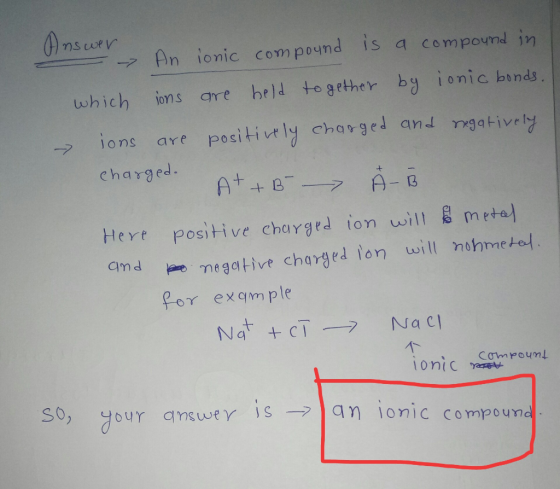
A compound that contains ions and is held together by ionic bonds is known as a/an
A compound that contains ions and is held together by ionic bonds is known as a/an
Homework Answers
Add Answer to:
A compound that contains ions and is held together by
ionic bonds is known as a/an
19. Which of the following statements regarding ionic compounds is correct? A) Ions are held together...
 19. Which of the following statements regarding ionic compounds is correct? A) Ions are held together in an ionic lattice by covalent bonds. B) The crystal structure of a given compound does not depend on the sizes and number of ions in a formula unit of the compound. C) Ionic compounds tend to have low melting points. D) Ionic compounds are formed when two metals react. E) In forming an ionic compound from its elements, one element transfers one or...
Which statement below regarding ionic compounds is FALSE? Question 5 options: Ions are held together by...
Which statement below regarding ionic compounds is FALSE? Question 5 options: Ions are held together by shared pairs of electrons. Oppositely charged ions collect together in part because isolated ions are not stable. Oppositely charged ions arrange themselves to minimize repulsions and maximize attractions. The energy associated with an ionic bond is a form of electrostatic potential energy. The net charge of an ionic compound is zero. Which statement regarding a pi-bond between two carbon atoms is correct? Question 6...
A crystalline solid has a high melting point and is known to be held together with...
A crystalline solid has a high melting point and is known to be held together with covalent bonds. This solid is an example of _____. A. A network covalent solid B. An ionic solid C. A metallic solid D. A molecular solid
Molecular compounds consist of: a. atoms of nonmetals bonded together by covalent bonds. b. ions held together...
Molecular compounds consist of: a. atoms of nonmetals bonded together by covalent bonds. b. ions held together by electrostatic forces. c. metal atoms in a crystalline network that share electrons among many atoms. d. both b and c
6. Predict whether each of the following is held together by ionic or covalent bonds. (a)...
 6. Predict whether each of the following is held together by ionic or covalent bonds. (a) zinc bromide, ZnBr2 (b) ammonia, NH3 (c) iodine heptafluoride, IF, (d) lead(II) sulfate, PbSO4 cu
The Gaseous compound HF contains covalent bonda and compound KF contains ionic bonds. Sketch the basic...
The Gaseous compound HF contains covalent bonda and compound KF contains ionic bonds. Sketch the basic particles of these two compounds appear.
LUT 6. Predict whether each of the following is held together by ionic or covalent bonds....
 LUT 6. Predict whether each of the following is held together by ionic or covalent bonds. (a) zinc bromide, ZnBrz (b) ammonia, Nh ( iodine heptafluoride, Fy (d) lead(II) sulfate, Poso,
In an ionic compound, the size of the ions affects the internuclear distance (the distance between...
 In an ionic compound, the size of the ions affects the internuclear distance (the distance between the centers of adjacent ions), which affects lattice energy (a measure of the attractive force holding those ions together). Based on ion sizes, arrange these compounds by their expected lattice energy. Note that many sources define lattice energies as negative values. Please arrange by magnitude and ignore the sign. attice energyl absolute value of the lattice energy Greatest lattice energy (strongest bonds) Least lattice...
The charges and sizes of the ions in an ionic compound affect the strength of the...
 The charges and sizes of the ions in an ionic compound affect the strength of the electrostatic attraction holding that compound together. Based on ion charges and relative ion sizes, arrange these ionic compounds by their expected melting points. Highest melting point MgF2 NaF Mgo KBr Lowest melting point Answer Bank
Page 1 TTUDIE I. JUDU3) Predict whether each of the following is held together by ionic...
 Page 1 TTUDIE I. JUDU3) Predict whether each of the following is held together by ionic or covalent bonds. (a) zinc bromide, ZnBr2 (b) ammonia, NH3 (c) iodine heptafluoride, IF7 (d) lead(II) sulfate, PbSO4 Problem 2. (6 points) Use the periodic table to predict the ionic charge for each of the following nonmetal ions. (a) Cl ion (b)I ion (c) Se ion (d)P ion
 19. Which of the following statements regarding ionic compounds is correct? A) Ions are held together in an ionic lattice by covalent bonds. B) The crystal structure of a given compound does not depend on the sizes and number of ions in a formula unit of the compound. C) Ionic compounds tend to have low melting points. D) Ionic compounds are formed when two metals react. E) In forming an ionic compound from its elements, one element transfers one or...
 6. Predict whether each of the following is held together by ionic or covalent bonds. (a) zinc bromide, ZnBr2 (b) ammonia, NH3 (c) iodine heptafluoride, IF, (d) lead(II) sulfate, PbSO4 cu
 LUT 6. Predict whether each of the following is held together by ionic or covalent bonds. (a) zinc bromide, ZnBrz (b) ammonia, Nh ( iodine heptafluoride, Fy (d) lead(II) sulfate, Poso,
 In an ionic compound, the size of the ions affects the internuclear distance (the distance between the centers of adjacent ions), which affects lattice energy (a measure of the attractive force holding those ions together). Based on ion sizes, arrange these compounds by their expected lattice energy. Note that many sources define lattice energies as negative values. Please arrange by magnitude and ignore the sign. attice energyl absolute value of the lattice energy Greatest lattice energy (strongest bonds) Least lattice...
 The charges and sizes of the ions in an ionic compound affect the strength of the electrostatic attraction holding that compound together. Based on ion charges and relative ion sizes, arrange these ionic compounds by their expected melting points. Highest melting point MgF2 NaF Mgo KBr Lowest melting point Answer Bank
 Page 1 TTUDIE I. JUDU3) Predict whether each of the following is held together by ionic or covalent bonds. (a) zinc bromide, ZnBr2 (b) ammonia, NH3 (c) iodine heptafluoride, IF7 (d) lead(II) sulfate, PbSO4 Problem 2. (6 points) Use the periodic table to predict the ionic charge for each of the following nonmetal ions. (a) Cl ion (b)I ion (c) Se ion (d)P ion
Most questions answered within 3 hours.
-
Where is the error in this code sequence?
String s1 = "Hello";
String s2 = "ello";...
asked 10 months ago -
Financial data for Joel de Paris, Inc., for last year
follow:
Joel de Paris, Inc.
Balance...
asked 10 months ago -
Consider this reaction:
Al2(SO4)3 (aq)+ BaCl3
(aq) Al2Cl6 (aq)- +
3BaSO4(s) . What is the...
asked 10 months ago -
Suppose that Savneet is considering increasing her
recent random sample from 20 car rentals to 40...
asked 10 months ago -
Trucks arrive at an unloading terminal at an average rate of 120
per hour.
Trucks arrive...
asked 10 months ago -
Why are methanol and ethanol completely soluble in water while
octanol is not very little soluble....
asked 10 months ago -
A facilities manager at a university reads in a research report
that the mean amount of...
asked 10 months ago -
When the CuSO4 is rehydrated by adding water to the anhydrous
compound, is this an endothermic...
asked 10 months ago -
A ray of sunlight is passing from diamond into crown glass; the
angle of incidence is...
asked 10 months ago -
A block of mass 0.249 kg is placed on top of a light, vertical
spring of...
asked 10 months ago -
how do the kidneys compensate in the presences of acidosis
a) trigger hyperventilate
b) reserve acid...
asked 10 months ago -
Question 501 pts
The rental rate of capital to the firm increases. Which of the
following...
asked 10 months ago