
Homework Answers
Add Answer to:
The drawing below shows a person who, starting from rest at the top of a cliff,...
The drawing shows a person who, starting from rest at the top of a cliff, swings...
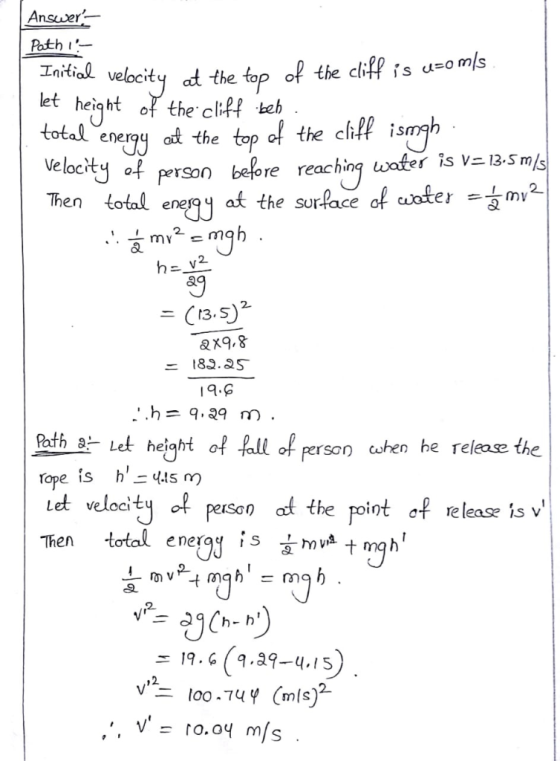
The drawing shows a person who, starting from rest at the top of a cliff, swings down at the end of a rope, releases it, and falls into the water below. There are two paths by which the person can enter the water. Suppose he enters the water at a speed of 10.2 m/s via path 1. How fast is he moving on path 2 when he releases the rope at a height of 2.33 m above the water? Ignore...
Consult Conceptual Example 9 in preparation for this problem. Interactive LearningWare 6.3 also provides useful background....
Consult Conceptual Example 9 in preparation for this problem. Interactive LearningWare 6.3 also provides useful background. The drawing shows a person who, starting from rest at the top of a cliff, swings down at the end of a rope, releases it, and falls into the water below. There are two paths by which the person can enter the water. Suppose he enters the water at a speed of 15.3 m/s via path 1. How fast is he moving on path...
A boy jumps from rest, straight down from the top of a cliff. He falls halfway...
 A boy jumps from rest, straight down from the top of a cliff. He falls halfway down to the water below in 0.952 s. How much time passes during his entire trip from the top down to the water? Ignore air resistance. the tolerance is +/-5%
(please show work) A boy jumps from rest, straight down from the top of a cliff....
(please show work) A boy jumps from rest, straight down from the top of a cliff. He falls halfway down to the water below in 0.907 s. How much time passes during his entire trip from the top down to the water? Ignore air resistance. t =
A water slide is constructed so that swimmers, starting from rest at the top of the...
 A water slide is constructed so that swimmers, starting from
rest at the top of the slide, leave the end of the slide traveling
horizontally. As the drawing shows, one person hits the water 5.00
m from the end of the slide in a time of 0.434 s after leaving the
slide. Ignore friction and air resistance, find the height H in the
drawing.
A water slide is constructed so that swimmers, starting from
rest at the top of the slide, leave the end of the slide traveling
horizontally. As the drawing shows, one person hits the water 5.00
m from the end of the slide in a time of 0.434 s after leaving the
slide. Ignore friction and air resistance, find the height H in the
drawing.
Starting from rest at the top, a child slides down the water slide at a swimming...
Starting from rest at the top, a child slides down the water slide at a swimming pool and enters the water at a final speed of 4.65 m/s. At what final speed would the child enter the water if the water slide were twice as high? Ignore friction and resistance from the air and the water lubricating the slide.
Starting from rest at the top, a child slides down the water slide at a swimming...
Starting from rest at the top, a child slides down the water slide at a swimming pool and enters the water at a final speed of 4.48 m/s. At what final speed would the child enter the water if the water slide were twice as high? Ignore friction and resistance from the air and the water lubricating the slide. I tried doing what the previous answers had but I couldnt come up with the correct answer.
Chapter 06, Problem 85 A water slide is constructed so that swimmers, starting from rest at...
 Chapter 06, Problem 85 A water slide is constructed so that swimmers, starting from rest at the top of the slide, leave the end of the slide traveling horizontally. As the drawing shows, one person hits the water 5.00 m from the end time of 0.469 s after leaving the slide. Ignore friction and air resistance, find the height H in the drawing. the slide in a Water slide 5.00 m- Number Units the tolerance is +/-2%
Chapter 03, Problem 75 As preparation for this problem, review Conceptual Example 9. From the top...
 Chapter 03, Problem 75 As preparation for this problem, review Conceptual Example 9. From the top of a cliff overlooking a lake, a person throws two stones, as shown in the drawing. The cliff is 23.6 m high. The two stones described have identical initial speeds of vo-13.5 m/s and are thrown at an angle θ-26.5。, one below the horizontal and one above the horizontal, what is the distance between the points where the stones strike the water? Neglect air...
Starting from rest at the top, a child slides down the water slide at a swimming pool and enters the water at a final speed of 4.00 m/s
Starting from rest at the top, a child slides down the water slide at a swimming pool and enters the water at a final speed of 4.00 m/s. At what final speed would the child enter the water if the water slide were twice as high? Ignore friction and resistance from the air and the water lubricating the slide.
 A boy jumps from rest, straight down from the top of a cliff. He falls halfway down to the water below in 0.952 s. How much time passes during his entire trip from the top down to the water? Ignore air resistance. the tolerance is +/-5%
 A water slide is constructed so that swimmers, starting from
rest at the top of the slide, leave the end of the slide traveling
horizontally. As the drawing shows, one person hits the water 5.00
m from the end of the slide in a time of 0.434 s after leaving the
slide. Ignore friction and air resistance, find the height H in the
drawing.
A water slide is constructed so that swimmers, starting from
rest at the top of the slide, leave the end of the slide traveling
horizontally. As the drawing shows, one person hits the water 5.00
m from the end of the slide in a time of 0.434 s after leaving the
slide. Ignore friction and air resistance, find the height H in the
drawing.
 Chapter 06, Problem 85 A water slide is constructed so that swimmers, starting from rest at the top of the slide, leave the end of the slide traveling horizontally. As the drawing shows, one person hits the water 5.00 m from the end time of 0.469 s after leaving the slide. Ignore friction and air resistance, find the height H in the drawing. the slide in a Water slide 5.00 m- Number Units the tolerance is +/-2%
 Chapter 03, Problem 75 As preparation for this problem, review Conceptual Example 9. From the top of a cliff overlooking a lake, a person throws two stones, as shown in the drawing. The cliff is 23.6 m high. The two stones described have identical initial speeds of vo-13.5 m/s and are thrown at an angle θ-26.5。, one below the horizontal and one above the horizontal, what is the distance between the points where the stones strike the water? Neglect air...
Most questions answered within 3 hours.
-
Where is the error in this code sequence?
String s1 = "Hello";
String s2 = "ello";...
asked 10 months ago -
Financial data for Joel de Paris, Inc., for last year
follow:
Joel de Paris, Inc.
Balance...
asked 10 months ago -
Consider this reaction:
Al2(SO4)3 (aq)+ BaCl3
(aq) Al2Cl6 (aq)- +
3BaSO4(s) . What is the...
asked 10 months ago -
Suppose that Savneet is considering increasing her
recent random sample from 20 car rentals to 40...
asked 10 months ago -
Trucks arrive at an unloading terminal at an average rate of 120
per hour.
Trucks arrive...
asked 10 months ago -
Why are methanol and ethanol completely soluble in water while
octanol is not very little soluble....
asked 10 months ago -
A facilities manager at a university reads in a research report
that the mean amount of...
asked 10 months ago -
When the CuSO4 is rehydrated by adding water to the anhydrous
compound, is this an endothermic...
asked 10 months ago -
A ray of sunlight is passing from diamond into crown glass; the
angle of incidence is...
asked 10 months ago -
A block of mass 0.249 kg is placed on top of a light, vertical
spring of...
asked 10 months ago -
how do the kidneys compensate in the presences of acidosis
a) trigger hyperventilate
b) reserve acid...
asked 10 months ago -
Question 501 pts
The rental rate of capital to the firm increases. Which of the
following...
asked 10 months ago