

Homework Answers
Given that,
[NH3 ] = 0.166 M
and [H2S ] = 0.166 M
Qc = [NH3][H2S] = 0.166 * 0.166 = 0.0276 M .... as activities of Solids is one, so [NH4HS] = 1 and is not included in equation
Now, Kc = 8.5 *10-3 < Qc
Thus, we have more concentration of products than in the equilibrium position. so, reaction will shift backward forming more NH4HS.
Hence, More solid will form as equilibrium is reached.
Add Answer to:
27. Consider the reaction. NH,HS(s) NH3(g) + H2S(g) At a certain temperature, Ke-8.5 × 10⁻³ In...
NH4HS(s) ⇌ NH3(g) + H2S(g) At a certain temperature, Kc = 8.5 x10^-3. For a reaction...
NH4HS(s) ⇌ NH3(g) + H2S(g) At a certain temperature, Kc = 8.5 x10^-3. For a reaction mixture at this temperature containing solid NH4HS and the following concentrations of NH3(g) and H2S(g), will more solid form, or will some of the existing solid decompose as equilibrium is reached? [NH3] = 167 mM [H2S] = 51 mM more solid solid decomposes no change [NH3] = 125 mM H2S] = 58 mM more solid solid decomposes no...
Consider this reaction: NH, HS(8) NH3(g) + H2S(9) An equilibrium mixture of this reaction at a...
 Consider this reaction: NH, HS(8) NH3(g) + H2S(9) An equilibrium mixture of this reaction at a certain temperature was found to have (NH3) = 0.258 M and (H2S) = 0.315 M. Part A What is the value of the equilibrium constant at this temperature? Express your answer to three significant figures. | ΑΣφ ? Kog Submit Request Answer < Return to Assignment Provide Feedback
Consider the following reaction: NH4HS(s)⇌NH3(g)+H2S(g) An equilibrium mixture of this reaction at a certain temperature was...
Consider the following reaction: NH4HS(s)⇌NH3(g)+H2S(g) An equilibrium mixture of this reaction at a certain temperature was found to have [NH3]= 0.280 M and [H2S]= 0.355 M . What is the value of the equilibrium constant (Kc) at this temperature?
Consider this reaction: NH, HS(8) =NH(g) + H2S(9) An equilibrium mixture of this reaction at a...
 Consider this reaction: NH, HS(8) =NH(g) + H2S(9) An equilibrium mixture of this reaction at a certain temperature was found to have (NHG]=0.258 M and [H.S] -0.315 M. Part A What is the value of the equilibrium constant at this temperature? Express your answer to three significant figures. ΜΟΙ ΑΣΦ 6. Submit Request Answer < Return to Assignment Provide Feedback
Consider the following reaction where K. - 1.80x10⁴ at 298 K. NH, HS()=NH3(g) + H2S(p) A...
 Consider the following reaction where K. - 1.80x10⁴ at 298 K. NH, HS()=NH3(g) + H2S(p) A reaction mixture was found to contain 6.00x10⁻² moles of NH,HS(s), 1.84x10⁻² moles of NH3(8), and 1.34*10-2 moles of H2S(3), in a 1.00 liter container Is the reaction at equilibrium? If not, what direction must it run in order to reach equilibrium? The reaction quotient, Qe, equals The reaction A. must run in the forward direction to reach equilibrium. B. must run in the reverse...
Consider the following reaction: NH4HS(s)⇌NH3(g)+H2S(g) An equilibrium mixture of this reaction at a certain temperature was...
Consider the following reaction: NH4HS(s)⇌NH3(g)+H2S(g) An equilibrium mixture of this reaction at a certain temperature was found to have [NH3]= 0.284 M and [H2S]= 0.355 M. You may want to reference (Pages 651 - 653) Section 15.6 while completing this problem. Part A What is the value of the equilibrium constant (Kc) at this temperature?
Consider the reaction: NH4HS (s) <--> NH3 (g) + H2S (g)
Consider the reaction: NH4HS (s) <--> NH3 (g) + H2S (g). An equilibrium mixture of this reaction at a certain temperature was found to have [NH3] = 0.278 M and [H2S] = 0.355 M. What is the value of the equilibrium constant (Kc) at this temperature? a. 0.126 b. 0.355 c. 0.783 d. 0.0987 e. 0.278
The reaction CO2(g) + C(s) <-> 2CO(g) has a Kp=5.78 at 1200k Delta n for the...
The reaction CO2(g) + C(s) <-> 2CO(g) has a Kp=5.78 at 1200k Delta n for the reaction is ___ Kc for the reaction is ____ 2) For the following reaction:NH4HS(s)<->NH3(g) + H2S (g) Kc=8.5x10^-3 At any given point the reaction mixture has solid NH4HS, NH3 at 0.166M and H2S at 0.166M. Is the reaction at equilibrium? Will more of the solid form, or will some of the existing solid decompose? 3) Consider the following reaction: CH3OH (g) <-> CO (g)...
The decomposition of NH4HS NH HS(s) 2 NH3(g) + H S(g) is an endothermic process. Using...
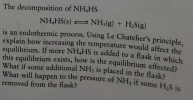 The decomposition of NH4HS NH HS(s) 2 NH3(g) + H S(g) is an endothermic process. Using Le Chatelier's principle explain how increasing the temperature would affect the equilibrium. If more NH4HS is added to a flask in this equilibrium exists, how is the equilibrium affer What if some additional NH3 is placed in the flask? What will happen to the pressure of NH; if some removed from the flask?
1) For the following reaction: SO2Cl2(g)<-> SO2(g) + Cl2 (g) Kp=2.91x10^3 at 298K In the reaction...
1) For the following reaction: SO2Cl2(g)<-> SO2(g) + Cl2 (g) Kp=2.91x10^3 at 298K In the reaction at equilibrium, the partial pressure of SO2 is 137 torr and that of CL2 is 285 torr. The partial pressure of SO2Cl2 is [x]torr. 2) For the following reaction:NH4HS(s)<->NH3(g) + H2S (g) Kc=8.5x10^-3 At any given point the reaction mixture has solid NH4HS, NH3 at 0.166M and H2S at 0.166M. a) Is the reaction at equilibrium? b)Will more of the solid form, or will...
 Consider this reaction: NH, HS(8) NH3(g) + H2S(9) An equilibrium mixture of this reaction at a certain temperature was found to have (NH3) = 0.258 M and (H2S) = 0.315 M. Part A What is the value of the equilibrium constant at this temperature? Express your answer to three significant figures. | ΑΣφ ? Kog Submit Request Answer < Return to Assignment Provide Feedback
 Consider this reaction: NH, HS(8) =NH(g) + H2S(9) An equilibrium mixture of this reaction at a certain temperature was found to have (NHG]=0.258 M and [H.S] -0.315 M. Part A What is the value of the equilibrium constant at this temperature? Express your answer to three significant figures. ΜΟΙ ΑΣΦ 6. Submit Request Answer < Return to Assignment Provide Feedback
 Consider the following reaction where K. - 1.80x10⁴ at 298 K. NH, HS()=NH3(g) + H2S(p) A reaction mixture was found to contain 6.00x10⁻² moles of NH,HS(s), 1.84x10⁻² moles of NH3(8), and 1.34*10-2 moles of H2S(3), in a 1.00 liter container Is the reaction at equilibrium? If not, what direction must it run in order to reach equilibrium? The reaction quotient, Qe, equals The reaction A. must run in the forward direction to reach equilibrium. B. must run in the reverse...
 The decomposition of NH4HS NH HS(s) 2 NH3(g) + H S(g) is an endothermic process. Using Le Chatelier's principle explain how increasing the temperature would affect the equilibrium. If more NH4HS is added to a flask in this equilibrium exists, how is the equilibrium affer What if some additional NH3 is placed in the flask? What will happen to the pressure of NH; if some removed from the flask?
Most questions answered within 3 hours.
-
Where is the error in this code sequence?
String s1 = "Hello";
String s2 = "ello";...
asked 11 months ago -
Financial data for Joel de Paris, Inc., for last year
follow:
Joel de Paris, Inc.
Balance...
asked 11 months ago -
Consider this reaction:
Al2(SO4)3 (aq)+ BaCl3
(aq) Al2Cl6 (aq)- +
3BaSO4(s) . What is the...
asked 11 months ago -
Suppose that Savneet is considering increasing her
recent random sample from 20 car rentals to 40...
asked 11 months ago -
Trucks arrive at an unloading terminal at an average rate of 120
per hour.
Trucks arrive...
asked 11 months ago -
Why are methanol and ethanol completely soluble in water while
octanol is not very little soluble....
asked 11 months ago -
A facilities manager at a university reads in a research report
that the mean amount of...
asked 11 months ago -
When the CuSO4 is rehydrated by adding water to the anhydrous
compound, is this an endothermic...
asked 11 months ago -
A ray of sunlight is passing from diamond into crown glass; the
angle of incidence is...
asked 11 months ago -
A block of mass 0.249 kg is placed on top of a light, vertical
spring of...
asked 11 months ago -
how do the kidneys compensate in the presences of acidosis
a) trigger hyperventilate
b) reserve acid...
asked 11 months ago -
Question 501 pts
The rental rate of capital to the firm increases. Which of the
following...
asked 11 months ago