
Homework Answers
Answer:
Add Answer to:
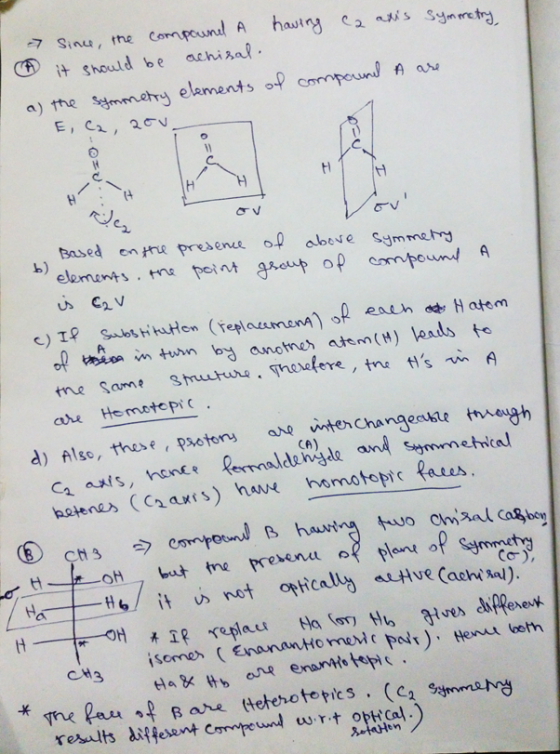
COMPOUND B ONLY PLEASE!
V 1 NAME Aua Chiral-ot achirsl ANSNer Not Related d) The faAre...
Provide the name for each of the above compounds, and determine if the compound is chiral....
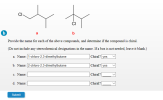 Provide the name for each of the above compounds, and determine
if the compound is chiral.
Provide the name for each of the above compounds, and determine if the compound is chiral. (Do not include any stereochemical designations in the name. If a box is not needed, leave it blank.) a. Name: 1-chloro-2,3-dimethylbutane Chiral? yes y b. Name: 2-chloro-2,3-dimethylbutane Chiral? yes Chiral? - Chiral? C y Y c. Name: d Name: Y Submit
Provide the name for each of the above compounds, and determine
if the compound is chiral.
Provide the name for each of the above compounds, and determine if the compound is chiral. (Do not include any stereochemical designations in the name. If a box is not needed, leave it blank.) a. Name: 1-chloro-2,3-dimethylbutane Chiral? yes y b. Name: 2-chloro-2,3-dimethylbutane Chiral? yes Chiral? - Chiral? C y Y c. Name: d Name: Y Submit
please explaine 2) Identify the chiral compound(s) below. IV A) only II B) III and IV...
 please explaine
2) Identify the chiral compound(s) below. IV A) only II B) III and IV C) II and III D) I, II, and IV
please explaine
2) Identify the chiral compound(s) below. IV A) only II B) III and IV C) II and III D) I, II, and IV
Which of the following compound(s) is/are chiral? C=C=CCHE Н CO2OH А B с D only a...
 Which of the following compound(s) is/are chiral?
C=C=CCHE Н CO2OH А B с D only a B and C A and D only B A and B
Which of the following compound(s) is/are chiral?
C=C=CCHE Н CO2OH А B с D only a B and C A and D only B A and B
NUM 55) How many stereogenic centers are present in the following compound County Name: it Name: A) 1 B) 2 ourse: D...
 NUM 55) How many stereogenic centers are present in the following compound County Name: it Name: A) 1 B) 2 ourse: D) 4 Section: 56) Which of the following molecules are achiral? Exam D) I, II A) I, IV B) II, III C) III, IV 57) Which of the following molecules are chiral? I. cis-1,3-Dibromocyclohexane II. 1-Bromo-1-methylcyclohexane III. trans-1-Bromo-3-methylcyclohexane IV. cis-1-Bromo-3-methylcyclohexane A) II, III B) III, IV C) 1, IV D) 1, 58) Which of the following statements is true?...
I got question #27 wrong. Can you please explain. e correct answer: (only one) many chiral...
 I got question #27 wrong. Can you please explain.
e correct answer: (only one) many chiral carbon atoms are in the following molecule (A) 3 B) 4 (C)3 2 (E) 21. How many chiral carbon atoms are in the following malceale? (A) 5 (B) 4 (C) 3 (D) 2 ) 007- O HOM han 22. How many chiral carbon atoms are in the following molecule (A) 5 (B) 4 (C)3 (D) 2 23. Ilow many chiral carbon atoms are in...
I got question #27 wrong. Can you please explain.
e correct answer: (only one) many chiral carbon atoms are in the following molecule (A) 3 B) 4 (C)3 2 (E) 21. How many chiral carbon atoms are in the following malceale? (A) 5 (B) 4 (C) 3 (D) 2 ) 007- O HOM han 22. How many chiral carbon atoms are in the following molecule (A) 5 (B) 4 (C)3 (D) 2 23. Ilow many chiral carbon atoms are in...
Compound A Compound B Give the IUPAC name for Compound A. 2. Give the IUPAC name...
 Compound A Compound B Give the IUPAC name for Compound A. 2. Give the IUPAC name for Compound B. 3. Which compound from above (Compound A or Compound B) is more soluble in water and why? 4. Which compound can be dehydrated to form a double bond (Compound A or Compound B)? Draw the most likely product of that dehydration. (Insert a picture of your drawing of the molecule or a scan of your drawing of the molecule) 5. Could...
What is a racemic mixture? A a pure chiral compound B a mixture of enantiomers in...
What is a racemic mixture? A a pure chiral compound B a mixture of enantiomers in an ratio C a 1:1 mixture of any two chiral compounds D a 1:1 mixture of a pair of enantiomers
A 0.110 M solution of an enantiomerically pure chiral compound D has an observed rotation of...
A 0.110 M solution of an enantiomerically pure chiral compound D has an observed rotation of 0.18° in a 1-dm sample container. The molar mass of the compound is 174.0 g/mol. (a) What is the specific rotation of D? (b) What is the observed rotation if this solution is mixed with an equal volume of a solution that is 0.110 M in L, the enantiomer of D? (c) What is the observed rotation if the solution of D is diluted...
A 0.140 M solution of an enantiomerically pure chiral compound D has an observed rotation of...
A 0.140 M solution of an enantiomerically pure chiral compound D has an observed rotation of 0.18° in a 1-dm sample container. The molar mass of the compound is 150.0 g/mol. (a) What is the specific rotation of D? (b) What is the observed rotation if this solution is mixed with an equal volume of a solution that is 0.140 M in L, the enantiomer of D? (c) What is the observed rotation if the solution of D is diluted...
Are the following compounds chiral, achiral or meso? b. Please state whether compounds IV and V...
 Are the following compounds chiral, achiral or meso?
b. Please state whether compounds IV and V are chiral, achiral, or meso (6 pts). Ph F3 CH3 Нас. Ph Н Br CI H Br CF3 IV V
Are the following compounds chiral, achiral or meso?
b. Please state whether compounds IV and V are chiral, achiral, or meso (6 pts). Ph F3 CH3 Нас. Ph Н Br CI H Br CF3 IV V
 Provide the name for each of the above compounds, and determine
if the compound is chiral.
Provide the name for each of the above compounds, and determine if the compound is chiral. (Do not include any stereochemical designations in the name. If a box is not needed, leave it blank.) a. Name: 1-chloro-2,3-dimethylbutane Chiral? yes y b. Name: 2-chloro-2,3-dimethylbutane Chiral? yes Chiral? - Chiral? C y Y c. Name: d Name: Y Submit
Provide the name for each of the above compounds, and determine
if the compound is chiral.
Provide the name for each of the above compounds, and determine if the compound is chiral. (Do not include any stereochemical designations in the name. If a box is not needed, leave it blank.) a. Name: 1-chloro-2,3-dimethylbutane Chiral? yes y b. Name: 2-chloro-2,3-dimethylbutane Chiral? yes Chiral? - Chiral? C y Y c. Name: d Name: Y Submit
 please explaine
2) Identify the chiral compound(s) below. IV A) only II B) III and IV C) II and III D) I, II, and IV
please explaine
2) Identify the chiral compound(s) below. IV A) only II B) III and IV C) II and III D) I, II, and IV
 Which of the following compound(s) is/are chiral?
C=C=CCHE Н CO2OH А B с D only a B and C A and D only B A and B
Which of the following compound(s) is/are chiral?
C=C=CCHE Н CO2OH А B с D only a B and C A and D only B A and B
 NUM 55) How many stereogenic centers are present in the following compound County Name: it Name: A) 1 B) 2 ourse: D) 4 Section: 56) Which of the following molecules are achiral? Exam D) I, II A) I, IV B) II, III C) III, IV 57) Which of the following molecules are chiral? I. cis-1,3-Dibromocyclohexane II. 1-Bromo-1-methylcyclohexane III. trans-1-Bromo-3-methylcyclohexane IV. cis-1-Bromo-3-methylcyclohexane A) II, III B) III, IV C) 1, IV D) 1, 58) Which of the following statements is true?...
 I got question #27 wrong. Can you please explain.
e correct answer: (only one) many chiral carbon atoms are in the following molecule (A) 3 B) 4 (C)3 2 (E) 21. How many chiral carbon atoms are in the following malceale? (A) 5 (B) 4 (C) 3 (D) 2 ) 007- O HOM han 22. How many chiral carbon atoms are in the following molecule (A) 5 (B) 4 (C)3 (D) 2 23. Ilow many chiral carbon atoms are in...
I got question #27 wrong. Can you please explain.
e correct answer: (only one) many chiral carbon atoms are in the following molecule (A) 3 B) 4 (C)3 2 (E) 21. How many chiral carbon atoms are in the following malceale? (A) 5 (B) 4 (C) 3 (D) 2 ) 007- O HOM han 22. How many chiral carbon atoms are in the following molecule (A) 5 (B) 4 (C)3 (D) 2 23. Ilow many chiral carbon atoms are in...
 Compound A Compound B Give the IUPAC name for Compound A. 2. Give the IUPAC name for Compound B. 3. Which compound from above (Compound A or Compound B) is more soluble in water and why? 4. Which compound can be dehydrated to form a double bond (Compound A or Compound B)? Draw the most likely product of that dehydration. (Insert a picture of your drawing of the molecule or a scan of your drawing of the molecule) 5. Could...
 Are the following compounds chiral, achiral or meso?
b. Please state whether compounds IV and V are chiral, achiral, or meso (6 pts). Ph F3 CH3 Нас. Ph Н Br CI H Br CF3 IV V
Are the following compounds chiral, achiral or meso?
b. Please state whether compounds IV and V are chiral, achiral, or meso (6 pts). Ph F3 CH3 Нас. Ph Н Br CI H Br CF3 IV V
Most questions answered within 3 hours.
-
Where is the error in this code sequence?
String s1 = "Hello";
String s2 = "ello";...
asked 10 months ago -
Financial data for Joel de Paris, Inc., for last year
follow:
Joel de Paris, Inc.
Balance...
asked 10 months ago -
Consider this reaction:
Al2(SO4)3 (aq)+ BaCl3
(aq) Al2Cl6 (aq)- +
3BaSO4(s) . What is the...
asked 10 months ago -
Suppose that Savneet is considering increasing her
recent random sample from 20 car rentals to 40...
asked 10 months ago -
Trucks arrive at an unloading terminal at an average rate of 120
per hour.
Trucks arrive...
asked 10 months ago -
Why are methanol and ethanol completely soluble in water while
octanol is not very little soluble....
asked 10 months ago -
A facilities manager at a university reads in a research report
that the mean amount of...
asked 10 months ago -
When the CuSO4 is rehydrated by adding water to the anhydrous
compound, is this an endothermic...
asked 10 months ago -
A ray of sunlight is passing from diamond into crown glass; the
angle of incidence is...
asked 10 months ago -
A block of mass 0.249 kg is placed on top of a light, vertical
spring of...
asked 10 months ago -
how do the kidneys compensate in the presences of acidosis
a) trigger hyperventilate
b) reserve acid...
asked 10 months ago -
Question 501 pts
The rental rate of capital to the firm increases. Which of the
following...
asked 10 months ago