
Homework Answers
Find the solution to both parts in the following handwritten solution.
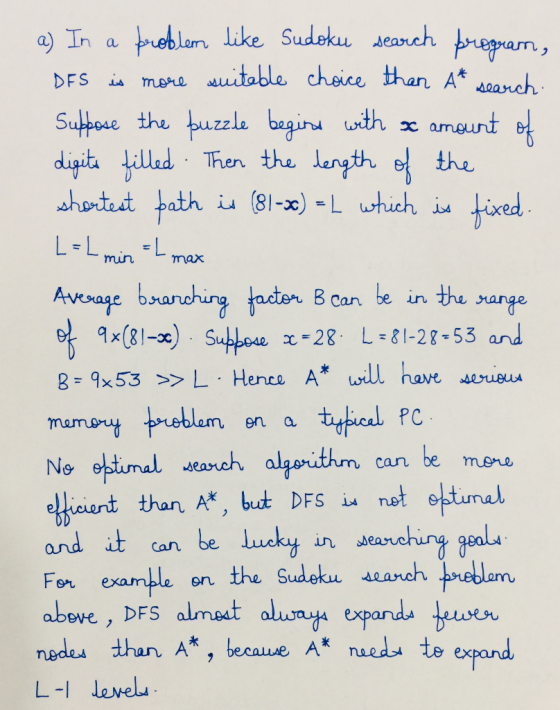
In the following solution of A* search,
g value = the movement cost to move from the
starting point to the current point in case, following the path
generated to get there.
h value = the estimated movement cost to move from
the current point on the grid to the final destination.
Parent of a point means the previous point in the shortest path to get to the current point.
h values are given in the table, and g values are to be calculated using the weight in the edges.

Add Answer to:
4. a) When would DFS be a better choice than A* search? (3 points) b) Which...
BFS & DFS graph search Argue which graph search strategy is better for each of the...
BFS & DFS graph search Argue which graph search strategy is better for each of the following applications: (you have to reason for your choice) 1. Crawling a network of web sites with a goal of indexing pages content. 2. Discovering paths between separate locations in a road map. 3. Given a location, find neighboring locations of distance k in a road map
Execute DFS on the graph below, starting in node a. Whenever you have a choice which...
 Execute DFS on the graph below, starting in node a. Whenever you have a choice which vertex to visit next, choose the next vertex in the adjacency list of the vertex (e.g., when you have reached node e, you must first try to visit node f, then g, and then . Indicate the outcome of the algorithm by labeling the edges of the graph either as T (tree edge) F (forward edge), B (back edge), or C (cross edge). Label...
PI) Given undirected graph answer the following questions: (30 points) (a) Show how a Breath-First Search...
 PI) Given undirected graph answer the following questions: (30 points) (a) Show how a Breath-First Search (BFS) works. Your starting node is B. You also need to show the discovery time for each node. (b) Given above graph, Apply Depth-First-Search (DFS), starting from node A. You should show the discovery time and return time (finishing time) on each of the node
Which of the following is FALSE about PubMed and Google search engines Google search engine a better choice for unu...
 Which of the following is FALSE about PubMed and Google search engines Google search engine a better choice for unusual cases and research topics PubMed is labor intensive but it provides evidence based medical answers-more precise searches Developed by the National Center for Biotechnology Inforr ation (NCB) and the National Library of Medicine (NLM) PubMed covers the fields of medicine, nursing, dentistry, veterinary medicine, health care administration, and the pre-clinical sciences
You will be implementing a Breadth-First Search (BFS) and a Depth-First Search (DFS) algorithm on a...
 You will be implementing a Breadth-First Search (BFS) and a
Depth-First Search (DFS) algorithm on a graph stored as an
adjacency list. The AdjacencyList class inherits from the Graph
class shown below. class Graph { private: vector _distances; vector
_previous; public: Graph() { } virtual int vertices() const = 0;
virtual int edges() const = 0; virtual int distance(int) const = 0;
virtual void bfs(int) const = 0; virtual void dfs(int) const = 0;
virtual void display() const = 0;...
You will be implementing a Breadth-First Search (BFS) and a
Depth-First Search (DFS) algorithm on a graph stored as an
adjacency list. The AdjacencyList class inherits from the Graph
class shown below. class Graph { private: vector _distances; vector
_previous; public: Graph() { } virtual int vertices() const = 0;
virtual int edges() const = 0; virtual int distance(int) const = 0;
virtual void bfs(int) const = 0; virtual void dfs(int) const = 0;
virtual void display() const = 0;...
Given the following sequential decision tree, determine which is the better investment, A or B. Read...
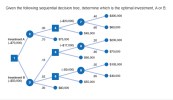 Given the following sequential decision tree, determine which is
the better investment, A or B.
Read problem description. Compute the expected value (payoff) of
each node.
Question 1, the expected value (payoff) of node 7
is___________?
Question 2, the expected value (payoff) of node 4
is___________?
Question 3, the
expected value (payoff) of node 5 is___________?
Question 4, the
expected value (payoff) of node 6 is___________?
Question 5, the
expected value (payoff) of node 3 is___________?
Question 6, the expected...
Given the following sequential decision tree, determine which is
the better investment, A or B.
Read problem description. Compute the expected value (payoff) of
each node.
Question 1, the expected value (payoff) of node 7
is___________?
Question 2, the expected value (payoff) of node 4
is___________?
Question 3, the
expected value (payoff) of node 5 is___________?
Question 4, the
expected value (payoff) of node 6 is___________?
Question 5, the
expected value (payoff) of node 3 is___________?
Question 6, the expected...
3 Consider images A and B below, and then answer the following questions a. Which image better represents the solut...
 3 Consider images A and B below, and then answer the following questions a. Which image better represents the solution formed when MgCl, is dissolved in water? Explain your choice. b. Which image better represents the solution formed when OCI, is dissolved in water? Explain your choice. C. Which solution would produce a precipitate upon addition of AgNO,? Explain. 294 Exploring General Organic & Biochemistry in the Laboratory
(b) Suppose you are designing a search aggregator, which for a given query fetches search results from two different se...
 (b) Suppose you are designing a search aggregator, which for a given query fetches search results from two different search engines and presents an intersection of the two search results. Here is a simplified version of this problem: Given two sorted integer arrays of lengths m and n, return a new array with elements that are present in both input arrays. The input array may contain duplicates, but there should be no duplicates in the output array. For example, if...
plz use python to answer it, thanks in advance 3. Tree and back arcs in a DFS 40 Marks For a given set of digraphs, write a program that performs DFS on each digraph starting at node 0 and prints...
 plz use python to answer it, thanks in advance
3. Tree and back arcs in a DFS 40 Marks For a given set of digraphs, write a program that performs DFS on each digraph starting at node 0 and prints out the total number of tree arcs and back arcs resulting from the traversal. Use our standard convention that when there is a choice of white or grey nodes, the one with the lowest index should be chosen. Input format:...
plz use python to answer it, thanks in advance
3. Tree and back arcs in a DFS 40 Marks For a given set of digraphs, write a program that performs DFS on each digraph starting at node 0 and prints out the total number of tree arcs and back arcs resulting from the traversal. Use our standard convention that when there is a choice of white or grey nodes, the one with the lowest index should be chosen. Input format:...
3. (8 points-7+1) Figure 4 shows an undirected graph G. Assume that the adjacency list lists the ...
 3. (8 points-7+1) Figure 4 shows an undirected graph G. Assume that the adjacency list lists the edges in alphabetical order. Figure 3: Graph for P3 (a) Apply depth first search (DFS) to graph G, and show the discovery and finish times of each vertex. In the main-loop of DFS, check the vertices in alphabetical the form dsc/fin, where dsc is the discovery time and fin is the finish time. (b) Draw the DFS tree obtained.
3. (8 points-7+1) Figure...
3. (8 points-7+1) Figure 4 shows an undirected graph G. Assume that the adjacency list lists the edges in alphabetical order. Figure 3: Graph for P3 (a) Apply depth first search (DFS) to graph G, and show the discovery and finish times of each vertex. In the main-loop of DFS, check the vertices in alphabetical the form dsc/fin, where dsc is the discovery time and fin is the finish time. (b) Draw the DFS tree obtained.
3. (8 points-7+1) Figure...
 Execute DFS on the graph below, starting in node a. Whenever you have a choice which vertex to visit next, choose the next vertex in the adjacency list of the vertex (e.g., when you have reached node e, you must first try to visit node f, then g, and then . Indicate the outcome of the algorithm by labeling the edges of the graph either as T (tree edge) F (forward edge), B (back edge), or C (cross edge). Label...
 PI) Given undirected graph answer the following questions: (30 points) (a) Show how a Breath-First Search (BFS) works. Your starting node is B. You also need to show the discovery time for each node. (b) Given above graph, Apply Depth-First-Search (DFS), starting from node A. You should show the discovery time and return time (finishing time) on each of the node
 Which of the following is FALSE about PubMed and Google search engines Google search engine a better choice for unusual cases and research topics PubMed is labor intensive but it provides evidence based medical answers-more precise searches Developed by the National Center for Biotechnology Inforr ation (NCB) and the National Library of Medicine (NLM) PubMed covers the fields of medicine, nursing, dentistry, veterinary medicine, health care administration, and the pre-clinical sciences
 You will be implementing a Breadth-First Search (BFS) and a
Depth-First Search (DFS) algorithm on a graph stored as an
adjacency list. The AdjacencyList class inherits from the Graph
class shown below. class Graph { private: vector _distances; vector
_previous; public: Graph() { } virtual int vertices() const = 0;
virtual int edges() const = 0; virtual int distance(int) const = 0;
virtual void bfs(int) const = 0; virtual void dfs(int) const = 0;
virtual void display() const = 0;...
You will be implementing a Breadth-First Search (BFS) and a
Depth-First Search (DFS) algorithm on a graph stored as an
adjacency list. The AdjacencyList class inherits from the Graph
class shown below. class Graph { private: vector _distances; vector
_previous; public: Graph() { } virtual int vertices() const = 0;
virtual int edges() const = 0; virtual int distance(int) const = 0;
virtual void bfs(int) const = 0; virtual void dfs(int) const = 0;
virtual void display() const = 0;...
 Given the following sequential decision tree, determine which is
the better investment, A or B.
Read problem description. Compute the expected value (payoff) of
each node.
Question 1, the expected value (payoff) of node 7
is___________?
Question 2, the expected value (payoff) of node 4
is___________?
Question 3, the
expected value (payoff) of node 5 is___________?
Question 4, the
expected value (payoff) of node 6 is___________?
Question 5, the
expected value (payoff) of node 3 is___________?
Question 6, the expected...
Given the following sequential decision tree, determine which is
the better investment, A or B.
Read problem description. Compute the expected value (payoff) of
each node.
Question 1, the expected value (payoff) of node 7
is___________?
Question 2, the expected value (payoff) of node 4
is___________?
Question 3, the
expected value (payoff) of node 5 is___________?
Question 4, the
expected value (payoff) of node 6 is___________?
Question 5, the
expected value (payoff) of node 3 is___________?
Question 6, the expected...
 3 Consider images A and B below, and then answer the following questions a. Which image better represents the solution formed when MgCl, is dissolved in water? Explain your choice. b. Which image better represents the solution formed when OCI, is dissolved in water? Explain your choice. C. Which solution would produce a precipitate upon addition of AgNO,? Explain. 294 Exploring General Organic & Biochemistry in the Laboratory
 (b) Suppose you are designing a search aggregator, which for a given query fetches search results from two different search engines and presents an intersection of the two search results. Here is a simplified version of this problem: Given two sorted integer arrays of lengths m and n, return a new array with elements that are present in both input arrays. The input array may contain duplicates, but there should be no duplicates in the output array. For example, if...
 plz use python to answer it, thanks in advance
3. Tree and back arcs in a DFS 40 Marks For a given set of digraphs, write a program that performs DFS on each digraph starting at node 0 and prints out the total number of tree arcs and back arcs resulting from the traversal. Use our standard convention that when there is a choice of white or grey nodes, the one with the lowest index should be chosen. Input format:...
plz use python to answer it, thanks in advance
3. Tree and back arcs in a DFS 40 Marks For a given set of digraphs, write a program that performs DFS on each digraph starting at node 0 and prints out the total number of tree arcs and back arcs resulting from the traversal. Use our standard convention that when there is a choice of white or grey nodes, the one with the lowest index should be chosen. Input format:...
 3. (8 points-7+1) Figure 4 shows an undirected graph G. Assume that the adjacency list lists the edges in alphabetical order. Figure 3: Graph for P3 (a) Apply depth first search (DFS) to graph G, and show the discovery and finish times of each vertex. In the main-loop of DFS, check the vertices in alphabetical the form dsc/fin, where dsc is the discovery time and fin is the finish time. (b) Draw the DFS tree obtained.
3. (8 points-7+1) Figure...
3. (8 points-7+1) Figure 4 shows an undirected graph G. Assume that the adjacency list lists the edges in alphabetical order. Figure 3: Graph for P3 (a) Apply depth first search (DFS) to graph G, and show the discovery and finish times of each vertex. In the main-loop of DFS, check the vertices in alphabetical the form dsc/fin, where dsc is the discovery time and fin is the finish time. (b) Draw the DFS tree obtained.
3. (8 points-7+1) Figure...
Most questions answered within 3 hours.
-
Where is the error in this code sequence?
String s1 = "Hello";
String s2 = "ello";...
asked 10 months ago -
Financial data for Joel de Paris, Inc., for last year
follow:
Joel de Paris, Inc.
Balance...
asked 10 months ago -
Consider this reaction:
Al2(SO4)3 (aq)+ BaCl3
(aq) Al2Cl6 (aq)- +
3BaSO4(s) . What is the...
asked 10 months ago -
Suppose that Savneet is considering increasing her
recent random sample from 20 car rentals to 40...
asked 10 months ago -
Trucks arrive at an unloading terminal at an average rate of 120
per hour.
Trucks arrive...
asked 10 months ago -
Why are methanol and ethanol completely soluble in water while
octanol is not very little soluble....
asked 10 months ago -
A facilities manager at a university reads in a research report
that the mean amount of...
asked 10 months ago -
When the CuSO4 is rehydrated by adding water to the anhydrous
compound, is this an endothermic...
asked 10 months ago -
A ray of sunlight is passing from diamond into crown glass; the
angle of incidence is...
asked 10 months ago -
A block of mass 0.249 kg is placed on top of a light, vertical
spring of...
asked 10 months ago -
how do the kidneys compensate in the presences of acidosis
a) trigger hyperventilate
b) reserve acid...
asked 10 months ago -
Question 501 pts
The rental rate of capital to the firm increases. Which of the
following...
asked 10 months ago