
Homework Answers
![© Algorith to compute out degree: fos GCVE) Step li for each u in v do a does not Step2: no han out-deg [ee] =0 Step 3% for e](http://img.homeworklib.com/questions/c7dab3e0-bbc0-11ea-ad7d-a9069327357d.png?x-oss-process=image/resize,w_560)
Add Answer to:
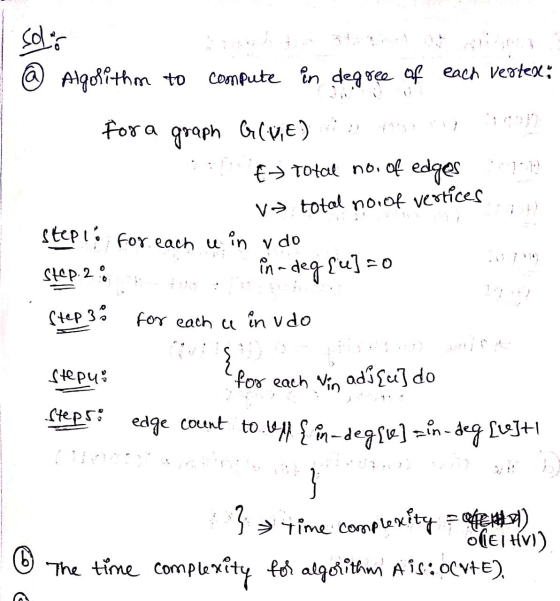
Exercise (15 points) Consider an adjacency-list representation of a directed graph G=(V.E). a) Propose in pseudocode...
For a directed graph the in-degree of a vertex is the number of edges it has...
 For a directed graph the in-degree of a vertex is the number of edges it has coming in to it, and the out- degree is the number of edges it has coming out. (a) Let G[i,j] be the adjacency matrix representation of a directed graph, write pseudocode (in the same detail as the text book) to compute the in-degree and out-degree of every vertex in the Page 1 of 2 CSC 375 Homework 3 Spring 2020 directed graph. Store results...
22.1-1 Given an adjacency-list representation of a directed graph, how long does it take to compute...
 22.1-1 Given an adjacency-list representation of a directed graph, how long does it take to compute the out-degree of every vertex? How long does it take to compute the in-degrees?
114points Let G- (V,E) be a directed graph. The in-degree of a vertex v is the...
 114points Let G- (V,E) be a directed graph. The in-degree of a vertex v is the number of edges (a) Design an algorithm (give pseudocode) that, given a vertex v EV, computes the in-degree of v under (b) Design an algorithm (give pseudocode) that, given a vertex v E V, computes the in-degree of v incident into v. the assumption that G is represented by an adjacency list. Give an analysis of your algorithm. under the assumption that G is...
Assume that the adjacency list representing a directed graph G has already been constructed. Show how...
Assume that the adjacency list representing a directed graph G has already been constructed. Show how to determine whether G contains a universal sink, that is a vertex with in-degree |V | − 1 and out-degree 0, in time O(|V |). **Please explain in detail
Consider an unweighted, undirected graph G = 〈V, E). The neighbourhood of a node u E V in the gr...
 Consider an unweighted, undirected graph G = 〈V, E). The neighbourhood of a node u E V in the graph is the set of all nodes that are adjacent (or directly connected) to v. Subsequently, we can define the neighbourhood degree of the node v as the sum of the degrees of all its neighbours (those nodes that are directly connects to v) (a) Design an algorithm that returns a list containing the neighbourhood degree for each node v V,...
Consider an unweighted, undirected graph G = 〈V, E). The neighbourhood of a node u E V in the gr...
 This question needs to be done using pseudocode (not any
particular programming language). Thanks
Consider an unweighted, undirected graph G = 〈V, E). The neighbourhood of a node u E V in the graph is the set of all nodes that are adjacent (or directly connected) to v. Subsequently, we can define the neighbourhood degree of the node v as the sum of the degrees of all its neighbours (those nodes that are directly connects to v) (a) Design an...
This question needs to be done using pseudocode (not any
particular programming language). Thanks
Consider an unweighted, undirected graph G = 〈V, E). The neighbourhood of a node u E V in the graph is the set of all nodes that are adjacent (or directly connected) to v. Subsequently, we can define the neighbourhood degree of the node v as the sum of the degrees of all its neighbours (those nodes that are directly connects to v) (a) Design an...
Let G = (V, E) be a directed acyclic graph with n vertices and m edges....
Let G = (V, E) be a directed acyclic graph with n vertices and m edges. Give an O(n + m) time algorithm that determines if G contains a directed path that touches every vertex in G exactly once. The graph G is given by its adjacency list representation.
5. The in-degree of a vertex in a directed graph is the number of edges directed...
 5. The in-degree of a vertex in a directed graph is the number of edges directed into it. Here is an algorithm for labeling each vertex with its in-degree, given an adjacency-list representation of the graph. for each vertex i: i.indegree = 0 for each vertex i: for each neighbor j of i: j.indegree = j.indegree + 1 Label each line with a big-bound on the time spent at the line over the entire run on the graph. Assume that...
Problem 3 (15 points). Let G (V,E) be the following directed graph. a. 1. Draw the...
 Problem 3 (15 points). Let G (V,E) be the following directed graph. a. 1. Draw the reverse graph G of G. 2. Run DFS on G to obtain a post number for each vertex. Assume that in the adjacency list representation of G, vertices are stored alphabetically, and in the list for each vertex, its adjacent vertices are also sorted alphabetically. In other words, the DFS algorithm needs to examine all vertices alphabetically, and when it traverses the adjacent vertices...
Write the pseudocode of the Depth First Search Algorithm DFS(G) using adjacencymatrix representation of the graph...
 Write the pseudocode of the Depth First Search Algorithm DFS(G)
using adjacencymatrix
representation of the graph G. What is the running time of your
pseudocode?
Specification: start from the psedocode discussed in class and
do only the modifications
needed for adjacency-matrix graph representation.
Below is the pseudocode discussed in class:
Write the pseudocode of the Depth First Search Algorithm DFS(G)
using adjacencymatrix
representation of the graph G. What is the running time of your
pseudocode?
Specification: start from the psedocode discussed in class and
do only the modifications
needed for adjacency-matrix graph representation.
Below is the pseudocode discussed in class:
 For a directed graph the in-degree of a vertex is the number of edges it has coming in to it, and the out- degree is the number of edges it has coming out. (a) Let G[i,j] be the adjacency matrix representation of a directed graph, write pseudocode (in the same detail as the text book) to compute the in-degree and out-degree of every vertex in the Page 1 of 2 CSC 375 Homework 3 Spring 2020 directed graph. Store results...
 22.1-1 Given an adjacency-list representation of a directed graph, how long does it take to compute the out-degree of every vertex? How long does it take to compute the in-degrees?
 114points Let G- (V,E) be a directed graph. The in-degree of a vertex v is the number of edges (a) Design an algorithm (give pseudocode) that, given a vertex v EV, computes the in-degree of v under (b) Design an algorithm (give pseudocode) that, given a vertex v E V, computes the in-degree of v incident into v. the assumption that G is represented by an adjacency list. Give an analysis of your algorithm. under the assumption that G is...
 Consider an unweighted, undirected graph G = 〈V, E). The neighbourhood of a node u E V in the graph is the set of all nodes that are adjacent (or directly connected) to v. Subsequently, we can define the neighbourhood degree of the node v as the sum of the degrees of all its neighbours (those nodes that are directly connects to v) (a) Design an algorithm that returns a list containing the neighbourhood degree for each node v V,...
 This question needs to be done using pseudocode (not any
particular programming language). Thanks
Consider an unweighted, undirected graph G = 〈V, E). The neighbourhood of a node u E V in the graph is the set of all nodes that are adjacent (or directly connected) to v. Subsequently, we can define the neighbourhood degree of the node v as the sum of the degrees of all its neighbours (those nodes that are directly connects to v) (a) Design an...
This question needs to be done using pseudocode (not any
particular programming language). Thanks
Consider an unweighted, undirected graph G = 〈V, E). The neighbourhood of a node u E V in the graph is the set of all nodes that are adjacent (or directly connected) to v. Subsequently, we can define the neighbourhood degree of the node v as the sum of the degrees of all its neighbours (those nodes that are directly connects to v) (a) Design an...
 5. The in-degree of a vertex in a directed graph is the number of edges directed into it. Here is an algorithm for labeling each vertex with its in-degree, given an adjacency-list representation of the graph. for each vertex i: i.indegree = 0 for each vertex i: for each neighbor j of i: j.indegree = j.indegree + 1 Label each line with a big-bound on the time spent at the line over the entire run on the graph. Assume that...
 Problem 3 (15 points). Let G (V,E) be the following directed graph. a. 1. Draw the reverse graph G of G. 2. Run DFS on G to obtain a post number for each vertex. Assume that in the adjacency list representation of G, vertices are stored alphabetically, and in the list for each vertex, its adjacent vertices are also sorted alphabetically. In other words, the DFS algorithm needs to examine all vertices alphabetically, and when it traverses the adjacent vertices...
 Write the pseudocode of the Depth First Search Algorithm DFS(G)
using adjacencymatrix
representation of the graph G. What is the running time of your
pseudocode?
Specification: start from the psedocode discussed in class and
do only the modifications
needed for adjacency-matrix graph representation.
Below is the pseudocode discussed in class:
Write the pseudocode of the Depth First Search Algorithm DFS(G)
using adjacencymatrix
representation of the graph G. What is the running time of your
pseudocode?
Specification: start from the psedocode discussed in class and
do only the modifications
needed for adjacency-matrix graph representation.
Below is the pseudocode discussed in class:
Most questions answered within 3 hours.
-
Where is the error in this code sequence?
String s1 = "Hello";
String s2 = "ello";...
asked 11 months ago -
Financial data for Joel de Paris, Inc., for last year
follow:
Joel de Paris, Inc.
Balance...
asked 11 months ago -
Consider this reaction:
Al2(SO4)3 (aq)+ BaCl3
(aq) Al2Cl6 (aq)- +
3BaSO4(s) . What is the...
asked 11 months ago -
Suppose that Savneet is considering increasing her
recent random sample from 20 car rentals to 40...
asked 11 months ago -
Trucks arrive at an unloading terminal at an average rate of 120
per hour.
Trucks arrive...
asked 11 months ago -
Why are methanol and ethanol completely soluble in water while
octanol is not very little soluble....
asked 11 months ago -
A facilities manager at a university reads in a research report
that the mean amount of...
asked 11 months ago -
When the CuSO4 is rehydrated by adding water to the anhydrous
compound, is this an endothermic...
asked 11 months ago -
A ray of sunlight is passing from diamond into crown glass; the
angle of incidence is...
asked 11 months ago -
A block of mass 0.249 kg is placed on top of a light, vertical
spring of...
asked 11 months ago -
how do the kidneys compensate in the presences of acidosis
a) trigger hyperventilate
b) reserve acid...
asked 11 months ago -
Question 501 pts
The rental rate of capital to the firm increases. Which of the
following...
asked 11 months ago