
Homework Answers

Add Answer to:
thermodynamic
The enthapy H(s, P, N) idefine as the Legeandre transform the intern eneryy u (s,...
The enthapy H(s, P, N) idefine as the Legeandre transform the intern eneryy u (s, v N) wit respec...
 thermodynamic
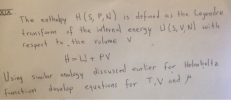
The enthapy H(s, P, N) idefine as the Legeandre transform the intern eneryy u (s, v N) wit respect to the volume v e enina Using swular analogy discussed earlier for Helmh。Ita function develsp equations for T,V and Silar ana
The enthapy H(s, P, N) idefine as the Legeandre transform the intern eneryy u (s, v N) wit respect to the volume v e enina Using swular analogy discussed earlier for Helmh。Ita function develsp equations for T,V and Silar...
thermodynamic
The enthapy H(s, P, N) idefine as the Legeandre transform the intern eneryy u (s, v N) wit respect to the volume v e enina Using swular analogy discussed earlier for Helmh。Ita function develsp equations for T,V and Silar ana
The enthapy H(s, P, N) idefine as the Legeandre transform the intern eneryy u (s, v N) wit respect to the volume v e enina Using swular analogy discussed earlier for Helmh。Ita function develsp equations for T,V and Silar...
Determine the system response y(t) for h(t)=u(t)+u(t-2) and x(t)=u(t). [Hint: use Laplace Transform multiplication: L[x(t)h(t)) =...
 Determine the system response y(t) for h(t)=u(t)+u(t-2) and x(t)=u(t). [Hint: use Laplace Transform multiplication: L[x(t)h(t)) = x(s)H(s). Useful Formula: Fourier Transform: F[f(t)] = F(w) sof(t)e-jw dt Inverse Fourier Transform: F-1[F(w)] = f (t) = 24., F(w)ejwidw Time Transformation property of Fourier Transform: f(at – to). FC)e=itoch Laplace Transform: L[f(t)] = F(s) = $© f(t)e-st dt Shifting property: L[f(t – to)u(t – to)] = e-toSF(s) e [tuce) = 1 and c [u(e) = )
Problem 1: Find the Laplace transform X(s) of x(0)-6cos(Sr-3)u(t-3). 10 Problem 2: (a) Find the inverse...
 Problem 1: Find the Laplace transform X(s) of x(0)-6cos(Sr-3)u(t-3). 10 Problem 2: (a) Find the inverse Laplace transform h() of H(s)-10s+34 (Hint: use the Laplace transform pair for Decaying Sine or Generic Oscillatory Decay.) (b) Draw the corresponding direct form II block diagram of the system described by H(s) and (c) determine the corresponding differential equation. Problem 3: Using the unilateral Laplace transform, solve the following differential equation with the given initial condition: y)+5y(0) 2u), y(0)1 Problem 4: For the...
06) Suppose a paramagnetic system that is under the action of an auxiliary (magnetic) field H....
06) Suppose a paramagnetic system that is under the action of an auxiliary (magnetic) field H. Thus, the work involved, it has to be that the work involved in a reversible process is described as đW = 10Hdm. where m is the total magnetic dipole moment of the system and u0 is the magnetic permeability of the vacuum. a) Determine the expression of the differential du of the internal energy U and indicate the two independent natural variables associated with...
06) Suppose a paramagnetic system that is under the action of an auxiliary (magnetic) field H....
 06) Suppose a paramagnetic system that is under the action of an auxiliary (magnetic) field H. Thus, the work involved, it has to be that the work involved in a reversible process is described as đW = 10Hdm. where m is the total magnetic dipole moment of the system and u0 is the magnetic permeability of the vacuum. a) Determine the expression of the differential du of the internal energy U and indicate the two independent natural variables associated with...
2 In the block diagram below, G(s) -1/s, P(s)P(s) s-+2 s+2 D(s)- k-oo Ше-ks[1-e-s/1001. The inver...
 2 In the block diagram below, G(s) -1/s, P(s)P(s) s-+2 s+2 D(s)- k-oo Ше-ks[1-e-s/1001. The inverse Laplace transforms of these equations are g(t), p(t),p(t), and d(t), respectively. The parameter K scales the feedback k-0 D(s) R(s) G(s) P(s) C(s) P(s) A Consider for a moment, D(s)- 0. Simplify the block diagram in terms of G(s), P(s), P(s) and find the transfer function by substituting the equations given above B What are the zeros and poles of the system you obtained...
B.2 The multiplicity of a monatomic ideal gas is given by 2 = f(N)VN U3N/2, where...
 B.2 The multiplicity of a monatomic ideal gas is given by 2 = f(N)VN U3N/2, where V is the volume occupied by the gas, U its internal energy, N the number of particles in the gas and f(N) a complicated function of N. [2] (i) Show that the entropy S of this system is given by 3 S = Nkg In V + ŽNkg In U + g(N), where g(N) is some function of N. (ii) Define the temperature T...
Derive F, P,U, and Cv in terms of N, V, T and constants for the Ideal...
Derive F, P,U, and Cv in terms of N, V, T and constants for the Ideal Gas partition function Q(N,V,T) = V^N / (L^(3N)*N!), where L = h/sqrt(2*pi*m*kB*T)
Question 16 (2 marks) Attempt 1 4 π[H(u+4)-H(u-16) Determine the Inverse Fourier transform of: F(a) Your...
 Question 16 (2 marks) Attempt 1 4 π[H(u+4)-H(u-16) Determine the Inverse Fourier transform of: F(a) Your answer should be expressed as a function of t using the correct syntax Inverse F.T. is ft)Skipped
By considering the volume V and entropy S as the two independent variables in the thermodynamic equation dE = TdS−PdV , derive the Maxwell relation between the derivatives ∂T/ ∂V and ∂P/ ∂S .
By considering the volume V and entropy S as the two independent variables in the thermodynamic equation dE = TdS−PdV , derive the Maxwell relation between the derivatives ∂T/ ∂V and ∂P/ ∂S .
 thermodynamic
The enthapy H(s, P, N) idefine as the Legeandre transform the intern eneryy u (s, v N) wit respect to the volume v e enina Using swular analogy discussed earlier for Helmh。Ita function develsp equations for T,V and Silar ana
The enthapy H(s, P, N) idefine as the Legeandre transform the intern eneryy u (s, v N) wit respect to the volume v e enina Using swular analogy discussed earlier for Helmh。Ita function develsp equations for T,V and Silar...
thermodynamic
The enthapy H(s, P, N) idefine as the Legeandre transform the intern eneryy u (s, v N) wit respect to the volume v e enina Using swular analogy discussed earlier for Helmh。Ita function develsp equations for T,V and Silar ana
The enthapy H(s, P, N) idefine as the Legeandre transform the intern eneryy u (s, v N) wit respect to the volume v e enina Using swular analogy discussed earlier for Helmh。Ita function develsp equations for T,V and Silar...
 Determine the system response y(t) for h(t)=u(t)+u(t-2) and x(t)=u(t). [Hint: use Laplace Transform multiplication: L[x(t)h(t)) = x(s)H(s). Useful Formula: Fourier Transform: F[f(t)] = F(w) sof(t)e-jw dt Inverse Fourier Transform: F-1[F(w)] = f (t) = 24., F(w)ejwidw Time Transformation property of Fourier Transform: f(at – to). FC)e=itoch Laplace Transform: L[f(t)] = F(s) = $© f(t)e-st dt Shifting property: L[f(t – to)u(t – to)] = e-toSF(s) e [tuce) = 1 and c [u(e) = )
 Problem 1: Find the Laplace transform X(s) of x(0)-6cos(Sr-3)u(t-3). 10 Problem 2: (a) Find the inverse Laplace transform h() of H(s)-10s+34 (Hint: use the Laplace transform pair for Decaying Sine or Generic Oscillatory Decay.) (b) Draw the corresponding direct form II block diagram of the system described by H(s) and (c) determine the corresponding differential equation. Problem 3: Using the unilateral Laplace transform, solve the following differential equation with the given initial condition: y)+5y(0) 2u), y(0)1 Problem 4: For the...
 06) Suppose a paramagnetic system that is under the action of an auxiliary (magnetic) field H. Thus, the work involved, it has to be that the work involved in a reversible process is described as đW = 10Hdm. where m is the total magnetic dipole moment of the system and u0 is the magnetic permeability of the vacuum. a) Determine the expression of the differential du of the internal energy U and indicate the two independent natural variables associated with...
 2 In the block diagram below, G(s) -1/s, P(s)P(s) s-+2 s+2 D(s)- k-oo Ше-ks[1-e-s/1001. The inverse Laplace transforms of these equations are g(t), p(t),p(t), and d(t), respectively. The parameter K scales the feedback k-0 D(s) R(s) G(s) P(s) C(s) P(s) A Consider for a moment, D(s)- 0. Simplify the block diagram in terms of G(s), P(s), P(s) and find the transfer function by substituting the equations given above B What are the zeros and poles of the system you obtained...
 B.2 The multiplicity of a monatomic ideal gas is given by 2 = f(N)VN U3N/2, where V is the volume occupied by the gas, U its internal energy, N the number of particles in the gas and f(N) a complicated function of N. [2] (i) Show that the entropy S of this system is given by 3 S = Nkg In V + ŽNkg In U + g(N), where g(N) is some function of N. (ii) Define the temperature T...
 Question 16 (2 marks) Attempt 1 4 π[H(u+4)-H(u-16) Determine the Inverse Fourier transform of: F(a) Your answer should be expressed as a function of t using the correct syntax Inverse F.T. is ft)Skipped
Most questions answered within 3 hours.
-
Where is the error in this code sequence?
String s1 = "Hello";
String s2 = "ello";...
asked 10 months ago -
Financial data for Joel de Paris, Inc., for last year
follow:
Joel de Paris, Inc.
Balance...
asked 10 months ago -
Consider this reaction:
Al2(SO4)3 (aq)+ BaCl3
(aq) Al2Cl6 (aq)- +
3BaSO4(s) . What is the...
asked 10 months ago -
Suppose that Savneet is considering increasing her
recent random sample from 20 car rentals to 40...
asked 10 months ago -
Trucks arrive at an unloading terminal at an average rate of 120
per hour.
Trucks arrive...
asked 10 months ago -
Why are methanol and ethanol completely soluble in water while
octanol is not very little soluble....
asked 10 months ago -
A facilities manager at a university reads in a research report
that the mean amount of...
asked 10 months ago -
When the CuSO4 is rehydrated by adding water to the anhydrous
compound, is this an endothermic...
asked 10 months ago -
A ray of sunlight is passing from diamond into crown glass; the
angle of incidence is...
asked 10 months ago -
A block of mass 0.249 kg is placed on top of a light, vertical
spring of...
asked 10 months ago -
how do the kidneys compensate in the presences of acidosis
a) trigger hyperventilate
b) reserve acid...
asked 10 months ago -
Question 501 pts
The rental rate of capital to the firm increases. Which of the
following...
asked 10 months ago