
Homework Answers
Add Answer to:
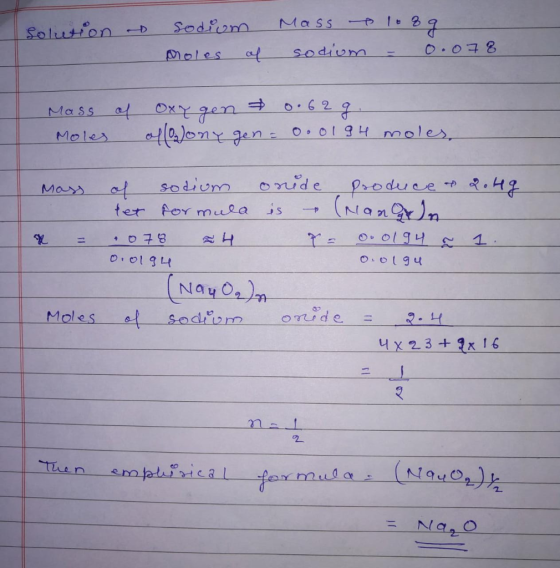
In an experiment, 1.8 g of sodium reacts with 0.62 g of oxygen, forming 2.4g of...
In an experiment, 3.0 g of sodium react with 1.0 g of oxygen, forming 4.0 g...
In an experiment, 3.0 g of sodium react with 1.0 g of oxygen, forming 4.0 g of sodium oxide. Determine the empirical formula for sodium oxide. Write a balanced chemical equation for this reaction. PLEASE, give a lot of detail for the balanced chemical equation part. I think it should be Na2 + O -> Na2O, but it keeps saying that is wrong.
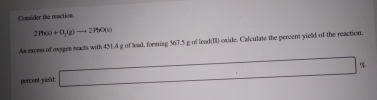
An excess of oxygen reacts with 451.4 g of lead, forming 367.5 g of Lead (II)...
 An excess of oxygen reacts with 451.4 g of lead,
forming 367.5 g of Lead (II) oxide
calculate the percent yield of the reaction
Consider the reaction. 2 Pb(s) + 0,(g) 2 PbO(s) An excess of oxygen reacts with 451.4 g of lead, forming 367.5 g of lead(II) oxide. Calculate the percent yield of the reaction. percent yield:
An excess of oxygen reacts with 451.4 g of lead,
forming 367.5 g of Lead (II) oxide
calculate the percent yield of the reaction
Consider the reaction. 2 Pb(s) + 0,(g) 2 PbO(s) An excess of oxygen reacts with 451.4 g of lead, forming 367.5 g of lead(II) oxide. Calculate the percent yield of the reaction. percent yield:
1. A 0.750-g sample of tin metal reacts with 0.201 g of oxygen gas to form tin oxide.
1. A 0.750-g sample of tin metal reacts with 0.201 g of oxygen gas to form tin oxide. Calculate the empirical formula of the tin oxide. 2. A 0.565-g sample of cobalt metal reacts with excess sulfur to give 1.027 g of cobalt sulfide. Calculate the empirical formula of the product. 3. A 1.164-g sample of iron filings reacts with chlorine gas to give 3.384 g of iron chloride. Calculate the empirical formula of the product? 4. A 0.626-8 sample of copper oxide...
A 1.500 g piece of calcium metal reacts with oxygen gas to form 2.099 g of...
A 1.500 g piece of calcium metal reacts with oxygen gas to form 2.099 g of calcium oxide. Calculate the empirical formula of calcium oxide
Question A0.276 g piece of solid magnesium reacts with gaseous oxygen from the atmosphere to form...
 Question A0.276 g piece of solid magnesium reacts with gaseous oxygen from the atmosphere to form solid magnesium oxide. In the laboratory a student weighs the mass of the magnesium oxide collected from this reaction as 0.304 g. 1st attempt Part 1 See Periodic Table The 0.276 g solid magnesium is the: Choose one: O A. actual yield. B. limiting reagent. C. excess reagent. O D. percent yield. O E. theoretical yield.
Experiment 3 Prelaboratory Assignment Empirical Formulas Date Lobo Sec. Name Desk No. 1. Elemental mercury was...
 Experiment 3 Prelaboratory Assignment Empirical Formulas Date Lobo Sec. Name Desk No. 1. Elemental mercury was first discovered when a mercury oxide was decomposed with heat, forming mercury metal and oxygen gas. When a 0.204-g sample of the mercury oxide heated. 0.189 g of mercury metal remains. Note: not attempt this experiment in the laboratory because of the release of toxic mercury vapor. a. What is the mole ratio of mercury to oxygen in the sample? b. What is the...
Map pling Learning In the following reaction, 4514 g of lead reacts with excess oxygen forming...
 Map pling Learning In the following reaction, 4514 g of lead reacts with excess oxygen forming 354.0 g of lead(I) oxide. Calculate the percent yield of the reaction. Number
Consider the reaction. 2Pb(s)+O2(g)⟶2PbO(s) An excess of oxygen reacts with 451.4 g of lead, forming 386.1...
Consider the reaction. 2Pb(s)+O2(g)⟶2PbO(s) An excess of oxygen reacts with 451.4 g of lead, forming 386.1 g of lead(II) oxide. Calculate the percent yield of the reaction.
1. When 2.50 g of copper metal reacts with molecular oxygen, the copper oxide product of the reaction has a mass of...
1. When 2.50 g of copper metal reacts with molecular oxygen, the copper oxide product of the reaction has a mass of 2.81 g. What is the empirical formula of the copper oxide product 2. When 10.8 g of silver was reacted with sulfur. 12.4 grams of product was produced there was only one product). What is the empirical formula of the product? 3. Lysine is a compound composed of carbon, hydrogen, nitrogen and oxygen. When 1.50 g of lysine is burned,...
a sample of titanium with a mass of 6.48g reacts with oxygen to form 10.80 g...
a sample of titanium with a mass of 6.48g reacts with oxygen to form 10.80 g of the metal oxide. determine the emperical formula of the metal oxide
 An excess of oxygen reacts with 451.4 g of lead,
forming 367.5 g of Lead (II) oxide
calculate the percent yield of the reaction
Consider the reaction. 2 Pb(s) + 0,(g) 2 PbO(s) An excess of oxygen reacts with 451.4 g of lead, forming 367.5 g of lead(II) oxide. Calculate the percent yield of the reaction. percent yield:
An excess of oxygen reacts with 451.4 g of lead,
forming 367.5 g of Lead (II) oxide
calculate the percent yield of the reaction
Consider the reaction. 2 Pb(s) + 0,(g) 2 PbO(s) An excess of oxygen reacts with 451.4 g of lead, forming 367.5 g of lead(II) oxide. Calculate the percent yield of the reaction. percent yield:
 Question A0.276 g piece of solid magnesium reacts with gaseous oxygen from the atmosphere to form solid magnesium oxide. In the laboratory a student weighs the mass of the magnesium oxide collected from this reaction as 0.304 g. 1st attempt Part 1 See Periodic Table The 0.276 g solid magnesium is the: Choose one: O A. actual yield. B. limiting reagent. C. excess reagent. O D. percent yield. O E. theoretical yield.
 Experiment 3 Prelaboratory Assignment Empirical Formulas Date Lobo Sec. Name Desk No. 1. Elemental mercury was first discovered when a mercury oxide was decomposed with heat, forming mercury metal and oxygen gas. When a 0.204-g sample of the mercury oxide heated. 0.189 g of mercury metal remains. Note: not attempt this experiment in the laboratory because of the release of toxic mercury vapor. a. What is the mole ratio of mercury to oxygen in the sample? b. What is the...
 Map pling Learning In the following reaction, 4514 g of lead reacts with excess oxygen forming 354.0 g of lead(I) oxide. Calculate the percent yield of the reaction. Number
Most questions answered within 3 hours.
-
Where is the error in this code sequence?
String s1 = "Hello";
String s2 = "ello";...
asked 11 months ago -
Financial data for Joel de Paris, Inc., for last year
follow:
Joel de Paris, Inc.
Balance...
asked 11 months ago -
Consider this reaction:
Al2(SO4)3 (aq)+ BaCl3
(aq) Al2Cl6 (aq)- +
3BaSO4(s) . What is the...
asked 11 months ago -
Suppose that Savneet is considering increasing her
recent random sample from 20 car rentals to 40...
asked 11 months ago -
Trucks arrive at an unloading terminal at an average rate of 120
per hour.
Trucks arrive...
asked 11 months ago -
Why are methanol and ethanol completely soluble in water while
octanol is not very little soluble....
asked 11 months ago -
A facilities manager at a university reads in a research report
that the mean amount of...
asked 11 months ago -
When the CuSO4 is rehydrated by adding water to the anhydrous
compound, is this an endothermic...
asked 11 months ago -
A ray of sunlight is passing from diamond into crown glass; the
angle of incidence is...
asked 11 months ago -
A block of mass 0.249 kg is placed on top of a light, vertical
spring of...
asked 11 months ago -
how do the kidneys compensate in the presences of acidosis
a) trigger hyperventilate
b) reserve acid...
asked 11 months ago -
Question 501 pts
The rental rate of capital to the firm increases. Which of the
following...
asked 11 months ago