
Homework Answers
Add Answer to:
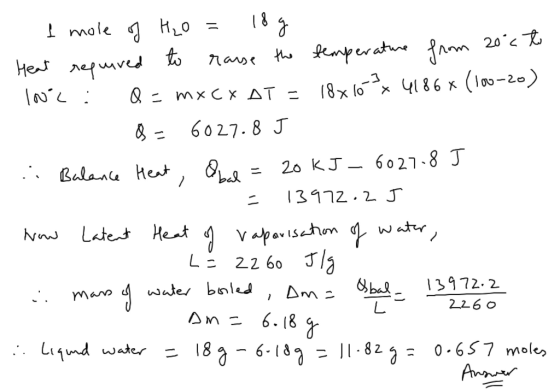
Up 8. One mole of water at 20° C has 20 kJ of thermal energy added....
32) The reaction of one mole of nitrogen gas with three moles of hydrogen gas releases 92 kJ of thermal energy to t...
 32) The reaction of one mole of nitrogen gas with three moles of hydrogen gas releases 92 kJ of thermal energy to the surroundings. Which of the following is TRUE? A) This reaction has a negative enthalpy of reaction. B) Complete reaction of two moles of nitrogen gas would release 184 kJ of thermal energy in this reaction. C) This reaction is exothermic. D) All of the above are true. E) None of the above are true. 33) How many...
A kettle of water has just boiled. At that moment the water inside contains roughly 775 kJ of thermal energy. a) After t...
A kettle of water has just boiled. At that moment the water inside contains roughly 775 kJ of thermal energy. a) After three hours resting on the counter, the water in the kettle has cooled to room temperature, losing about 170 kJ of thermal energy in the process. Where did that thermal energy go, and by what process(es)? b) Has the quality of the water’s thermal energy increased or decreased? Explain. You have just invented a new light bulb which...
When 8.70 kj of thermal energy is added to 2.50 mol of liquid methanol, it vaporizes....
When 8.70 kj of thermal energy is added to 2.50 mol of liquid methanol, it vaporizes. Determine the heat of caporization in kj/mol of methanol.
(a) Calculate the entropy and free energy change per mole when liquid water boils at 1...
(a) Calculate the entropy and free energy change per mole when liquid water boils at 1 atm pressure. assume that for water ∆Hvap =2095.50 KJ/Kg (b) State whether the process is spontaneous or not
Calculate the mass of water vapour that could be produced when (1.73x10^3)kJ of energy is added...
Calculate the mass of water vapour that could be produced when (1.73x10^3)kJ of energy is added to an excess amount of liquid water at its boiling point.
a. One kilogram of ice at -20°C is heated to 0°C and melted. The resulting water...
 a. One kilogram of ice at -20°C is heated to 0°C and melted. The resulting water is heated to 100°C. The water vaporizes and the steam is heated to 400°C. Assume that all of the processes are isobaric, and calculate the change in enthalpy in Joules. The specific heats (at constant pressure) of ice, liquid water, and steam are 2.30, 4.18, and 2.01 kJ/kgoC respectively Calculate the change in enthalpy for the combustion of one mole of glucose according to...
Assume that the complete combustion of one mole of fructose, a monosaccharide, to carbon dioxide and...
 Assume that the complete combustion of one mole of fructose, a
monosaccharide, to carbon dioxide and water liberates 2810 kJ of
energy (Δ?°′=−2810 kJ/mol ). If the energy generated by the
combustion of fructose is entirely converted to the synthesis of a
hypothetical compound X, calculate the number of moles of the
compound that could theoretically be generated. Use the value
Δ?°′compound X=−75.7 kJ/mol . Round your answer to two significant
figures.
Thank you!!
Assume that the complete combustion of...
Assume that the complete combustion of one mole of fructose, a
monosaccharide, to carbon dioxide and water liberates 2810 kJ of
energy (Δ?°′=−2810 kJ/mol ). If the energy generated by the
combustion of fructose is entirely converted to the synthesis of a
hypothetical compound X, calculate the number of moles of the
compound that could theoretically be generated. Use the value
Δ?°′compound X=−75.7 kJ/mol . Round your answer to two significant
figures.
Thank you!!
Assume that the complete combustion of...
If 53.2 kJ of heat are added to 0.861 moles of ice at −5.00 °C, what...
If 53.2 kJ of heat are added to 0.861 moles of ice at −5.00 °C, what will be the resulting temperature and state of the water? Cm(s) = 37.6 J/(mol·K) ΔHfus = 6.02 kJ/mol Cm(ℓ) = 75.3 J/(mol·K) ΔHvap = 40.67 kJ/mol Cm(g) = 33.1 J/(mol·K) liquid at 67.5 °C liquid at 98.9 °C vapor at 286 °C vapor at 323 °C vapor at 350 °C
1. If 145 kJ of energy is added to water, what mass of water can be...
 1. If 145 kJ of energy is added to water, what mass of water can be heated from 35°C to 100°C and then vaporized at 100°C. a. Identify the type of problem and what C105 concepts are being used? 2. Find the error in the following solved problem. Correct the error. A compound has a percent composition of carbon equal to 48.6383%, hydrogen equal to 8.1636%, and oxygen equal to 43.1981%. What is the empirical formula for the compound? Assume...
32) The reaction of one mole of nitrogen gas with three moles of hydrogen gas releases 92 ) thermal energy to the s...
 32) The reaction of one mole of nitrogen gas with three moles of hydrogen gas releases 92 ) thermal energy to the surroundings. Which of the following is TRUE? A) This reaction has a negative enthalpy of reaction. B) Complete reaction of two moles of nitrogen gas would release 184 kl of thermal energy this reaction. C) This reaction is exothermic. D) All of the above are true. E) None of the above are true. 33) How many grams of...
 32) The reaction of one mole of nitrogen gas with three moles of hydrogen gas releases 92 kJ of thermal energy to the surroundings. Which of the following is TRUE? A) This reaction has a negative enthalpy of reaction. B) Complete reaction of two moles of nitrogen gas would release 184 kJ of thermal energy in this reaction. C) This reaction is exothermic. D) All of the above are true. E) None of the above are true. 33) How many...
 a. One kilogram of ice at -20°C is heated to 0°C and melted. The resulting water is heated to 100°C. The water vaporizes and the steam is heated to 400°C. Assume that all of the processes are isobaric, and calculate the change in enthalpy in Joules. The specific heats (at constant pressure) of ice, liquid water, and steam are 2.30, 4.18, and 2.01 kJ/kgoC respectively Calculate the change in enthalpy for the combustion of one mole of glucose according to...
 Assume that the complete combustion of one mole of fructose, a
monosaccharide, to carbon dioxide and water liberates 2810 kJ of
energy (Δ?°′=−2810 kJ/mol ). If the energy generated by the
combustion of fructose is entirely converted to the synthesis of a
hypothetical compound X, calculate the number of moles of the
compound that could theoretically be generated. Use the value
Δ?°′compound X=−75.7 kJ/mol . Round your answer to two significant
figures.
Thank you!!
Assume that the complete combustion of...
Assume that the complete combustion of one mole of fructose, a
monosaccharide, to carbon dioxide and water liberates 2810 kJ of
energy (Δ?°′=−2810 kJ/mol ). If the energy generated by the
combustion of fructose is entirely converted to the synthesis of a
hypothetical compound X, calculate the number of moles of the
compound that could theoretically be generated. Use the value
Δ?°′compound X=−75.7 kJ/mol . Round your answer to two significant
figures.
Thank you!!
Assume that the complete combustion of...
 1. If 145 kJ of energy is added to water, what mass of water can be heated from 35°C to 100°C and then vaporized at 100°C. a. Identify the type of problem and what C105 concepts are being used? 2. Find the error in the following solved problem. Correct the error. A compound has a percent composition of carbon equal to 48.6383%, hydrogen equal to 8.1636%, and oxygen equal to 43.1981%. What is the empirical formula for the compound? Assume...
 32) The reaction of one mole of nitrogen gas with three moles of hydrogen gas releases 92 ) thermal energy to the surroundings. Which of the following is TRUE? A) This reaction has a negative enthalpy of reaction. B) Complete reaction of two moles of nitrogen gas would release 184 kl of thermal energy this reaction. C) This reaction is exothermic. D) All of the above are true. E) None of the above are true. 33) How many grams of...
Most questions answered within 3 hours.
-
Where is the error in this code sequence?
String s1 = "Hello";
String s2 = "ello";...
asked 11 months ago -
Financial data for Joel de Paris, Inc., for last year
follow:
Joel de Paris, Inc.
Balance...
asked 11 months ago -
Consider this reaction:
Al2(SO4)3 (aq)+ BaCl3
(aq) Al2Cl6 (aq)- +
3BaSO4(s) . What is the...
asked 11 months ago -
Suppose that Savneet is considering increasing her
recent random sample from 20 car rentals to 40...
asked 11 months ago -
Trucks arrive at an unloading terminal at an average rate of 120
per hour.
Trucks arrive...
asked 11 months ago -
Why are methanol and ethanol completely soluble in water while
octanol is not very little soluble....
asked 11 months ago -
A facilities manager at a university reads in a research report
that the mean amount of...
asked 11 months ago -
When the CuSO4 is rehydrated by adding water to the anhydrous
compound, is this an endothermic...
asked 11 months ago -
A ray of sunlight is passing from diamond into crown glass; the
angle of incidence is...
asked 11 months ago -
A block of mass 0.249 kg is placed on top of a light, vertical
spring of...
asked 11 months ago -
how do the kidneys compensate in the presences of acidosis
a) trigger hyperventilate
b) reserve acid...
asked 11 months ago -
Question 501 pts
The rental rate of capital to the firm increases. Which of the
following...
asked 11 months ago