Using the theorem of equivalences and the substitution theorem prove that: A ⊕ B ≡ ¬(A...
Homework Answers
We know that,
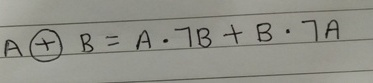
RHS=
And LHS =
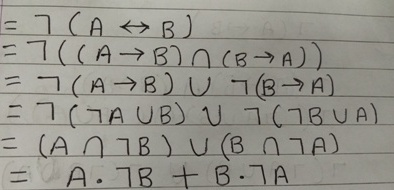
which is nothing but LHS
So LHS = RHS
Add Answer to:
Using the theorem of equivalences and the substitution
theorem prove that:
A ⊕ B ≡ ¬(A...
Using ONLY logical equivalences (not truth tables!), prove for the following that one element of the...
Using ONLY logical equivalences (not truth tables!), prove for the following that one element of the pair is logically equivalent to the other one using logical equivalences (ex. De Morgan's laws, Absorption laws, Negation laws etc.) a) ~d -> (a && b && c) = ~(~a && ~d) && ((d || b) & (c || d)) b) (a->b) && (c->d) = (c NOR a) || (b && ~c) || (d && ~a) || (b && d) c) (~a && ~b)...
Verify the logical equivalences using the theorem below: (p ∧ ( ~ ( ~ p ∨...
 Verify the logical equivalences using the theorem below:
(p ∧ ( ~ ( ~ p ∨ q ) ) ) ∨ (p ∧ q) ≡ p
Theorem 2.1.1 Let p, q, and r be statement variables, t a tautology, and c a contradiction. The following logical equivalences are true. 1. Commutativity: p1q=q1p; p V q = 9VP 2. Associativity: ( pq) Ar=p1qAr); (pVq) Vr=pv (Vr) 3. Distributivity: PA(Vr) = (p19) (par); p V (qar) = (pVg) (Vr) 4. Identity: pAt=p:...
Verify the logical equivalences using the theorem below:
(p ∧ ( ~ ( ~ p ∨ q ) ) ) ∨ (p ∧ q) ≡ p
Theorem 2.1.1 Let p, q, and r be statement variables, t a tautology, and c a contradiction. The following logical equivalences are true. 1. Commutativity: p1q=q1p; p V q = 9VP 2. Associativity: ( pq) Ar=p1qAr); (pVq) Vr=pv (Vr) 3. Distributivity: PA(Vr) = (p19) (par); p V (qar) = (pVg) (Vr) 4. Identity: pAt=p:...
(a) use the logical equivalences p → q ≡∼p ∨ q and p ↔ q ≡...
(a) use the logical equivalences p → q ≡∼p ∨ q and p ↔ q ≡ (∼p ∨ q) ∧ (∼q ∨ p) to rewrite the given statement forms without using the symbol → or ↔, and (b) use the logi- cal equivalence p ∨ q ≡∼(∼p∧ ∼q) to rewrite each statement form using only ∧ and ∼. * p∨∼q→r∨q
In this assignment you will write code that will prove both equations for three logical equivalences...
 In this assignment you will write code that will prove both equations for three logical equivalences (pick any three except the double negative law). Below is the list of logical equivalences. Please create a program that allows a user to test logical equivalences and have proof of their equivalency for the user. The rubric is below. Submit screen shots of the code, input, and output of the program. Theorem 2.1.1 Logical Equivalences Given any statement variables p, q, and r,...
Prove that: A'+B'+C'+D' = A'B'C'D' using theorems of boolean algebra to prove DeMorgans theorem for four...
Prove that: A'+B'+C'+D' = A'B'C'D' using theorems of boolean algebra to prove DeMorgans theorem for four variables
Note that x does not occur free in C in this equivalence. Prove the following using other equivalences 4. ∃x(c → A(x)) ≡...
Note that x does not occur free in C in this equivalence. Prove the following using other equivalences 4. ∃x(c → A(x)) ≡ c → ∃xA(x) 5. ∀x(A(x) → C) ≡ ∃A(x) → C 6. ∃x(A(x) → C) ≡ ∀xA(x) → C
Problem 21.11. Prove the following corollary of Theorem 21.13 above. Theorem 21.13. Let A, B,C,...
 Hello, can you please solve 21.11, using the Theorem 21.13?
Thank you.
Problem 21.11. Prove the following corollary of Theorem 21.13 above. Theorem 21.13. Let A, B,C, and D be nonempty sets with AC and Bn D. Then
Problem 21.11. Prove the following corollary of Theorem 21.13 above.
Theorem 21.13. Let A, B,C, and D be nonempty sets with AC and Bn D. Then
Hello, can you please solve 21.11, using the Theorem 21.13?
Thank you.
Problem 21.11. Prove the following corollary of Theorem 21.13 above. Theorem 21.13. Let A, B,C, and D be nonempty sets with AC and Bn D. Then
Problem 21.11. Prove the following corollary of Theorem 21.13 above.
Theorem 21.13. Let A, B,C, and D be nonempty sets with AC and Bn D. Then
Prove the following theorem using induction THEOREM 39. If a 70 and m, n e Z,...
 Prove the following theorem using induction
THEOREM 39. If a 70 and m, n e Z, then aman = am+n and (a")" = amn. Moreover, if a, n EN, then a" EN.
Prove the following theorem using induction
THEOREM 39. If a 70 and m, n e Z, then aman = am+n and (a")" = amn. Moreover, if a, n EN, then a" EN.
2. Prove the following in as many ways as possible. a) DeMorgan's theorem b) CONCENSUS THEOREM
2. Prove the following in as many ways as possible. a) DeMorgan's theorem b) CONCENSUS THEOREM
Solve the following problems using Fermat's Little Theorem (a) Prove that, if 5 does not divide...
 Solve the following problems using Fermat's Little Theorem (a) Prove that, if 5 does not divide n, then 5n1. (b) Prove that, if gcd(n, 6) 1, then 12n2 - 1 (c) Prove that, if 5 does not divide n-1, , or n+1, then 5(n21).
 Verify the logical equivalences using the theorem below:
(p ∧ ( ~ ( ~ p ∨ q ) ) ) ∨ (p ∧ q) ≡ p
Theorem 2.1.1 Let p, q, and r be statement variables, t a tautology, and c a contradiction. The following logical equivalences are true. 1. Commutativity: p1q=q1p; p V q = 9VP 2. Associativity: ( pq) Ar=p1qAr); (pVq) Vr=pv (Vr) 3. Distributivity: PA(Vr) = (p19) (par); p V (qar) = (pVg) (Vr) 4. Identity: pAt=p:...
Verify the logical equivalences using the theorem below:
(p ∧ ( ~ ( ~ p ∨ q ) ) ) ∨ (p ∧ q) ≡ p
Theorem 2.1.1 Let p, q, and r be statement variables, t a tautology, and c a contradiction. The following logical equivalences are true. 1. Commutativity: p1q=q1p; p V q = 9VP 2. Associativity: ( pq) Ar=p1qAr); (pVq) Vr=pv (Vr) 3. Distributivity: PA(Vr) = (p19) (par); p V (qar) = (pVg) (Vr) 4. Identity: pAt=p:...
 In this assignment you will write code that will prove both equations for three logical equivalences (pick any three except the double negative law). Below is the list of logical equivalences. Please create a program that allows a user to test logical equivalences and have proof of their equivalency for the user. The rubric is below. Submit screen shots of the code, input, and output of the program. Theorem 2.1.1 Logical Equivalences Given any statement variables p, q, and r,...
 Hello, can you please solve 21.11, using the Theorem 21.13?
Thank you.
Problem 21.11. Prove the following corollary of Theorem 21.13 above. Theorem 21.13. Let A, B,C, and D be nonempty sets with AC and Bn D. Then
Problem 21.11. Prove the following corollary of Theorem 21.13 above.
Theorem 21.13. Let A, B,C, and D be nonempty sets with AC and Bn D. Then
Hello, can you please solve 21.11, using the Theorem 21.13?
Thank you.
Problem 21.11. Prove the following corollary of Theorem 21.13 above. Theorem 21.13. Let A, B,C, and D be nonempty sets with AC and Bn D. Then
Problem 21.11. Prove the following corollary of Theorem 21.13 above.
Theorem 21.13. Let A, B,C, and D be nonempty sets with AC and Bn D. Then
 Prove the following theorem using induction
THEOREM 39. If a 70 and m, n e Z, then aman = am+n and (a")" = amn. Moreover, if a, n EN, then a" EN.
Prove the following theorem using induction
THEOREM 39. If a 70 and m, n e Z, then aman = am+n and (a")" = amn. Moreover, if a, n EN, then a" EN.
 Solve the following problems using Fermat's Little Theorem (a) Prove that, if 5 does not divide n, then 5n1. (b) Prove that, if gcd(n, 6) 1, then 12n2 - 1 (c) Prove that, if 5 does not divide n-1, , or n+1, then 5(n21).
Most questions answered within 3 hours.
-
Where is the error in this code sequence?
String s1 = "Hello";
String s2 = "ello";...
asked 10 months ago -
Financial data for Joel de Paris, Inc., for last year
follow:
Joel de Paris, Inc.
Balance...
asked 10 months ago -
Consider this reaction:
Al2(SO4)3 (aq)+ BaCl3
(aq) Al2Cl6 (aq)- +
3BaSO4(s) . What is the...
asked 10 months ago -
Suppose that Savneet is considering increasing her
recent random sample from 20 car rentals to 40...
asked 10 months ago -
Trucks arrive at an unloading terminal at an average rate of 120
per hour.
Trucks arrive...
asked 10 months ago -
Why are methanol and ethanol completely soluble in water while
octanol is not very little soluble....
asked 10 months ago -
A facilities manager at a university reads in a research report
that the mean amount of...
asked 10 months ago -
When the CuSO4 is rehydrated by adding water to the anhydrous
compound, is this an endothermic...
asked 10 months ago -
A ray of sunlight is passing from diamond into crown glass; the
angle of incidence is...
asked 10 months ago -
A block of mass 0.249 kg is placed on top of a light, vertical
spring of...
asked 10 months ago -
how do the kidneys compensate in the presences of acidosis
a) trigger hyperventilate
b) reserve acid...
asked 10 months ago -
Question 501 pts
The rental rate of capital to the firm increases. Which of the
following...
asked 10 months ago