
Homework Answers
1) here as experiment is done without replacement ; this is hypergeometric distribution
with paramter N =15+10 =25 ; G =10 and n=2
below is pmf of S :
P(S=s) =
| s | P(s) |
| 0 | 0.35 |
| 1 | 0.5 |
| 2 | 0.15 |
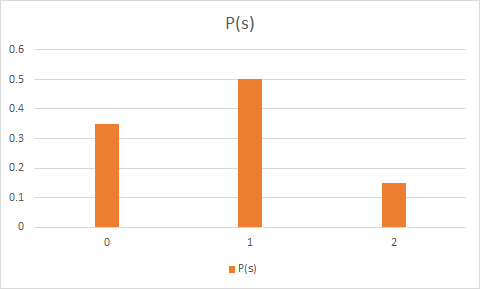
also from Hypergeometric distribution expected value E(x) =nG/N =2*10/25=0.8
Add Answer to:
Directions: Each problem below describes an experiment and defines a random variable. For each problem: (a)...
Directions: Each problem below describes an experiment and defines a random variable. For each problem: (a)...
 Directions: Each problem below describes an experiment and defines a random variable. For each problem: (a) Find the distribution of the random variable (and provide it as a chart) (b) Calculate the expected value of the random variable Do not round values.
For the experiment described below, let x determine a random variable, and use your knowledge of...
 For the experiment described below, let x determine a random variable, and use your knowledge of probability to prepare a probability distribution. Four cards are drawn (with replacement) and the number of black cards is noted. A probability distribution for the given experiment is as follows. х 0 1 2 3 4 1 16 P(x) 16 4 8
Question B2 (a) The table below shows the discrete probability distribution of a random variable X:...
 Question B2 (a) The table below shows the discrete probability distribution of a random variable X: X P(X) 1 0. 2 7 18 W Tk 25 0.1 Suppose u = 12. Find the values of w and k. Hence, find the variance. (5 marks) (b) Suppose 15 students in a class are to be assigned randomly into 5 groups for group presentation. Each group contains 3 students. In how many different ways can these groups be formed? (3 marks) Suppose...
ASAP Exercise 6. This problem describes an experiment in which conditional probabilities are used to compute...
 ASAP
Exercise 6. This problem describes an experiment in which conditional probabilities are used to compute "proper" probability. The experiment starts with two urns, Urn #1 contains 5 white marbles and 2 black marbles. Urn #2 contains 7 white marbles and 3 black marbles. One marble from each urn is drawn at random. (For each urn, the chance of each marble being drawn is the same.) Let T be the event that the two marbles are the same color. Let...
ASAP
Exercise 6. This problem describes an experiment in which conditional probabilities are used to compute "proper" probability. The experiment starts with two urns, Urn #1 contains 5 white marbles and 2 black marbles. Urn #2 contains 7 white marbles and 3 black marbles. One marble from each urn is drawn at random. (For each urn, the chance of each marble being drawn is the same.) Let T be the event that the two marbles are the same color. Let...
PROBLEM: Marbles in a Box Suppose there are 17 marbles in a box. There are 5...
 PROBLEM: Marbles in a Box Suppose there are 17 marbles in a box. There are 5 blue marbles, 4 yellow marbles, 3 red marbles, and 5 green marbles. The experiment is selecting 2 marbles randomly from the box, without replacement. Let x be the number of blue marbles. Note: The picture shown is an example of marbles in the box. The number of marbles and their color code does not reflect to this problem (a) Determine whether the experiment is...
1. Determine whether or not the random variable X is a binomial randon variable. If so...
 1. Determine whether or not the random variable X is a binomial randon variable. If so give the values of n and p. If not, explain why not. a. X is the number of dots on the top face of fair die that is rolled. b. X is the number of hearts in a five-card hand drawn (without replacement) from a well-shuffled ordinary deck c. X is the number of defective parts in a sample of ten randomly selected parts...
Help step by step please 1. For each of the following boxes, write the corresponding random...
 Help step by step please
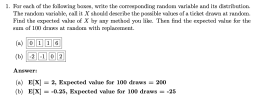
1. For each of the following boxes, write the corresponding random variable and its distribution. The random variable, call it X should describe the possible values of a ticket drawn at random. Find the expected value of X by any method you like. Then find the expected value for the sum of 100 draws at random with replacement (a) 011 6 (b) -2-1 0 2 Answer (a) E[X]= 2, Expected value for 100 draws (b)...
Help step by step please
1. For each of the following boxes, write the corresponding random variable and its distribution. The random variable, call it X should describe the possible values of a ticket drawn at random. Find the expected value of X by any method you like. Then find the expected value for the sum of 100 draws at random with replacement (a) 011 6 (b) -2-1 0 2 Answer (a) E[X]= 2, Expected value for 100 draws (b)...
Determine whether the random variable is discrete or continuous. In each case, state the possible values of the random variable.
Determine whether the random variable is discrete or continuous. In each case, state the possible values of the random variable. (a) The number of points scored during a basketball game. (b) The amount of rain in City B during April. (a) Is the number of points scored during a basketball game discrete or continuous? A. The random variable is discrete. The possible values are x≥0. B. The random variable is continuous. The possible values are x =0, 1, 2..... C. The random variable is discrete. The...
I will rate asap. Thx Problem 1. Let X be a geometric(1/3) random variable that is...
 I will rate asap. Thx
Problem 1. Let X be a geometric(1/3) random variable that is independent of Y which is Poisson(4). A rectangle is drawn with side lengths X and Y +1. Find the expected values of the perimeter and the area of the rectangle
I will rate asap. Thx
Problem 1. Let X be a geometric(1/3) random variable that is independent of Y which is Poisson(4). A rectangle is drawn with side lengths X and Y +1. Find the expected values of the perimeter and the area of the rectangle
 Directions: Each problem below describes an experiment and defines a random variable. For each problem: (a) Find the distribution of the random variable (and provide it as a chart) (b) Calculate the expected value of the random variable Do not round values.
 For the experiment described below, let x determine a random variable, and use your knowledge of probability to prepare a probability distribution. Four cards are drawn (with replacement) and the number of black cards is noted. A probability distribution for the given experiment is as follows. х 0 1 2 3 4 1 16 P(x) 16 4 8
 Question B2 (a) The table below shows the discrete probability distribution of a random variable X: X P(X) 1 0. 2 7 18 W Tk 25 0.1 Suppose u = 12. Find the values of w and k. Hence, find the variance. (5 marks) (b) Suppose 15 students in a class are to be assigned randomly into 5 groups for group presentation. Each group contains 3 students. In how many different ways can these groups be formed? (3 marks) Suppose...
 ASAP
Exercise 6. This problem describes an experiment in which conditional probabilities are used to compute "proper" probability. The experiment starts with two urns, Urn #1 contains 5 white marbles and 2 black marbles. Urn #2 contains 7 white marbles and 3 black marbles. One marble from each urn is drawn at random. (For each urn, the chance of each marble being drawn is the same.) Let T be the event that the two marbles are the same color. Let...
ASAP
Exercise 6. This problem describes an experiment in which conditional probabilities are used to compute "proper" probability. The experiment starts with two urns, Urn #1 contains 5 white marbles and 2 black marbles. Urn #2 contains 7 white marbles and 3 black marbles. One marble from each urn is drawn at random. (For each urn, the chance of each marble being drawn is the same.) Let T be the event that the two marbles are the same color. Let...
 PROBLEM: Marbles in a Box Suppose there are 17 marbles in a box. There are 5 blue marbles, 4 yellow marbles, 3 red marbles, and 5 green marbles. The experiment is selecting 2 marbles randomly from the box, without replacement. Let x be the number of blue marbles. Note: The picture shown is an example of marbles in the box. The number of marbles and their color code does not reflect to this problem (a) Determine whether the experiment is...
 1. Determine whether or not the random variable X is a binomial randon variable. If so give the values of n and p. If not, explain why not. a. X is the number of dots on the top face of fair die that is rolled. b. X is the number of hearts in a five-card hand drawn (without replacement) from a well-shuffled ordinary deck c. X is the number of defective parts in a sample of ten randomly selected parts...
 Help step by step please
1. For each of the following boxes, write the corresponding random variable and its distribution. The random variable, call it X should describe the possible values of a ticket drawn at random. Find the expected value of X by any method you like. Then find the expected value for the sum of 100 draws at random with replacement (a) 011 6 (b) -2-1 0 2 Answer (a) E[X]= 2, Expected value for 100 draws (b)...
Help step by step please
1. For each of the following boxes, write the corresponding random variable and its distribution. The random variable, call it X should describe the possible values of a ticket drawn at random. Find the expected value of X by any method you like. Then find the expected value for the sum of 100 draws at random with replacement (a) 011 6 (b) -2-1 0 2 Answer (a) E[X]= 2, Expected value for 100 draws (b)...
 I will rate asap. Thx
Problem 1. Let X be a geometric(1/3) random variable that is independent of Y which is Poisson(4). A rectangle is drawn with side lengths X and Y +1. Find the expected values of the perimeter and the area of the rectangle
I will rate asap. Thx
Problem 1. Let X be a geometric(1/3) random variable that is independent of Y which is Poisson(4). A rectangle is drawn with side lengths X and Y +1. Find the expected values of the perimeter and the area of the rectangle
Most questions answered within 3 hours.
-
Where is the error in this code sequence?
String s1 = "Hello";
String s2 = "ello";...
asked 11 months ago -
Financial data for Joel de Paris, Inc., for last year
follow:
Joel de Paris, Inc.
Balance...
asked 11 months ago -
Consider this reaction:
Al2(SO4)3 (aq)+ BaCl3
(aq) Al2Cl6 (aq)- +
3BaSO4(s) . What is the...
asked 11 months ago -
Suppose that Savneet is considering increasing her
recent random sample from 20 car rentals to 40...
asked 11 months ago -
Trucks arrive at an unloading terminal at an average rate of 120
per hour.
Trucks arrive...
asked 11 months ago -
Why are methanol and ethanol completely soluble in water while
octanol is not very little soluble....
asked 11 months ago -
A facilities manager at a university reads in a research report
that the mean amount of...
asked 11 months ago -
When the CuSO4 is rehydrated by adding water to the anhydrous
compound, is this an endothermic...
asked 11 months ago -
A ray of sunlight is passing from diamond into crown glass; the
angle of incidence is...
asked 11 months ago -
A block of mass 0.249 kg is placed on top of a light, vertical
spring of...
asked 11 months ago -
how do the kidneys compensate in the presences of acidosis
a) trigger hyperventilate
b) reserve acid...
asked 11 months ago -
Question 501 pts
The rental rate of capital to the firm increases. Which of the
following...
asked 11 months ago