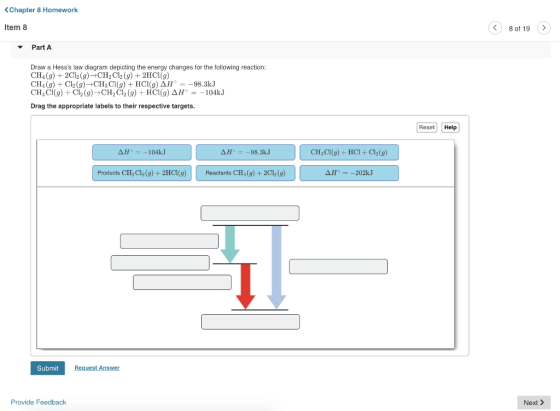
Hi, I have problem solving this...
Homework Answers
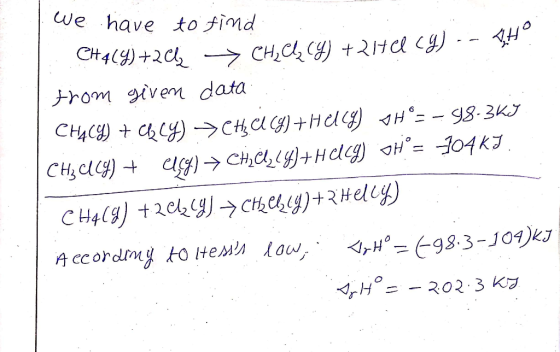
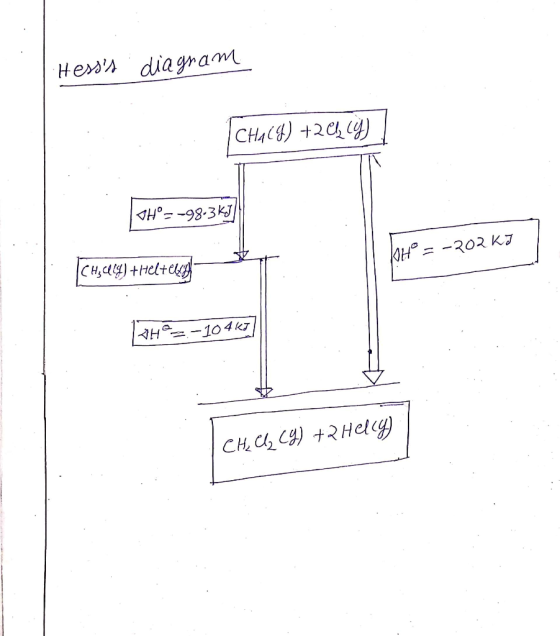
According to the Hess's law : For a chemical reaction , the net heat change (∆H ) will be same same weather the reaction occurs in one step or several steps .
Let a reaction when occurs in one step
A -----> C ∆H = ∆H1
But when the same reaction occurs in two steps
A -------> B ∆H = ∆H2
B ------> C ∆H = ∆H3
Then according to the Hess's law
∆H1 = ∆H2 + ∆H3
Add Answer to:
Hi, I have problem solving this...
<Chapter 8 Homework Item 8 8 of 19 Part A...
6-8 Using the table below, calculate the AH rxn for each of the following equations. Selected...
 6-8 Using the table below, calculate the AH rxn for each of the following equations. Selected Standard Enthalpies of Formation at 25° C (298K) AH (kJ/mol) (kJ/mol Formula AH 0 Silver 92.3 Agis) AgC(3) 0 1270 218 Formula AH (kJ/mol Formula Calcium Ca(s) CI (9) Ca(s) 635.1 HC (G) Caco (s)-1206.9 Hydrogen Hig) Carbon C(graphite) 0 H (9) C(diamond) 1.9 Nitrogen COL) -1105 N19) CO(g) -393.5 NH,(g CH_(9) 74.9 NO(9) CH,OHI) -238.6 Oxygen HỎNG) 133 O.) CS.) 87.9 O (9)...
I hope the answer is clear and correct thanks Question 1 (1 point) What is the...
 I hope the answer is clear and correct thanks
Question 1 (1 point) What is the change in enthalpy (in kJ mol'?) for the following reaction F2(g) + Cabr,(s) CaF() + Brz(1) O 1) -112 kJmo12 O2) 504 kJmo11 03) -504 kJmol 1 04) 537 kJmo11 O 5) -537 kJmol'i Question 2 (1 point) What is true about the following reaction at 25°C? F,(g) + 2HCl(g) 2 2017(g) + H (9) Ahrº=76 kJ mol'i Asr°=-10.13 J mol'i Ki Agrº=79 kJ...
I hope the answer is clear and correct thanks
Question 1 (1 point) What is the change in enthalpy (in kJ mol'?) for the following reaction F2(g) + Cabr,(s) CaF() + Brz(1) O 1) -112 kJmo12 O2) 504 kJmo11 03) -504 kJmol 1 04) 537 kJmo11 O 5) -537 kJmol'i Question 2 (1 point) What is true about the following reaction at 25°C? F,(g) + 2HCl(g) 2 2017(g) + H (9) Ahrº=76 kJ mol'i Asr°=-10.13 J mol'i Ki Agrº=79 kJ...
D18 Kinetics Review Sheets 8 H*(aq) + 4 Cl(aq) + MnO4 (aq) - 2 Cl(g) +...
 D18 Kinetics Review Sheets 8 H*(aq) + 4 Cl(aq) + MnO4 (aq) - 2 Cl(g) + Mn(aq) + 4H2O(l) 1. Cl2 (9) can be generated in the laboratory by reacting potassium permanganate with an acidified solution of sodium chloride. The net-ionic equation for the reaction is given above. a. A 25.00 mL sample of 0.250 M NaCl reacts completely with excess KMnO.(aq). The Cl(a) produced is dried and stored in a sealed container. At 22°C the pressure of the Cl2(g)...
ALEKS Chemistry O ENTROPY AND FREE ENERGY Calculating reaction free energy under nonstandard conditions A chemist...
 ALEKS Chemistry O ENTROPY AND FREE ENERGY Calculating reaction free energy under nonstandard conditions A chemist fills a reaction vessel with 0.546 atm nitrogen monoxide (NO) gas, 1.48 atm chlorine (CI) gas, and 4.56 atm nitrosyl chloride (NOCI) gas at a temperature of 25.0°C. Under these conditions, calculate the reaction free energy AG for the following chemical reaction: 2NO(g) +C12(e) - 2NOCI(8) Use the thermodynamic information in the ALEKS Data tab. Round your answer to the nearest kilojoule. х 5...
 6-8 Using the table below, calculate the AH rxn for each of the following equations. Selected Standard Enthalpies of Formation at 25° C (298K) AH (kJ/mol) (kJ/mol Formula AH 0 Silver 92.3 Agis) AgC(3) 0 1270 218 Formula AH (kJ/mol Formula Calcium Ca(s) CI (9) Ca(s) 635.1 HC (G) Caco (s)-1206.9 Hydrogen Hig) Carbon C(graphite) 0 H (9) C(diamond) 1.9 Nitrogen COL) -1105 N19) CO(g) -393.5 NH,(g CH_(9) 74.9 NO(9) CH,OHI) -238.6 Oxygen HỎNG) 133 O.) CS.) 87.9 O (9)...
 I hope the answer is clear and correct thanks
Question 1 (1 point) What is the change in enthalpy (in kJ mol'?) for the following reaction F2(g) + Cabr,(s) CaF() + Brz(1) O 1) -112 kJmo12 O2) 504 kJmo11 03) -504 kJmol 1 04) 537 kJmo11 O 5) -537 kJmol'i Question 2 (1 point) What is true about the following reaction at 25°C? F,(g) + 2HCl(g) 2 2017(g) + H (9) Ahrº=76 kJ mol'i Asr°=-10.13 J mol'i Ki Agrº=79 kJ...
I hope the answer is clear and correct thanks
Question 1 (1 point) What is the change in enthalpy (in kJ mol'?) for the following reaction F2(g) + Cabr,(s) CaF() + Brz(1) O 1) -112 kJmo12 O2) 504 kJmo11 03) -504 kJmol 1 04) 537 kJmo11 O 5) -537 kJmol'i Question 2 (1 point) What is true about the following reaction at 25°C? F,(g) + 2HCl(g) 2 2017(g) + H (9) Ahrº=76 kJ mol'i Asr°=-10.13 J mol'i Ki Agrº=79 kJ...
 D18 Kinetics Review Sheets 8 H*(aq) + 4 Cl(aq) + MnO4 (aq) - 2 Cl(g) + Mn(aq) + 4H2O(l) 1. Cl2 (9) can be generated in the laboratory by reacting potassium permanganate with an acidified solution of sodium chloride. The net-ionic equation for the reaction is given above. a. A 25.00 mL sample of 0.250 M NaCl reacts completely with excess KMnO.(aq). The Cl(a) produced is dried and stored in a sealed container. At 22°C the pressure of the Cl2(g)...
 ALEKS Chemistry O ENTROPY AND FREE ENERGY Calculating reaction free energy under nonstandard conditions A chemist fills a reaction vessel with 0.546 atm nitrogen monoxide (NO) gas, 1.48 atm chlorine (CI) gas, and 4.56 atm nitrosyl chloride (NOCI) gas at a temperature of 25.0°C. Under these conditions, calculate the reaction free energy AG for the following chemical reaction: 2NO(g) +C12(e) - 2NOCI(8) Use the thermodynamic information in the ALEKS Data tab. Round your answer to the nearest kilojoule. х 5...
Most questions answered within 3 hours.
-
Where is the error in this code sequence?
String s1 = "Hello";
String s2 = "ello";...
asked 11 months ago -
Financial data for Joel de Paris, Inc., for last year
follow:
Joel de Paris, Inc.
Balance...
asked 11 months ago -
Consider this reaction:
Al2(SO4)3 (aq)+ BaCl3
(aq) Al2Cl6 (aq)- +
3BaSO4(s) . What is the...
asked 11 months ago -
Suppose that Savneet is considering increasing her
recent random sample from 20 car rentals to 40...
asked 11 months ago -
Trucks arrive at an unloading terminal at an average rate of 120
per hour.
Trucks arrive...
asked 11 months ago -
Why are methanol and ethanol completely soluble in water while
octanol is not very little soluble....
asked 11 months ago -
A facilities manager at a university reads in a research report
that the mean amount of...
asked 11 months ago -
When the CuSO4 is rehydrated by adding water to the anhydrous
compound, is this an endothermic...
asked 11 months ago -
A ray of sunlight is passing from diamond into crown glass; the
angle of incidence is...
asked 11 months ago -
A block of mass 0.249 kg is placed on top of a light, vertical
spring of...
asked 11 months ago -
how do the kidneys compensate in the presences of acidosis
a) trigger hyperventilate
b) reserve acid...
asked 11 months ago -
Question 501 pts
The rental rate of capital to the firm increases. Which of the
following...
asked 11 months ago