Hi
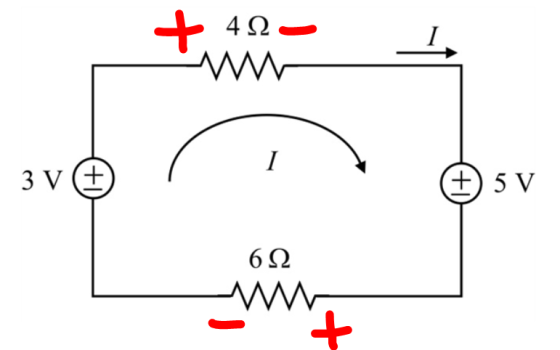
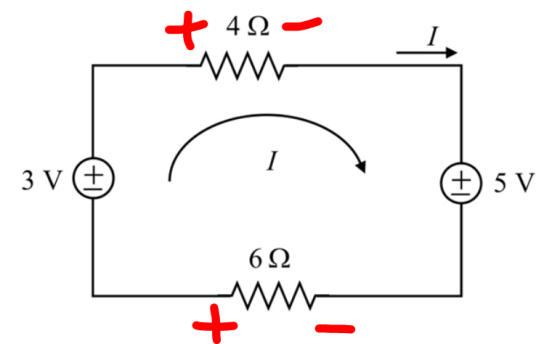
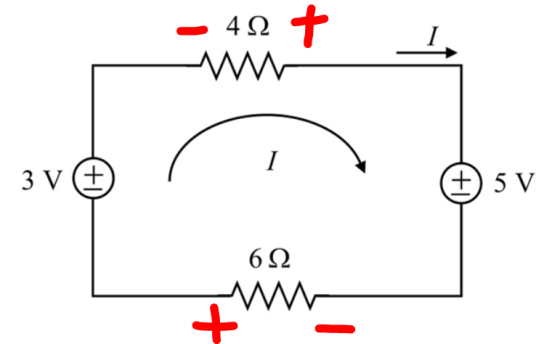
is there a practical way to determine the sign of any resistor in any circuit?
see pic 1, 2, and 3. which one of them is the correct way to apply KVL?
Homework Answers


Add Answer to:
Hi
is there a practical way to determine the sign of any resistor
in any circuit?...
a. A circuit is formed by connecting a resistor between the terminals of an ideal battery...
a. A circuit is formed by connecting a resistor between the terminals of an ideal battery of 6 volts. The battery has no internal resistance. Which two statements are correct when 1 C of charge flow around the complete circuit. 1. 6 V is the potential difference across the resistor. 2. 1 A of current flows through the resistor. 3. 6 J of thermal energy is dissipated in the resistor. 4. The resistor had a resistance of 6 ohms. b....
For the circuit below, determine the MAGNITUDE of the CURRENT passing through each resistor. V1 =...
 For the circuit below, determine the MAGNITUDE of the
CURRENT passing through each resistor. V1 = 7 V,
V2 = 12 V, V3 = 4 V, R1 = 19 Ω,
R2 = 3 Ω, R3 = 6 Ω.
For the circuit below, determine the MAGNITUDE of the CURRENT passing through each resistor. V1-7 V, V2 = 12 V, V3 = 4 V, R1 = 19 Ω, R2-3 Ω, R3 = 6 Ω. R1 V I3-
For the circuit below, determine the MAGNITUDE of the
CURRENT passing through each resistor. V1 = 7 V,
V2 = 12 V, V3 = 4 V, R1 = 19 Ω,
R2 = 3 Ω, R3 = 6 Ω.
For the circuit below, determine the MAGNITUDE of the CURRENT passing through each resistor. V1-7 V, V2 = 12 V, V3 = 4 V, R1 = 19 Ω, R2-3 Ω, R3 = 6 Ω. R1 V I3-
Procedure Load Multisim Live in a web browser and sign in. Create a new circuit. a....
 Procedure Load Multisim Live in a web browser and sign in. Create a new circuit. a. Place the components and wire up the circuit shown in Figure 1 b. D1 D2 R1 V1 2k9 10V Figure 1 Set the simulation mode to "DC Op". Simulate the circuit and determine the following values C. (1) Voltage at node 2: V= (2) Voltage at node 3: V3 Total current (3) Change the resistor value to 50. Answer the following questions. d. (4)...
please solve them all 2) For the circuit shown in Figure 1. Find the following: A....
 please solve them all
2) For the circuit shown in Figure 1. Find the following: A. How many independent loops are present in the circuit? B. How many nodes are present in the circuit? C. Write a KVL equation at every independent loop (mesh) in the circuit in terms of the indicated voltage and current variables. D. Write a KCL equation at every node in the circuit. Write those equations using the indicated voltage variables by incorporating Ohm's Law for...
please solve them all
2) For the circuit shown in Figure 1. Find the following: A. How many independent loops are present in the circuit? B. How many nodes are present in the circuit? C. Write a KVL equation at every independent loop (mesh) in the circuit in terms of the indicated voltage and current variables. D. Write a KCL equation at every node in the circuit. Write those equations using the indicated voltage variables by incorporating Ohm's Law for...
Using the Nodal method, determine V, i.e., the voltage across the 3-2 resistor in the circuit...
 Using the Nodal method, determine V, i.e., the voltage across the 3-2 resistor in the circuit of Figure 1. (15 points) 1. (Note: This problem is required to be solved with the Nodal method.) + 3 0 V 20 5 A Figure 1
The placement of resistors in a circuit is one factor that can determine the current passing through the resistor.
 The placement of resistors in a circuit is one factor that can determine the current passing through the resistor. You will be given three circuits, and for each circuit you will be asked to compare the current through the various resistors.Click on the link to see the figure.Rank the resistors in the figure below (A to C) on the basis of the current that flows through them. Rank from largest to smallest. To rank items as equivalent, overlap them.
- Determine the current through the 2-2 resistor, i.e., 1, in the circuit of Figure 2....
 - Determine the current through the 2-2 resistor, i.e., 1, in the circuit of Figure 2. points) 6 0 60 12 V (t 18 V( 20 Figure 2 -ver:
Circuits For the circuit below, determine the MAGNITUDE of the CURRENT passing through each resistor. V1...
 Circuits
For the circuit below, determine the MAGNITUDE of the CURRENT passing through each resistor. V1 = 6 V, V2 = 18 V, V3 = 3 V, R1 = 1 ?, R2 = 16 ?, R3 = 10 ?. R1 V 11 = 3A I21.5A 13 = 1.5A ½Az V3 R3
Circuits
For the circuit below, determine the MAGNITUDE of the CURRENT passing through each resistor. V1 = 6 V, V2 = 18 V, V3 = 3 V, R1 = 1 ?, R2 = 16 ?, R3 = 10 ?. R1 V 11 = 3A I21.5A 13 = 1.5A ½Az V3 R3
Question 1 In the circuit shown below, determine the magnitude and direction of current flow through...
 Question 1 In the circuit shown below, determine the magnitude and direction of current flow through each resistor using KVL and KCL. [5 points]. If point A is grounded, what is the potential at point B? [1 point] If a shorting wire is connected between A and B, what power is dissipated in the 5 12 resistor? [2 points] 223 5v 322 1.5V 322
please do all parts of both questions thanks 5. (10 points) For the circuit shown in...
 please do all parts of both questions thanks
5. (10 points) For the circuit shown in Figure 2, compute the voltage across the load terminals. *Tip: use KVL 0.19 0.52 1 = 60/A 120/0° v VLOND LOAD Figure 2. Circuit for problem 5. 6. (15 points) A 60-Hz, single-phase source with V = 277230°volts is applied to a circuit element (a) Determine the instantaneous source voltage (b) Also determine the phasor and instantaneous currents entering the positive terminal if the...
please do all parts of both questions thanks
5. (10 points) For the circuit shown in Figure 2, compute the voltage across the load terminals. *Tip: use KVL 0.19 0.52 1 = 60/A 120/0° v VLOND LOAD Figure 2. Circuit for problem 5. 6. (15 points) A 60-Hz, single-phase source with V = 277230°volts is applied to a circuit element (a) Determine the instantaneous source voltage (b) Also determine the phasor and instantaneous currents entering the positive terminal if the...
 For the circuit below, determine the MAGNITUDE of the
CURRENT passing through each resistor. V1 = 7 V,
V2 = 12 V, V3 = 4 V, R1 = 19 Ω,
R2 = 3 Ω, R3 = 6 Ω.
For the circuit below, determine the MAGNITUDE of the CURRENT passing through each resistor. V1-7 V, V2 = 12 V, V3 = 4 V, R1 = 19 Ω, R2-3 Ω, R3 = 6 Ω. R1 V I3-
For the circuit below, determine the MAGNITUDE of the
CURRENT passing through each resistor. V1 = 7 V,
V2 = 12 V, V3 = 4 V, R1 = 19 Ω,
R2 = 3 Ω, R3 = 6 Ω.
For the circuit below, determine the MAGNITUDE of the CURRENT passing through each resistor. V1-7 V, V2 = 12 V, V3 = 4 V, R1 = 19 Ω, R2-3 Ω, R3 = 6 Ω. R1 V I3-
 Procedure Load Multisim Live in a web browser and sign in. Create a new circuit. a. Place the components and wire up the circuit shown in Figure 1 b. D1 D2 R1 V1 2k9 10V Figure 1 Set the simulation mode to "DC Op". Simulate the circuit and determine the following values C. (1) Voltage at node 2: V= (2) Voltage at node 3: V3 Total current (3) Change the resistor value to 50. Answer the following questions. d. (4)...
 please solve them all
2) For the circuit shown in Figure 1. Find the following: A. How many independent loops are present in the circuit? B. How many nodes are present in the circuit? C. Write a KVL equation at every independent loop (mesh) in the circuit in terms of the indicated voltage and current variables. D. Write a KCL equation at every node in the circuit. Write those equations using the indicated voltage variables by incorporating Ohm's Law for...
please solve them all
2) For the circuit shown in Figure 1. Find the following: A. How many independent loops are present in the circuit? B. How many nodes are present in the circuit? C. Write a KVL equation at every independent loop (mesh) in the circuit in terms of the indicated voltage and current variables. D. Write a KCL equation at every node in the circuit. Write those equations using the indicated voltage variables by incorporating Ohm's Law for...
 Using the Nodal method, determine V, i.e., the voltage across the 3-2 resistor in the circuit of Figure 1. (15 points) 1. (Note: This problem is required to be solved with the Nodal method.) + 3 0 V 20 5 A Figure 1
 - Determine the current through the 2-2 resistor, i.e., 1, in the circuit of Figure 2. points) 6 0 60 12 V (t 18 V( 20 Figure 2 -ver:
 Circuits
For the circuit below, determine the MAGNITUDE of the CURRENT passing through each resistor. V1 = 6 V, V2 = 18 V, V3 = 3 V, R1 = 1 ?, R2 = 16 ?, R3 = 10 ?. R1 V 11 = 3A I21.5A 13 = 1.5A ½Az V3 R3
Circuits
For the circuit below, determine the MAGNITUDE of the CURRENT passing through each resistor. V1 = 6 V, V2 = 18 V, V3 = 3 V, R1 = 1 ?, R2 = 16 ?, R3 = 10 ?. R1 V 11 = 3A I21.5A 13 = 1.5A ½Az V3 R3
 Question 1 In the circuit shown below, determine the magnitude and direction of current flow through each resistor using KVL and KCL. [5 points]. If point A is grounded, what is the potential at point B? [1 point] If a shorting wire is connected between A and B, what power is dissipated in the 5 12 resistor? [2 points] 223 5v 322 1.5V 322
 please do all parts of both questions thanks
5. (10 points) For the circuit shown in Figure 2, compute the voltage across the load terminals. *Tip: use KVL 0.19 0.52 1 = 60/A 120/0° v VLOND LOAD Figure 2. Circuit for problem 5. 6. (15 points) A 60-Hz, single-phase source with V = 277230°volts is applied to a circuit element (a) Determine the instantaneous source voltage (b) Also determine the phasor and instantaneous currents entering the positive terminal if the...
please do all parts of both questions thanks
5. (10 points) For the circuit shown in Figure 2, compute the voltage across the load terminals. *Tip: use KVL 0.19 0.52 1 = 60/A 120/0° v VLOND LOAD Figure 2. Circuit for problem 5. 6. (15 points) A 60-Hz, single-phase source with V = 277230°volts is applied to a circuit element (a) Determine the instantaneous source voltage (b) Also determine the phasor and instantaneous currents entering the positive terminal if the...
Most questions answered within 3 hours.
-
Where is the error in this code sequence?
String s1 = "Hello";
String s2 = "ello";...
asked 10 months ago -
Financial data for Joel de Paris, Inc., for last year
follow:
Joel de Paris, Inc.
Balance...
asked 10 months ago -
Consider this reaction:
Al2(SO4)3 (aq)+ BaCl3
(aq) Al2Cl6 (aq)- +
3BaSO4(s) . What is the...
asked 10 months ago -
Suppose that Savneet is considering increasing her
recent random sample from 20 car rentals to 40...
asked 10 months ago -
Trucks arrive at an unloading terminal at an average rate of 120
per hour.
Trucks arrive...
asked 10 months ago -
Why are methanol and ethanol completely soluble in water while
octanol is not very little soluble....
asked 10 months ago -
A facilities manager at a university reads in a research report
that the mean amount of...
asked 10 months ago -
When the CuSO4 is rehydrated by adding water to the anhydrous
compound, is this an endothermic...
asked 10 months ago -
A ray of sunlight is passing from diamond into crown glass; the
angle of incidence is...
asked 10 months ago -
A block of mass 0.249 kg is placed on top of a light, vertical
spring of...
asked 10 months ago -
how do the kidneys compensate in the presences of acidosis
a) trigger hyperventilate
b) reserve acid...
asked 10 months ago -
Question 501 pts
The rental rate of capital to the firm increases. Which of the
following...
asked 10 months ago