
Homework Answers

Add Answer to:
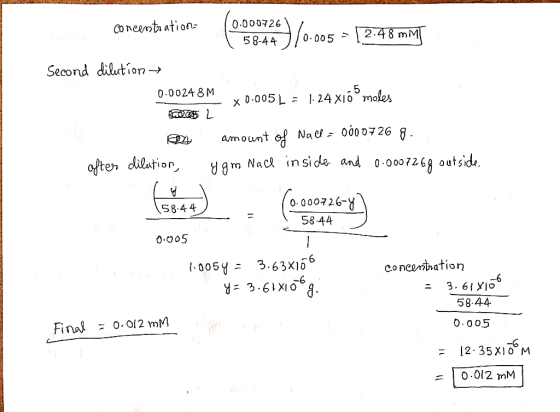
You have a 5.0 ml sample of a protein in 0.5M NaCI. You place the protein/salt...
7) (2 points) if we place one dialysis bag (permeable to water but not permeable to...
 7) (2 points) if we place one dialysis bag (permeable to water but not permeable to Naci) filled with 10% Nach into a beaker of distilled water and wait 2 hours what is the expected result? Explain what would happen to the weight of the bag (you do not need to have specific numbers, just trends). Explain why it happened.
yellow, green or red, the test is positive. The color of the solution depends on the...
 yellow, green or red, the test is positive. The color of the solution depends on the concentration of 3. Observe the color of your negative and positive controls. Note which one has a red color. 4 After the dialysis of the NaCi-elucose-red dye solution has progressed for an hour, test the water outside the dialysis bag (your experimental data) for the presence of Ci and glucose same way you did for your controls in steps 1 and 2. Observe if...
Experiment 2: Diffusion Concentration Gradients and Membrane Permeability Data Tables Table 2: Indicator Reagent Data Indicator...
 Experiment 2: Diffusion Concentration Gradients and Membrane
Permeability
Data Tables
Table 2: Indicator Reagent Data
Indicator
Starch Positive
Starch Negative
Glucose Positive
Glucose Negative
Glucose Test Strip
n/a
n/a
green
yellow
IKI Solution
dark blue
light brown
n/a
n/a
Table 3: Diffusion of Starch and Glucose Over
Time
Indicator
Dialysis Bag After 60 Minutes
Beaker Water After 60 Minutes
Glucose Test Strip
yellow
green ( if all glucose passed to the beaker from the bag)
IKI
from incolore changed to...
Experiment 2: Diffusion Concentration Gradients and Membrane
Permeability
Data Tables
Table 2: Indicator Reagent Data
Indicator
Starch Positive
Starch Negative
Glucose Positive
Glucose Negative
Glucose Test Strip
n/a
n/a
green
yellow
IKI Solution
dark blue
light brown
n/a
n/a
Table 3: Diffusion of Starch and Glucose Over
Time
Indicator
Dialysis Bag After 60 Minutes
Beaker Water After 60 Minutes
Glucose Test Strip
yellow
green ( if all glucose passed to the beaker from the bag)
IKI
from incolore changed to...
30. How many Tablespoons of table salt (NaCI) would you need to add to 2 quarts...
 30. How many Tablespoons of table salt (NaCI) would you need to add to 2 quarts of water to increase the boiling point by 5°C? (1 Tablespoon NaCl = 17.06 g; 1 quart-0.946 L; d(H2O) 1.0 g/mL) (a) 17 (b) 32 (c) 79 (d) 540 31 . A covalent compound with molar mass of 62.0 g/mol was dissolved in water at 20.0°C to yield a 2.00 L solution with an osmotic pressure of 524 torr. What mass of the compound...
CRITICAL THINKING QUESTIONS 1. A pre-weighed dialysis bag which contained a solution of 10% glucose was...
 CRITICAL THINKING QUESTIONS 1. A pre-weighed dialysis bag which contained a solution of 10% glucose was placed in a beaker containing a solution of 20% glucose. After one hour, the bag was weighed again a. Calculate the % mass change of this dialysis bag from the following information: • Mass of bag before experiment: 15.39 • Mass of bag after experiment: 12.79 b. Determine the tonicity of the beaker when it is compared to the dialysis bag: 2. facell had...
Biochem help 2 14. What would be the net charge on the dipeptide Ser-His at pH-...
 Biochem help 2
14. What would be the net charge on the dipeptide Ser-His at pH- 6.04? (Choose the one best answer.) a) 1.5 b) +1; c) +0.5 d) 0 e) -0.5; 15. The pKa of a lysine side chain in a protein ending up on the outside of a globular protein has a different pKa than if the lysine is buried within the interior of a protein. What would be the expected pKa of a side chain of lysine...
Biochem help 2
14. What would be the net charge on the dipeptide Ser-His at pH- 6.04? (Choose the one best answer.) a) 1.5 b) +1; c) +0.5 d) 0 e) -0.5; 15. The pKa of a lysine side chain in a protein ending up on the outside of a globular protein has a different pKa than if the lysine is buried within the interior of a protein. What would be the expected pKa of a side chain of lysine...
You have a water sample from a creek that is thought to contain some amount of...
You have a water sample from a creek that is thought to contain some amount of dissolved copper ions. It has no apparent blue color. You set up standards of varying known concentrations of Cu2+, mix 0ml of each into 1.0 ml 10 g/L glucose + 1.0 ml of BCA solution, let them all sit long enough to reach equilibrium (some heat helps them get there faster), and you find these results: Cu2+(mg/L) Absorbance at 562nm 0.0 0.000 2.0 0.150 4.0...
EQUL 499- Det. Of pH of Strong Acid, weak acid, salt, and buffer solution Discussion Topics...
 EQUL 499- Det. Of pH of Strong Acid, weak acid, salt, and buffer solution Discussion Topics Discussion Topics (need to submit in Blackboard): 1. What is a buffer? • A buffer is a solution that, when introduced to a new environment, undergoes minimal pH change, typically when adding acidic or basic solutions. These are extremely important for life because the pH of human blood is delicate and even if it is changed by 0.1, there may be catastrophic effects. 2....
1. Calculate the molarity of the following solutions: a. 318 g Mg Br, in 859 ml...
 1. Calculate the molarity of the following solutions: a. 318 g Mg Br, in 859 ml solution b. 8.28 g Ca(C,H,O,), in 414 ml solution c. 31,1 g Al,(80.), in 766 ml solution d. 59.8 g CaCl, in 100 ml solution e. 313.5 g LICIO, in 250 ml solution | 849 Calculate the moles of solute needed to prepare each of the following: 2. LOL of a 3.0 M NaCl solution b. 0.40 L of a 1.0 M KBr solution...
Experiment 17A. A Solubility Product Constant Procedure Getting Started 1. Obtain a 10 ml pipet, ...
 question#1
Experiment 17A. A Solubility Product Constant Procedure Getting Started 1. Obtain a 10 ml pipet, a 50 mL buret, and 2 pieces of 120 cm filter paper Preparing Saturated Solutions of M10J MIO), is an insoluble divalent iodate salt. The identity of the cation M-is unknown. 1 Prepare MIO,), by adding S0 ml of o.2 M KIO, to 20 mL of 1 Molar M(NO,J, in a 150 mt 2. Stir the mixture vigorously with a stirring rod. A white,...
question#1
Experiment 17A. A Solubility Product Constant Procedure Getting Started 1. Obtain a 10 ml pipet, a 50 mL buret, and 2 pieces of 120 cm filter paper Preparing Saturated Solutions of M10J MIO), is an insoluble divalent iodate salt. The identity of the cation M-is unknown. 1 Prepare MIO,), by adding S0 ml of o.2 M KIO, to 20 mL of 1 Molar M(NO,J, in a 150 mt 2. Stir the mixture vigorously with a stirring rod. A white,...
 7) (2 points) if we place one dialysis bag (permeable to water but not permeable to Naci) filled with 10% Nach into a beaker of distilled water and wait 2 hours what is the expected result? Explain what would happen to the weight of the bag (you do not need to have specific numbers, just trends). Explain why it happened.
 yellow, green or red, the test is positive. The color of the solution depends on the concentration of 3. Observe the color of your negative and positive controls. Note which one has a red color. 4 After the dialysis of the NaCi-elucose-red dye solution has progressed for an hour, test the water outside the dialysis bag (your experimental data) for the presence of Ci and glucose same way you did for your controls in steps 1 and 2. Observe if...
 Experiment 2: Diffusion Concentration Gradients and Membrane
Permeability
Data Tables
Table 2: Indicator Reagent Data
Indicator
Starch Positive
Starch Negative
Glucose Positive
Glucose Negative
Glucose Test Strip
n/a
n/a
green
yellow
IKI Solution
dark blue
light brown
n/a
n/a
Table 3: Diffusion of Starch and Glucose Over
Time
Indicator
Dialysis Bag After 60 Minutes
Beaker Water After 60 Minutes
Glucose Test Strip
yellow
green ( if all glucose passed to the beaker from the bag)
IKI
from incolore changed to...
Experiment 2: Diffusion Concentration Gradients and Membrane
Permeability
Data Tables
Table 2: Indicator Reagent Data
Indicator
Starch Positive
Starch Negative
Glucose Positive
Glucose Negative
Glucose Test Strip
n/a
n/a
green
yellow
IKI Solution
dark blue
light brown
n/a
n/a
Table 3: Diffusion of Starch and Glucose Over
Time
Indicator
Dialysis Bag After 60 Minutes
Beaker Water After 60 Minutes
Glucose Test Strip
yellow
green ( if all glucose passed to the beaker from the bag)
IKI
from incolore changed to...
 30. How many Tablespoons of table salt (NaCI) would you need to add to 2 quarts of water to increase the boiling point by 5°C? (1 Tablespoon NaCl = 17.06 g; 1 quart-0.946 L; d(H2O) 1.0 g/mL) (a) 17 (b) 32 (c) 79 (d) 540 31 . A covalent compound with molar mass of 62.0 g/mol was dissolved in water at 20.0°C to yield a 2.00 L solution with an osmotic pressure of 524 torr. What mass of the compound...
 CRITICAL THINKING QUESTIONS 1. A pre-weighed dialysis bag which contained a solution of 10% glucose was placed in a beaker containing a solution of 20% glucose. After one hour, the bag was weighed again a. Calculate the % mass change of this dialysis bag from the following information: • Mass of bag before experiment: 15.39 • Mass of bag after experiment: 12.79 b. Determine the tonicity of the beaker when it is compared to the dialysis bag: 2. facell had...
 Biochem help 2
14. What would be the net charge on the dipeptide Ser-His at pH- 6.04? (Choose the one best answer.) a) 1.5 b) +1; c) +0.5 d) 0 e) -0.5; 15. The pKa of a lysine side chain in a protein ending up on the outside of a globular protein has a different pKa than if the lysine is buried within the interior of a protein. What would be the expected pKa of a side chain of lysine...
Biochem help 2
14. What would be the net charge on the dipeptide Ser-His at pH- 6.04? (Choose the one best answer.) a) 1.5 b) +1; c) +0.5 d) 0 e) -0.5; 15. The pKa of a lysine side chain in a protein ending up on the outside of a globular protein has a different pKa than if the lysine is buried within the interior of a protein. What would be the expected pKa of a side chain of lysine...
 EQUL 499- Det. Of pH of Strong Acid, weak acid, salt, and buffer solution Discussion Topics Discussion Topics (need to submit in Blackboard): 1. What is a buffer? • A buffer is a solution that, when introduced to a new environment, undergoes minimal pH change, typically when adding acidic or basic solutions. These are extremely important for life because the pH of human blood is delicate and even if it is changed by 0.1, there may be catastrophic effects. 2....
 1. Calculate the molarity of the following solutions: a. 318 g Mg Br, in 859 ml solution b. 8.28 g Ca(C,H,O,), in 414 ml solution c. 31,1 g Al,(80.), in 766 ml solution d. 59.8 g CaCl, in 100 ml solution e. 313.5 g LICIO, in 250 ml solution | 849 Calculate the moles of solute needed to prepare each of the following: 2. LOL of a 3.0 M NaCl solution b. 0.40 L of a 1.0 M KBr solution...
 question#1
Experiment 17A. A Solubility Product Constant Procedure Getting Started 1. Obtain a 10 ml pipet, a 50 mL buret, and 2 pieces of 120 cm filter paper Preparing Saturated Solutions of M10J MIO), is an insoluble divalent iodate salt. The identity of the cation M-is unknown. 1 Prepare MIO,), by adding S0 ml of o.2 M KIO, to 20 mL of 1 Molar M(NO,J, in a 150 mt 2. Stir the mixture vigorously with a stirring rod. A white,...
question#1
Experiment 17A. A Solubility Product Constant Procedure Getting Started 1. Obtain a 10 ml pipet, a 50 mL buret, and 2 pieces of 120 cm filter paper Preparing Saturated Solutions of M10J MIO), is an insoluble divalent iodate salt. The identity of the cation M-is unknown. 1 Prepare MIO,), by adding S0 ml of o.2 M KIO, to 20 mL of 1 Molar M(NO,J, in a 150 mt 2. Stir the mixture vigorously with a stirring rod. A white,...
Most questions answered within 3 hours.
-
Where is the error in this code sequence?
String s1 = "Hello";
String s2 = "ello";...
asked 11 months ago -
Financial data for Joel de Paris, Inc., for last year
follow:
Joel de Paris, Inc.
Balance...
asked 11 months ago -
Consider this reaction:
Al2(SO4)3 (aq)+ BaCl3
(aq) Al2Cl6 (aq)- +
3BaSO4(s) . What is the...
asked 11 months ago -
Suppose that Savneet is considering increasing her
recent random sample from 20 car rentals to 40...
asked 11 months ago -
Trucks arrive at an unloading terminal at an average rate of 120
per hour.
Trucks arrive...
asked 11 months ago -
Why are methanol and ethanol completely soluble in water while
octanol is not very little soluble....
asked 11 months ago -
A facilities manager at a university reads in a research report
that the mean amount of...
asked 11 months ago -
When the CuSO4 is rehydrated by adding water to the anhydrous
compound, is this an endothermic...
asked 11 months ago -
A ray of sunlight is passing from diamond into crown glass; the
angle of incidence is...
asked 11 months ago -
A block of mass 0.249 kg is placed on top of a light, vertical
spring of...
asked 11 months ago -
how do the kidneys compensate in the presences of acidosis
a) trigger hyperventilate
b) reserve acid...
asked 11 months ago -
Question 501 pts
The rental rate of capital to the firm increases. Which of the
following...
asked 11 months ago