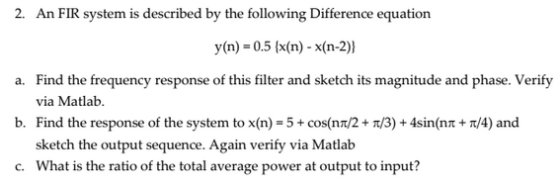
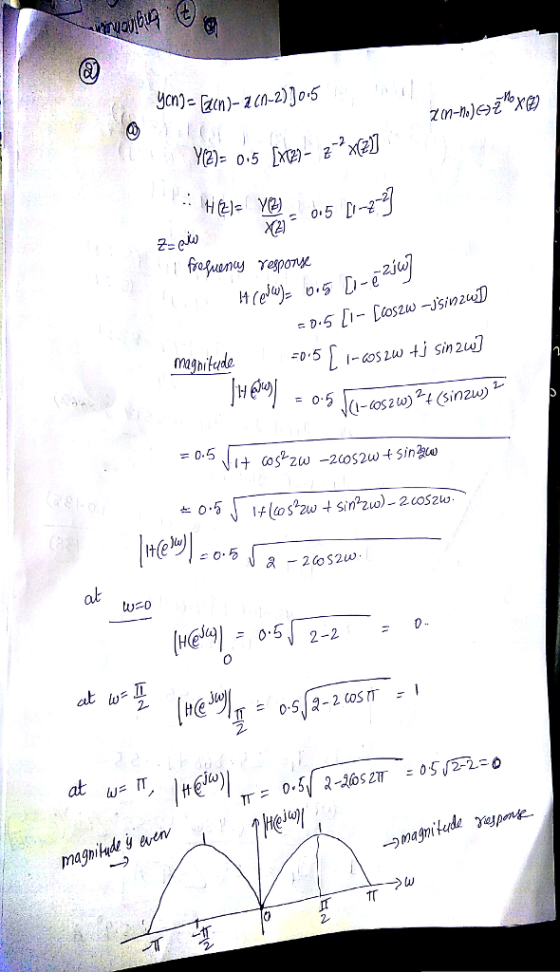
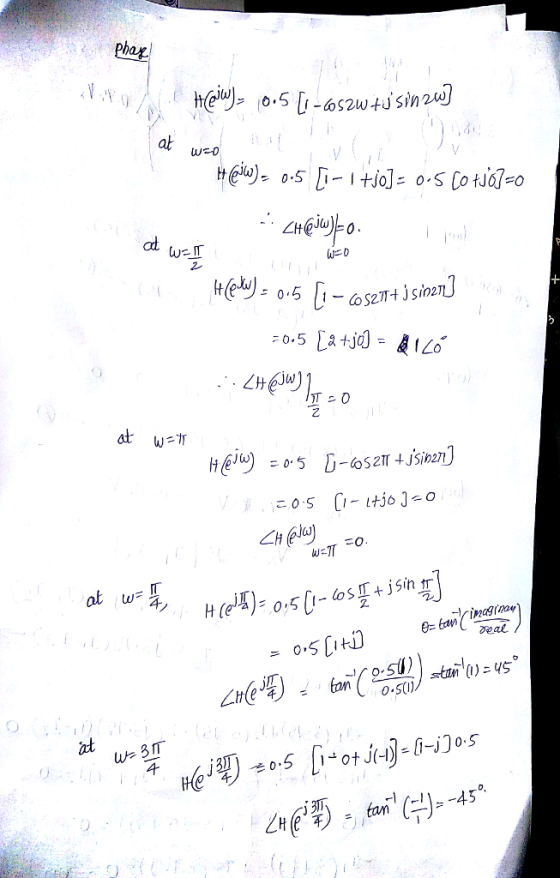
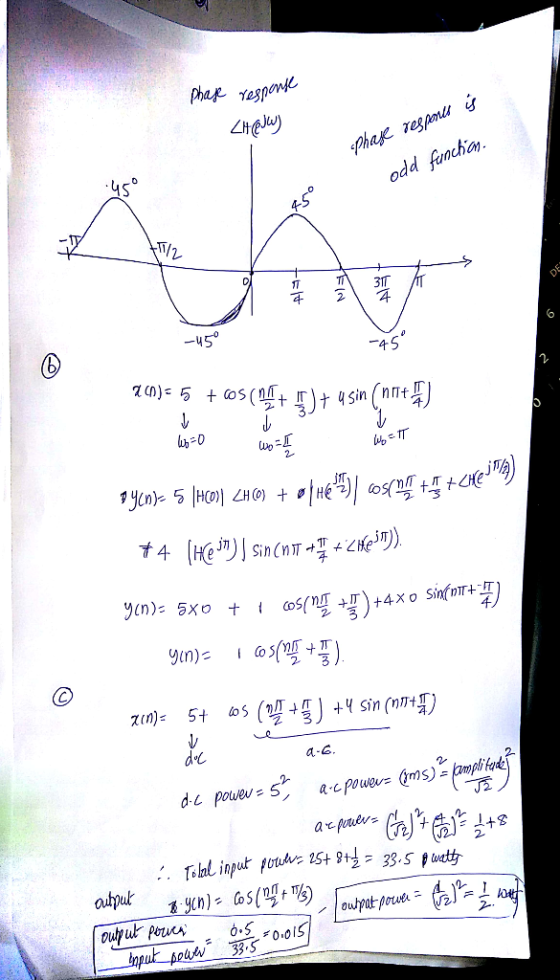
Please Show All the Steps Carefully. Please include both Written and Matlab approach. Written meaning Approaching the problem by hand and not using Matlab at all. Highest rating will be given to those who show all the Written and Mattab steps carefully. Do not skip the Written Method at all! Show All Your Work, Please!
Homework Answers
Add Answer to:
Please Show All the Steps Carefully. Please include both Written
and Matlab approach. Written meaning Approaching...
Please Show All the Steps carefully with full explanation. Highest rating will be given to those...
 Please Show All the Steps carefully with full explanation.
Highest rating will be given to those who show all the parts with
proper explanation. Thanks.
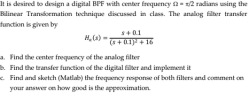
It is desired to design a digital BPF with center frequency/2 radians using the Bilinear Transformation technique discussed in class. The analog filter transfer function is given by Ha (s)-(s +0.1% + 16 a. b. c. Find the center frequency of the analog filter Find the transfer function of the digital filter and implement it...
Please Show All the Steps carefully with full explanation.
Highest rating will be given to those who show all the parts with
proper explanation. Thanks.
It is desired to design a digital BPF with center frequency/2 radians using the Bilinear Transformation technique discussed in class. The analog filter transfer function is given by Ha (s)-(s +0.1% + 16 a. b. c. Find the center frequency of the analog filter Find the transfer function of the digital filter and implement it...
All i want is the whole MATLAB code for this nothing else
 All i want is the whole MATLAB code for this nothing
else
H(s) where, Q-5, and 40-2000, rad./sec. a) Use MATLAB to determine magnitude response and phase response of the filter. b) What type of filter is it? c) What will be the output of this filter if input x,() SCos(1001). Show all calculations step by step as shown in Lecture-20 d) Verify your answer of part (c) by using Simulink model. Attach the snapshot of Simulink model and output....
All i want is the whole MATLAB code for this nothing
else
H(s) where, Q-5, and 40-2000, rad./sec. a) Use MATLAB to determine magnitude response and phase response of the filter. b) What type of filter is it? c) What will be the output of this filter if input x,() SCos(1001). Show all calculations step by step as shown in Lecture-20 d) Verify your answer of part (c) by using Simulink model. Attach the snapshot of Simulink model and output....
Clear steps, please. Consider the following LTI system where, Q -5, and w 2000m rad./sec. a)...
 Clear steps, please.
Consider the following LTI system where, Q -5, and w 2000m rad./sec. a) Use MATLAB to determine magnitude response and phase response of the filter. b) What type of filter is it? c) What will be the output of this filter if input xio- 5Cos(1000). Show all calculations step by step as shown in Lecture-21 . d) Verify your answer of part (e) by using Simulink model. Attach the snapshot of Simulink model and output. e) What...
Clear steps, please.
Consider the following LTI system where, Q -5, and w 2000m rad./sec. a) Use MATLAB to determine magnitude response and phase response of the filter. b) What type of filter is it? c) What will be the output of this filter if input xio- 5Cos(1000). Show all calculations step by step as shown in Lecture-21 . d) Verify your answer of part (e) by using Simulink model. Attach the snapshot of Simulink model and output. e) What...
100 Consider the following LTI system, 5, and wo = 2000π rad/sec. where, Q a) Use MATLAB to deter...
 please complete this project.
100 Consider the following LTI system, 5, and wo = 2000π rad/sec. where, Q a) Use MATLAB to determine magnitude response and phase response of the filter b) What type of filter is it? c) What will be the output of this filter if input x,(t)-5Cos(100t). Show all calculations step by step as shown in Lecture-20 d) Verify your answer of part (e) by using Simulink model. Attach the snapshot of Simulink model and output e)...
please complete this project.
100 Consider the following LTI system, 5, and wo = 2000π rad/sec. where, Q a) Use MATLAB to determine magnitude response and phase response of the filter b) What type of filter is it? c) What will be the output of this filter if input x,(t)-5Cos(100t). Show all calculations step by step as shown in Lecture-20 d) Verify your answer of part (e) by using Simulink model. Attach the snapshot of Simulink model and output e)...
Please complete only F, H, and J only. step by step clearly. please follow the questions. also ty...
 please complete only F, H, and J only. step by step clearly.
please follow the questions. also type any codes you used.
100 Consider the following LTI system, where, Q = 5, and wo 200π rad. /sec. a) Use MATLAB to determine magnitude response and phase response of the filter b) What type of filter is it? c) What will be the output of this filter if input x,(t)-5Cos(100t). Show all calculations step by step as shown in Lecture-20 d)...
please complete only F, H, and J only. step by step clearly.
please follow the questions. also type any codes you used.
100 Consider the following LTI system, where, Q = 5, and wo 200π rad. /sec. a) Use MATLAB to determine magnitude response and phase response of the filter b) What type of filter is it? c) What will be the output of this filter if input x,(t)-5Cos(100t). Show all calculations step by step as shown in Lecture-20 d)...
Please show all the steps clearly. 5. The transfer function of a system is given by...
 Please show all the steps clearly.
5. The transfer function of a system is given by Z Н(2) (z2-0.8z+ 0.15) -0.4n for n2 0. Find the response of To such a system we apply an input of the type x [n] the system in n domain using MATLAB for obtaining the partial fraction expansion and then manually inverting the output using z-transform tables.
5. The transfer function of a system is given by Z Н(2) (z2-0.8z+ 0.15) -0.4n for n2...
Please show all the steps clearly.
5. The transfer function of a system is given by Z Н(2) (z2-0.8z+ 0.15) -0.4n for n2 0. Find the response of To such a system we apply an input of the type x [n] the system in n domain using MATLAB for obtaining the partial fraction expansion and then manually inverting the output using z-transform tables.
5. The transfer function of a system is given by Z Н(2) (z2-0.8z+ 0.15) -0.4n for n2...
Please read the instructions carefully and show me the matlab code in detail and the graph...
 Please read the instructions carefully and show me the matlab
code in detail and the graph
For all the questions below, whenever necessary, use a time resolution of 10ms for your time axis and plot in the range t 10,10]. Matlab hint for time axis: t [0:0.01:101 Remember your script should be self-sufficient and run without any errors to receive any points. Question 1. Find the impulse response h(t) for the LTIC system (1) provided below, using Matlab's built in...
Please read the instructions carefully and show me the matlab
code in detail and the graph
For all the questions below, whenever necessary, use a time resolution of 10ms for your time axis and plot in the range t 10,10]. Matlab hint for time axis: t [0:0.01:101 Remember your script should be self-sufficient and run without any errors to receive any points. Question 1. Find the impulse response h(t) for the LTIC system (1) provided below, using Matlab's built in...
Consider the following LTI system where, Q-5, and wo2000T rad./sec. e) What will be the output...
 Consider the following LTI system where, Q-5, and wo2000T rad./sec. e) What will be the output of this filter if input x2(t) = 5Cos(2000mt) Show all calculations on paper f)Verify your answer of part (e) by using Simulink model. Attach the snapshot of Simulink model and output. g What will be the output of this filter if input x(0) 5Cos(4000t). Show all calculations on paper. h) Verify your answer of part (g) by using Simulink model. Attach the snapshot of...
please answer all questions and show all steps Vout Figure 2: RC Circuit 2. (15pts) Derive...
 please answer all questions and show all steps
Vout Figure 2: RC Circuit 2. (15pts) Derive the equation for the frequency response H(ju) of the RC circuit in Figure 2. Take the inverse transform of H (ju) to compute the impulse response h(t). Compute the magnitude response, H(jw). Is this a low-pass or high pass filter? Explain your answer. 3. (10pts) Let h(t)2u(t) and (t)(t). Use the Fourier transform to compute the output of the system
please answer all questions and show all steps
Vout Figure 2: RC Circuit 2. (15pts) Derive the equation for the frequency response H(ju) of the RC circuit in Figure 2. Take the inverse transform of H (ju) to compute the impulse response h(t). Compute the magnitude response, H(jw). Is this a low-pass or high pass filter? Explain your answer. 3. (10pts) Let h(t)2u(t) and (t)(t). Use the Fourier transform to compute the output of the system
Home-Work 5 All questions carry equal points. Don't forget to highlight your final answers 25 ues...
 Home-Work 5 All questions carry equal points. Don't forget to highlight your final answers 25 uestion # 1 Use table to find Fourier transform. Sketch the magnitude response and phase response (i) x(t) Cos(1000t) (ii) x(t) 13Cos(100t)- 7Sin(500t) (iv) x(t) rect To (v) xo)-rect ()Cos(10001) (v) x(o) -ret)Cos(000t) Question # 2 Let h(t) be a linear time invariant system, with the following transfer function s + 1 000m (a) Find H(w) (b) Sketch the magnitude and phase response of H(w)...
 Please Show All the Steps carefully with full explanation.
Highest rating will be given to those who show all the parts with
proper explanation. Thanks.
It is desired to design a digital BPF with center frequency/2 radians using the Bilinear Transformation technique discussed in class. The analog filter transfer function is given by Ha (s)-(s +0.1% + 16 a. b. c. Find the center frequency of the analog filter Find the transfer function of the digital filter and implement it...
Please Show All the Steps carefully with full explanation.
Highest rating will be given to those who show all the parts with
proper explanation. Thanks.
It is desired to design a digital BPF with center frequency/2 radians using the Bilinear Transformation technique discussed in class. The analog filter transfer function is given by Ha (s)-(s +0.1% + 16 a. b. c. Find the center frequency of the analog filter Find the transfer function of the digital filter and implement it...
 All i want is the whole MATLAB code for this nothing
else
H(s) where, Q-5, and 40-2000, rad./sec. a) Use MATLAB to determine magnitude response and phase response of the filter. b) What type of filter is it? c) What will be the output of this filter if input x,() SCos(1001). Show all calculations step by step as shown in Lecture-20 d) Verify your answer of part (c) by using Simulink model. Attach the snapshot of Simulink model and output....
All i want is the whole MATLAB code for this nothing
else
H(s) where, Q-5, and 40-2000, rad./sec. a) Use MATLAB to determine magnitude response and phase response of the filter. b) What type of filter is it? c) What will be the output of this filter if input x,() SCos(1001). Show all calculations step by step as shown in Lecture-20 d) Verify your answer of part (c) by using Simulink model. Attach the snapshot of Simulink model and output....
 Clear steps, please.
Consider the following LTI system where, Q -5, and w 2000m rad./sec. a) Use MATLAB to determine magnitude response and phase response of the filter. b) What type of filter is it? c) What will be the output of this filter if input xio- 5Cos(1000). Show all calculations step by step as shown in Lecture-21 . d) Verify your answer of part (e) by using Simulink model. Attach the snapshot of Simulink model and output. e) What...
Clear steps, please.
Consider the following LTI system where, Q -5, and w 2000m rad./sec. a) Use MATLAB to determine magnitude response and phase response of the filter. b) What type of filter is it? c) What will be the output of this filter if input xio- 5Cos(1000). Show all calculations step by step as shown in Lecture-21 . d) Verify your answer of part (e) by using Simulink model. Attach the snapshot of Simulink model and output. e) What...
 please complete this project.
100 Consider the following LTI system, 5, and wo = 2000π rad/sec. where, Q a) Use MATLAB to determine magnitude response and phase response of the filter b) What type of filter is it? c) What will be the output of this filter if input x,(t)-5Cos(100t). Show all calculations step by step as shown in Lecture-20 d) Verify your answer of part (e) by using Simulink model. Attach the snapshot of Simulink model and output e)...
please complete this project.
100 Consider the following LTI system, 5, and wo = 2000π rad/sec. where, Q a) Use MATLAB to determine magnitude response and phase response of the filter b) What type of filter is it? c) What will be the output of this filter if input x,(t)-5Cos(100t). Show all calculations step by step as shown in Lecture-20 d) Verify your answer of part (e) by using Simulink model. Attach the snapshot of Simulink model and output e)...
 please complete only F, H, and J only. step by step clearly.
please follow the questions. also type any codes you used.
100 Consider the following LTI system, where, Q = 5, and wo 200π rad. /sec. a) Use MATLAB to determine magnitude response and phase response of the filter b) What type of filter is it? c) What will be the output of this filter if input x,(t)-5Cos(100t). Show all calculations step by step as shown in Lecture-20 d)...
please complete only F, H, and J only. step by step clearly.
please follow the questions. also type any codes you used.
100 Consider the following LTI system, where, Q = 5, and wo 200π rad. /sec. a) Use MATLAB to determine magnitude response and phase response of the filter b) What type of filter is it? c) What will be the output of this filter if input x,(t)-5Cos(100t). Show all calculations step by step as shown in Lecture-20 d)...
 Please show all the steps clearly.
5. The transfer function of a system is given by Z Н(2) (z2-0.8z+ 0.15) -0.4n for n2 0. Find the response of To such a system we apply an input of the type x [n] the system in n domain using MATLAB for obtaining the partial fraction expansion and then manually inverting the output using z-transform tables.
5. The transfer function of a system is given by Z Н(2) (z2-0.8z+ 0.15) -0.4n for n2...
Please show all the steps clearly.
5. The transfer function of a system is given by Z Н(2) (z2-0.8z+ 0.15) -0.4n for n2 0. Find the response of To such a system we apply an input of the type x [n] the system in n domain using MATLAB for obtaining the partial fraction expansion and then manually inverting the output using z-transform tables.
5. The transfer function of a system is given by Z Н(2) (z2-0.8z+ 0.15) -0.4n for n2...
 Please read the instructions carefully and show me the matlab
code in detail and the graph
For all the questions below, whenever necessary, use a time resolution of 10ms for your time axis and plot in the range t 10,10]. Matlab hint for time axis: t [0:0.01:101 Remember your script should be self-sufficient and run without any errors to receive any points. Question 1. Find the impulse response h(t) for the LTIC system (1) provided below, using Matlab's built in...
Please read the instructions carefully and show me the matlab
code in detail and the graph
For all the questions below, whenever necessary, use a time resolution of 10ms for your time axis and plot in the range t 10,10]. Matlab hint for time axis: t [0:0.01:101 Remember your script should be self-sufficient and run without any errors to receive any points. Question 1. Find the impulse response h(t) for the LTIC system (1) provided below, using Matlab's built in...
 Consider the following LTI system where, Q-5, and wo2000T rad./sec. e) What will be the output of this filter if input x2(t) = 5Cos(2000mt) Show all calculations on paper f)Verify your answer of part (e) by using Simulink model. Attach the snapshot of Simulink model and output. g What will be the output of this filter if input x(0) 5Cos(4000t). Show all calculations on paper. h) Verify your answer of part (g) by using Simulink model. Attach the snapshot of...
 please answer all questions and show all steps
Vout Figure 2: RC Circuit 2. (15pts) Derive the equation for the frequency response H(ju) of the RC circuit in Figure 2. Take the inverse transform of H (ju) to compute the impulse response h(t). Compute the magnitude response, H(jw). Is this a low-pass or high pass filter? Explain your answer. 3. (10pts) Let h(t)2u(t) and (t)(t). Use the Fourier transform to compute the output of the system
please answer all questions and show all steps
Vout Figure 2: RC Circuit 2. (15pts) Derive the equation for the frequency response H(ju) of the RC circuit in Figure 2. Take the inverse transform of H (ju) to compute the impulse response h(t). Compute the magnitude response, H(jw). Is this a low-pass or high pass filter? Explain your answer. 3. (10pts) Let h(t)2u(t) and (t)(t). Use the Fourier transform to compute the output of the system
 Home-Work 5 All questions carry equal points. Don't forget to highlight your final answers 25 uestion # 1 Use table to find Fourier transform. Sketch the magnitude response and phase response (i) x(t) Cos(1000t) (ii) x(t) 13Cos(100t)- 7Sin(500t) (iv) x(t) rect To (v) xo)-rect ()Cos(10001) (v) x(o) -ret)Cos(000t) Question # 2 Let h(t) be a linear time invariant system, with the following transfer function s + 1 000m (a) Find H(w) (b) Sketch the magnitude and phase response of H(w)...
Most questions answered within 3 hours.
-
Where is the error in this code sequence?
String s1 = "Hello";
String s2 = "ello";...
asked 11 months ago -
Financial data for Joel de Paris, Inc., for last year
follow:
Joel de Paris, Inc.
Balance...
asked 11 months ago -
Consider this reaction:
Al2(SO4)3 (aq)+ BaCl3
(aq) Al2Cl6 (aq)- +
3BaSO4(s) . What is the...
asked 11 months ago -
Suppose that Savneet is considering increasing her
recent random sample from 20 car rentals to 40...
asked 11 months ago -
Trucks arrive at an unloading terminal at an average rate of 120
per hour.
Trucks arrive...
asked 11 months ago -
Why are methanol and ethanol completely soluble in water while
octanol is not very little soluble....
asked 11 months ago -
A facilities manager at a university reads in a research report
that the mean amount of...
asked 11 months ago -
When the CuSO4 is rehydrated by adding water to the anhydrous
compound, is this an endothermic...
asked 11 months ago -
A ray of sunlight is passing from diamond into crown glass; the
angle of incidence is...
asked 11 months ago -
A block of mass 0.249 kg is placed on top of a light, vertical
spring of...
asked 11 months ago -
how do the kidneys compensate in the presences of acidosis
a) trigger hyperventilate
b) reserve acid...
asked 11 months ago -
Question 501 pts
The rental rate of capital to the firm increases. Which of the
following...
asked 11 months ago