

Homework Answers
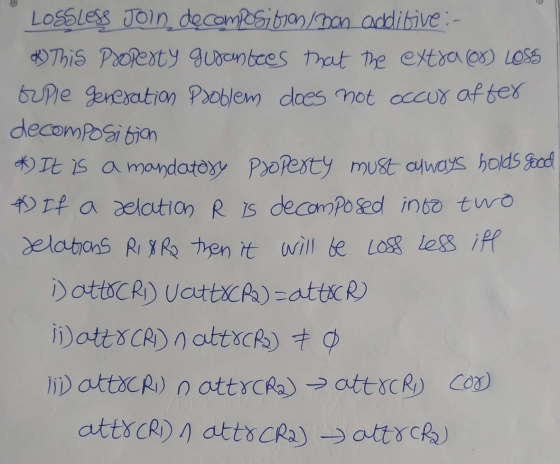
 it is lossless
decomposition
it is lossless
decomposition
Understanding third step is difficult
One relation sufficient for satisfies the relation
Practice more problems than you are perfect
Anything doubtful or not understand just comment I will touch with you
Please thumbs-up for my effort
Thank you and all the best
Add Answer to:
Consider the schema R=(A, B, C, D, E) and let the following set F of functional...
consider the schema R-(A,B.C,D,E) and the following set F of functional dependencies holds on R ABC...
 consider the schema R-(A,B.C,D,E) and the following set F of functional dependencies holds on R ABC CD-E B- D E-A Problem 2. Suppose that we decompose the relation schema R into R, -(A, B, C) and R, (C, D,E). Show that this decomposition is not a lossless-join decomposition.
Consider the following relation R = {A,B,C,D,E} and the following set of functional dependencies F =...
Consider the following relation R = {A,B,C,D,E} and the following set of functional dependencies F = { A → BC CD → E B → D E → A} F = { A → BC CD → E B → D E → A} Give a lossless, dependency-preserving decomposition into 3NF of schema R
Consider the following relation R= {A, B, C, D, E} and the following set of functional...
 Consider the following relation R= {A, B, C, D, E} and the following set of functional dependencies F={ A → BC CD → E B + D E + A} Give a lossless, dependency-preserving decomposition into 3NF of schema R
Consider a relational schema R(A, B, C, D) with a set of functional dependencies F =...
Consider a relational schema R(A, B, C, D) with a set of functional dependencies F = { D --> AB, C --> B, CD --> A, AD --> B, B --> A } a. Compute { B, C }+ b. Show that { C, D } is a candidate key of R. c. Is { R1(A, B, C), R2(C, D ) } a lossless-join decomposition? Why? d. Compute a minimal cover Fmin of F.
Consider the schema R = (A, B, C, D, E) and let the following set F...
Consider the schema R = (A, B, C, D, E) and let the following set F of functional dependencies holdforR: F = {A -> BC, CD -> E, C -> A, B -> D,} 1) Prove or disprove ADE is in the closure of F. A proof can be made by using inference rules IR1 through IR3. A disproof should be done by showing a relational instance (counter example) that refutes the rule. 2) What are the candidate keys of...
Consider the following relation R(A,B,C,D,E,G) and the set of functional dependencies F = { A →...
Consider the following relation R(A,B,C,D,E,G) and the set of functional dependencies F = { A → BCD BC → DE B → D D → A} Give a 3NF decomposition of the given schema based on a canonical cover
Given a schema R (A, B, C, D, E, F)and a set Fof functional dependencies {A...
Given a schema R (A, B, C, D, E, F)and a set Fof functional dependencies {A →B, A →D, CD →E, CD →F, C →F, C →E, BD →E}, find the closure of the set of functional dependencies ?+
Consider the relation schema R(T, E, C, D, Y) and the following set of F of...
Consider the relation schema R(T, E, C, D, Y) and the following set of F of functional dependencies: CY à E E à Y DY à T CT à D The relation R decomposes into R1(C, Y, E), R2(C, T, D). 1. Is this decomposition lossless-join? _________________Blank 1 True False 2. Is this decomposition dependency preserving? ? _____________Blank 2 True False
Given the following Schema S = (R, FD) where R = (A, B, C, D, E, F) and FD contains the following...
Given the following Schema S = (R, FD) where R = (A, B, C, D, E, F) and FD contains the following dependencies: A -> BC B ->C C -> D D ->E C -> E E -> F DE -> F C -> F 1. Find a minimal cover of F 2. Find a key for the schema 3. Find a 3N decomposition of the schema that satisfies the lossless join decomposition and dependency preservation properties 4. Find a...
5c. Consider the relation R(ABCDE) with the set of functional dependencies F={BE→D, DE→A, AD→C, B→E}. Using...
5c. Consider the relation R(ABCDE) with the set of functional dependencies F={BE→D, DE→A, AD→C, B→E}. Using decomposition, find a lossless, dependency preserving, BCNF set of relations for R, if such exists. Be sure to identify the projections of the functional dependencies onto the resulting relations at each stage of the decomposition.
 consider the schema R-(A,B.C,D,E) and the following set F of functional dependencies holds on R ABC CD-E B- D E-A Problem 2. Suppose that we decompose the relation schema R into R, -(A, B, C) and R, (C, D,E). Show that this decomposition is not a lossless-join decomposition.
 Consider the following relation R= {A, B, C, D, E} and the following set of functional dependencies F={ A → BC CD → E B + D E + A} Give a lossless, dependency-preserving decomposition into 3NF of schema R
Most questions answered within 3 hours.
-
Where is the error in this code sequence?
String s1 = "Hello";
String s2 = "ello";...
asked 10 months ago -
Financial data for Joel de Paris, Inc., for last year
follow:
Joel de Paris, Inc.
Balance...
asked 10 months ago -
Consider this reaction:
Al2(SO4)3 (aq)+ BaCl3
(aq) Al2Cl6 (aq)- +
3BaSO4(s) . What is the...
asked 10 months ago -
Suppose that Savneet is considering increasing her
recent random sample from 20 car rentals to 40...
asked 10 months ago -
Trucks arrive at an unloading terminal at an average rate of 120
per hour.
Trucks arrive...
asked 10 months ago -
Why are methanol and ethanol completely soluble in water while
octanol is not very little soluble....
asked 10 months ago -
A facilities manager at a university reads in a research report
that the mean amount of...
asked 10 months ago -
When the CuSO4 is rehydrated by adding water to the anhydrous
compound, is this an endothermic...
asked 10 months ago -
A ray of sunlight is passing from diamond into crown glass; the
angle of incidence is...
asked 10 months ago -
A block of mass 0.249 kg is placed on top of a light, vertical
spring of...
asked 10 months ago -
how do the kidneys compensate in the presences of acidosis
a) trigger hyperventilate
b) reserve acid...
asked 10 months ago -
Question 501 pts
The rental rate of capital to the firm increases. Which of the
following...
asked 10 months ago