
Homework Answers
Add Answer to:
Thank you.
5. Find the solution u(x, y) of Laplace's equation in the rectangle 0<<a, 0<y<b...
1. (a) Derive the solution u(x, y) of Laplace's equation in the rectangle 0 < x...
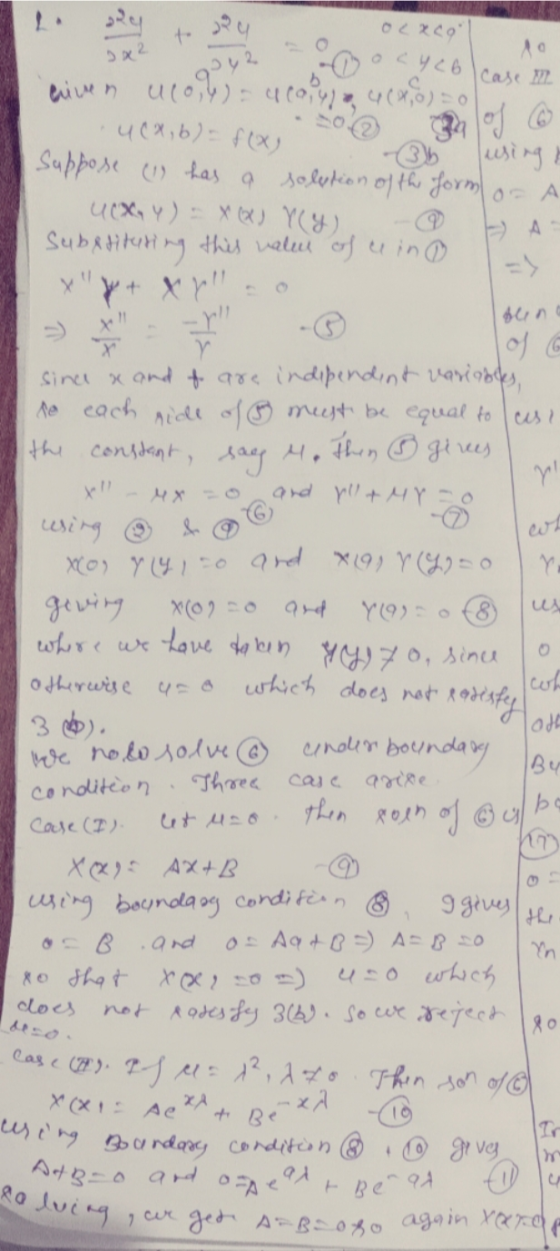
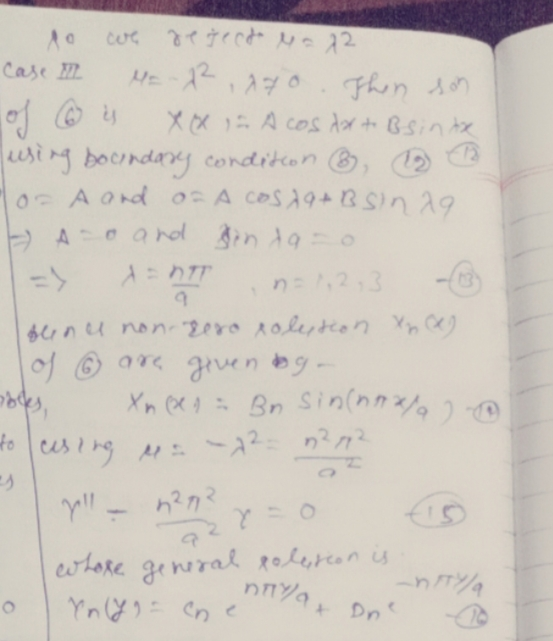
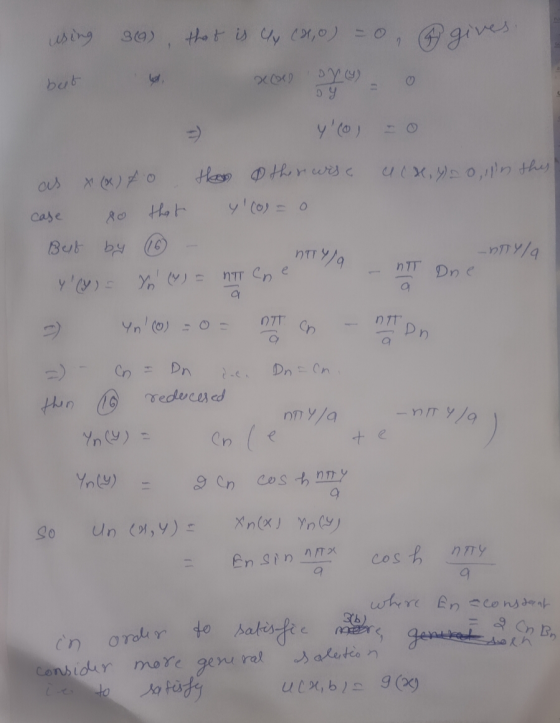
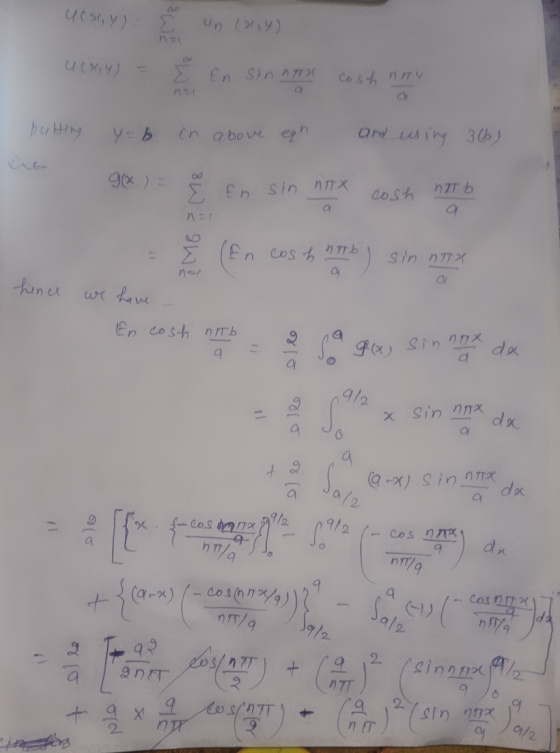
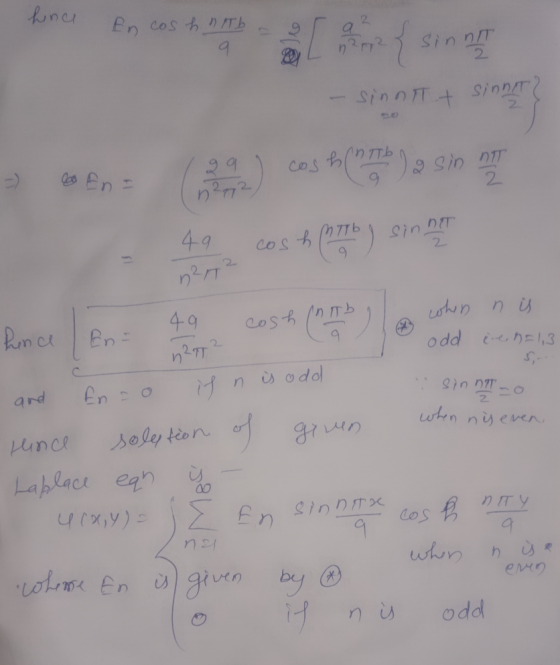
 1. (a) Derive the solution u(x, y) of Laplace's equation in the rectangle 0 < x <a, 0 <y <b, that satisfies the boundary conditions u(0,y) = 0, u(a, y) = 0, u(x,0) = 0, u(x,b) = g(x), 0 0 0 < a. (b) Find the solution if a = 4, b = 2, and g(x) = 0 <r <a/2, a-r, a/2 < x <a.
We can expect the solution u(x,y) to be in the form X(x)Y(y). or I believe that...
 We can expect the solution u(x,y) to be in the form
X(x)Y(y).
or
I believe that these are the correct forms of X(x) and Y(y).
2. Laplace's equation Consider Laplace's equation on the rectangle with 0 < x < L and 0 < < H: PDE BC BC BC u(x,0) 0, u(z, H) = g(z). (10) where a mixture of Dirichlet and Neumann boundary conditions is specified, and only one of the sides has a boundary condition that is nonhomogeneous...
We can expect the solution u(x,y) to be in the form
X(x)Y(y).
or
I believe that these are the correct forms of X(x) and Y(y).
2. Laplace's equation Consider Laplace's equation on the rectangle with 0 < x < L and 0 < < H: PDE BC BC BC u(x,0) 0, u(z, H) = g(z). (10) where a mixture of Dirichlet and Neumann boundary conditions is specified, and only one of the sides has a boundary condition that is nonhomogeneous...
(a) Find the solution u(x, y) of Laplace's equation in the semi-infinite strip 0 0, and the addit...
 (a) Find the solution u(x, y) of Laplace's equation in the semi-infinite strip 0<x<a, y>0, that satisfies the boundary conditions u(0, y)-0 u(a, y)-0, y > 0, and the additional condition that u(x, y) -0 as yoo, etnyla sin nTX where Cn X where Cn- NTX) where Cn = u(x, y) - -Ttny/a sin(where Cn u(x, y) n=1 u(x, y) - (b) Find the solution if f(x) = x(a-x) V(x)- (c) Let a9. Find the smallest value of yo for...
2. Solve for the bounded solution of Laplace's equation v2T=0 in the UHP: [2] < 0,...
 2. Solve for the bounded solution of Laplace's equation v2T=0 in the UHP: [2] < 0, y > 0 with the following boundary conditions given on y = 0: T(x,0) = {A on x < l1, B on li < x < l2,C on x > la} A, B, C are real constants.
Problem 4. (25 points) Find the solution to the 2-dimensional Laplace's equation OLY + = 0...
 Problem 4. (25 points) Find the solution to the 2-dimensional Laplace's equation OLY + = 0 inside the square 0<x<1 0 <y <1 subject to the boundary conditions V(x,0) = 0 = V(x, 1) V(0,y) = 0 V(1,y) = 2 sin (31 y)
(a) Find the solution to Laplace's equation on a disk with boundary condition u(1,0) = 5...
 (a) Find the solution to Laplace's equation on a disk with boundary condition u(1,0) = 5 + sin(40). (You do not need to derive the general solution to the polar Laplace's equation.) (b) Verify that the solution to (a) satisfies the mean value property. (Hint: compare the average value of u(r, ) on the boundary r=1 to the value of u(r,() at r = 0.) (c) Find the minimum and maximum of the solution to (a) and verify they occur...
(Laplace's equation in polar coordinates) (a) Find the solution to Laplace's equation on a disk with...
 (Laplace's equation in polar coordinates) (a) Find the solution to Laplace's equation on a disk with boundary condition u(1,0) = 5 + sin(40). (You do not need to derive the general solution to the polar Laplace's equation.) (b) Verify that the solution to (a) satisfies the mean value property. (Hint: compare the average value of u(r, 0) on the boundary r = 1 to the value of u(r,) at r=0.) (c) Find the minimum and maximum of the solution to...
Solve heat equation in a rectangle du = k ( ou + dou), 0<x<t, 0<y< 1,...
 Solve heat equation in a rectangle du = k ( ou + dou), 0<x<t, 0<y< 1, t> 0 u(x, 0, 1) = 0, uy(x,1,1) = 0, with boundary conditions u(O, y,t) = 0, u(r, y, t) = 0, and initial condition u(x, y,0) = (y – į v?) sin(2x).
3. This question is about non-homogeneous boundary conditions (a) Consider Laplace's equation on a rectangle, with...
 3. This question is about non-homogeneous boundary conditions (a) Consider Laplace's equation on a rectangle, with fully inhomogeneous boundary conditions =0 0 a, 0< y <b u(x, 0) fi() u(, b) f2(a) u(0, y)g (x) ua, y) = 92(r) 0 ra Homogenise the boundary conditions to convert the problem to one of the form 2 F(x, y) 0 xa,0 y < b + (x, 0)= fi() b(x, b) f2(x) b(0, y)0 (a, y) = 0 0y b 0 y sb...
In spherical polar coordinates (r, 0, ¢), the general solution of Laplace's equation which has cylindrical...
 In spherical polar coordinates (r, 0, ¢), the general solution of Laplace's equation which has cylindrical symmetry about the polar axis is bounded on the polar axis can be expressed as u(r, 0) = Rm(r)P,(cos 0), (A) where P is the Legendre polyomial of degree n, and R(r) is the general solution of the differential equation *() - n(n + 1)R = 0, (r > 0), dr dr where n is a non-negative integer. (You are not asked to show...
 1. (a) Derive the solution u(x, y) of Laplace's equation in the rectangle 0 < x <a, 0 <y <b, that satisfies the boundary conditions u(0,y) = 0, u(a, y) = 0, u(x,0) = 0, u(x,b) = g(x), 0 0 0 < a. (b) Find the solution if a = 4, b = 2, and g(x) = 0 <r <a/2, a-r, a/2 < x <a.
 We can expect the solution u(x,y) to be in the form
X(x)Y(y).
or
I believe that these are the correct forms of X(x) and Y(y).
2. Laplace's equation Consider Laplace's equation on the rectangle with 0 < x < L and 0 < < H: PDE BC BC BC u(x,0) 0, u(z, H) = g(z). (10) where a mixture of Dirichlet and Neumann boundary conditions is specified, and only one of the sides has a boundary condition that is nonhomogeneous...
We can expect the solution u(x,y) to be in the form
X(x)Y(y).
or
I believe that these are the correct forms of X(x) and Y(y).
2. Laplace's equation Consider Laplace's equation on the rectangle with 0 < x < L and 0 < < H: PDE BC BC BC u(x,0) 0, u(z, H) = g(z). (10) where a mixture of Dirichlet and Neumann boundary conditions is specified, and only one of the sides has a boundary condition that is nonhomogeneous...
 (a) Find the solution u(x, y) of Laplace's equation in the semi-infinite strip 0<x<a, y>0, that satisfies the boundary conditions u(0, y)-0 u(a, y)-0, y > 0, and the additional condition that u(x, y) -0 as yoo, etnyla sin nTX where Cn X where Cn- NTX) where Cn = u(x, y) - -Ttny/a sin(where Cn u(x, y) n=1 u(x, y) - (b) Find the solution if f(x) = x(a-x) V(x)- (c) Let a9. Find the smallest value of yo for...
 2. Solve for the bounded solution of Laplace's equation v2T=0 in the UHP: [2] < 0, y > 0 with the following boundary conditions given on y = 0: T(x,0) = {A on x < l1, B on li < x < l2,C on x > la} A, B, C are real constants.
 Problem 4. (25 points) Find the solution to the 2-dimensional Laplace's equation OLY + = 0 inside the square 0<x<1 0 <y <1 subject to the boundary conditions V(x,0) = 0 = V(x, 1) V(0,y) = 0 V(1,y) = 2 sin (31 y)
 (a) Find the solution to Laplace's equation on a disk with boundary condition u(1,0) = 5 + sin(40). (You do not need to derive the general solution to the polar Laplace's equation.) (b) Verify that the solution to (a) satisfies the mean value property. (Hint: compare the average value of u(r, ) on the boundary r=1 to the value of u(r,() at r = 0.) (c) Find the minimum and maximum of the solution to (a) and verify they occur...
 (Laplace's equation in polar coordinates) (a) Find the solution to Laplace's equation on a disk with boundary condition u(1,0) = 5 + sin(40). (You do not need to derive the general solution to the polar Laplace's equation.) (b) Verify that the solution to (a) satisfies the mean value property. (Hint: compare the average value of u(r, 0) on the boundary r = 1 to the value of u(r,) at r=0.) (c) Find the minimum and maximum of the solution to...
 Solve heat equation in a rectangle du = k ( ou + dou), 0<x<t, 0<y< 1, t> 0 u(x, 0, 1) = 0, uy(x,1,1) = 0, with boundary conditions u(O, y,t) = 0, u(r, y, t) = 0, and initial condition u(x, y,0) = (y – į v?) sin(2x).
 3. This question is about non-homogeneous boundary conditions (a) Consider Laplace's equation on a rectangle, with fully inhomogeneous boundary conditions =0 0 a, 0< y <b u(x, 0) fi() u(, b) f2(a) u(0, y)g (x) ua, y) = 92(r) 0 ra Homogenise the boundary conditions to convert the problem to one of the form 2 F(x, y) 0 xa,0 y < b + (x, 0)= fi() b(x, b) f2(x) b(0, y)0 (a, y) = 0 0y b 0 y sb...
 In spherical polar coordinates (r, 0, ¢), the general solution of Laplace's equation which has cylindrical symmetry about the polar axis is bounded on the polar axis can be expressed as u(r, 0) = Rm(r)P,(cos 0), (A) where P is the Legendre polyomial of degree n, and R(r) is the general solution of the differential equation *() - n(n + 1)R = 0, (r > 0), dr dr where n is a non-negative integer. (You are not asked to show...
Most questions answered within 3 hours.
-
Where is the error in this code sequence?
String s1 = "Hello";
String s2 = "ello";...
asked 11 months ago -
Financial data for Joel de Paris, Inc., for last year
follow:
Joel de Paris, Inc.
Balance...
asked 11 months ago -
Consider this reaction:
Al2(SO4)3 (aq)+ BaCl3
(aq) Al2Cl6 (aq)- +
3BaSO4(s) . What is the...
asked 11 months ago -
Suppose that Savneet is considering increasing her
recent random sample from 20 car rentals to 40...
asked 11 months ago -
Trucks arrive at an unloading terminal at an average rate of 120
per hour.
Trucks arrive...
asked 11 months ago -
Why are methanol and ethanol completely soluble in water while
octanol is not very little soluble....
asked 11 months ago -
A facilities manager at a university reads in a research report
that the mean amount of...
asked 11 months ago -
When the CuSO4 is rehydrated by adding water to the anhydrous
compound, is this an endothermic...
asked 11 months ago -
A ray of sunlight is passing from diamond into crown glass; the
angle of incidence is...
asked 11 months ago -
A block of mass 0.249 kg is placed on top of a light, vertical
spring of...
asked 11 months ago -
how do the kidneys compensate in the presences of acidosis
a) trigger hyperventilate
b) reserve acid...
asked 11 months ago -
Question 501 pts
The rental rate of capital to the firm increases. Which of the
following...
asked 11 months ago